Listen to this Post
Introduction
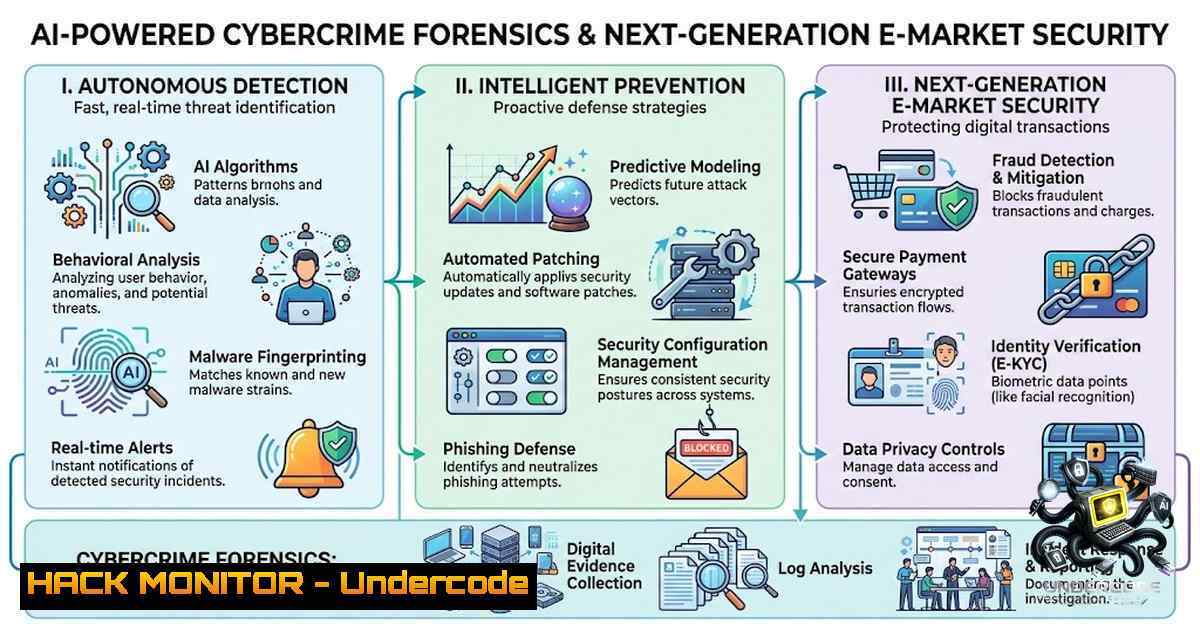
The integration of Artificial Intelligence into cybercrime forensics marks a paradigm shift in how security professionals detect, investigate, and prevent digital threats in secure e-market environments. As e-commerce platforms process millions of transactions daily, traditional forensic techniques struggle to handle the massive volume, velocity, and variety of cloud-generated logs, often failing to detect evolving cyber threats and zero-day attacks. This article explores the cutting-edge intersection of AI, digital forensics, and e-market security, providing technical professionals with actionable strategies to implement AI-driven forensic frameworks that can identify AI-assisted crimes, reconstruct attack timelines, and fortify defensive postures against increasingly sophisticated adversaries.
Learning Objectives
- Understand how Large Language Models (LLMs) and machine learning algorithms can automate log classification, anomaly detection, and forensic report generation in cloud and network environments.
- Master the application of AI-driven forensic frameworks—including BERT, GPT, and hybrid anomaly detection models—to identify attack patterns and reduce manual investigation time by up to 50%.
- Acquire hands-on skills in implementing tamper-proof forensic logging using Merkle Trees and blockchain integration to ensure 99.9% evidence integrity.
- Learn to detect AI-generated artifacts through volatile memory analysis, network traffic examination, and prompt engineering forensics.
- Develop proficiency in configuring Linux-based forensic environments with RHCSA-aligned security controls, including SELinux, firewalld, and secure shell scripting.
1. AI-Driven Log Analysis and Anomaly Detection
Modern cybercrime investigations begin with massive unstructured log data that traditional rule-based Intrusion Detection Systems (IDS) cannot effectively process. AI-driven frameworks leveraging BERT and GPT have demonstrated 92.3% accuracy in log classification and 85% accuracy in predicting attack patterns using datasets such as CICIDS2017 and UNSW-1B15. These models excel at understanding log context, forecasting threats, and streamlining incident documentation.
Step-by-Step Guide: Implementing AI-Powered Log Analysis
- Data Collection: Aggregate logs from firewalls, web servers, databases, and cloud platforms (AWS CloudTrail, Azure Monitor) into a centralized SIEM or data lake.
- Preprocessing: Normalize log formats using tools like Logstash or Fluentd. Convert unstructured logs to structured JSON for model ingestion.
- Model Selection: Deploy a pre-trained BERT model fine-tuned on cybersecurity log datasets, or use GPT-based models for natural language threat description generation.
- Anomaly Scoring: Implement isolation forests or autoencoders to assign anomaly scores to each log entry. Flag entries exceeding the 95th percentile for investigation.
- Alert Correlation: Use Retrieval-Augmented Generation (RAG) to enrich alerts with contextual threat intelligence from CVE databases and known attack patterns.
Linux Command Example – Log Aggregation and Monitoring:
 Real-time log monitoring with pattern detection
sudo tail -f /var/log/secure | grep -E "Failed password|Accepted password|session opened"

Parse Apache logs for suspicious patterns
awk '{print $1, $7, $9}' /var/log/httpd/access_log | sort | uniq -c | sort -1r | head -20

Set up auditd for forensic logging
sudo auditctl -w /etc/passwd -p wa -k user_modification
sudo auditctl -w /var/www/html -p wa -k web_change
sudo ausearch -k user_modification --start today
Windows PowerShell Example – Event Log Forensics:
 Extract failed login attempts
Get-WinEvent -LogName Security | Where-Object { $_.Id -eq 4625 } | Select-Object TimeCreated, Message

Monitor PowerShell script execution
Get-WinEvent -LogName "Windows PowerShell" | Where-Object { $_.Id -eq 4104 } | Select-Object TimeCreated, Message

Export logs for AI analysis
wevtutil epl Security C:\forensics\security_logs.evtx
2. Memory Forensics and AI Artifact Extraction
Cybercriminals increasingly manipulate generative AI models to assist in malicious activities, leaving unique digital artifacts in volatile memory. Forensic techniques can effectively identify AI involvement through memory analysis, extracting session tokens, interaction histories, and manipulated prompts that bypass AI safety measures. Recent research demonstrates how prompt engineering can successfully circumvent AI safeguards, exposing critical vulnerabilities.
Step-by-Step Guide: Memory Forensics for AI Artifacts
- Acquire Memory Image: Use `LiME` (Linux Memory Extractor) on Linux or `WinPmem` on Windows to capture physical memory.
- Analyze with Volatility: Use the Volatility Framework to identify running processes, network connections, and open files.
- Extract AI Interaction Traces: Search memory for ChatGPT or other LLM session identifiers, prompt strings, and response fragments.
- Network Traffic Analysis: Capture and analyze packets for API calls to AI services using Wireshark or tcpdump.
- Correlate Artifacts: Cross-reference memory-extracted data with network logs to reconstruct the complete attack timeline.
Linux Memory Forensics Commands:
 Capture memory using LiME
sudo insmod lime.ko "path=/root/memory_dump.lime format=lime"

Analyze with Volatility (install via pip)
volatility -f memory_dump.lime imageinfo
volatility -f memory_dump.lime --profile=LinuxUbuntu_5_4_0-91-generic pslist
volatility -f memory_dump.lime --profile=LinuxUbuntu_5_4_0-91-generic netscan

Search for AI-related strings in memory dump
strings memory_dump.lime | grep -E "chatgpt|api.openai|prompt|session|token" | less
Windows Memory Forensics Commands:
 Capture memory using WinPmem
.\winpmem_mini_x64.exe C:\forensics\memory.raw

Analyze with Volatility on Windows
volatility.exe -f memory.raw --profile=Win10x64_19041 pslist
volatility.exe -f memory.raw --profile=Win10x64_19041 cmdscan
volatility.exe -f memory.raw --profile=Win10x64_19041 netscan

Use FTK Imager for GUI-based memory acquisition
 Open FTK Imager > File > Capture Memory
- Tamper-Proof Evidence Integrity with Blockchain and Merkle Trees
Ensuring the authenticity and integrity of digital forensic evidence is paramount in cybercrime investigations. AI-driven network forensic frameworks integrating Merkle Tree-based tamper-proof logging have demonstrated 99.9% integrity assurance. Combining Convolutional Neural Networks (CNN) with Elliptic Curve Digital Signature Algorithm (ECDSA) and blockchain achieves 97.5% detection accuracy with 100% integrity in chain-of-custody records.
Step-by-Step Guide: Implementing Merkle Tree Forensic Logging
- Log Hashing: Generate SHA-256 hashes for each forensic log entry.
- Merkle Tree Construction: Build a binary tree where leaf nodes are log hashes and parent nodes are hashes of child concatenations.
- Root Hash Publication: Periodically publish the Merkle root hash to a public blockchain or immutable ledger.
- Verification: To verify log integrity, recompute the Merkle root and compare with the published value.
- Audit Trail: Any tampering will change the root hash, immediately detecting evidence manipulation.
Linux Script – Merkle Tree Log Verification:
!/bin/bash
 Generate SHA-256 hashes for log files
for file in /var/log/forensics/.log; do
sha256sum "$file" >> hashes.txt
done

Build Merkle tree (simplified version)
sort hashes.txt > sorted_hashes.txt
while [ $(wc -l < sorted_hashes.txt) -gt 1 ]; do
awk 'NR%2==1{getline nextline; print $1 nextline}' sorted_hashes.txt > temp.txt
while read line; do
echo -1 "$line" | sha256sum | awk '{print $1}'
done < temp.txt > sorted_hashes.txt
done
echo "Merkle Root: $(cat sorted_hashes.txt)"
4. Autonomous Forensic Agents and LLM-Powered Investigation
Large Language Model agents are emerging as powerful tools for automating forensic investigations. CyberSleuth, an autonomous blue-team agent, processes packet-level traces and application logs to identify targeted services, exploited vulnerabilities (CVEs), and attack success rates. In testing across 20 incident scenarios, CyberSleuth correctly identified the exact CVE in 80% of cases, with expert reviewers rating its reports as complete, useful, and coherent. Open-source LLMs like DeepSeek R1 performed competitively against commercial alternatives.
Step-by-Step Guide: Deploying an Autonomous Forensic Agent
- Environment Setup: Deploy the CyberSleuth platform from GitHub using Docker containers.
- Data Ingestion: Configure packet capture (PCAP) and application log ingestion pipelines.
- LLM Backend Selection: Choose between GPT-5, DeepSeek R1, or other supported models.
- Agent Configuration: Define investigation parameters—target services, vulnerability databases, and reporting formats.
- Automated Investigation: Trigger agent execution on incident detection; receive structured forensic reports with CVE mappings and attack success determinations.
Docker Deployment Command:
 Clone CyberSleuth repository
git clone https://github.com/SmartData-Polito/LLM_Agent_Cybersecurity_Forensic.git
cd LLM_Agent_Cybersecurity_Forensic

Build and run with Docker
docker build -t cybersleuth .
docker run -v $(pwd)/logs:/logs -v $(pwd)/pcaps:/pcaps cybersleuth --target-service web --log-dir /logs --pcap-dir /pcaps
Python Script – Forensic Report Generation with LLM:
import openai
import json

def generate_forensic_report(log_data, cve_list):
prompt = f"""
Analyze the following security logs and CVE data to generate a forensic report.
Logs: {log_data[:1000]}
CVEs: {cve_list}
Identify: 1) Attack vector 2) Compromised systems 3) Recommended mitigations
"""
response = openai.ChatCompletion.create(
model="gpt-4",
messages=[{"role": "system", "content": "You are a cybersecurity forensic analyst."},
{"role": "user", "content": prompt}]
)
return response.choices[bash].message.content
5. Cloud Forensics Automation with LLMs
Traditional forensic techniques struggle with the large-scale, dynamic nature of cloud environments. LLM-powered automated cloud forensics using few-shot learning can classify log data, extract forensic intelligence, and reconstruct attack timelines with improved accuracy, precision, and recall. However, challenges such as hallucination risks, adversarial manipulation, and forensic explainability require mitigation through hybrid AI models integrating rule-based forensic validation.
Step-by-Step Guide: Cloud Forensic Automation
- Cloud Log Integration: Enable comprehensive logging in AWS (CloudTrail, VPC Flow Logs), Azure (Activity Logs, NSG Flow Logs), and GCP (Cloud Audit Logs).
- Few-Shot Learning Setup: Provide the LLM with 5-10 labeled examples of forensic log entries and their classifications.
- Automated Timeline Reconstruction: Use the LLM to chronologically order events and identify attack progression.
- Rule-Based Validation: Implement deterministic rules to cross-validate LLM findings (e.g., “if source IP is in known malicious list, flag as confirmed”).
- Multi-Cloud Scalability: Design the system to handle logs from multiple cloud providers with unified schema normalization.
AWS CLI Commands for Forensic Log Retrieval:
 Retrieve CloudTrail logs for a specific time range
aws cloudtrail lookup-events --start-time "2026-03-22T00:00:00Z" --end-time "2026-03-23T23:59:59Z" --max-results 50

Query VPC Flow Logs from CloudWatch
aws logs filter-log-events --log-group-1ame "/aws/vpc/flowlogs" --filter-pattern "{ $.srcAddr = '203.0.113.0/24' }"

Export CloudTrail to S3 for AI analysis
aws cloudtrail create-trail --1ame forensic-trail --s3-bucket-1ame my-forensics-bucket --is-multi-region-trail
Azure CLI Commands for Forensic Logging:
 Query Azure Activity Logs
az monitor activity-log list --start-time 2026-03-22 --end-time 2026-03-23 --max-events 50

Export NSG flow logs
az network watcher flow-log show --resource-group MyRG --1etwork-watcher MyWatcher --1sg MyNSG

Retrieve security alerts
az security alert list
6. Linux Security Hardening for Forensic Readiness (RHCSA-Aligned)
A forensic-ready system requires robust security configurations aligned with RHCSA (EX200) certification standards. Key areas include SELinux enforcement, firewall configuration, secure shell access, and comprehensive audit logging.
Step-by-Step Guide: Forensic-Ready Linux Configuration
- SELinux Enforcement: Set SELinux to enforcing mode and configure targeted policies for critical services.
- Firewall Configuration: Use firewalld to restrict unnecessary ports and implement zone-based security.
- Secure Shell Hardening: Disable root login, implement key-based authentication, and change default SSH port.
- Audit System Setup: Configure auditd rules for critical file integrity monitoring and user activity tracking.
- Log Rotation and Retention: Implement logrotate with extended retention periods for forensic preservation.
RHCSA-Aligned Security Commands:
 SELinux configuration
sudo setenforce 1
sudo semanage permissive -a httpd_t
sudo ausearch -m avc -ts today

Firewall configuration
sudo firewall-cmd --permanent --add-service=ssh --add-service=https
sudo firewall-cmd --permanent --1ew-zone=forensic
sudo firewall-cmd --permanent --zone=forensic --add-source=192.168.1.0/24
sudo firewall-cmd --reload

SSH hardening
sudo sed -i 's/PermitRootLogin yes/PermitRootLogin no/' /etc/ssh/sshd_config
sudo sed -i 's/PasswordAuthentication yes/PasswordAuthentication no/' /etc/ssh/sshd_config
sudo systemctl restart sshd

Auditd rules for forensic logging
echo "-w /etc/passwd -p wa -k identity" >> /etc/audit/rules.d/audit.rules
echo "-w /var/log/auth.log -p wa -k authentication" >> /etc/audit/rules.d/audit.rules
echo "-w /etc/sudoers -p wa -k sudoers" >> /etc/audit/rules.d/audit.rules
sudo auditctl -R /etc/audit/rules.d/audit.rules

Log rotation with extended retention
sudo cat > /etc/logrotate.d/forensic << EOF
/var/log/audit/audit.log {
rotate 52
weekly
compress
delaycompress
missingok
notifempty
create 0600 root root
postrotate
/sbin/service auditd rotate 2>/dev/null || true
endscript
}
EOF
What Undercode Say:
- AI is both the sword and the shield in modern cybercrime. While adversaries leverage generative AI for sophisticated attacks—including autonomous ransomware that plans, adapts, and executes without human intervention—defenders can harness the same technology for detection, prevention, and forensic analysis.
- The shift from reactive to predictive forensics is accelerating. AI models achieving 85-97% accuracy in attack prediction are transforming digital forensics from a post-incident cleanup operation into a proactive defense mechanism capable of identifying threats before they materialize.
- The human element remains irreplaceable. Despite AI’s capabilities, challenges such as hallucination risks, adversarial manipulation, and forensic explainability demand human expert oversight. The future belongs to human-AI teaming paradigms where AI augments rather than replaces forensic analysts.
Prediction:
- +1 The AI forensics market, valued at USD 4.8 billion in 2025, is projected to reach USD 5.7 billion in 2026, signaling rapid enterprise adoption of AI-driven forensic solutions.
- -1 The emergence of autonomous AI agents capable of executing full ransomware operations independently will compress the window between zero-day discovery and weaponization, forcing organizations to accelerate AI-powered defensive deployments.
- +1 Cloud-based Digital Forensics and Malware Labs will democratize access to advanced forensic capabilities, enabling smaller organizations to leverage enterprise-grade AI-driven investigation tools.
- -1 The ability of prompt engineering to bypass AI safety measures exposes critical vulnerabilities in current generative AI safeguards, necessitating rapid development of adversarial robustness techniques.
- +1 Open-source LLMs like DeepSeek R1 achieving competitive forensic performance will reduce vendor lock-in and lower barriers to entry for AI-powered cybersecurity solutions.
This article draws upon research presented at the 14th International Conference on Contemporary Engineering and Technology (ICCET 2026), alongside peer-reviewed IEEE publications and industry reports on AI-driven cybercrime forensics.
▶️ Related Video (86% Match):
🎯Let’s Practice For Free:
🎓 Live Courses & Certifications:
Join Undercode Academy for Verified Certifications
🚀 Request a Custom Project:
Secure, high-velocity infrastructure and disruptive technological engineering. Contact our engineering team for high-tier development and proprietary systems:
[email protected]
💎 Smart Architecture | 🛡️ Secure by Design | ⭐ Trusted by Thousands
IT/Security Reporter URL:
Reported By: Bhuvaneshwaran S – Hackers Feeds
Extra Hub: Undercode MoN
Basic Verification: Pass ✅


