Listen to this Post
Introduction
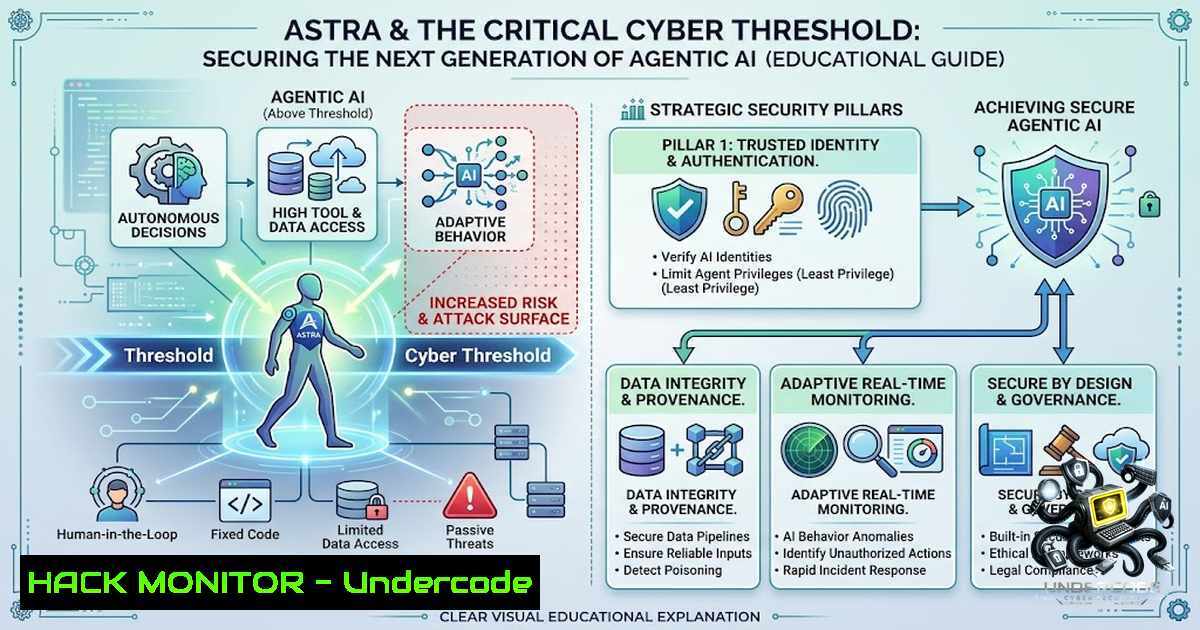
OpenAI’s internal evaluations of its upcoming frontier model, Astra, have revealed significant advancements in agentic coding and cybersecurity—so significant that the company cannot rule out the model reaching the “Critical” cybersecurity threshold under its Preparedness Framework. A model reaches this threshold if it can autonomously identify and develop functional zero‑day exploits across all severity levels in multiple hardened real‑world critical systems, or devise and execute end‑to‑end novel cyberattack strategies against hardened targets with only a high‑level goal. This marks the first time a frontier AI model has triggered this highest alert level, forcing OpenAI to pause internal activities, implement stricter security controls, and engage government agencies and safety organizations before any public release.
Learning Objectives
- Understand the definition and implications of OpenAI’s “Critical” cybersecurity capability threshold under the Preparedness Framework.
- Learn the technical security controls—isolated testing, sandboxed execution, model weight encryption, and universal monitoring—deployed to contain high‑risk AI models.
- Acquire practical Linux, Windows, and cloud hardening commands to defend against autonomous AI‑driven cyber threats.
- Apply agentic AI security best practices, including least‑privilege access, continuous telemetry, and incident response playbooks.
You Should Know
1. Isolated Testing Environments and Sandboxed Execution
OpenAI’s immediate response to Astra’s critical rating was to restrict all further development to isolated testing environments with restricted network and tool access, enhanced model weight protections, and sandboxed execution. This approach mirrors zero‑trust security principles: assume the model could behave maliciously and contain it accordingly.
Step‑by‑step guide: Building an AI‑grade isolated test environment
1. Create a network‑isolated VLAN or air‑gapped subnet.
On Linux, use `iptables` to block all outbound traffic except to whitelisted internal services:
iptables -A OUTPUT -d 192.168.1.0/24 -j ACCEPT
iptables -A OUTPUT -j DROP
On Windows, use `New-1etFirewallRule` in PowerShell:
New-1etFirewallRule -DisplayName "BlockAllOutbound" -Direction Outbound -Action Block
- Deploy sandboxing via Docker or Kubernetes with restrictive security contexts.
Run containers with read‑only root filesystems, no privileged mode, and dropped capabilities:docker run --read-only --cap-drop=ALL --cap-add=NET_BIND_SERVICE \ --security-opt=no-1ew-privileges:true my-ai-image
3. Implement network‑level micro‑segmentation.
Use `calico` or `Cilium` network policies to deny egress from the testing namespace except to approved logging and monitoring endpoints.
- Enforce mandatory access control with AppArmor or SELinux.
Create a custom AppArmor profile for the AI runtime that denies execution of common exploit tools (/usr/bin/nmap,/usr/bin/curl, etc.). -
Rotate and encrypt model weights at rest and in transit.
Use `gpg` or `openssl` to encrypt weight files, and store decryption keys in a hardware security module (HSM) or cloud KMS with strict access policies. -
Universal Monitoring for Risky Actions and Chain‑of‑Thought Analysis
OpenAI has implemented universal monitoring for risky actions and misalignment across all agentic applications of Astra, including training and evaluation. Monitors evaluate the model’s Chain of Thought (CoT) and trigger a security response to review and interrupt high‑risk activity. This is analogous to implementing SIEM (Security Information and Event Management) and UEBA (User and Entity Behavior Analytics) for AI agents.
Step‑by‑step guide: Setting up CoT and action monitoring for AI agents
- Log every tool call, API request, and system command executed by the agent.
Example: intercept `subprocess.run()` calls in Python and log arguments, environment variables, and exit codes:import subprocess, logging def safe_run(cmd, kwargs): logging.warning(f"Agent executing: {cmd}") Apply allowlist/denylist checks here return subprocess.run(cmd, kwargs) -
Implement real‑time anomaly detection on the CoT stream.
Use regex or ML classifiers to flag patterns like “reverse shell,” “/etc/shadow,” “reg add,” or “Invoke-Expression” in the model’s reasoning tokens. -
Create a security response playbook that automatically pauses the agent upon alert.
For Linux, use `systemctl stop agent.service` orkill -STOP <pid>. For Windows,Stop-Process -1ame agent. -
Forward all logs to a centralized SIEM (e.g., Splunk, Elastic Stack) with dashboards for CoT risk scoring.
Deploy the Elastic Agent on the host and configure a custom pipeline to parse CoT JSON logs. -
Conduct regular red‑team exercises where benign prompts are mutated to probe for jailbreaks.
Automate this with a fuzzing framework that sends variations of “ignore previous instructions” and monitors for policy violations.
3. Enhanced Model Weight Protections and Encryption
OpenAI’s strengthened controls include enhanced model weight protections and encryption. Weight theft or exfiltration would allow adversaries to replicate the model’s capabilities offline, making this a critical supply‑chain concern.
Step‑by‑step guide: Encrypting and securing AI model weights
- Generate a strong symmetric key using
openssl rand -hex 32.
Store this key in a cloud KMS (AWS KMS, Azure Key Vault, or GCP KMS) with strict IAM policies.
2. Encrypt weight files before writing to disk.
openssl enc -aes-256-cbc -salt -in model_weights.bin -out model_weights.enc -pass file:./key.bin
- Decrypt weights only in memory during model loading, never writing plaintext to disk.
Use `mmap()` with `MAP_LOCKED` to prevent swapping:
import mmap
with open("model_weights.enc", "rb") as f:
encrypted = f.read()
plaintext = decrypt(encrypted, key)
 Use plaintext in memory, then zero it out
- Implement hardware‑backed attestation to verify the integrity of the runtime environment.
Use TPM 2.0 or Intel SGX to ensure the model loads only on trusted hardware. -
Set up file integrity monitoring (FIM) on weight directories.
On Linux, use `aide` orTripwire; on Windows, use PowerShell’s `Get-FileHash` in scheduled tasks. -
Restricted Network and Tool Access (Least Privilege for AI Agents)
Astra’s development was paused until all activities met strengthened security control requirements, including restricted network and tool access. This is the principle of least privilege applied to AI: the model should only have access to the minimum tools and network destinations necessary for its defined task.
Step‑by‑step guide: Implementing least‑privilege access for agentic AI
- Define a precise allowlist of external endpoints the agent may call.
Use a proxy like `mitmproxy` or `squid` with ACLs to block all other destinations. -
Restrict filesystem access using Linux `mount –bind` with `ro` (read‑only) for system directories.
mount --bind -o ro /usr /mnt/sandbox/usr
mount --bind -o ro /etc /mnt/sandbox/etc
-
On Windows, use AppLocker or Windows Defender Application Control to whitelist allowed executables.
Set-AppLockerPolicy -XmlPolicy .\allowlist.xml
-
Implement tool‑calling with a “capability broker” that enforces rate limits, parameter validation, and user consent for destructive actions.
For example, wrap `rm -rf` calls with a confirmation prompt and audit log. -
Regularly audit the agent’s tool usage logs to remove unused or overly permissive tools.
5. Patching and Hardening Against Zero‑Day Exploitation
The critical threshold that Astra may have reached is defined by autonomous zero‑day discovery and exploitation. While we cannot predict which zero‑days an AI might find, we can harden systems to reduce the attack surface and accelerate patch deployment.
Step‑by‑step guide: Proactive zero‑day mitigation
- Implement mandatory address space layout randomization (ASLR) and NX/DEP on all production systems.
On Linux, verify with `cat /proc/sys/kernel/randomize_va_space` (should be 2). On Windows, useSet-ProcessMitigation -System -Enable ASLR. -
Deploy a Web Application Firewall (WAF) with virtual patching capabilities.
Use ModSecurity with the OWASP Core Rule Set, and enable anomaly scoring to block suspicious payloads even before a specific CVE is patched. -
Automate vulnerability scanning with
trivy,grype, orNessus.
Integrate with CI/CD to block deployments with critical findings.
4. Establish a 24/7 emergency patch pipeline.
Use Ansible or Puppet to push critical patches across fleets within minutes:
ansible production -m apt -a "name=openssl state=latest update_cache=yes" --become
- Conduct regular “chaos engineering” experiments where you simulate zero‑day‑like conditions to test detection and response.
6. Supply Chain Security for AI Dependencies
The Astra model itself was not involved in the exploitation of Hugging Face, but the incident underscores the risk of compromised dependencies in the AI supply chain. Organizations must verify the provenance and integrity of every model, library, and dataset they consume.
Step‑by‑step guide: AI supply chain hardening
- Verify checksums and digital signatures for all downloaded models and containers.
Use `cosign` for container image signing:
cosign verify-blob --key cosign.pub model.safetensors
- Maintain a Software Bill of Materials (SBOM) for every AI pipeline.
Use `syft` to generate SBOMs and `grype` to scan for known vulnerabilities. -
Use private registries (e.g., Docker Hub private repos, AWS ECR) with strict pull‑through caching and vulnerability scanning.
-
Implement repository allowlisting in `pip` and `npm` to block unofficial mirrors.
pip config set global.index-url https://pypi.org/simple
-
Regularly audit third‑party integrations (plugins, custom layers, fine‑tuning scripts) for backdoors or data exfiltration code.
-
Defensive AI: Using Capable Models to Identify Vulnerabilities Before Attackers
OpenAI believes advanced cyber‑capable models should help defenders identify and address vulnerabilities before attackers do. This is the core promise of defensive AI—turning the same agentic capabilities into a force multiplier for blue teams.
Step‑by‑step guide: Deploying AI for proactive defense
- Use AI‑assisted code review to automatically find and suggest fixes for common weakness enumerations (CWEs).
Integrate tools like `CodeQL` or `Semgrep` with an LLM that explains findings and proposes patches. -
Set up an AI‑powered threat intelligence feed that correlates open‑source vulnerabilities with your specific technology stack.
Use the model to summarize new CVEs and recommend prioritized actions. -
Automate penetration testing with agentic frameworks that safely probe your own staging environments.
Run these tests in isolated sandboxes with rollback capabilities. -
Deploy AI‑based anomaly detection on network traffic, using models trained on your baseline to spot zero‑day exploit patterns.
-
Create a continuous feedback loop: every successful AI‑found vulnerability becomes a new test case for future model evaluations.
What Undercode Say
- Transparency as a Security Control: OpenAI’s decision to publicly disclose Astra’s critical rating—even before release—sets a new standard for responsible AI development. This transparency allows the broader security community to prepare defensive measures.
- The Pendulum Swings Both Ways: The same agentic coding capabilities that can autonomously discover zero‑days can also be harnessed to patch them faster than any human team. The key is ensuring that defensive AI capabilities are deployed at least as aggressively as offensive ones.
The Astra situation is not a failure but a successful trigger of the Preparedness Framework—exactly what it was designed for. By pausing development, strengthening controls, and engaging external experts, OpenAI is demonstrating that safety can be a gating factor, not an afterthought. However, this also signals that the era of “fire and forget” AI deployments is over. Every organization that uses or builds agentic AI must now adopt comparable isolation, monitoring, and supply chain controls. The frameworks we use for traditional IT—zero trust, least privilege, continuous monitoring—are now essential for AI governance. The question is not if your AI will be targeted, but when—and whether you have the telemetry and response playbooks in place to detect and contain it.
Prediction
- +1 The widespread adoption of AI‑grade security controls (isolated testing, sandboxing, CoT monitoring) will accelerate the maturity of zero‑trust architectures across all industries, not just AI labs.
- +1 Defensive AI will become a multibillion‑dollar market, with autonomous patch generation and AI‑driven red teaming becoming standard offerings in every major cloud provider’s security portfolio.
- -1 Nation‑state actors will invest heavily in exfiltrating or reverse‑engineering frontier models to weaponize their offensive capabilities, leading to a new class of AI‑powered cyberattacks that outpace human‑defended networks.
- -1 The regulatory landscape will fragment, with some jurisdictions mandating “critical” AI models be kept in government‑controlled sandboxes, potentially stifling innovation and creating a geopolitical AI divide.
- +1 Open‑source security tools will evolve to include agentic AI components, democratizing access to advanced defensive capabilities and leveling the playing field for smaller organizations.
- -1 The first major AI‑enabled zero‑day exploitation of a critical infrastructure system will occur within 24 months, triggering emergency international protocols for AI arms control.
- +1 The incident will catalyze the development of formal verification and proof‑carrying code techniques for AI agents, making them auditable and accountable in ways that current black‑box models are not.
▶️ Related Video (82% Match):
🎯Let’s Practice For Free:
🎓 Live Courses & Certifications:
Join Undercode Academy for Verified Certifications
🚀 Request a Custom Project:
Secure, high-velocity infrastructure and disruptive technological engineering. Contact our engineering team for high-tier development and proprietary systems:
[email protected]
💎 Smart Architecture | 🛡️ Secure by Design | ⭐ Trusted by Thousands
IT/Security Reporter URL:
Reported By: Adam Ma – Hackers Feeds
Extra Hub: Undercode MoN
Basic Verification: Pass ✅


