Listen to this Post
Introduction:
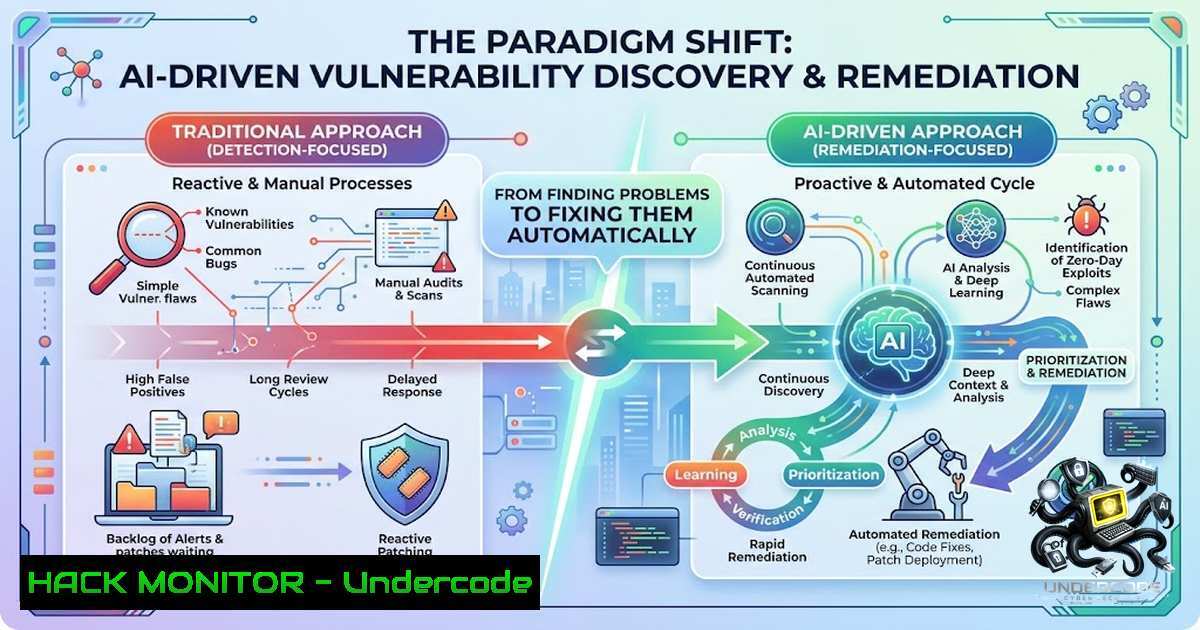
Google Threat Intelligence (GTI) and Mandiant have achieved a significant milestone by identifying over 100 critical vulnerabilities within a mere two days, utilizing a multi-agent AI system to analyze compromised code repositories. This breakthrough signals a fundamental shift in the cybersecurity paradigm, moving the bottleneck from the speed of vulnerability detection to the efficiency of prioritization, remediation, and decision-making. As AI accelerates the “Detect” phase, the real challenge emerges in scaling our ability to “Remediate” and “Validate” effectively.
Learning Objectives & Secrets:
- Objective 1: Understand the Architecture of AI-Directed Vulnerability Discovery. Learn how specialized AI agents orchestrate to analyze code, model threats, and map exploitation paths.
- Objective 2: Master Prioritization in an AI-Driven Landscape. Uncover the secret to using automated risk scoring and dynamic threat intelligence to triage thousands of findings rapidly.
- Objective 3: Automate Remediation and Validation. Discover how to implement automated patch deployment and verification protocols to keep pace with AI-driven detection, ensuring that the creation of backlogs is avoided.
You Should Know:
1. The Mandiant & GTI Multi-Agent AI Framework
The system developed by Mandiant orchestrates several specialized agents, each handling a distinct task: scanning code for anomalies, building a comprehensive threat model, identifying potential exploitation pathways, and validating the discovered vulnerabilities. This collaborative effort resulted in over 100 confirmed critical vulnerabilities and 12 new CVEs attributed to the approach. This is a perfect example of “Agentic AI” in cybersecurity.
Step‑by‑step guide explaining what this does and how to use it:
To emulate this detection capability, you can leverage open-source and commercial tools to build a multi-layered scanning pipeline.
- Step 1: Static Application Security Testing (SAST). Use `Semgrep` for custom rule-based scanning. Linux Command:
semgrep --config auto /path/to/repo --output findings.json
-
Step 2: Dependency Scanning. Identify known vulnerabilities in third-party libraries using
Trivy. Linux Command:trivy fs /path/to/repo --format json --output dependencies.json
-
Step 3: Secret Detection. Use `TruffleHog` to find hardcoded credentials. Linux Command:
trufflehog git file:///path/to/repo --json > secrets.json
-
Step 4: AI Aggregation. Use a Python script to correlate outputs and prioritize findings based on exploitability and asset criticality, mirroring the AI agent’s role.
2. The Triage Bottleneck: Risk Contextualization
The article highlights that detecting vulnerabilities is only half the battle. The real challenge lies in answering: “Which vulnerability do we fix first?” Without a robust triage system, you simply create a backlog faster. Modern vulnerability management requires integrating real-time threat intelligence, asset criticality (e.g., from a CMDB), and exploit availability.
Step‑by‑step guide explaining what this does and how to use it:
To prioritize effectively, you can build a dynamic triage script.
- Step 1: Ingestion. Aggregate findings into a central database (e.g., using a SIEM or a simple SQLite DB). Windows Command (using PowerShell):
Get-Content findings.json | ConvertFrom-Json | Export-Csv -Path findings.csv
-
Step 2: Enrichment. Integrate CVSS scores with EPSS (Exploit Prediction Scoring System). Linux Command (using a simple API call):
curl -X POST https://api.first.org/epss/v2/cve -H "Content-Type: application/json" -d '{"cve-id": ["CVE-2024-1234"]}' -
Step 3: Scoring. Weight the risk based on a formula:
Risk = (CVSS Business Impact) / Maturity of Mitigation. Prioritize vulnerabilities with an “Active Exploitation” flag.
3. Remediation at Scale: Patching Without Breaking Production
The fear of production downtime is a primary reason for patching delays. To keep pace with AI detection, you need advanced patch management and testing protocols. This involves using “patch Tuesday” automation, canary deployments, and extensive regression testing.
Step‑by‑step guide explaining what this does and how to use it:
- Step 1: Identify Missing Patches.
- Linux (Debian/Ubuntu):
sudo apt-get update && sudo apt-get upgrade --dry-run
- Windows (PowerShell):
Get-HotFix | Select-Object Description, InstalledOn
-
Step 2: Automate Patch Deployment.
Use Ansible or Azure/WSUS to deploy patches to test environments first. The key is Segmented Deployment: patch staging (Dev → Staging → Production). -
Step 3: Rollback Preparedness. For any patch, ensure a rollback plan is prepared. For Linux, this includes backing up kernel modules; for Windows, having a System Restore point.
4. Validation: Closing the Loop
The final and most critical phase of the new loop is “Validate.” How do you ensure that a patch truly mitigated the vulnerability? This requires re-scanning and validating the fix.
Step‑by‑step guide explaining what this does and how to use it:
- Step 1: Re-scan the asset.
Utilize `nuclei` for template-based vulnerability scanning to confirm the vulnerability is no longer exploitable.nuclei -target https://vulnerable-app.com -t cves/2024/CVE-2024-1234.yaml
-
Step 2: Policy Enforcement.
Use Open Policy Agent (OPA) to enforce that all high-risk vulnerabilities are remediated within an SLA. This codifies your validation process. -
Step 3: Continuous Monitoring.
Use an EDR like CrowdStrike or SentinelOne to monitor for post-patch exploitation attempts, ensuring the mitigation was effective.
5. Building an AI-Powered Remediation Pipeline
To fully embrace the “Detect → Prioritize → Remediate → Validate” loop, one must integrate these tools into a CI/CD pipeline. This is the ultimate form of “shifting left.”
Step‑by‑step guide explaining what this does and how to use it:
- Step 1: Integrate Trivy and Semgrep directly into your GitHub/GitLab CI actions.
- Step 2: Use an AI service to automatically create a Jira ticket with a summary, risk score, and a suggested remediation (e.g., “Update package X to version Y”).
- Step 3: Use a ChatOps tool to alert the security team in Slack/Teams only if the vulnerability is Critical and exploitable, reducing alert fatigue.
- Step 4: Automatically trigger a validation scan post-patch to confirm the vulnerability is resolved and move the ticket to “Resolved.”
What Undercode Say:
- Key Takeaway 1: The evolution of AI in cybersecurity is rapidly changing the equation from “finding bugs” to “fixing bugs.” The bottleneck is decisively shifting to remediation and prioritization.
- Key Takeaway 2: To stay ahead, organizations must invest not just in detection AI, but in “Remediation AI” to close the loop. The ability to self-heal and validate without human intervention for low-risk issues will be the next competitive advantage.
- Analysis:
The announcement from Mandiant and Google is less about the number of vulnerabilities and more about the operational velocity it represents. While a 100-vulnerability discovery in two days is impressive, it pales in comparison to the logistics of fixing them. The real innovation will be in how organizations build their teams around data. Security analysts will transition from “code auditors” to “risk decision-makers.” The ability to trust AI to validate, prioritize, and initiate remediation will be paramount. The biggest challenge remains the “Black Box” problem, where without explainability, security teams may not trust AI recommendations, slowing down the very process the AI is meant to accelerate.
Prediction:
- +1 The AI-driven vulnerability detection market is set to explode. Vendors will quickly integrate “Agentic AI” into their core platforms to provide automated validation.
- -1 The “fix gap” will become a more significant metric than the “detection gap.” Companies that don’t modernize their patching and incident response playbooks will see their cyber-risk increase despite having more tools, as they drown in unmanageable remediation backlogs.
- +1 We will witness the rise of “AI SOC Analysts” that autonomously handle the “Detect, Prioritize, and Validate” phases, allowing human teams to focus solely on the complex decisions involving business impact and unique exploitation paths.
▶️ Related Video (88% Match):
🎯Let’s Practice For Free:
🎓 Live Courses & Certifications:
Join Undercode Academy for Verified Certifications
🚀 Request a Custom Project:
Secure, high-velocity infrastructure and disruptive technological engineering. Contact our engineering team for high-tier development and proprietary systems:
[email protected]
💎 Smart Architecture | 🛡️ Secure by Design | ⭐ Trusted by Thousands
IT/Security Reporter URL:
Reported By: https://lnkd.in/p/ekYqjf8Y – Hackers Feeds
Extra Hub: Undercode MoN
Basic Verification: Pass ✅


