
Listen to this Post
Introduction:
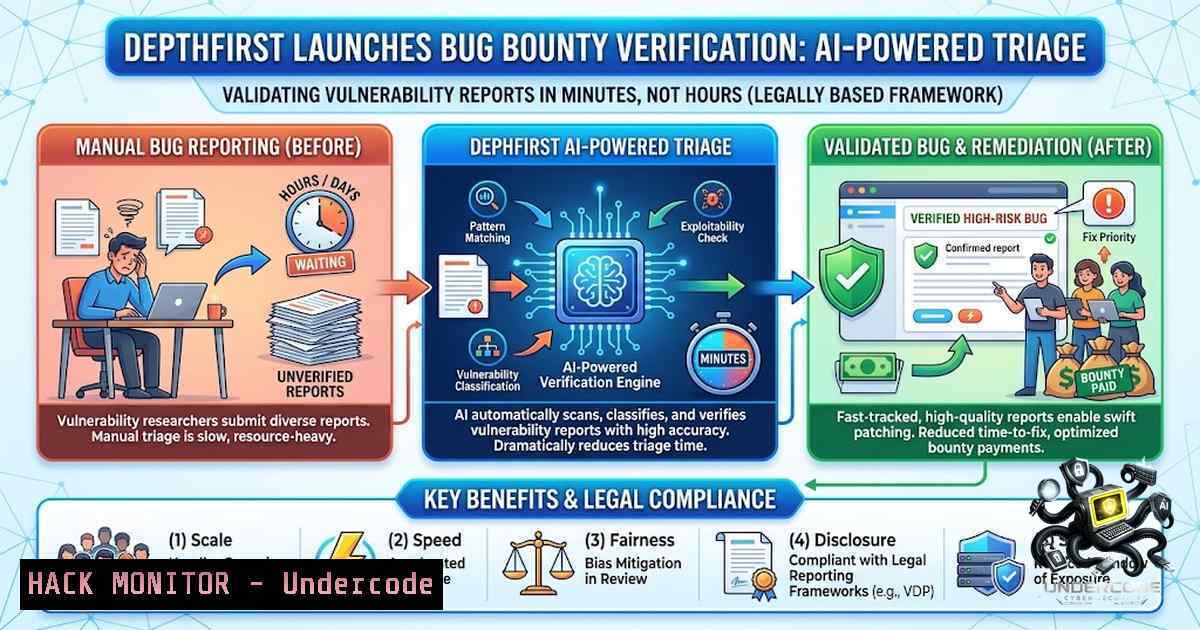
The cybersecurity industry is facing a paradoxical crisis: AI can now generate convincing vulnerability reports with a single prompt, but validating whether those findings are real still requires 30 minutes to three hours of a security engineer’s time. This asymmetric cost—where generation is near-free but verification remains expensive—has created a triage bottleneck that threatens to overwhelm security teams. Depthfirst’s new Bug Bounty Verification feature directly addresses this problem by transforming each incoming report into a hypothesis for an automated Agentic Pentesting run, testing the claim against the application’s threat model, codebase, and running environment.
Learning Objectives & Secrets:
- Objective 1: Understand the Bug Bounty Verification Workflow – Learn how depthfirst ingests vulnerability reports, converts them into testable hypotheses, and executes targeted autonomous penetration testing to validate or refute each claim.
-
Objective 2 Secret Tip: Leverage the Three-Verdict System – Each report returns one of three clear outcomes: exploitable vulnerability, false positive, or needs deeper validation. This eliminates ambiguous “maybe” findings that waste engineering cycles.
-
Objective 3 Secret Tip: Inspect the Full Audit Trail – Every verdict includes the complete requests, responses, and run log, enabling security teams to inspect exactly what the agent attempted before accepting, rejecting, or escalating a report.
You Should Know:
- The Triage Cost Crisis: Why Bug Bounty Verification Matters
The fundamental problem Bug Bounty Verification solves is the widening gap between vulnerability discovery and validation. AI security agents can now surface vulnerabilities at scale—depthfirst’s autonomous agent recently scanned FFmpeg’s 1.5 million lines of C code and discovered 21 zero-day vulnerabilities for approximately $1,000 in compute costs. However, the validation bottleneck remains severe. A conservative estimate suggests that triaging a single finding—reading the alert, opening source files, tracing data flow, and making a judgment call—costs roughly $128,000 in labor across 560 findings before a single vulnerability is mitigated.
The Linux Foundation recently launched a $12.5 million initiative specifically to help maintainers manage the surge of low-quality, AI-generated vulnerability reports overwhelming triage processes. Elastic Security Labs built an AI triage system that agrees with human engineers 85% of the time, at roughly $2 per report—but even that still requires human oversight. Depthfirst’s approach differs by actually testing the claim against the running application rather than relying on pattern matching or heuristic scoring.
Step-by-Step Guide: Implementing Automated Vulnerability Triage
For security teams looking to implement automated triage workflows similar to depthfirst’s approach:
- Establish a Triage Pipeline: Configure your bug bounty platform to forward incoming reports to depthfirst’s verification engine.
-
Define Threat Models: Ensure your application’s threat model, codebase access, and running environment are properly configured so the agent can test hypotheses against production-like conditions.
-
Set Verdict Handling Rules: Create automated workflows for each verdict type—escalate exploitable findings to engineering, dismiss false positives with audit trails, and queue “needs deeper validation” for manual review.
-
Monitor Agent Activity: Review the full run logs periodically to understand what the agent attempted and refine your threat model accordingly.
-
Measure Cost-Per-Verified-Finding: Track triage time per finding by source to identify which tools generate cheap-to-verify findings versus expensive noise.
2. How Agentic Pentesting Validates Vulnerability Reports
Depthfirst’s verification engine operates on a simple but powerful premise: treat every vulnerability report as a hypothesis to be tested. When a report arrives—whether from an external bug bounty hunter or an internal security scan—the system launches a targeted Agentic Pentesting run specifically designed to validate that claim.
Unlike traditional vulnerability scanners that follow predefined signatures, agentic pentesting uses autonomous AI agents that can reason about application logic, follow complex exploit chains, and adapt their approach based on what they discover. Research from AWS Security Blog describes how multi-agent penetration testing systems orchestrate specialized security agents to work collaboratively on vulnerability detection. Similarly, frameworks like AutoSec-Agent use a Planner–Summarizer–Validator (PSV) iterative reasoning loop to maintain safety constraints while conducting scalable penetration testing.
Step-by-Step Guide: Validating a Vulnerability Report with Agentic Testing
- Report Ingestion: The system receives a vulnerability report containing the claim, affected endpoints, and any proof-of-concept code.
-
Hypothesis Formation: The agent parses the report and formulates a testable hypothesis—e.g., “Endpoint X is vulnerable to SQL injection at parameter Y.”
-
Targeted Testing: The agent executes a focused penetration test against the running application, attempting to reproduce the reported vulnerability.
-
Evidence Collection: All requests, responses, and intermediate steps are logged for audit purposes.
-
Verdict Generation: Based on the test results, the system returns one of three verdicts—exploitable, false positive, or needs deeper validation.
Linux Command Example: Simulating Report Validation with cURL
 Simulate sending a vulnerability report to a verification endpoint
curl -X POST https://api.depthfirst.com/verify \
-H "Authorization: Bearer $API_KEY" \
-H "Content-Type: application/json" \
-d '{
"report_id": "BUG-2026-001",
"target": "https://app.example.com/api/v1/users",
"claim": "SQL injection at id parameter",
"poc": "https://gist.github.com/.../poc.py"
}'

Check verification status
curl -X GET https://api.depthfirst.com/verify/status/BUG-2026-001 \
-H "Authorization: Bearer $API_KEY"
3. The Three-Verdict System and Audit Trail
One of the most valuable aspects of Bug Bounty Verification is its transparent verdict system. Rather than returning a simple “pass/fail” result, depthfirst provides three distinct outcomes:
- Exploitable Vulnerability: The agent successfully reproduced the vulnerability in the running application. This finding should be escalated immediately for remediation.
-
False Positive: The agent could not reproduce the claimed vulnerability, and the evidence suggests the report is incorrect. The system provides the full test log so teams can understand why.
-
Needs Deeper Validation: The agent encountered conditions that require human expertise—perhaps the exploit requires specific environmental conditions, or the agent couldn’t fully execute the attack chain.
Each verdict includes the complete requests, responses, and full run log, allowing security teams to inspect exactly what the agent attempted before accepting, rejecting, or escalating the report. This transparency is critical for building trust in automated systems and maintaining auditability for compliance purposes.
Windows Command Example: Monitoring Triage Pipeline with PowerShell
 Check verification queue status
Invoke-RestMethod -Uri "https://api.depthfirst.com/verify/queue" `
-Headers @{Authorization = "Bearer $env:API_KEY"}

 Retrieve full audit log for a specific report
$report = Invoke-RestMethod -Uri "https://api.depthfirst.com/verify/logs/BUG-2026-001" `
-Headers @{Authorization = "Bearer $env:API_KEY"}
$report.audit_trail | Format-Table -AutoSize
4. Security Implications and Responsible Disclosure
The rise of autonomous security agents introduces new challenges for responsible disclosure. When depthfirst’s agent discovered 21 zero-days in FFmpeg, the company faced a critical question: how do you responsibly disclose vulnerabilities when AI can find them faster than humans can patch? The company published its findings with CVE assignments (CVE-2026-39210 through CVE-2026-39218) and provided reproducible proof-of-concept inputs.
However, as AI Weekly noted, “organizations relying on periodic manual audits or bug bounty programs for open source dependency security face a structural coverage gap as AI agents surface decades-old heap and stack overflows faster than review cycles can absorb”. The proof-of-concept inputs published on GitHub are accessible to offensive actors before patches land, creating a race condition between disclosure and exploitation.
Bug Bounty Verification helps address this by enabling faster validation of incoming reports, potentially reducing the window between discovery and remediation. By automating the triage process, security teams can focus their limited human expertise on confirmed vulnerabilities rather than spending hours validating dubious claims.
5. Implementation Best Practices for Security Teams
For organizations considering adopting automated vulnerability verification, several best practices emerge from depthfirst’s approach and broader industry research:
Establish Clear Triage Rules: Elastic Security Labs found that triage rules calibrated against a corpus of over 3,300 known-outcome reports achieved 85% agreement with human engineers. Organizations should build similar validation datasets to calibrate their automated systems.
Track Cost-Per-Verified-Finding: The metric that matters isn’t cost-per-finding, but cost-per-verified-finding. Log triage time per finding by source to identify which tools generate cheap-to-verify findings and which generate expensive noise.
Maintain Human-in-the-Loop Checkpoints: Systems like Sentriage use AI-powered triage with human-in-the-loop checkpoints at each stage. This ensures that critical decisions still involve human judgment while automating routine validation.
Implement Safety Constraints: Research on agentic pentesting emphasizes the importance of rollback validation, disallow lists, and sandboxing to enforce safety. Ensure your automated testing environment is isolated from production systems.
API Security Configuration Example: Restricting Agent Access
 Example API security policy for automated testing agents
security_policy:
agent_roles:
- role: "verification_agent"
permissions:
- "read:application_state"
- "execute:test_payloads"
restrictions:
- "disallow:production_write"
- "rate_limit:100_requests_per_minute"
- "sandbox:isolated_environment"
audit_logging:
enabled: true
retention_days: 90
include:
- "all_requests"
- "all_responses"
- "agent_decision_path"
What Undercode Say:
- Key Takeaway 1: The bottleneck in AI-powered security isn’t vulnerability discovery—it’s validation. Depthfirst’s Bug Bounty Verification directly addresses this by automating the triage process with agentic pentesting.
-
Key Takeaway 2: Transparency is essential for trust. By providing full audit trails—requests, responses, and run logs—depthfirst enables security teams to verify the verifier.
Analysis: Depthfirst’s approach represents a fundamental shift in how security teams handle vulnerability reports. Rather than treating every report as potentially valid and investing significant engineering time in validation, the system flips the model: reports are treated as hypotheses until proven otherwise. This is particularly important as AI-generated vulnerability reports become more common and more convincing. The three-verdict system—exploitable, false positive, or needs deeper validation—provides clear decision points for security workflows. However, organizations must still maintain human oversight, particularly for the “needs deeper validation” category where automated testing reaches its limits. The true value proposition isn’t just time savings—it’s the ability to focus scarce security engineering talent on confirmed vulnerabilities rather than spending hours validating dubious claims.
Prediction:
- +1 Automated vulnerability verification will become a standard component of bug bounty programs within 12-18 months, reducing triage costs by 70-80% for organizations with mature security programs.
-
+1 The cost-per-verified-finding metric will replace traditional cost-per-finding as the primary measure of security tool effectiveness.
-
-1 The speed of AI-powered vulnerability discovery will continue to outpace human patch capacity, creating a growing “discovery-to-remediation gap” that automated verification alone cannot solve.
-
-1 Organizations that fail to implement automated triage workflows will face increasing security debt as AI-generated reports overwhelm their security teams.
-
+1 Depthfirst’s Open Defense Initiative—providing $5 million in credits to help companies and open-source developers find code bugs with AI—will accelerate adoption of autonomous security testing across the industry.
▶️ Related Video (78% Match):
https://www.youtube.com/watch?v=-gbY4v9tm0o
🎯Let’s Practice For Free:
🎓 Live Courses & Certifications:
Join Undercode Academy for Verified Certifications
🚀 Request a Custom Project:
Secure, high-velocity infrastructure and disruptive technological engineering. Contact our engineering team for high-tier development and proprietary systems:
[email protected]
💎 Smart Architecture | 🛡️ Secure by Design | ⭐ Trusted by Thousands
IT/Security Reporter URL:
Reported By: https://lnkd.in/p/evg3QnaK – Hackers Feeds
Extra Hub: Undercode MoN
Basic Verification: Pass ✅


