
Listen to this Post
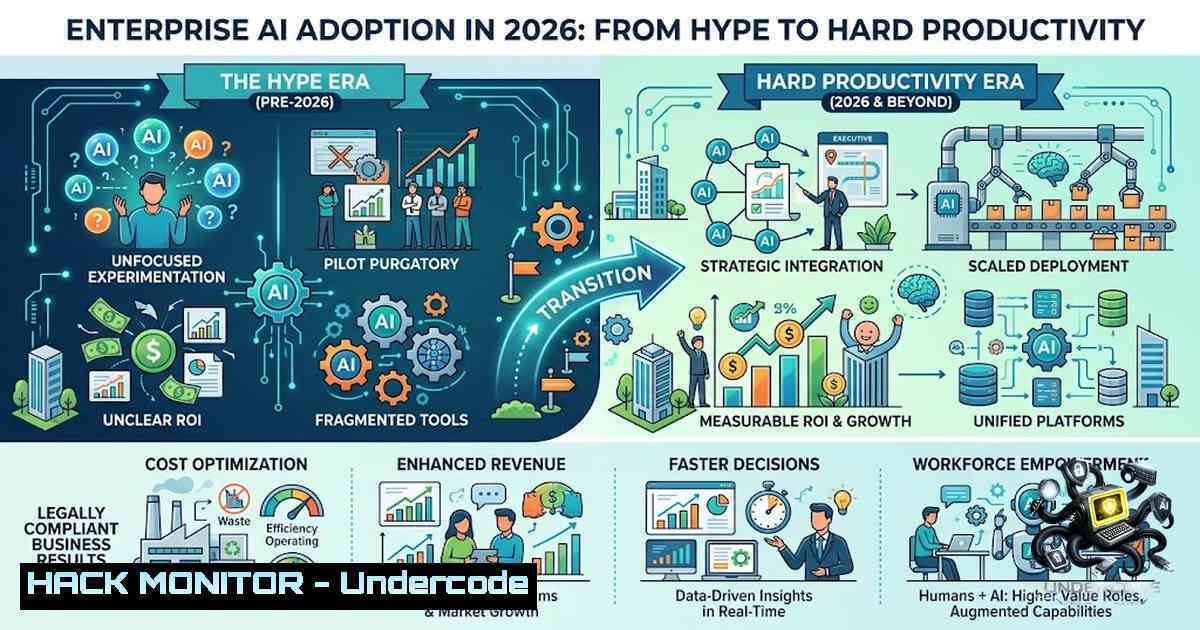
Introduction:
The diffusion of technology has historically followed a predictable pattern: new innovations are adopted with increasing speed, yet full economic integration consistently takes 15–20 years. In 2026, we are witnessing this phenomenon play out in real time with enterprise AI. While AI adoption has accelerated faster than any prior technology—roughly 2 years compared to 8 for the internet—the productivity gains remain elusive for most organizations. The gap between AI capability and measurable business impact is now the defining challenge of our era, as Sam Altman recently acknowledged: “the economy has much more inertia” than anticipated.
Learning Objectives & Secrets:
- Objective 1: Understand the Technology Diffusion Gap — Recognize why rapid AI adoption does not automatically translate into productivity gains, and identify the organizational bottlenecks that slow full integration.
-
Objective 2 Secret Tip: Rethink Processes, Not Just Tools — The real productivity leap comes not from deploying AI tools but from redesigning entire workflows around them, much like factories were reimagined around diesel engines.
-
Objective 3 Secret Tip: Target the “Corporate Spice” — Focus AI agents on high-value, repetitive tasks like Excel modeling and PowerPoint generation where measurable efficiency gains are achievable today.
- The State of Enterprise AI Adoption: Numbers That Matter
By the end of 2025, approximately 18% of firms had adopted AI, with over 20% expecting to use it in the first half of 2026. Enterprise-wide AI adoption doubled in 2026 to 24%, up from 12% in 2025. However, these figures mask a critical reality: 95% of AI pilots fail to scale, according to an MIT study. While 79% of enterprises have adopted AI agents in some capacity, only 23% are actually scaling agentic AI systems. Gartner predicts 40% of enterprise applications will feature task-specific AI agents by the end of 2026, up from less than 5% in 2025. The adoption curve shows we are transitioning between early and late majority phases.
What This Means for You:
If your organization is among the 76% yet to achieve full-scale AI adoption, you are not alone—but the window of competitive advantage is closing. Companies that deploy more than 10 AI agents and allocate over half their AI budget to agentic systems are seeing ROI rates of 88%—14% higher than average.
- The Agentic Revolution: From Chatbots to Computer Control
The evolution of AI agents has been dramatic. In 2022–2023, we had chatbots producing “fun dinosaurs essays.” By late 2024, early agents could perform basic computer tasks but were “mostly bad for the majority of even the power users.” Mid-2025 saw Codex released, and by December 2025, agents could run for hours on generous subscriptions. January 2026 marked the turning point: agents became “extraordinary at using the computer”.
Today’s agents can run verification loops, execute complex multi-stage workflows, and even perform novel mathematics. But the real breakthrough for enterprise users came when agents got good at Excel and PowerPoint. Anthropic’s Claude can now work directly in Microsoft Excel, PowerPoint, and Word through add-ins, building financial models from filings, auditing formulas across linked workbooks, and running sensitivity analysis. In PowerPoint, Claude can draft presentations that update automatically when underlying figures change.
Step‑by‑Step Guide: Setting Up Claude for Microsoft 365
- Visit claude.com/claude-for-microsoft-365 to enable the integration.
- Install the Claude add-in for Excel, PowerPoint, and Word through your Microsoft 365 admin center.
- Authenticate your Anthropic account and grant necessary permissions.
- Open Excel and use the Claude pane to describe the model you need: “Build a three-statement financial model using the data in Sheet1, with sensitivity analysis on revenue growth.”
- Review the generated formulas and audit the workbook for accuracy.
3. AI-Powered Excel Automation: Commands and Tools
For power users and IT professionals, here are verified commands and tools to integrate AI agents with Excel workflows:
Windows PowerShell – Excel COM Automation
 Launch Excel and create a new workbook
$excel = New-Object -ComObject Excel.Application
$excel.Visible = $true
$workbook = $excel.Workbooks.Add()
$worksheet = $workbook.Worksheets.Item(1)
$worksheet.Cells.Item(1,1) = "AI-Generated Report"
$worksheet.Cells.Item(2,1) = "Date: $(Get-Date)"
$workbook.SaveAs("C:\Reports\AI_Report.xlsx")
$excel.Quit()
xlflow – AI-Agent-Ready Excel VBA Framework
xlflow is a CLI framework for editing, testing, running, tracing, and diffing Excel VBA projects:
 Install xlflow
npm install -g xlflow

Extract VBA modules from an Excel file
xlflow extract --file report.xlsm --output ./vba_modules/

Run a VBA macro via CLI
xlflow run --file report.xlsm --macro "GenerateReport"

Diff VBA changes between versions
xlflow diff --base v1.xlsm --head v2.xlsm
ShortcutXL – AI Agent with Excel Superpowers
ShortcutXL is an AI agent that lives on your computer with Excel capabilities:
 Install via npm
npm install -g shortcutxl

Start the agent
shortcutxl start

Command the agent to analyze spreadsheet
shortcutxl analyze --file sales_data.xlsx --query "Find top 10 customers by revenue"
4. Enterprise AI Security and API Hardening
As AI agents gain access to sensitive corporate data and systems, security becomes paramount. Here are essential security practices:
API Key Management (Linux/macOS)
 Store API keys securely using environment variables
echo "export ANTHROPIC_API_KEY=sk-ant-..." >> ~/.bashrc
source ~/.bashrc

Use a secrets manager for production
 AWS Secrets Manager
aws secretsmanager create-secret --1ame anthropic/api-key --secret-string "sk-ant-..."

Retrieve securely in scripts
export ANTHROPIC_API_KEY=$(aws secretsmanager get-secret-value --secret-id anthropic/api-key --query SecretString --output text)
Implementing Rate Limiting and Access Controls
For organizations exposing AI agent APIs internally:
 Flask example with rate limiting
from flask import Flask, request, jsonify
from flask_limiter import Limiter
from flask_limiter.util import get_remote_address

app = Flask(<strong>name</strong>)
limiter = Limiter(get_remote_address, app=app, default_limits=["200 per day", "50 per hour"])

@app.route("/api/agent/execute")
@limiter.limit("10 per minute")
def execute_agent():
 Validate authentication token
token = request.headers.get("Authorization")
if not validate_token(token):
return jsonify({"error": "Unauthorized"}), 401
 Execute agent task
result = run_agent_task(request.json)
return jsonify(result)
Cloud Hardening for AI Workloads (Azure Example)
 Restrict AI agent access to specific storage accounts
az storage account update --1ame aistorage --default-action Deny
az storage account network-rule add --1ame aistorage --action Allow --ip-address 192.168.1.0/24

Enable managed identity for secure authentication
az webapp identity assign --1ame ai-agent-app --resource-group ai-rg
az keyvault set-policy --1ame ai-kv --object-id <managed-identity-id> --secret-permissions get list
5. Measuring AI ROI: The 88% Club
Google’s The ROI of AI 2025 report surveyed over 3,000 business executives. The findings are striking: 74% of companies reported they have already recouped their investment in at least one AI project. However, the real differentiator is scale. Companies that deploy more than 10 AI agents and allocate over 50% of their AI budget to agentic systems achieve ROI rates of 88%—14% higher than the average. These “heavyweight” adopters are not experimenting; they are transforming.
Step‑by‑Step Guide: Building an AI ROI Dashboard
- Identify 3–5 high-volume, repetitive tasks in your organization (e.g., monthly reporting, data entry, presentation creation).
- Measure current time and cost per task over a 30-day baseline.
- Deploy AI agents to automate these tasks (start with Excel and PowerPoint automation).
- Measure post-deployment time and cost over another 30 days.
- Calculate ROI:
(Baseline Cost - AI Cost) / AI Cost × 100.
6. Scale successful pilots to other departments.
6. The Competitive Landscape: Who’s Winning Enterprise AI?
As of May 2026, the enterprise AI landscape has shifted dramatically. OpenAI peaked at 62% enterprise share in September 2025 but dropped to 56% by March 2026. Meanwhile, Anthropic has surged, climbing from 8% to 46% of enterprise AI spend. Gemini adoption grew from 27% to 40% share. This shift reflects enterprise preference for agents that can actually do things—not just chat.
Agentic Coding Tools Comparison (2026)
| Tool | Key Feature | Terminal-Bench 2.0 Score |
||-|–|
| Codex CLI | Goal mode runs for hours unsupervised | 82.7% |
| Claude Code | Precision for complex agent workflows | State-of-the-art |
| Gemini CLI | Multi-modal capabilities | Growing rapidly |
| Cursor Agent | IDE integration | Strong adoption |
7. Future-Proofing Your AI Strategy: Practical Recommendations
For IT Leaders:
- Deploy AI agents that integrate directly with your existing Microsoft 365 stack.
- Implement MCP (Model Context Protocol) servers for seamless agent-to-application communication.
- Use open-source frameworks like xlflow to give AI agents CLI access to Excel VBA projects.
For Security Teams:
- Implement API key rotation and secrets management.
- Restrict AI agent network access using cloud provider security groups.
- Audit agent actions with comprehensive logging.
For Business Leaders:
- Stop treating AI as a pilot project—commit to full-scale deployment.
- Rethink processes around AI, not just add AI to existing workflows.
- Measure ROI rigorously and scale what works.
What Undercode Say:
- Key Takeaway 1: The gap between AI capability and enterprise productivity is not a technology problem—it’s an organizational inertia problem. Full diffusion takes 15–20 years regardless of how fast the technology itself improves.
-
Key Takeaway 2: The 88% ROI achieved by “heavyweight” AI adopters proves that scale matters more than experimentation. Companies deploying 10+ AI agents are seeing measurable returns while pilots stall.
The critical insight from Wakacje.pl’s experience is that the “corporate spice”—spreadsheets, PowerPoints, and routine data work—is where AI agents deliver immediate value. The breakthrough of January 2026, when agents became “extraordinary at using the computer,” marks the inflection point where AI transitions from a novelty to a necessity. Organizations that fail to move beyond experimentation risk being left behind as competitors achieve compounding productivity gains. The technology is ready. The question is whether your organization’s culture and processes are ready to embrace it.
Prediction:
- +1 Enterprise AI agent deployment will surpass 40% of applications by end of 2026, driven by Microsoft 365 integrations and falling implementation costs.
-
+1 Companies that achieve full-scale AI deployment (10+ agents, 50%+ AI budget allocation) will see productivity gains 2–3x higher than pilot-only organizations by 2027.
-
-1 Organizations that treat AI as a series of isolated pilots rather than a strategic transformation will see ROI stagnate below 30%, mirroring the failed digital transformations of the 2010s.
-
-1 The security gap will widen as AI agents gain access to more systems, with AI-related data breaches increasing 40% year-over-year unless API hardening and access controls are prioritized.
-
+1 The 15–20 year technology diffusion cycle will compress for AI as competitive pressure forces faster organizational adaptation, potentially reaching full economic integration in 10–12 years.
-
+1 Open-source frameworks like xlflow and ShortcutXL will democratize AI agent deployment, enabling small and medium enterprises to compete with larger organizations.
▶️ Related Video (88% Match):
https://www.youtube.com/watch?v=8_fxC7pIagk
🎯Let’s Practice For Free:
🎓 Live Courses & Certifications:
Join Undercode Academy for Verified Certifications
🚀 Request a Custom Project:
Secure, high-velocity infrastructure and disruptive technological engineering. Contact our engineering team for high-tier development and proprietary systems:
[email protected]
💎 Smart Architecture | 🛡️ Secure by Design | ⭐ Trusted by Thousands
IT/Security Reporter URL:
Reported By: https://lnkd.in/p/eJib6bKM – Hackers Feeds
Extra Hub: Undercode MoN
Basic Verification: Pass ✅


