Listen to this Post
Introduction:
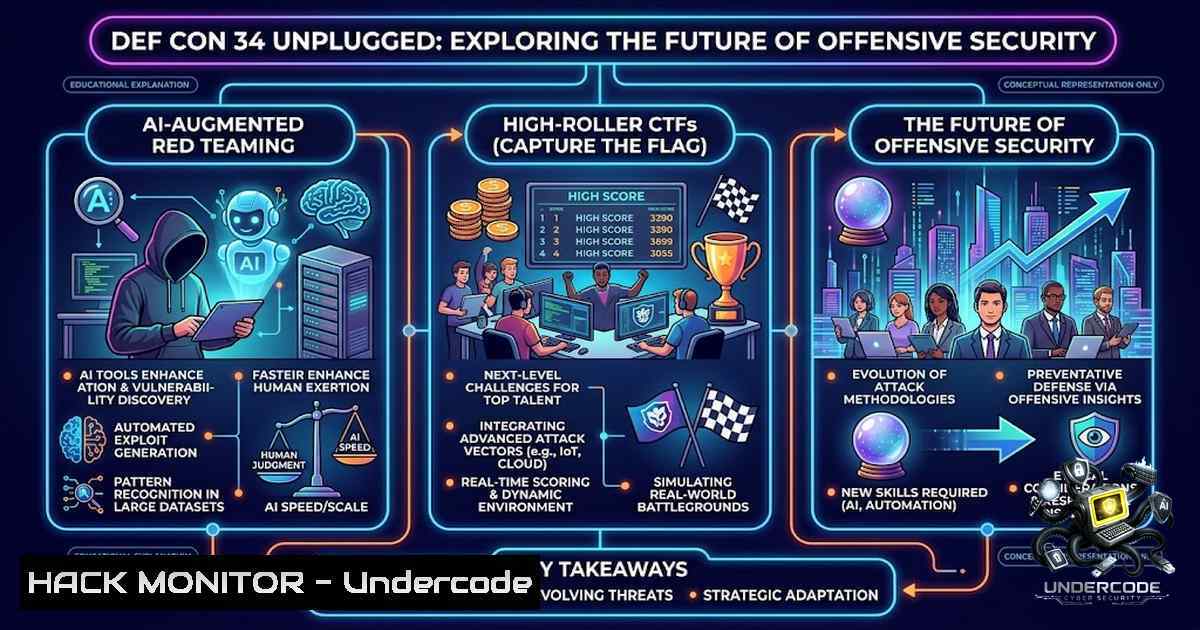
DEF CON 34 transformed the Las Vegas Convention Center into a living laboratory of offensive security, where 686 qualifying teams converged for what the industry calls the “Hacking Olympics”. Amidst the badge pickup lines and corridor conversations, a new paradigm emerged: AI is no longer a theoretical assistant but an active participant in vulnerability discovery and CTF competition. This article dissects the technical undercurrents of DEF CON 34—from the SkillBit-hosted “Hacking on the High Roller” CTF to the Hack The Box Data Dystopia: Manhunt challenge—and provides actionable commands, configurations, and methodologies for practitioners looking to operationalize AI-assisted security workflows.
Learning Objectives:
- Master the workflow of AI-assisted CTF challenge solving using Anthropic’s Opus 5 under the Cyber Verification Program.
- Implement practical Linux and Windows commands for binary analysis, steganography, and web exploitation as demonstrated in DEF CON CTF challenges.
- Configure red team engagement frameworks that prioritize defensive outcomes over technical theatrics.
You Should Know:
- Operationalizing AI for Vulnerability Discovery: Opus 5 in the Cyber Verification Program
Anthropic’s Claude Opus 5 represents a deliberate balancing act: it identifies software vulnerabilities at a rate approaching the company’s most capable system, Mythos 5, but deliberately trails in autonomous exploit generation. Under the Cyber Verification Program (CVP), vetted researchers gain access to a less-restricted version where binary-based vulnerability scanning and penetration testing workflows are partially unblocked. In practice, Opus 5 handles easy CTF challenges autonomously and medium-difficulty ones with light guidance, but still requires a human to define the target and validate findings.
To integrate Opus 5 into your security research pipeline, start with source-code analysis—the model excels at spotting OSS-Fuzz-discovered bugs, achieving a 79.4% detection rate compared to Opus 4.8’s 38.5%. Use the following workflow for AI-assisted code review:
Linux/macOS: Setting up a secure code review environment with Opus 5 API
 Install Anthropic CLI and authenticate
pip install anthropic
export ANTHROPIC_API_KEY="your_cvp_api_key"

Create a review script that feeds source code to Opus 5 for analysis
cat > review_code.py << 'EOF'
import anthropic
import sys

client = anthropic.Anthropic(api_key="your_cvp_api_key")
with open(sys.argv[bash], 'r') as f:
code = f.read()

response = client.messages.create(
model="claude-3-opus-5-20260724",
max_tokens=4096,
messages=[{
"role": "user",
"content": f"Perform a security vulnerability scan on this source code. Identify buffer overflows, injection points, and logic flaws. Provide CWE classifications and recommended fixes.\n\n{code}"
}]
)
print(response.content[bash].text)
EOF

python3 review_code.py vulnerable_app.c
Windows (PowerShell): API integration for batch analysis
$env:ANTHROPIC_API_KEY="your_cvp_api_key"
$code = Get-Content -Path ".\vulnerable_app.c" -Raw
$body = @{
model = "claude-3-opus-5-20260724"
max_tokens = 4096
messages = @(
@{
role = "user"
content = "Analyze this C code for memory safety issues: $code"
}
)
} | ConvertTo-Json -Depth 10
Invoke-RestMethod -Uri "https://api.anthropic.com/v1/messages" -Method Post -Headers @{
"x-api-key" = $env:ANTHROPIC_API_KEY
"anthropic-version" = "2023-06-01"
"Content-Type" = "application/json"
} -Body $body
- CTF Challenge Arsenal: Extracting Flags from Binary and Web Exploits
The DEF CON CTF qualifiers showcased a multi-stage attack chain: XSS → cookie tossing → CSRF bypass → prototype pollution → SQL injection through parser differences. For the SkillBit-hosted CTF, competitors used tools like `strings` and `exiftool` to extract flags embedded in images. Here’s a step-by-step guide for common CTF techniques observed at DEF CON 34:
Step 1: Steganography and Metadata Extraction
 Extract hidden flags from image metadata
exiftool -a -u challenge.jpg | grep -i flag
strings challenge.jpg | grep -E 'SkillBit{[^}]+}|flag{[^}]+}'

Check for appended data (common in DEF CON challenges)
binwalk -e challenge.jpg
dd if=challenge.jpg bs=1 skip=$(stat -c%s challenge.jpg) of=hidden_data.bin 2>/dev/null
Step 2: SQL Injection via Parser Differential (BirdBlog-style)
The BirdBlog challenge exploited parser differences between the application and the database. To test for similar vulnerabilities:
-- Exploit template for pg-minify prototype pollution leading to SQLi
' UNION SELECT flag FROM flags WHERE '1'='1' --
-- Tampering with slugify to break parser assumptions
SELECT  FROM posts WHERE slug = 'anything' OR '1'='1' -- '
Step 3: Cookie Tossing and CSRF Exploitation
// JavaScript payload for cookie tossing (observed in DEF CON CTF)
document.cookie = "session=malicious; path=/admin; domain=.target.com";
// Then trigger a CSRF request to the admin endpoint
fetch('/admin/change_password', {
method: 'POST',
credentials: 'include',
headers: {'Content-Type': 'application/x-www-form-urlencoded'},
body: 'new_password=hacked123'
});
- Red Team Village: Designing Exercises That Actually Matter
The Red Team Village at DEF CON 34 emphasized a critical shift: red team engagements are often judged on technical achievements like “got domain admin” rather than answering the defensive questions they were meant to address. Billy Giles’s workshop challenged attendees to design red team exercises around clear defensive outcomes—building objectives, starting conditions, technique selection, and success metrics that map to organizational risk.
To implement this framework, use the following operational checklist:
Linux: Setting up a red team engagement tracker
 Create a structured engagement log
mkdir -p ~/redteam_engagement/{objectives,techniques,metrics}
cat > ~/redteam_engagement/objectives/defensive_questions.yaml << 'EOF'
engagement: "Active Directory Hardening Assessment"
defensive_questions:
- "Can we detect lateral movement using LSASS dumping?"
- "Are privileged groups monitored for unauthorized membership changes?"
- "Does the SIEM correlate failed logins with successful privilege escalations?"
success_metrics:
- "Time to detection (TTD) under 15 minutes"
- "Alert fidelity > 90% (no false positives)"
- "Remediation playbook executed within 1 hour"
EOF

Use BloodHound to map attack paths relevant to the engagement
bloodhound --collector All --zipFilename ad_data.zip
 Then analyze with Cypher queries to identify high-value targets
Windows (PowerShell): Active Directory enumeration for red team planning
 Enumerate AD groups and memberships
Get-ADGroup -Filter  | Select-Object Name, GroupCategory, GroupScope
Get-ADGroupMember -Identity "Domain Admins" | Select-Object Name, SamAccountName

Check for Kerberoastable accounts
Add-Type -AssemblyName System.IdentityModel
$spns = Get-ADUser -Filter {ServicePrincipalName -1e $null} -Properties ServicePrincipalName
$spns | ForEach-Object { Write-Host "$($<em>.Name) - $($</em>.ServicePrincipalName)" }
- Biohacking Village: Medical Device Security and Firmware Analysis
The Biohacking Village placed over $4 billion in medical technology within reach of independent security researchers. The “Code Crimson” CTF dropped participants into a compromised naval hospital base, requiring them to track movement, correlate activity, and chase down a spy operating inside a critical medical environment. This represents a growing intersection of healthcare cybersecurity, firmware analysis, and wireless protocol testing.
For firmware analysis of medical devices, use these commands:
Linux: Extracting and analyzing medical device firmware
 Use binwalk to extract filesystems from firmware images
binwalk -Me medical_device_firmware.bin

Check for hardcoded credentials and certificates
grep -r -i "password|secret|key|cert" extracted_firmware/

Analyze wireless protocols (common in infusion pumps and wearables)
 Capture Bluetooth Low Energy (BLE) traffic
sudo hcitool lescan
sudo gatttool -b <BLE_MAC> --characteristics

Analyze Zigbee/Z-Wave traffic (if applicable)
 Using Wireshark with the appropriate dissectors
tshark -r wireless_capture.pcap -Y "wpan" -T fields -e wpan.src64 -e wpan.dst64
Windows: Using Ghidra for firmware reverse engineering
 Launch Ghidra from command line (ensure Java is installed)
& "C:\tools\ghidra\ghidraRun.bat"

Headless analysis for batch processing
& "C:\tools\ghidra\support\analyzeHeadless.bat" .\firmware_project -import firmware.bin -analysisTimeout 300 -postScript AnalyzeAll
- Hack The Box Data Dystopia: Manhunt — One-Man Army Tactics
The Data Dystopia CTF 2026: Manhunt, running from August 8–10, 2026, challenges participants to navigate a dystopian data governance scenario. With dynamic scoring that decreases as more participants solve a challenge, maintaining a top-5 position as a solo competitor requires efficient enumeration and exploitation.
Linux: Rapid enumeration script for HTB-style machines
!/bin/bash
 Quick enumeration script for CTF machines
echo "[] Starting comprehensive enumeration on $1"
nmap -sC -sV -p- -T4 $1 -oN nmap_full.txt
gobuster dir -u http://$1 -w /usr/share/wordlists/dirbuster/directory-list-2.3-medium.txt -x php,html,txt -o gobuster.txt
ffuf -u http://$1/FUZZ -w /usr/share/seclists/Discovery/Web-Content/common.txt -o ffuf.json

Check for common vulnerabilities
nikto -h http://$1 -o nikto_report.txt
whatweb http://$1
Windows: PowerShell-based vulnerability scanning
 Test for common web vulnerabilities using Invoke-WebRequest
$target = "http://$env:CTF_TARGET"
 Test for SQL injection
$payloads = @("' OR '1'='1", "' UNION SELECT NULL--", "'; DROP TABLE users--")
foreach ($payload in $payloads) {
$url = "$target/login?user=admin&pass=$payload"
try { Invoke-WebRequest -Uri $url -Method Get } catch { Write-Host "Potential injection at: $url" }
}
 Check for directory traversal
$traversal = "../../../../etc/passwd"
$url = "$target/download?file=$traversal"
Invoke-WebRequest -Uri $url -Method Get
What Undercode Say:
- AI is a force multiplier, not a replacement. Opus 5 handles easy challenges autonomously but requires human direction for medium and hard tasks. The Cyber Verification Program provides a controlled pathway for defensive research, but the model’s exploit-generation capabilities remain deliberately constrained. The 99 ACE exploits generated on ExploitBench demonstrate that AI can produce offensive artifacts, but safety classifiers and fallback mechanisms (to Opus 4.8) ensure that general users cannot weaponize these capabilities.
-
Red teaming must evolve beyond technical checkboxes. The industry is moving toward outcome-driven engagements that answer defensive questions rather than simply achieving domain admin. This requires a shift in metrics, reporting, and stakeholder communication—a theme echoed across multiple DEF CON villages. The integration of AI into red team workflows is inevitable, but the panel “Is Red Teaming Dead?” concluded that the discipline’s value remains fundamentally human, with AI serving as an accelerator for enumeration and reconnaissance.
Prediction:
-
+1 AI-assisted CTF platforms will proliferate, with models like Opus 5 becoming standard tools for vulnerability discovery in enterprise DevSecOps pipelines. The Cyber Verification Program model—controlled access for vetted researchers—will become the template for regulating offensive AI capabilities.
-
+1 DEF CON’s village model will expand to include dedicated AI Red Teaming villages, focusing on prompt injection, model jailbreaks, and AI-specific attack surfaces. The Biohacking Village’s success with medical device security will drive increased regulatory scrutiny and mandatory security testing for connected health technologies.
-
-1 The gap between AI-assisted vulnerability discovery and autonomous exploit generation will narrow. As models like Opus 5 improve, the safeguards designed to prevent misuse will face increasing adversarial pressure, potentially leading to more restrictive export controls or bifurcated model releases.
-
-1 The dynamic scoring systems used in CTFs will become targets for gamification abuse, with teams potentially manipulating solve rates to inflate or deflate point values. This could necessitate changes to CTF scoring algorithms and increased anti-cheat measures.
-
+1 The convergence of cybersecurity, AI, and biohacking will create new interdisciplinary career paths. Professionals who can bridge firmware analysis, wireless protocol security, and AI-assisted vulnerability discovery will be in high demand, as demonstrated by the multi-village engagements at DEF CON 34.
▶️ Related Video (78% Match):
https://www.youtube.com/watch?v=-X1vf69CxCA
🎯Let’s Practice For Free:
🎓 Live Courses & Certifications:
Join Undercode Academy for Verified Certifications
🚀 Request a Custom Project:
Secure, high-velocity infrastructure and disruptive technological engineering. Contact our engineering team for high-tier development and proprietary systems:
[email protected]
💎 Smart Architecture | 🛡️ Secure by Design | ⭐ Trusted by Thousands
IT/Security Reporter URL:
Reported By: Peterrakolcza First – Hackers Feeds
Extra Hub: Undercode MoN
Basic Verification: Pass ✅


