Listen to this Post
Introduction
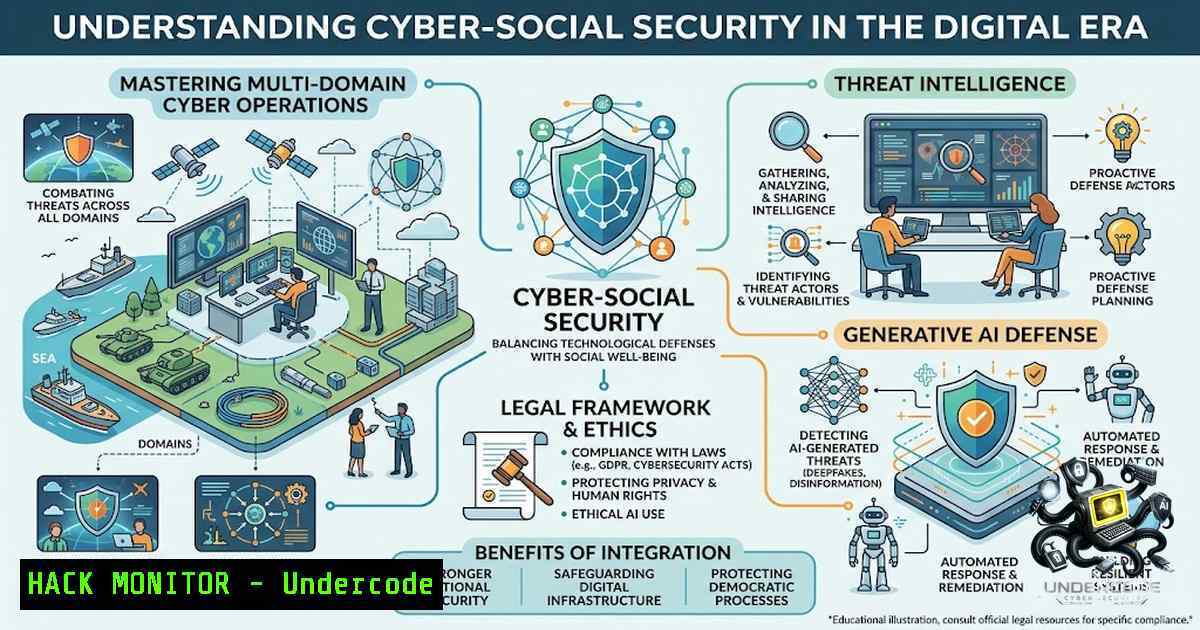
The convergence of cyber, informational, cognitive, and physical domains has redefined modern security operations. No longer confined to protecting perimeters and infrastructure, cybersecurity now demands a holistic understanding of the entire socio-technical ecosystem—where human factors, AI-driven threats, and hybrid warfare tactics intersect. The recent Summer School “Cyber-Social Security in the Digital Era,” culminating in the TRIDENT SHIELD multi-domain exercise, underscored this paradigm shift by training participants in Cyber Threat Intelligence (CTI), Red Team vs Blue Team operations, Malware Analysis, Wargaming, Hybrid Warfare, and Generative AI security. This article distills those core competencies into actionable technical knowledge, providing security professionals with verified commands, configurations, and step-by-step guides to operationalize these critical skills.
Learning Objectives
- Objective 1: Master Cyber Threat Intelligence (CTI) triage and OSINT collection using CLI tools to enrich indicators of compromise (IOCs) and score risk across multiple threat feeds.
- Objective 2: Execute Red Team and Blue Team operations using modern Command & Control (C2) frameworks, Atomic Red Team tests, and defensive monitoring tools to measure detection coverage.
- Objective 3: Perform static and dynamic malware analysis in isolated Linux environments, author YARA rules, and integrate threat intelligence into SIEM workflows.
- Objective 4: Understand and mitigate Generative AI security risks, including prompt injection, data poisoning, and model extraction attacks, with practical defense strategies.
You Should Know
- Cyber Threat Intelligence (CTI) Triage and OSINT Collection
What This Does:
CTI triage is the process of rapidly enriching suspicious artifacts—IP addresses, domains, and file hashes—using multiple threat intelligence sources to determine maliciousness and prioritize alerts. SOC analysts at L1/L2 tiers rely on CLI tools to normalize results, score risk, and produce readable, colorized output for fast decision-making.
Step‑by‑Step Guide:
- Install a CTI Triage CLI Tool – Use `ctitool` (Python 3.10+ required):
git clone https://github.com/SidhuK007/ctitool.git
cd cti-tool
python -m venv .venv
source .venv/bin/activate  Linux/macOS; on Windows: .venv\Scripts\activate
pip install -r requirements.txt
-
Configure API Keys – Create a config file at
~/.ctitool/config.yml:cache: path: "~/.ctitool/cache.sqlite" providers: virustotal: enabled: true api_key: "YOUR_VT_API_KEY" shodan: enabled: true api_key: "YOUR_SHODAN_API_KEY" censys: enabled: true api_id: "YOUR_CENSYS_ID" api_secret: "YOUR_CENSYS_SECRET"
-
Enrich Artifacts – Run triage on IPs, domains, or file hashes:
python cti_triage.py --ip 8.8.8.8
python cti_triage.py --domain example.com
python cti_triage.py --sha256 <hash>
-
Alternative OSINT/Threat Intel CLI – Install `harpoon` for broader OSINT collection:
pip install harpoon
harpoon config  Interactive API key setup
harpoon update  Download required GeoIP databases
harpoon ip 8.8.8.8  IP geolocation and reputation
harpoon domain example.com  DNS, certificate transparency, and WHOIS
harpoon hashlookup <hash>  CIRCL hash lookup
-
Cache Management – Purge provider caches to refresh data:
python cti_triage.py --purge-cache
python cti_triage.py --purge-provider virustotal
Key Takeaway: Automated CTI triage reduces mean time to response (MTTR) by providing analysts with consolidated, risk-scored intelligence from multiple sources in seconds, enabling rapid L1/L2 alert disposition.
- Red Team vs. Blue Team Operations: C2 Frameworks and Atomic Testing
What This Does:
Red Team operations simulate adversarial tactics, techniques, and procedures (TTPs) using Command & Control (C2) frameworks to test defensive capabilities. Blue Teams leverage Atomic Red Team tests to validate detection coverage and measure response effectiveness. This section covers deploying a modern C2 framework and running adversary emulation tests.
Step‑by‑Step Guide:
- Deploy Havoc C2 Framework – Install on Kali Linux:
sudo apt update
sudo apt install havoc
havoc -h  Display help
-
Start Havoc Team Server – Launch the C2 server (requires a config file):
havoc server --config /path/to/config.yml
The server manages agents, jobs, and profiles.
-
Connect Havoc Client – From a separate terminal:
havoc client --connect <server_ip>:<port>
This provides a GUI/CLI interface for agent management and post-exploitation.
-
Run Atomic Red Team Tests – Install the Atomic Red Team operator:
sudo apt install python3-atomic-operator
atomic-operator get_atomics  Downloads the RedCanary atomic-red-team repo
atomic-operator search "T1059"  Search for a specific technique (e.g., Command and Scripting Interpreter)
atomic-operator run --technique T1059 --test-1umber 1
-
Blue Team: Monitor and Detect – On the defensive side, use
auditd,osquery, or Wazuh to log process execution and network connections. For example, monitor new outbound connections:sudo auditctl -a always,exit -F arch=b64 -S connect -k outbound_conn ausearch -k outbound_conn --format raw
Key Takeaway: Red Team/Blue Team exercises, powered by frameworks like Havoc and Atomic Red Team, provide measurable insights into defensive gaps. Purple Team engagements—where both sides collaborate—accelerate detection engineering and improve overall security posture.
- Malware Analysis: Static and Dynamic Triage in Linux Sandboxes
What This Does:
Malware analysis involves extracting indicators from suspicious binaries, observing runtime behavior, and creating detection signatures. A Linux-based sandbox with tools like strings, strace, tcpdump, and YARA enables safe, automated analysis.
Step‑by‑Step Guide:
- Set Up an Isolated Analysis Environment – Use a UTM-based Linux sandbox or a dedicated VM with network isolation.
2. Static Analysis – Extract Strings and Metadata:
file malware_sample.exe
strings malware_sample.exe | grep -i "http|cmd|powershell" > extracted_strings.txt
md5sum malware_sample.exe
sha1sum malware_sample.exe
- Monitor System Calls with `strace` – Trace file, network, and process operations:
strace -e trace=file,network,process -o malware_trace.log ./malware_sample
-
Capture Network Traffic with `tcpdump` – Log all network activity during execution:
sudo tcpdump -i eth0 -w malware_capture.pcap
-
Deploy Threat Meister Workflow – A comprehensive CLI for cataloging samples, authoring YARA rules, and enriching with VirusTotal:
git clone https://github.com/MEISTSEC/threat_meister.git
cd threat_meister
./setup_lab_debian.sh  For Debian/Ubuntu
export PATH="$HOME/.local/bin:$PATH"
threat_meister init  Initialize lab under ~/threat_meister
threat_meister add sample malware_sample.exe  Add to catalog
threat_meister yara generate  Generate YARA rules from catalog
threat_meister export ioc  Export IOCs for SIEM integration
-
Scan with ClamAV – Detect known malware signatures:
sudo apt install clamav clamav-daemon -y
clamscan malware_sample.exe
Key Takeaway: A disciplined malware analysis workflow—combining static extraction, dynamic tracing, and signature generation—enables security teams to rapidly characterize threats, produce YARA rules, and feed IOCs into detection systems.
- Wargaming and Hybrid Warfare: Simulating Multi-Domain Cyber Conflicts
What This Does:
Cybersecurity wargaming simulates realistic attack scenarios to evaluate strategic decision-making, risk management, and behavioral responses under pressure. Hybrid warfare blends cyberattacks, electronic warfare, disinformation, and kinetic operations, requiring coordinated defense across multiple domains.
Step‑by‑Step Guide:
- Design a Wargaming Scenario – Define objectives, threat actors, and escalation paths. Use a framework like MITRE ATT&CK to map adversary TTPs to specific phases (reconnaissance, weaponization, delivery, exploitation, etc.).
-
Build a Multi-Domain Exercise – Simulate attacks across cyber, information, and physical domains. For example:
– Cyber: Ransomware deployment on critical infrastructure.
– Informational: Disinformation campaign on social media.
– Physical: Disruption of power grid via OT compromise.
- Use a Cyber Range – Deploy a realistic training environment using tools like VMware vRealize or open-source alternatives (e.g., Metasploitable, Kali Linux, and custom containers). NATO’s Multi-Domain Operations (MDO) paradigm emphasizes synchronizing capabilities across maritime, land, air, space, and cyber domains.
-
Conduct Tabletop Exercises – Gather stakeholders (executives, IT, legal, PR) and walk through the scenario. Adjudicators use AI-assisted systems to generate probability assessments and effects. Document decisions and identify areas for improvement.
-
Integrate Hybrid Threat Intelligence – Monitor for hybrid indicators: coordinated cyberattacks, fake news, economic pressure, and sabotage. Use OSINT tools like
theHarvester,Recon-1g, and `SpiderFoot` to detect disinformation campaigns.
Key Takeaway: Wargaming and hybrid warfare simulations expose vulnerabilities in decision-making processes, communication channels, and cross-domain coordination. Regular exercises build organizational resilience against complex, multi-vector threats.
5. Generative AI Security: Threats and Mitigations
What This Does:
Generative AI (GenAI) introduces new attack vectors, including prompt injection, data poisoning, model extraction, and adversarial outputs. Securing LLM-based systems requires layered defenses at the data layer, model layer, and application layer.
Step‑by‑Step Guide:
- Identify GenAI Attack Surfaces – Map threats to the LLM lifecycle:
– Training Data: Poisoning, backdoor insertion.
– Inference: Prompt injection, jailbreaking, adversarial prompting.
– Retrieval-Augmented Generation (RAG): Context window manipulation, data leakage.
- Implement Input Validation and Sanitization – Use regex and allowlists to filter malicious prompts. Example Python snippet:
import re def sanitize_prompt(prompt): Block common injection patterns blocked_patterns = [r"ignore previous instructions", r"system prompt", r"you are now"] for pattern in blocked_patterns: if re.search(pattern, prompt, re.IGNORECASE): raise ValueError("Prompt injection detected") return prompt -
Deploy MLOps Monitoring – Log all model inputs and outputs. Use anomaly detection to flag unusual query patterns (e.g., excessive length, repeated attempts).
-
Enforce Strict Access Controls – Apply role-based access control (RBAC) to model endpoints. Use API keys with least-privilege permissions and audit logs.
-
Conduct Red Teaming on AI Models – Use tools like `Promptfoo` or `Garak` to automatically test LLMs for vulnerabilities:
pip install promptfoo
promptfoo eval -c config.yaml  Run adversarial tests against your model endpoint
-
Stay Updated with OWASP GenAI Security Framework – The OWASP Top 10 for LLMs provides a structured approach to identifying and mitigating risks.
Key Takeaway: GenAI security is not a one-time fix but an ongoing process of monitoring, testing, and updating defenses. Proactive red teaming and continuous validation are essential to stay ahead of adversarial AI tactics.
- Multi-Domain Operations (MDO): Integrating Cyber into Joint Operations
What This Does:
Multi-Domain Operations coordinate capabilities across land, air, maritime, space, and cyber domains to execute synchronized actions at scale. Cybersecurity is a critical enabler of force readiness within NATO’s MDO paradigm.
Step‑by‑Step Guide:
- Understand the MDO Kill Chain – Map cyber actions to traditional military targeting cycles. Use a kill-chain-centric approach for cyber strike packages.
-
Simulate Cyber Effects in Exercises – Integrate cyber domain entities into distributed simulations. NATO requires credible simulation of cyber events alongside maritime, air, space, and land domains.
-
Deploy Deployable Cyber Ranges – Use portable cyber ranges (e.g., PMTEC’s Deployable Cyber Range) to train coalition forces in realistic, multi-domain environments.
-
Foster Interoperability – Align cyber defense tools and procedures across allied nations. Emphasize AI-enabled detection, anticipatory resilience, and technical interoperability.
Key Takeaway: MDO demands that cyber operators think beyond traditional IT security and understand how cyber actions impact physical, informational, and cognitive domains. Integration into joint planning and decision-making is paramount.
What Undercode Say
- Key Takeaway 1: Cyber-Social Security is not merely about technology—it is about protecting the entire socio-technical ecosystem. The TRIDENT SHIELD exercise demonstrated that effective defense requires seamless integration of technical skills, human judgment, and inter-organizational collaboration.
-
Key Takeaway 2: Generative AI is a double-edged sword. While it enhances threat detection and automation, it also lowers the barrier for sophisticated attacks like phishing, disinformation, and adaptive malware. Organizations must invest in AI-specific security controls and continuous red teaming.
Analysis: The Summer School’s curriculum—spanning CTI, Red/Blue Teaming, Malware Analysis, Wargaming, Hybrid Warfare, and GenAI—reflects a mature understanding of modern cyber threats. The inclusion of Multi-Domain Operations and the TRIDENT SHIELD exercise highlights the shift from siloed security to integrated, cross-domain resilience. However, the rapid evolution of AI and hybrid threats means that training must be continuous and adaptive. Institutions must foster partnerships between academia, industry, and military to keep curricula relevant. The emphasis on “factor humano” (human factor) is particularly noteworthy, as social engineering and cognitive attacks remain the most effective vectors.
Prediction
- +1 The integration of AI into cyber wargaming will accelerate, with AI-generated adversary behaviors and automated adjudication becoming standard in exercises by 2028, dramatically improving training realism and efficiency.
-
+1 Cyber-Social Security will emerge as a distinct discipline, combining technical cybersecurity with behavioral science, cognitive security, and information warfare, leading to new certification programs and university degrees.
-
-1 Generative AI will enable a new wave of hyper-personalized phishing and deepfake-based social engineering attacks that bypass traditional defenses, forcing a fundamental rethinking of identity and authentication.
-
-1 The proliferation of hybrid warfare tactics—blending cyberattacks, disinformation, and economic coercion—will outpace international legal frameworks, creating a “grey zone” of conflict where attribution and response remain ambiguous.
-
+1 Multi-Domain Operations will drive the development of unified cyber-physical security platforms that integrate IT, OT, and intelligence data, enabling real-time, cross-domain threat correlation and response.
-
-1 Without aggressive investment in AI security research and workforce development, organizations will face a widening gap between AI adoption and AI defense, leaving critical systems vulnerable to model extraction, poisoning, and adversarial attacks.
▶️ Related Video (76% Match):
https://www.youtube.com/watch?v=-Ax8tMsOLLQ
🎯Let’s Practice For Free:
🎓 Live Courses & Certifications:
Join Undercode Academy for Verified Certifications
🚀 Request a Custom Project:
Secure, high-velocity infrastructure and disruptive technological engineering. Contact our engineering team for high-tier development and proprietary systems:
[email protected]
💎 Smart Architecture | 🛡️ Secure by Design | ⭐ Trusted by Thousands
IT/Security Reporter URL:
Reported By: Cybersocialsecurity Summerschool – Hackers Feeds
Extra Hub: Undercode MoN
Basic Verification: Pass ✅


