Listen to this Post
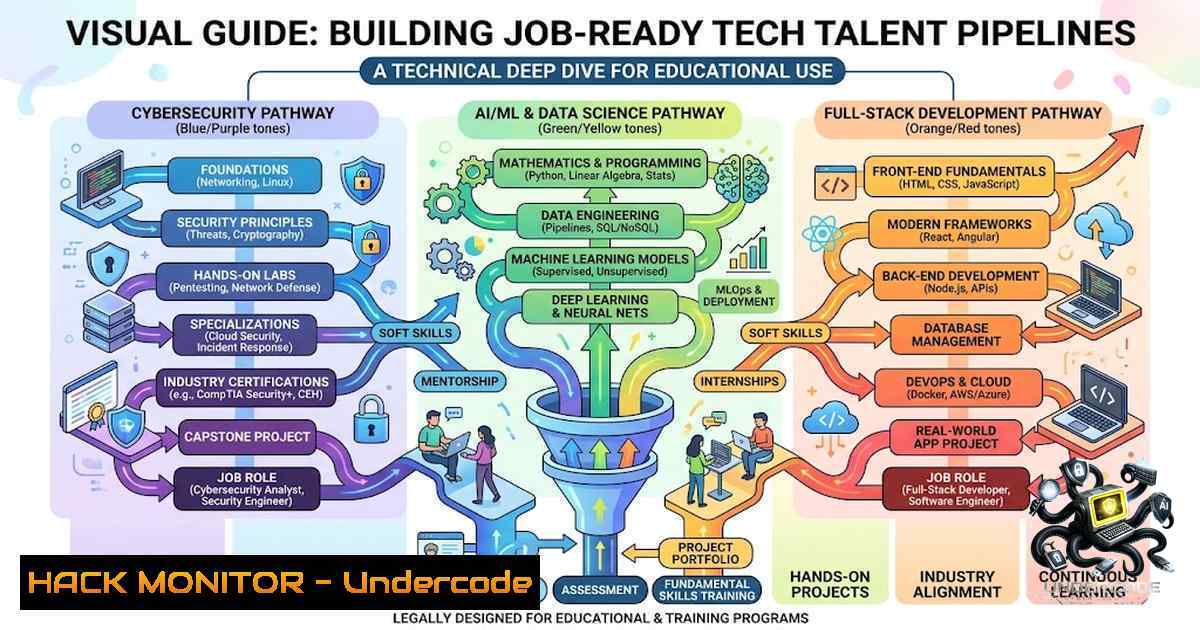
Introduction:
The modern enterprise faces a dual challenge: an accelerating skills gap in critical technologies like cybersecurity, artificial intelligence, and cloud computing, and an increasingly complex threat landscape that demands proactive defense. Organizations that fail to cultivate a robust talent pipeline risk not only stagnation but also significant security vulnerabilities. This article provides a comprehensive technical roadmap for building and evaluating job-ready tech talent, focusing on the practical skills, tools, and methodologies that separate competent practitioners from exceptional ones.
Learning Objectives:
- Master the foundational security principles and command-line tools necessary for system hardening and vulnerability assessment.
- Implement CI/CD pipelines with integrated security scanning to enforce “security as code” practices.
- Develop and deploy AI/ML models in production environments with a focus on data security and model integrity.
- Understand the architecture and secure configuration of modern cloud-1ative applications.
You Should Know:
- The Security Mindset: System Hardening and Vulnerability Assessment
A job-ready cybersecurity professional must demonstrate proficiency in both offensive and defensive techniques. This begins with a deep understanding of system internals and the ability to harden operating systems against common attack vectors. For Linux environments, this involves mastering user privilege management, firewall configuration, and service lockdown.
Step-by-Step Guide: Basic Linux System Hardening
This guide outlines essential steps to secure a fresh Linux server installation, a fundamental task for any security or DevOps role.
- Update and Patch the System: Ensure all packages are up-to-date to mitigate known vulnerabilities.
sudo apt update && sudo apt upgrade -y  Debian/Ubuntu
sudo yum update -y  RHEL/CentOS
-
Configure the Firewall: Restrict incoming and outgoing traffic to only necessary ports. Using `ufw` (Uncomplicated Firewall) on Ubuntu:
sudo ufw default deny incoming
sudo ufw default allow outgoing
sudo ufw allow ssh
sudo ufw allow http
sudo ufw allow https
sudo ufw enable
-
Secure SSH Access: Disable root login and password authentication, favoring key-based authentication.
sudo nano /etc/ssh/sshd_config
Set: PermitRootLogin no
Set: PasswordAuthentication no
Set: PubkeyAuthentication yes
sudo systemctl restart sshd
-
Implement Fail2ban: Protect against brute-force attacks by banning IPs after repeated failed login attempts.
sudo apt install fail2ban -y
sudo systemctl enable fail2ban
sudo systemctl start fail2ban
-
Securing the Software Supply Chain: DevSecOps and CI/CD Integration
Modern development practices demand that security is integrated from the outset. A full-stack or DevOps professional must be able to embed security scanning into the CI/CD pipeline, ensuring that vulnerabilities are caught before they reach production.
Step-by-Step Guide: Integrating SCA and SAST in a GitHub Actions Pipeline
This example demonstrates how to automate security scanning using GitHub Actions, a critical skill for modern developers and DevOps engineers.
- Create a GitHub Actions Workflow File: In your repository, create
.github/workflows/security-scan.yml.
2. Define the Workflow:
name: Security Scan Pipeline

on:
push:
branches: [ main, develop ]
pull_request:
branches: [ main ]

jobs:
security-scan:
runs-on: ubuntu-latest
steps:
- uses: actions/checkout@v3

<ul>
<li>name: Run Trivy vulnerability scanner
uses: aquasecurity/trivy-action@master
with:
scan-type: 'fs'
scan-ref: '.'
format: 'table'
exit-code: '1'
ignore-unfixed: true
severity: 'CRITICAL,HIGH'</p></li>
<li><p>name: Run Gitleaks to detect secrets
uses: gitleaks/gitleaks-action@v2
env:
GITHUB_TOKEN: ${{ secrets.GITHUB_TOKEN }}
3. Explanation:
- Trivy: A comprehensive vulnerability scanner for container images, file systems, and Git repositories. The configuration scans the entire file system (
fs) for vulnerabilities, failing the build (exit-code: '1') if any CRITICAL or HIGH severity issues are found. - Gitleaks: A tool for detecting and preventing hardcoded secrets like passwords, API keys, and tokens from being committed to the repository.
- AI/ML in Production: Model Security and Data Governance
The deployment of AI and machine learning models introduces a new attack surface. Professionals in this domain must understand not only model development but also the security and ethical implications of their work. This includes protecting against data poisoning, model inversion, and ensuring compliance with data privacy regulations.
Step-by-Step Guide: Setting Up a Secure JupyterHub Environment for Collaborative Data Science
A secure, multi-user environment is essential for any data science or AI team.
1. Install JupyterHub and DockerSpawner:
sudo apt install python3-pip docker.io
sudo pip3 install jupyterhub dockerspawner
2. Configure JupyterHub: Create a `jupyterhub_config.py` file.
 jupyterhub_config.py
c.JupyterHub.spawner_class = 'dockerspawner.DockerSpawner'
c.DockerSpawner.image = 'jupyter/datascience-1otebook'
c.DockerSpawner.network_name = 'jupyterhub-1etwork'
c.Authenticator.admin_users = {'admin'}
3. Run JupyterHub:
sudo jupyterhub -f jupyterhub_config.py
4. Implement Security Best Practices:
- Use HTTPS with a valid SSL certificate.
- Implement strong authentication (e.g., OAuth2) and role-based access control.
- Regularly update the base Docker images to patch vulnerabilities.
- Isolate user environments using Docker to prevent cross-user data access.
- API Security: Building and Securing RESTful and GraphQL APIs
For backend and full-stack developers, API security is paramount. This involves implementing proper authentication, authorization, input validation, and rate limiting.
Step-by-Step Guide: Securing a REST API with JWT and Middleware (Node.js/Express)
1. Install Required Packages:
npm install jsonwebtoken express-jwt helmet express-rate-limit
2. Implement Helmet.js for Security Headers:
const helmet = require('helmet');
app.use(helmet());
3. Implement Rate Limiting:
const rateLimit = require('express-rate-limit');
const limiter = rateLimit({
windowMs: 15  60  1000, // 15 minutes
max: 100 // limit each IP to 100 requests per windowMs
});
app.use('/api/', limiter);
4. Implement JWT Authentication Middleware:
const jwt = require('jsonwebtoken');
function authenticateToken(req, res, next) {
const authHeader = req.headers['authorization'];
const token = authHeader && authHeader.split(' ')[bash];
if (token == null) return res.sendStatus(401);

jwt.verify(token, process.env.ACCESS_TOKEN_SECRET, (err, user) => {
if (err) return res.sendStatus(403);
req.user = user;
next();
});
}
// Apply to protected routes
app.use('/api/protected', authenticateToken);
- Cloud Security Hardening: AWS IAM and S3 Best Practices
Cloud professionals must be adept at securing cloud infrastructure. Misconfigured S3 buckets and overly permissive IAM roles are among the most common and critical vulnerabilities.
Step-by-Step Guide: Securing an S3 Bucket Using AWS CLI
1. Create a Private S3 Bucket:
aws s3api create-bucket --bucket my-secure-bucket --region us-east-1
2. Block All Public Access:
aws s3api put-public-access-block \
--bucket my-secure-bucket \
--public-access-block-configuration "BlockPublicAcls=true,IgnorePublicAcls=true,BlockPublicPolicy=true,RestrictPublicBuckets=true"
3. Apply a Bucket Policy to Enforce Encryption:
{
"Version": "2012-10-17",
"Statement": [
{
"Sid": "DenyUnencryptedObjectUploads",
"Effect": "Deny",
"Principal": "",
"Action": "s3:PutObject",
"Resource": "arn:aws:s3:::my-secure-bucket/",
"Condition": {
"StringNotEquals": {
"s3:x-amz-server-side-encryption": "AES256"
}
}
}
]
}
aws s3api put-bucket-policy --bucket my-secure-bucket --policy file://policy.json
4. Enable Versioning and MFA Delete:
aws s3api put-bucket-versioning --bucket my-secure-bucket --versioning-configuration Status=Enabled,MFADelete=Enabled
- Vulnerability Exploitation and Mitigation: SQL Injection and XSS
Understanding how to exploit vulnerabilities is key to defending against them. Frontend and backend developers must be able to identify and remediate common web application flaws.
Step-by-Step Guide: Identifying and Fixing SQL Injection in a Python (Flask) Application
1. Vulnerable Code (DO NOT USE):
@app.route('/user/<user_id>')
def get_user(user_id):
query = f"SELECT  FROM users WHERE id = {user_id}"
result = db.engine.execute(query)
 ...
This code is directly interpolating user input into the SQL query, making it susceptible to injection. An attacker could provide `1; DROP TABLE users; –` as the user_id.
2. Mitigated Code (Use Parameterized Queries):
from sqlalchemy import text
@app.route('/user/<user_id>')
def get_user(user_id):
query = text("SELECT  FROM users WHERE id = :user_id")
result = db.engine.execute(query, {'user_id': user_id})
 ...
Using parameterized queries (or an ORM) ensures that user input is treated as data, not as executable code, effectively neutralizing the injection attack.
What Undercode Say:
- Key Takeaway 1: The most effective way to bridge the talent gap is through a combination of rigorous hands-on training and direct industry partnership. Programs that simulate real-world scenarios—from setting up secure cloud infrastructure to responding to simulated breaches—produce candidates who are truly “day-one ready.”
- Key Takeaway 2: The modern tech professional is a polyglot. The lines between developer, security engineer, and data scientist are blurring. A successful candidate must possess not only deep expertise in their primary domain but also a working knowledge of adjacent fields, such as understanding CI/CD as a developer or basic scripting as a security analyst.
Analysis: The LinkedIn post from HiTech Mentor highlights a critical pain point in the tech industry: the disconnect between academic knowledge and practical, job-ready skills. The institute’s approach of focusing on industry-relevant skills and building a direct bridge to employers addresses this gap effectively. By offering training in emerging fields like AI/ML and cybersecurity alongside traditional development roles, HiTech Mentor is positioning its talent pool to meet the diverse and evolving needs of the modern enterprise. The emphasis on “practical, industry-relevant skills” is not just marketing jargon; it is a fundamental shift away from theoretical learning towards a competency-based model that directly benefits both the candidate and the hiring organization.
Prediction:
- +1 The demand for professionals who can navigate the intersection of AI, security, and cloud will continue to outstrip supply, making targeted training programs like those offered by HiTech Mentor increasingly vital to the global economy.
- -1 Organizations that fail to adapt their hiring and training strategies to prioritize practical skills over traditional credentials will find themselves unable to compete for top talent, leading to a widening security and innovation gap.
- +1 The integration of security into every stage of the software development lifecycle (DevSecOps) will become a non-1egotiable standard, creating a massive upskilling opportunity for developers and operations professionals alike.
- -1 The rapid adoption of AI tools without corresponding security and governance frameworks will lead to a surge in data breaches and compliance violations, underscoring the need for AI-specific security training.
- +1 The trend towards “security as code” and infrastructure as code (IaC) will empower development teams to own security outcomes, fostering a culture of shared responsibility and accelerating the delivery of secure software.
- -1 The persistence of legacy systems and “shadow IT” will continue to be a major vulnerability, requiring a multi-generational approach to security that combines modern DevSecOps practices with traditional network and endpoint protection.
- +1 As the barrier to entry for AI and data science lowers, the differentiator will shift from model development to model deployment and operationalization (MLOps), creating a new set of high-demand skills.
- -1 The cybersecurity skills gap is not just a hiring challenge; it is a national security concern. A lack of qualified professionals leaves critical infrastructure and sensitive data exposed to increasingly sophisticated state-sponsored and criminal actors.
- +1 Mentorship and apprenticeship models, which provide structured on-the-job training, will prove to be the most effective method for developing the next generation of tech talent, as they combine theoretical knowledge with practical, hands-on experience.
- -1 Without sustained investment in education and training, the tech industry risks creating a two-tiered workforce: a small, highly skilled elite and a larger contingent of workers with obsolete or insufficient skills, exacerbating economic inequality.
▶️ Related Video (72% Match):
🎯Let’s Practice For Free:
🎓 Live Courses & Certifications:
Join Undercode Academy for Verified Certifications
🚀 Request a Custom Project:
Secure, high-velocity infrastructure and disruptive technological engineering. Contact our engineering team for high-tier development and proprietary systems:
[email protected]
💎 Smart Architecture | 🛡️ Secure by Design | ⭐ Trusted by Thousands
IT/Security Reporter URL:
Reported By: Shamshad Husain – Hackers Feeds
Extra Hub: Undercode MoN
Basic Verification: Pass ✅


