
Listen to this Post
Introduction:
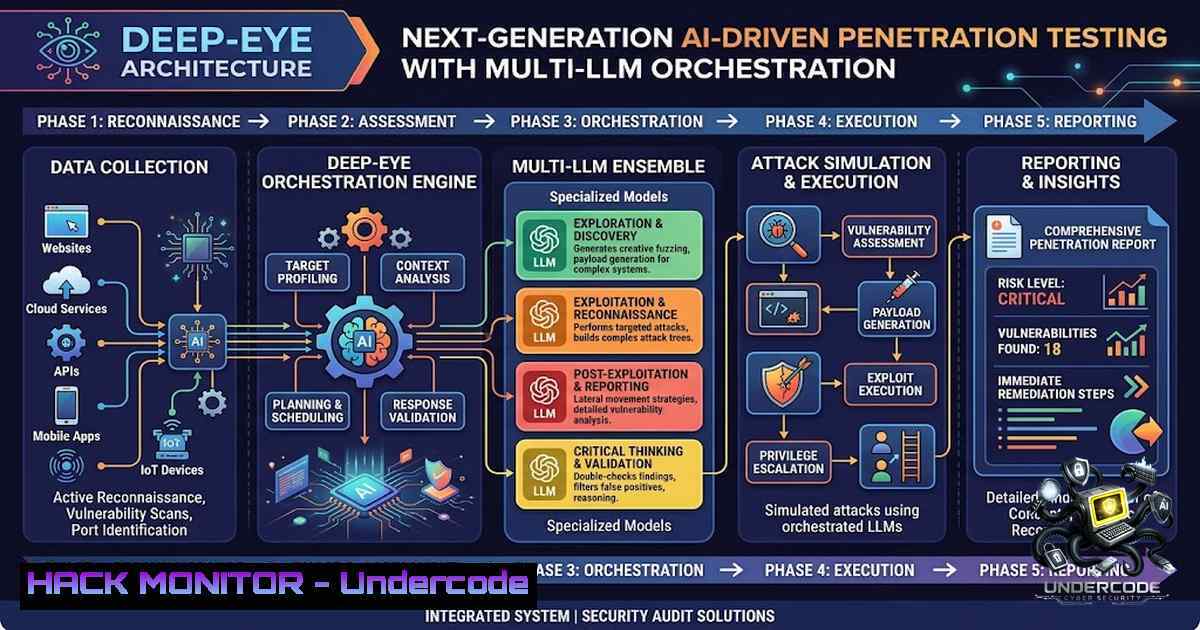
The intersection of artificial intelligence and offensive security has given rise to a new generation of penetration testing tools that transcend traditional signature-based vulnerability scanners. Deep-Eye, an open-source AI-driven penetration testing framework developed by Muhammad Zakir Ramadhan, represents a paradigm shift in automated security assessment by orchestrating multiple large language models (LLMs) to generate context-aware payloads, perform intelligent reconnaissance, and produce professional-grade security reports. Unlike conventional vulnerability scanners that rely on static rule sets, Deep-Eye leverages the reasoning capabilities of AI providers including OpenAI, Claude, Grok, Gemini, and locally-hosted OLLAMA models to dynamically craft attack vectors tailored to the target’s technology stack and detected vulnerabilities. This approach transforms hours of manual testing into minutes of intelligent automation while maintaining human-level contextual understanding of complex web and API flaws.
Learning Objectives & Secrets:
- Objective 1: Master Multi-Provider AI Orchestration — Learn how Deep-Eye integrates with 11 different AI providers including OpenAI, Anthropic Claude, Grok, Gemini, OLLAMA, Groq, Mistral, OpenRouter, LiteLLM, and LM Studio. Secret tip: Configure fallback providers in `config.yaml` so if one API fails, the tool automatically switches to another—ensuring uninterrupted scanning even during provider outages or rate-limiting events.
-
Objective 2: Context-Aware Payload Generation with CVE Intelligence — Understand how Deep-Eye generates WAF-evading payloads by fingerprinting the target’s technology stack (Django, Spring, React, etc.) and integrating RAG-indexed CVE databases from NVD, MITRE, and Exploit-DB. Secret tip: Enable CVE awareness in the configuration to automatically pull relevant exploit patterns for detected software versions, dramatically increasing the accuracy and relevance of generated attack vectors.
-
Objective 3: Automated Triage and Professional Reporting — Leverage AI-powered false-positive filtering with evidence summaries and replay capabilities to eliminate noise from scan results. Secret tip: Use the `–retest-1ew` flag with a baseline JSON file to only test newly discovered findings in subsequent scans—perfect for continuous security monitoring and regression testing.
You Should Know:
- Core Architecture: How Deep-Eye Orchestrates AI for Web Attacks
Deep-Eye is a Python-based scanner that structures its workflow into three primary phases: reconnaissance, attack execution, and reporting. The reconnaissance layer integrates passive OSINT techniques including Google Dorks, DNS enumeration, certificate transparency log scanning via CRT.sh, and GitHub/Pastebin monitoring for leaked credentials or API keys. Once the target’s attack surface is mapped, the AI coordination engine determines which of the 50+ vulnerability checks to deploy based on the detected technology stack—for example, crafting time-based blind SQL injection strings tailored to a MySQL backend or encoding XSS vectors to bypass WAF rules.
Step‑by‑Step Installation Guide:
 Clone the repository
git clone https://github.com/zakirkun/deep-eye.git
cd deep-eye

Linux/Mac installation
chmod +x scripts/install.sh && ./scripts/install.sh
source .deep-venv/bin/activate

Windows installation (PowerShell)
.\scripts\install.ps1

Manual installation (alternative)
pip install -r requirements.txt
cp config/config.example.yaml config/config.yaml
Basic Usage Commands:
 Basic single-target scan
python deep_eye.py -u https://target.com

Scan with configuration file
python deep_eye.py -c config/config.yaml

Verbose mode with multi-format output
python deep_eye.py -u https://target.com -v --formats junit,csv,xlsx

Natural-language scope definition
python deep_eye.py -u https://target.com --scope-1l "only /api/ no /logout host target.com"

Scan diffing between two scans
python deep_eye.py --diff baseline.json current.json --diff-format html --diff-output diff_report.html

Retest only new findings
python deep_eye.py -u https://target.com --retest-1ew baseline.json
The tool supports over 50 vulnerability checks including SQL injection, XSS, SSRF, JWT deep inspection, IDOR, GraphQL deep testing, CORS/CSP misconfigurations, and supply-chain JavaScript analysis.
2. Configuring AI Providers for Maximum Effectiveness
Deep-Eye’s power lies in its ability to dynamically switch between AI providers based on the vulnerability context. GPT-4 excels at creative payloads and filter bypasses, Claude is more methodical and better at analyzing framework-specific attack surfaces, while locally-hosted OLLAMA models provide fast, cost-free scanning with complete data privacy.
Configuration File Setup (`config/config.yaml`):
ai_providers:
openai:
enabled: true
api_key: "sk-xxxxxxxx"
model: "gpt-4o"
claude:
enabled: true
api_key: "sk-ant-xxxxx"
model: "claude-3-opus-20240229"
ollama:
enabled: true
base_url: "http://localhost:11434"
model: "llama3.1:latest"
grok:
enabled: false
api_key: "xai-xxxxx"

scanner:
target_url: "https://example.com"
default_depth: 2
default_threads: 5
enable_recon: true
proxy: "http://127.0.0.1:8080"

reporting:
enabled: true
output_directory: "reports"
default_format: "html"
dedupe: true

openapi:
enabled: true
source: "https://target.com/openapi.json"

ai_triage:
enabled: true
min_severity: high
evidence_summary: true
fp_replay: true
3. Advanced Reconnaissance and Intelligence Gathering
Deep-Eye’s reconnaissance capabilities extend far beyond basic crawling. The tool integrates passive OSINT techniques including Google Dorking, DNS brute-forcing, subdomain enumeration, and certificate transparency log analysis. It can detect leaked credentials or API keys in public GitHub repositories and Pastebin dumps, providing critical intelligence before launching active attack modules.
Reconnaissance Commands:
 Full reconnaissance pipeline
python deep_eye.py -u target.com --recon --subdomain-enum --dns-bruteforce

Export reconnaissance findings
python deep_eye.py -u target.com --recon --output recon_results.json

GitHub leak detection
python deep_eye.py -u target.com --github-leaks --pastebin-monitor
4. Web Application Firewall (WAF) Evasion Techniques
Deep-Eye employs sophisticated WAF fingerprinting to identify the protection layer in front of the target application. Based on the detected WAF (Cloudflare, AWS WAF, ModSecurity, etc.), the AI generates obfuscated payloads designed to bypass specific filtering rules.
API Security Testing Commands:
 Scan API endpoints with OpenAPI specification
python deep_eye.py --openapi https://target.com/openapi.json

GraphQL deep testing
python deep_eye.py -u https://target.com/graphql --graphql-deep

JWT token security assessment
python deep_eye.py -u https://target.com --jwt-deep --jwt-secret wordlist.txt
5. Compliance Mapping and Professional Reporting
Deep-Eye automatically maps discovered vulnerabilities to compliance frameworks including PCI-DSS v4, SOC2 CC, and ISO 27001:2022. This feature is invaluable for organizations required to demonstrate security compliance in audits. The tool generates professional reports in multiple formats including HTML, PDF, JSON, SARIF, JUnit, CSV, and XLSX.
Report Generation Commands:
 Generate HTML report
python deep_eye.py -u https://target.com --format html

Generate multiple formats simultaneously
python deep_eye.py -u https://target.com --formats html,pdf,json

Bug bounty-style HackerOne report
python deep_eye.py -u https://target.com --bug-bounty-report

Compliance-focused reporting
python deep_eye.py -u https://target.com --compliance pci-dss,soc2
6. CI/CD Integration and Automated Scanning Pipelines
For organizations implementing DevSecOps practices, Deep-Eye can be integrated into CI/CD pipelines for continuous security assessment.
Jenkins Pipeline Integration:
stage('Security Scan') {
steps {
sh '''
git clone https://github.com/zakirkun/deep-eye.git
cd deep-eye
pip install -r requirements.txt
python deep_eye.py -u ${TARGET_URL} --format junit --output reports/
'''
}
post {
always {
junit 'reports/.xml'
}
}
}
GitHub Actions Workflow:
name: Security Scan
on: [bash]
jobs:
scan:
runs-on: ubuntu-latest
steps:
- uses: actions/checkout@v3
- name: Run Deep-Eye Scan
env:
OPENAI_API_KEY: ${{ secrets.OPENAI_API_KEY }}
run: |
git clone https://github.com/zakirkun/deep-eye.git
cd deep-eye
pip install -r requirements.txt
python deep_eye.py -u ${{ secrets.TARGET_URL }} --format sarif --output scan.sarif
- name: Upload SARIF results
uses: github/codeql-action/upload-sarif@v2
with:
sarif_file: deep-eye/scan.sarif
What Undercode Say:
- Key Takeaway 1: Deep-Eye represents a fundamental shift from signature-based vulnerability scanning to AI-driven, context-aware security testing. The ability to orchestrate multiple LLM providers allows the tool to adapt its approach based on the target’s technology stack, generating payloads that traditional scanners would never produce. This multi-provider approach also provides redundancy—if one AI provider is unavailable or rate-limited, the tool seamlessly fails over to another, ensuring continuous operation.
-
Key Takeaway 2: The most dangerous aspect of tools like Deep-Eye is their potential for misuse. While designed for legitimate penetration testing and bug bounty hunting, the same capabilities that make it effective for security professionals could be weaponized by malicious actors. Organizations must implement robust security monitoring, Web Application Firewalls with AI-detection capabilities, and regular security assessments to defend against AI-augmented attacks. The tool’s 50+ vulnerability checks and automated exploitation capabilities mean that the window between vulnerability discovery and exploitation has dramatically shortened.
Prediction:
-
+1 Deep-Eye and similar AI-driven penetration testing tools will become standard components of enterprise security programs within 18-24 months, dramatically reducing the cost and time required for comprehensive security assessments while improving vulnerability discovery rates through context-aware payload generation.
-
+1 The integration of RAG-indexed CVE databases and real-time exploit intelligence will enable security teams to prioritize remediation efforts based on actual exploitability rather than theoretical risk scores, leading to more efficient allocation of security resources.
-
-1 The democratization of AI-powered hacking tools will lead to a significant increase in automated attacks against web applications and APIs, forcing organizations to invest heavily in AI-detection capabilities, advanced WAF solutions, and continuous security monitoring.
-
-1 Regulatory bodies will likely introduce new compliance requirements specifically addressing the use of AI in security testing, including mandatory disclosure of AI-assisted testing methodologies and stricter authorization requirements for automated penetration testing.
-
+1 Open-source AI security tools like Deep-Eye will accelerate innovation in defensive security as blue teams adopt the same technologies to test their own defenses, creating a virtuous cycle of security improvement across the industry.
-
-1 The reliance on external AI providers introduces new supply chain risks—if an AI provider’s API is compromised or the model is poisoned, organizations using these tools could be exposed to malicious payloads or inaccurate vulnerability assessments.
-
+1 Local LLM deployment options like OLLAMA integration will become increasingly important for organizations with strict data privacy requirements, enabling AI-powered security testing without exposing sensitive target information to third-party API providers.
-
-1 Security professionals who fail to adopt AI-augmented testing methodologies risk falling behind attackers who are already leveraging these technologies, creating a dangerous asymmetry in the cybersecurity landscape.
-
+1 The compliance mapping features of Deep-Eye will streamline audit processes for organizations subject to PCI-DSS, SOC2, and ISO 27001 requirements, reducing the manual effort required to demonstrate security controls.
-
+1 As AI-powered security tools mature, we will see the emergence of fully autonomous penetration testing agents capable of continuous, human-supervised security assessment at machine speed, fundamentally changing how organizations approach application security.
▶️ Related Video (92% Match):
https://www.youtube.com/watch?v=004L5r9rA_E
🎯Let’s Practice For Free:
🎓 Live Courses & Certifications:
Join Undercode Academy for Verified Certifications
🚀 Request a Custom Project:
Secure, high-velocity infrastructure and disruptive technological engineering. Contact our engineering team for high-tier development and proprietary systems:
[email protected]
💎 Smart Architecture | 🛡️ Secure by Design | ⭐ Trusted by Thousands
IT/Security Reporter URL:
Reported By: https://lnkd.in/p/et5PzNkp – Hackers Feeds
Extra Hub: Undercode MoN
Basic Verification: Pass ✅


