
Listen to this Post
Introduction:
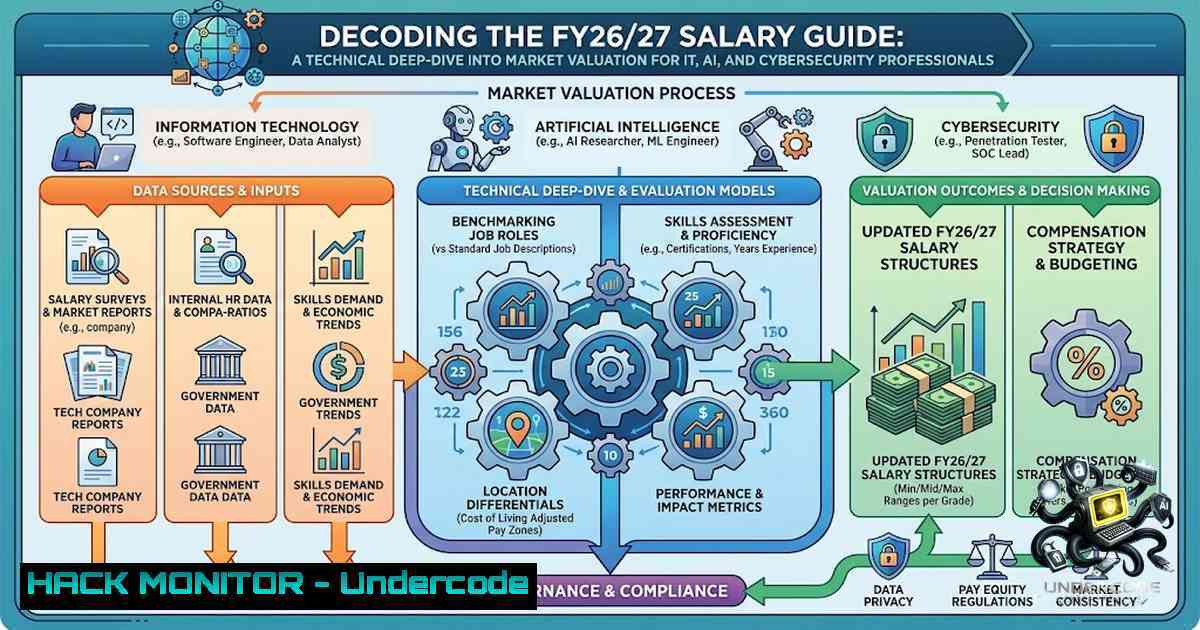
The release of The Onset’s FY26/27 Salary Guide provides a critical benchmark for the technology sector, yet as industry expert Tania Graham-Brown highlights, these figures represent a starting point for negotiation, not an absolute cap on earning potential. For cybersecurity engineers, AI architects, and cloud infrastructure specialists, understanding the gap between a “benchmark” and a “compelling offer” requires a deep technical evaluation of one’s own capabilities. This article breaks down the guide’s implications while providing the technical toolkit necessary to position yourself or your team above the curve in a competitive market.
Learning Objectives & Secrets:
- Objective 1: Identify and document the specific technical capabilities (e.g., zero-trust architecture, threat intelligence automation) that inflate your market value beyond the average salary benchmark.
- Objective 2 Secret Tips: To effectively negotiate a higher salary, always quantify your contributions in terms of infrastructure cost reduction (e.g., “Reduced cloud spend by 30% via reserved instances”) or time saved through automation.
- Objective 3 Secret Tips: When analyzing salary data, filter by “industry vertical” rather than just “job title.” For instance, a Security Engineer in FinTech will often command a premium of 15-20% over one in retail due to compliance and risk requirements.
You Should Know:
- Building a Portfolio That Commands a Premium: The “Scarcity, Impact, and Capability” Factor
The guide’s emphasis on companies paying for “scarcity, impact, and capability” suggests a need to create tangible evidence of your value. While the salary guide provides a snapshot, you need a systematic method to track and showcase your technical impact. This involves using version control and automation to document your journey.
Step‑by‑Step Guide to “Value Documentation”:
This process helps you build a quantifiable “Impact Portfolio” to present during reviews or interviews.
- Initialize a Personal GitHub Repository: Create a private repository named `Professional-Impact-Tracking` to store scripts and logs. This is your digital evidence locker.
mkdir ~/Professional-Impact-Tracking
cd ~/Professional-Impact-Tracking
git init
- Create an Automation Script (Linux/Mac Example): Write a script to collect system performance metrics to prove infrastructure optimization if you are a DevOps/Cloud engineer.
nano capture_performance.sh
Add the following content:
!/bin/bash
TIMESTAMP=$(date)
echo "- Performance Snapshot: $TIMESTAMP -" >> impact_log.txt
echo "CPU Load: $(top -bn1 | grep "Cpu(s)" | awk '{print $2}')%" >> impact_log.txt
echo "Memory Usage: $(free -m | awk 'NR==2{printf "%.2f%%", $3100/$2}')" >> impact_log.txt
echo "Disk Usage: $(df -h / | awk 'NR==2 {print $5}')" >> impact_log.txt
echo "--" >> impact_log.txt
3. Schedule the Script (Cron Job): Prove you can automate reporting for a weekly review.
crontab -e
 Add the line: 0 9   1 /home/youruser/Professional-Impact-Tracking/capture_performance.sh
4. Integrate Security Scans: If you are in security, run a weekly vulnerability scan on a test environment and append a summary.
nmap -sV -p- -oN weekly_scan.txt <target-ip>
grep open weekly_scan.txt >> impact_log.txt
5. Push the Logs: Commit and push these logs to your repository. This provides a historical graph of how you maintained or improved system performance over time.
- Mastering the Economics of Cloud Hardening & Cost Optimization
The salary guide reveals that roles requiring specific, high-impact skills (like FinOps certified engineers) command higher pay. Companies value professionals who can secure an environment while simultaneously reducing costs. This section focuses on the practical application of cloud security policies and cost reduction strategies via Infrastructure as Code (IaC).
Step‑by‑Step Guide to Cloud Cost & Security Hardening:
This tutorial uses AWS as an example to demonstrate how identifying and fixing misconfigurations can be your strongest negotiation lever.
- Install AWS CLI and Configure Credentials: Ensure you have the CLI installed and configured with a user that has IAM read and EC2/Describe permissions.
aws configure
Windows (PowerShell Alternative):
 Install AWSPowerShell module
Install-Module -1ame AWSPowerShell -Force
 Set credentials
Set-AWSCredentials -AccessKey YOUR_ACCESS_KEY -SecretKey YOUR_SECRET_KEY
2. Audit for Unused Resources: Identify “zombie” resources that cost money without providing value. The script below identifies unattached Elastic IPs (which cost hourly).
aws ec2 describe-addresses --query 'Addresses[?AssociationId==<code>null</code>]'
3. Check Public Buckets: Misconfigured S3 buckets are a top security risk and a sign of poor hygiene. Companies pay a premium for engineers who prevent data breaches.
aws s3api list-buckets --query "Buckets[].Name" | while read -r bucket; do
aws s3api get-bucket-acl --bucket "$bucket" --query "Grants[?Grantee.URI=='http://acs.amazonaws.com/groups/global/AllUsers']"
done
4. Implement Cost Alerts: Ensure you have billing alerts enabled to prevent financial surprises, a core skill for cloud architects.
aws budgets create-budget --account-id <your-account-id> --budget file://budget.json
(Create a `budget.json` file with your budget thresholds).
- Remediation via Policy: Use the following AWS CLI command to enable MFA Delete on an S3 bucket, protecting against accidental deletion.
aws s3api put-bucket-versioning --bucket your-bucket-1ame --versioning-configuration Status=Enabled,MFADelete=Enabled
-
Understanding API Security & Exploitation for High-Trust Products
The “High Trust Products” mentioned in the recruiter’s profile require secure coding and API architecture. Salaries for Senior Engineers building these systems are often elevated due to the reduced risk of liability. Understanding how to test your own API is paramount.
Step‑by‑Step Guide to API Endpoint Security Testing:
This section demonstrates how to test for common API misconfigurations to ensure you can claim competence in secure software development.
- Use `curl` to Interact with an API: Test for endpoint availability and content-type.
curl -i -X GET https://api.example.com/v1/users/1 -H "Content-Type: application/json"
- Check for Rate Limiting: Implement a script to test if the API rate limit protects against brute force. This is a core security requirement for high-traffic products.
for i in {1..100}; do curl -s -o /dev/null -w "%{http_code}\n" -X GET https://api.example.com/v1/login -d 'user=admin' -H "Content-Type: application/json" done | sort | uniq -c - Fuzzing for Directory Traversal: Use this command to test if the API is vulnerable to path injection, a common cause of data exfiltration.
curl -X GET "https://api.example.com/v1/files/../../../../etc/passwd"
- Scan with Nmap for Open Ports: Ensure you aren’t exposing unnecessary internal services.
nmap -sV -p- -T4 api.example.com
- Check JWT Security: Decode a JWT token to check its structure or test for the “alg: none” vulnerability.
echo -1 "eyJhbGciOiJIUzI1NiIsInR5cCI6IkpXVCJ9.eyJzdWIiOiIxMjM0NTY3ODkwIiwibmFtZSI6IkpvaG4gRG9lIiwiaWF0IjoxNTE2MjM5MDIyfQ.SflKxwRJSMeKKF2QT4fwpMeJf36POk6yJV_adQssw5c" | cut -d'.' -f2 | base64 -d 2>/dev/null | jq .
4. Leveraging AI for Competitive Intelligence
The salary guide mentions “AI” as a key vertical. Professionals who use AI to enhance their own workflows—from report generation to threat hunting—stand out. This section looks at integrating Large Language Models (LLMs) locally for privacy-sensitive data analysis.
Step‑by‑Step Guide to Setting Up a Local LLM:
Running a model like Mistral or Llama 3 locally demonstrates understanding of AI deployment and data privacy.
- Install `ollama` (Cross-Platform): This is one of the easiest ways to run models.
Linux/Mac
curl -fsSL https://ollama.com/install.sh | sh
Windows - Download from ollama.com/download
- Pull an AI Model: Download the `llama3.2` model (or `mistral` for lighter systems) for cybersecurity analysis tasks.
ollama pull llama3.2
- Create a Custom Prompt for Security: Use the following command to summarize a log file or a Nmap scan result.
ollama run llama3.2 "Summarize this vulnerability scan in simple business terms: $(cat weekly_scan.txt)"
- Integrate with Python: Create a script to automate analysis of suspicious IPs.
analyze.py import subprocess import sys</li> </ol> log_data = sys.argv[bash] response = subprocess.run( ["ollama", "run", "llama3.2", f"Analyze these logs for malicious activity: {log_data}"], capture_output=True, text=True ) print(response.stdout)- Preparing for the Technical Interview: The “Capability” Test
Since the guide highlights that companies are paying for capability over tenure, this section focuses on practical Linux commands and troubleshooting skills commonly tested in Senior IT roles.
Step‑by‑Step Guide to System Troubleshooting:
Being a “high-impact” engineer means solving problems fast. Here is a workflow for analyzing a “memory leak” on a Linux server.
1. Check the Top Processes:
top -o %MEM
Windows (Tasklist):
tasklist /v | sort /R
2. Investigate the Heap Usage of a Java Process:
jmap -histo $(pgrep -f 'java') | head -20
3. Check File Descriptor Limits: Often the root cause of “connection refused” errors in high-traffic apps.
lsof -p $(pgrep -f 'nginx') | wc -l
4. Check System Logs for I/O Errors:
dmesg | grep -i error | tail -5
5. Restart the Service Gracefully: Use systemctl to simulate a restart and check logs.
sudo systemctl restart application.service && sudo journalctl -u application.service -f
6. Staying Updated with Industry Trends
The FY26/27 guide is a static snapshot. Staying relevant means having a system to get real-time data on critical vulnerabilities like CVEs.
Step‑by‑Step Guide to Setting Up a Threat Intelligence Feed:
1. Use the NVD API: Use `curl` to fetch the latest critical vulnerabilities.curl -X GET "https://services.nvd.nist.gov/rest/json/cves/2.0?cvssV3Severity=CRITICAL"
2. Create an Alert Script: Use a cron job and `mail` to send a summary of new critical vulnerabilities affecting your tech stack (e.g., Linux kernel, Nginx, Python libraries).
 Script to check for specific CVE
curl -X GET "https://services.nvd.nist.gov/rest/json/cves/2.0?keywordSearch=nginx" | jq '.vulnerabilities[] | .cve.id'
What Undercode Say:
- Key Takeaway 1: The FY26/27 Salary Guide confirms that the most lucrative roles are now hybrid “Design/Engineering/AI” positions, demanding a unique combination of technical depth and business acumen. The data suggests that purely siloed positions are seeing a smaller salary increase percentage compared to cross-functional roles.
- Key Takeaway 2: There is a consistent theme of “capability” overriding “experience.” A self-taught engineer who can automate a complex CI/CD pipeline with security integration is viewed as more valuable than an engineer with ten years of experience who relies on manual processes. The guide acts as a lens to view the market’s return on investment for upskilling in specific cloud and AI technologies.
- Analysis: The role of the recruiter, as described by Tania, is shifting from a “salary data presenter” to a “market translator.” For the job seeker, leveraging the technical skills outlined in this article—specifically the ability to build, secure, automate, and optimize—is non-1egotiable. The market data is telling you where the market is spending money; your engineering portfolio must prove you can save or generate that money. The “soft” skills of negotiation now rely heavily on the “hard” evidence of infrastructure-as-code, cost-reduction scripts, and automated vulnerability management. If the salary guide says “AI skills are valuable,” you must show you can deploy a local model and integrate it into your workflow today, not just mention you have knowledge of the theory.
Prediction:
- +1: As more companies adopt salary transparency guides, the baseline for negotiation will rise, forcing organizations to compete aggressively on “benefits and mission” rather than just salary, potentially improving workplace culture.
- +1: The clear delineation of “scarcity” skills in the guide will accelerate the launch of targeted bootcamps and upskilling programs, filling the critical talent gap in Australian FinTech and GovTech within the next 12-18 months.
- +1: The focus on “AI-enabled” roles will lead to a standardized “AI Developer” benchmark that stabilizes compensation chaos over the next two fiscal years.
- -1: The guide’s data might inadvertently create a glass ceiling effect, where employees view the “average” as a hard limit rather than a starting point, leading to increased turnover as top performers seek to exploit the gap outside the domestic market.
- -1: The focus on “scarcity” (e.g., niche AI security) could lead to market oversaturation as professionals rush to train in these specific areas, diluting the premium by 2028.
▶️ Related Video (74% Match):
🎯Let’s Practice For Free:
🎓 Live Courses & Certifications:
Join Undercode Academy for Verified Certifications
🚀 Request a Custom Project:
Secure, high-velocity infrastructure and disruptive technological engineering. Contact our engineering team for high-tier development and proprietary systems:
[email protected]
💎 Smart Architecture | 🛡️ Secure by Design | ⭐ Trusted by ThousandsIT/Security Reporter URL:
Reported By: https://lnkd.in/p/e2NVN6-X – Hackers Feeds
Extra Hub: Undercode MoN
Basic Verification: Pass ✅🔐JOIN OUR CYBER WORLD [ CVE News • HackMonitor • UndercodeNews ]
📢 Follow UndercodeTesting & Stay Tuned:
- Preparing for the Technical Interview: The “Capability” Test


