
Listen to this Post
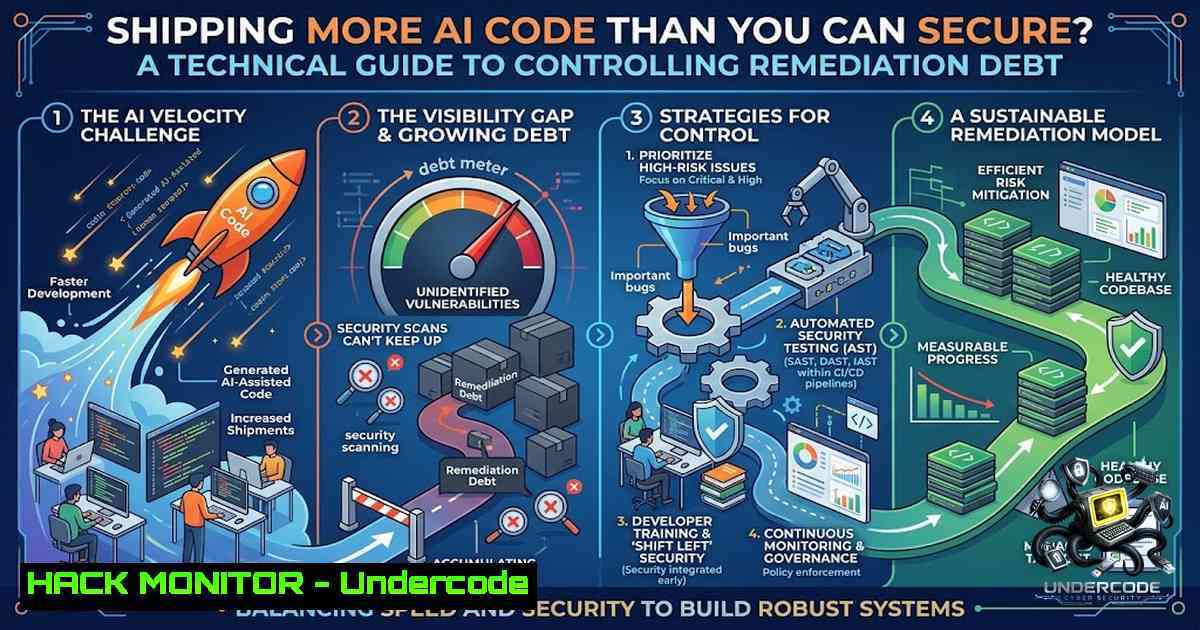
Introduction:
The integration of AI coding assistants into development workflows has delivered unprecedented velocity—developers using tools like GitHub Copilot, Claude Code, and Cursor produce three to four times more code than their unassisted peers. However, this acceleration comes with a hidden cost: AI-generated code introduces security issues at ten times the rate of human-written code, primarily through unchecked open-source dependencies, insecure code patterns, exposed secrets, and cloud misconfigurations. The result is a rapidly accumulating form of technical debt—remediation debt—where security backlogs grow faster than teams can close them, creating unplanned work that increasingly consumes engineering sprints and threatens supply chain integrity.
Learning Objectives & Secrets:
- Objective 1: Understand Remediation Debt Mechanics – Learn how AI coding tools accelerate dependency intake beyond traditional governance capacity, creating a compounding backlog of unaddressed vulnerabilities that lands on engineering teams. A survey of 300 enterprise leaders across technology, financial services, healthcare, manufacturing, and government revealed that 97% of organizations report some level of AI coding assistant use, yet remediation programs are struggling to keep pace.
-
Objective 2 Secret Tip: Shift Governance Upstream – Instead of relying on reactive scanners that find problems after they enter the pipeline (with an average 54-day remediation window for critical CVEs), implement proactive open-source management that vets dependencies before they reach developers. Curated ingestion gateways can reduce exposure to slopsquatting attacks by approximately 95%.
-
Objective 3 Secret Tip: Automate Dependency Policy Enforcement – Write enforceable dependency rules that run as quality gates at pull request time and again on nightly schedules, rechecking every repository against vulnerabilities disclosed after merge. This dual-layer approach catches both immediate and delayed risks without relying on developer memory or manual reviews.
You Should Know:
1. Slopsquatting: The AI Package Hallucination Attack Vector
AI coding assistants frequently import packages that do not exist, creating a supply-chain vulnerability known as slopsquatting (or AI package hallucination exploitation). When a model suggests a package name that doesn’t exist in public registries like PyPI or npm, attackers can pre-register these hallucinated names and upload malicious payloads. Research shows that open-source models hallucinate packages at an alarming 21.7% of the time, with Sonatype finding a 27.76% hallucination rate across nearly 37,000 dependency upgrade recommendations.
Step-by-Step Mitigation:
- Block direct registry queries from developer workstations and AI agents to unvetted public package registries
- Isolate AI-suggested dependencies in sandbox environments for automated vulnerability and reachability analysis
- Employ curated ingestion gateways that pre-vet packages against known malicious typosquats and slopsquatting targets
- Generate SBOMs with full transitive dependency coverage for every release and store them with the artifact
Linux/Windows Commands for Dependency Auditing:
 Generate SBOM with Syft (Linux/macOS)
syft dir:. -o spdx-json > sbom.spdx.json

Scan for vulnerabilities with Grype
grype sbom.spdx.json

NPM audit for JavaScript dependencies
npm audit --production --json > npm-audit-report.json

Python safety check
safety check --json > safety-report.json

OWASP Dependency-Check (Cross-platform)
dependency-check --scan ./ --format JSON --out dependency-report.json

Windows: Using PowerShell to list all installed npm packages
Get-ChildItem -Path .\node_modules -Directory | ForEach-Object { npm view $_.Name version }
- The Rules File Backdoor: When AI Configuration Becomes an Attack Surface
In March 2025, security researchers disclosed the “Rules File Backdoor”—attackers can hide adversarial instructions inside configuration files that AI assistants read for project context (e.g., .cursorrules, .github/copilot-instructions.md) using zero-width Unicode and bidirectional text markers invisible in normal editors. A poisoned rules file can silently instruct Cursor or Copilot to insert backdoors or exfiltration snippets into future AI-generated code, with no warning shown to the developer approving the diff. These files are rarely code-reviewed with the same scrutiny as a `package.json` change, making them a critical blind spot.
Step-by-Step Hardening:
- Treat rules files as code—subject them to the same peer review and version control processes as source code
- Scan rules files for hidden Unicode characters using specialized tools before commit
- Restrict AI agent permissions—do not grant filesystem write, package-install, or push permissions without explicit approval
- Implement policy-as-code that validates AI assistant behavior against organizational standards
Detection Commands:
 Find hidden Unicode characters in rules files (Linux/macOS)
find . -1ame ".cursorrules" -o -1ame "copilot-instructions.md" | xargs cat | od -c | grep -E "\[0-9]+"

Python script to detect zero-width characters
python3 -c "import sys; print([c for c in open(sys.argv[bash]).read() if ord(c) in [8203,8204,8205,8287,8234,8235,8236,8237]])" .cursorrules

Windows PowerShell: Check for non-printable characters
Get-Content .cursorrules | Format-Hex | Select-String "00"
- Stale, Bleeding-Edge, and Non-Existent: The Three Failure Modes of AI Dependency Version Selection
AI assistants get dependency versions wrong in three distinct directions:
- Stale versions – The model defaults to the version most widely documented in its training data, which is almost always an older release that carries every vulnerability disclosed since it shipped
- Bleeding-edge releases – When prompted to fix an outdated dependency, AI can overcorrect to a version only days old, which has had less time for production use, bug reports, and ecosystem scrutiny
- Non-existent versions – The model recommends a version string that was never published at all
Step-by-Step Version Governance:
- Pin dependencies explicitly in lockfiles (
package-lock.json,poetry.lock,Cargo.lock) and commit them to version control - Enforce version constraints with tools like Renovate’s security presets, which include a 14-day minimum release age to let new versions mature
- Run dependency checks in CI on every change and fail builds for high-impact issues
- Recheck nightly against newly disclosed vulnerabilities, regardless of when the code was merged
CI/CD Pipeline Commands:
 GitHub Actions example for dependency scanning
- name: Dependency Scan
run: |
npm audit --production --audit-level=high
safety check -r requirements.txt --full-report
continue-on-error: false

Trivy filesystem scan (Linux/Windows/macOS)
trivy fs . --severity CRITICAL,HIGH --exit-code 1

OSSF Scorecard for supply chain health
scorecard --local . --format json > scorecard-report.json
- Remediation Debt: The Hidden Cost of AI-Generated Code
Remediation debt behaves like traditional tech debt but compounds faster because AI removes the natural pause that once existed between dependency selection and integration. A developer used to perform a quick security review on every import—searching for a package, reading documentation, and checking maintenance activity. Today, AI coding tools surface dependency recommendations directly in the developer workflow, eliminating that moment of evaluation. The result: more dependencies enter the environment faster, and the remediation work accumulates interest until it eventually lands in a sprint nobody planned for. Sixty percent of enterprise developers now spend 50% or more of their time on maintenance and bug fixes instead of new feature development.
Step-by-Step Debt Management:
- Measure your remediation debt by tracking the total number of open security findings and their average age
- Implement proactive governance that governs dependencies before they enter the environment, not after
- Use automated remediation tools—Veracode Fix, for example, can cut remediation time for 2,000 security flaws from months to minutes, saving $240,000 compared to manual remediation
- Create a remediation SLI/SLO that caps the maximum age of unpatched critical vulnerabilities
Tracking Commands:
 Track open vulnerabilities by age (using GitHub CLI)
gh api repos/:owner/:repo/dependabot/alerts --paginate | jq '.[] | {package: .security_advisory.package.name, severity: .security_advisory.severity, created: .created_at}'

Generate dependency graph (npm)
npm ls --json --depth=5 > dependency-graph.json

Python: List all transitive dependencies with pipdeptree
pipdeptree --json > transitive-deps.json

Windows: Using winget to list outdated packages
winget upgrade --accept-source-agreements
- SBOM Blind Spots: What Your Inventory Isn’t Telling You
A standard SBOM captures direct dependencies, but most vulnerabilities live in transitive ones—the packages your packages depend on. AI code assistants introduce dependencies at machine speed, including packages that may not exist, may be compromised, or may have been created specifically to match predicted hallucinations. The regulatory environment has also changed—incomplete provenance is no longer just a security gap but a documented liability. CISA and its G7 partners have released minimum elements for an AI Software Bill of Materials, extending traditional SBOM concepts to include models, datasets, software components, providers, and licenses.
Step-by-Step Complete SBOM Implementation:
- Generate SBOMs with full transitive dependency coverage—not just top-level packages
- Store SBOMs with the artifact/image for every release
- Tie inventory to deployable units—service, image, runtime, release version
4. Sign artifacts and verify signatures before deployment
- Extend SBOM to include AI components—models, datasets, and AI services that influence your software
SBOM Generation Commands:
 Generate SPDX SBOM with Trivy
trivy sbom . --format spdx-json > sbom.spdx.json

Generate CycloneDX SBOM with OWASP Dependency-Track
dependency-track-client --sbom ./bom.xml --project "MyProject" --version "1.0.0"

Python: Generate SBOM with pip-licenses
pip-licenses --format=json --with-urls --with-license-file > sbom-python.json

Windows: Chocolatey package audit
choco outdated --limit-output
What Undercode Say:
- Key Takeaway 1: AI coding tools didn’t create the open-source dependency problem—they accelerated it beyond the capacity of traditional governance models. The productivity gains promised by AI will ultimately be consumed by downstream cleanup unless organizations shift from reactive scanning to proactive ingestion governance.
-
Key Takeaway 2: The attack surface has expanded to include AI assistant configuration files, hallucinated package recommendations, and the collapse of previously separate trust boundaries (code authorship, dependency selection, and execution) into a single non-deterministic process. Securing AI-generated code requires governing at the point of package selection, not after commits are already in the pipeline.
Analysis: The remediation debt problem is structural, not procedural. Organizations that treat it as a tooling issue—adding more scanners—will continue to see backlogs grow. The organizations that succeed will be those that move governance upstream, treating dependency selection as a security control rather than a developer convenience. With 97% of organizations already using AI coding assistants and AI-assisted developers producing 10 times more security issues than their unassisted peers, the gap between code generation and security validation will only widen. The 54-day average remediation window for critical CVEs is unsustainable when AI can introduce hundreds of new dependencies in a single sprint. Proactive governance—curated catalogs, pre-vetted packages, and automated policy enforcement—is no longer optional; it is the only path to sustainable AI-assisted development at scale.
Prediction:
- +1 Organizations that implement proactive open-source governance within the next 12–18 months will achieve a 3–5x reduction in remediation debt and reclaim 30–40% of engineering time currently spent on unplanned security work, directly improving feature velocity and developer satisfaction.
-
-1 Organizations that continue to rely on reactive scanning will experience a compounding remediation debt crisis by 2027, with critical vulnerabilities aging beyond 90 days on average, increasing breach risk, audit failures, and regulatory penalties as SBOM and AI provenance requirements become legally enforceable.
-
-1 The slopsquatting attack vector will mature into a preferred supply-chain compromise method, with attackers automating the registration of hallucinated package names based on LLM outputs. Organizations without curated ingestion gateways will face a 10x increase in malicious dependency incidents by mid-2027.
-
+1 The emergence of AI-1ative SBOM standards (AI BOMs) will create new opportunities for automated compliance and risk scoring, enabling continuous assessment of AI-generated code against organizational security policies without manual intervention.
-
-1 The rules file backdoor class of vulnerabilities will proliferate as AI coding assistants gain broader filesystem and execution permissions. Security teams that fail to scan configuration files with the same rigor as source code will face silent backdoors propagating across their codebases undetected.
▶️ Related Video (78% Match):
https://www.youtube.com/watch?v=6AgndHSkHFI
🎯Let’s Practice For Free:
🎓 Live Courses & Certifications:
Join Undercode Academy for Verified Certifications
🚀 Request a Custom Project:
Secure, high-velocity infrastructure and disruptive technological engineering. Contact our engineering team for high-tier development and proprietary systems:
[email protected]
💎 Smart Architecture | 🛡️ Secure by Design | ⭐ Trusted by Thousands
IT/Security Reporter URL:
Reported By: https://lnkd.in/p/eMcweCEN – Hackers Feeds
Extra Hub: Undercode MoN
Basic Verification: Pass ✅


