Listen to this Post
Introduction:
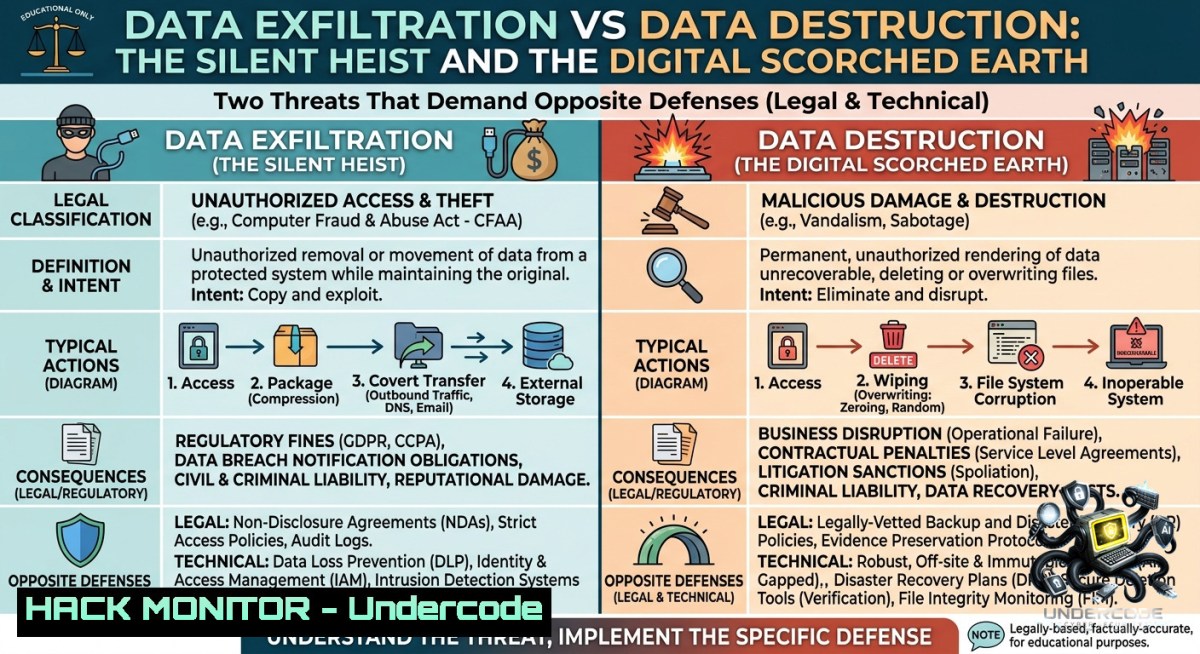
Not every cyberattack ends with a ransom note or a data leak. Some adversaries spend weeks quietly siphoning intellectual property through encrypted tunnels, while others deploy wipers to irreversibly erase servers and backups in a single, deafening blow. Understanding the tactical chasm between data exfiltration (stealthy theft) and data destruction (loud sabotage) is the first step toward building defense-in-depth that stops both.
Learning Objectives:
– Detect and block covert data exfiltration channels (DNS/HTTPS tunneling, cloud API abuse, USB drops)
– Harden systems and backups against destructive wiper malware and privilege escalation attacks
– Implement immutable backup strategies, egress filtering, and EDR rules for both threat scenarios
You Should Know:
1. Detecting DNS Tunneling for Exfiltration (Linux/Windows)
Attackers exfiltrate data by encoding it into DNS queries to a malicious domain. This bypasses traditional firewalls because DNS is almost always allowed.
How it works: The attacker splits stolen data into small chunks, encodes them (Base64, hex), and sends them as subdomain labels (e.g., `exfiltrated-data.malicious.com`). A listener decodes and reassembles the data.
Step-by-step detection & mitigation:
– Monitor for anomalous DNS query lengths – legitimate DNS names rarely exceed 50 characters; tunneling often uses 100+.
– Linux command to capture suspicious DNS traffic:
sudo tcpdump -i eth0 -1 port 53 -A | grep -E "([A-Za-z0-9+/]{40,})"
– Windows (PowerShell) to check recent DNS cache for long names:
Get-DnsClientCache | Where-Object {$_.Name.Length -gt 50} | Format-Table Name, Entry
– Mitigation: Use DNS over HTTPS (DoH) with a trusted resolver, implement response policy zones (RPZ), and set maximum query length limits on internal DNS servers.
2. Blocking HTTPS Tunneling with Egress Filtering
Exfiltration via encrypted web traffic (HTTPS) hides inside seemingly normal API calls or web requests. Attackers use tools like `dnscat2` or `Meterpreter` over HTTPS.
Step-by-step egress control:
– Allowlist outbound destinations – instead of blocking ports, block all unknown external IPs. On Linux with iptables:
sudo iptables -A OUTPUT -d 192.168.0.0/16 -j ACCEPT  internal
sudo iptables -A OUTPUT -d 10.0.0.0/8 -j ACCEPT
sudo iptables -A OUTPUT -d 172.16.0.0/12 -j ACCEPT
sudo iptables -A OUTPUT -j DROP  drop everything else
– Use a transparent TLS inspection proxy (e.g., Squid with SSL bump) on enterprise edges. Decrypt, inspect, re-encrypt.
– Cloud hardening – in AWS, enforce egress via NAT gateway with VPC flow logs; set S3 bucket policies to prevent uploads to unapproved external buckets:
{
"Effect": "Deny",
"Action": "s3:PutObject",
"Resource": "",
"Condition": {"NotIpAddress": {"aws:SourceIp": "10.0.0.0/8"}}
}
3. Wiper Malware Simulation and Immutable Backup Configuration
Data destruction attacks often use built-in OS commands. A simple wiper might run `cipher /w` on Windows or `shred` on Linux to overwrite files. More advanced wipers delete volume shadow copies.
Step-by-step to test your defenses safely:
– Simulate a wiper (do not run on production) – on a test VM, create a harmless script that deletes only test files:
 Linux simulator (prints actions instead of deleting)
echo "rm -rf /fake/path/to/data" | tee -a wipe.log
– Verify shadow copy protection on Windows:
 Check existing shadow copies
vssadmin list shadows
 Create immutable copy (requires third-party tool or Azure Backup)
 Hardening: Disable admin access to VSS via GPO
– Immutable backup strategy:
– AWS S3 Object Lock (compliance mode): prevents deletion for a set period.
– Linux with `chattr +i` on backup directories:
sudo chattr +i /backups/critical_db/
– Windows – use BitLocker + NTFS permissions denying even SYSTEM write access to backup folders after write.
– Offline/air-gapped backups – physically disconnect or use a tape robot.
4. Threat Hunting for Covert Channels (UEBA & Log Analysis)
User and Entity Behavior Analytics (UEBA) detects unusual data transfer volumes. A spike in outbound traffic from a finance workstation at 3 AM could be exfiltration.
Step-by-step hunting query (Splunk/ELK):
– Splunk (bytes transferred per host per hour):
index=network_bytes_per_host | stats sum(bytes_out) as total_out by host, date_hour | where total_out > 50000000
– Linux command to monitor live outbound connections per process:
sudo nethogs -t -d 5 | grep -v "0.00"
– Windows PowerShell to list processes with open outbound sockets:
Get-1etTCPConnection -State Established | Where-Object {$_.RemotePort -eq 443} | Select-Object OwningProcess, RemoteAddress
– Integrate with Sysmon event ID 3 (network connection) and ID 22 (DNS query). Hunt for high entropy in DNS names using a simple entropy script.
5. Privilege Escalation to Destroy Backups (Mitigation)
Wiper malware often escalates from user to SYSTEM or root to delete backups. The `rm -rf /` or `Get-Volume | Clear-Disk` attacks require high privileges.
Step-by-step least privilege & backup protection:
– Linux: Remove sudo rights for destructive commands. Use `sudoers` restrictions:
user ALL=(ALL) ALL, !/usr/bin/rm, !/bin/chmod -R, !/sbin/shutdown
– Windows: Implement Just Enough Administration (JEA) and LAPS. Disable local admin reuse.
– Backup monitoring – detect deletion of backup catalogs:
 Linux audit rule for backup directory
sudo auditctl -w /backups/ -p wa -k backup_deletion
 Check with ausearch -k backup_deletion
– Cloud – enable Azure Backup soft delete and AWS Backup vault lock (immutable mode for 7+ days).
6. Incident Response: Distinguishing Exfiltration from Destruction
When an alert fires, your first question: is data leaving or being erased? Different playbooks apply.
Step-by-step triage commands:
– Check for mass file deletions (Linux):
sudo find / -type f -mmin -10 -ls 2>/dev/null | wc -l
– Check for unusual outbound traffic (both OS):
 Linux – top 10 outbound IPs
sudo netstat -tunap | grep ESTABLISHED | awk '{print $5}' | cut -d: -f1 | sort | uniq -c | sort -1r | head
 Windows – outbound connections count
Get-1etTCPConnection | Where-Object {$_.State -eq 'Established' -and $_.RemotePort -1e 443} | Group-Object RemoteAddress | Sort-Object Count -Descending
– Preserve evidence – capture memory for destruction tools (e.g., `LiME` for Linux, `DumpIt` for Windows). For exfiltration, capture full pcap (tcpdump) to replay tunnels.
7. Hardening Cloud APIs Against Data Theft
Compromised API keys are a top exfiltration vector. Attackers list S3 buckets and download everything.
Step-by-step API security & monitoring:
– Enforce short-lived credentials – use AWS IAM roles anywhere (no static keys).
– Detect anomalous API calls (e.g., `s3:GetObject` spikes) with CloudTrail + GuardDuty.
– Linux CLI to monitor S3 access using AWS CLI with `–debug` and jq:
aws s3api list-objects --bucket my-sensitivedata --query 'Contents[?LastModified>='2026-06-01']'
– Prevent mass download – set bucket policy limiting `GetObject` per IP per hour:
{
"Effect": "Deny",
"Action": "s3:GetObject",
"Resource": "arn:aws:s3:::my-bucket/",
"Condition": {"NumericLessThan": {"s3:max-keys": 100}}
}
What Undercode Say:
– Key Takeaway 1: Exfiltration and destruction require opposite detection mindsets – one demands traffic inspection and behavioral baselines; the other needs immutable storage and integrity monitoring. Most security teams over-index on breach prevention and under-index on backup immutability.
– Key Takeaway 2: The same misconfiguration (e.g., overly permissive IAM roles, missing egress filters) can enable both theft and sabotage. Attackers who fail to exfiltrate often pivot to destruction to cover tracks. Defenses must be layered, not siloed.
Analysis (10 lines): The post rightly emphasizes that not all cyberattacks share the same goal, yet many organizations apply a one-size-fits-all “ransomware” playbook. Data exfiltration is far more insidious – dwell times average 200+ days, and stolen IP rarely returns. Data destruction, while less frequent, causes immediate operational collapse and often destroys forensic evidence. The shared lesson – visibility, least privilege, and tested recovery – is sound, but implementation is where most fail. For exfiltration, enterprises neglect egress filtering because “it breaks business workflows.” For destruction, they assume cloud backups are immutable without verifying lock periods. The commands and hardening steps provided above close these gaps: from detecting DNS tunnels with `tcpdump` to enforcing S3 Object Lock. Real defense requires both proactive monitoring (hunting for long DNS names) and reactive resilience (immutable backups that survive `rm -rf`). Without these, you’re either a silent victim of theft or a loud victim of sabotage.
Expected Output:
Prediction:
– +1 Regulatory bodies (SEC, GDPR, NYDFS) will mandate immutable backup retention policies for critical systems by 2027, driving adoption of object lock and air-gap architectures.
– -1 As AI-powered exfiltration tools evolve, attackers will automate adaptive tunneling that mimics normal user behavior, defeating static entropy detection and forcing a shift to graph-based UEBA.
– +1 The rise of “wiper-as-a-service” on cybercrime forums will lower the bar for destructive attacks, but also accelerate investment in immutable infrastructure and real-time file integrity monitoring.
– -1 Many mid-sized enterprises will continue treating exfiltration and destruction as the same threat, leading to failed audits and preventable breaches until a major supply-chain wiper event forces a market correction.
▶️ Related Video (68% Match):
🎯Let’s Practice For Free:
🎓 Live Courses & Certifications:
[Join Undercode Academy for Verified Certifications](https://undercode.co.uk/certifications/)
🚀 Request a Custom Project:
Secure, high-velocity infrastructure and disruptive technological engineering. Contact our engineering team for high-tier development and proprietary systems:
[[email protected]](mailto:[email protected])
💎 Smart Architecture | 🛡️ Secure by Design | ⭐ Trusted by Thousands
IT/Security Reporter URL:
Reported By: [Cybersecurity Dataexfiltration](https://www.linkedin.com/posts/cybersecurity-dataexfiltration-datadestruction-share-7467558508872257536-dZHo/) – Hackers Feeds
Extra Hub: Undercode MoN
Basic Verification: Pass ✅
🔐JOIN OUR CYBER WORLD [ CVE News • HackMonitor • UndercodeNews ]
[💬 Whatsapp](https://undercode.help/whatsapp) | [💬 Telegram](https://t.me/UndercodeCommunity)
📢 Follow UndercodeTesting & Stay Tuned:
[𝕏 formerly Twitter 🐦](https://x.com/undercodeupdate) | [@ Threads](https://www.threads.net/@undercodetesting) | [🔗 Linkedin](https://www.linkedin.com/company/undercodetesting/) | [🦋BlueSky](https://bsky.app/profile/undercode.bsky.social)


