Listen to this Post
Introduction:
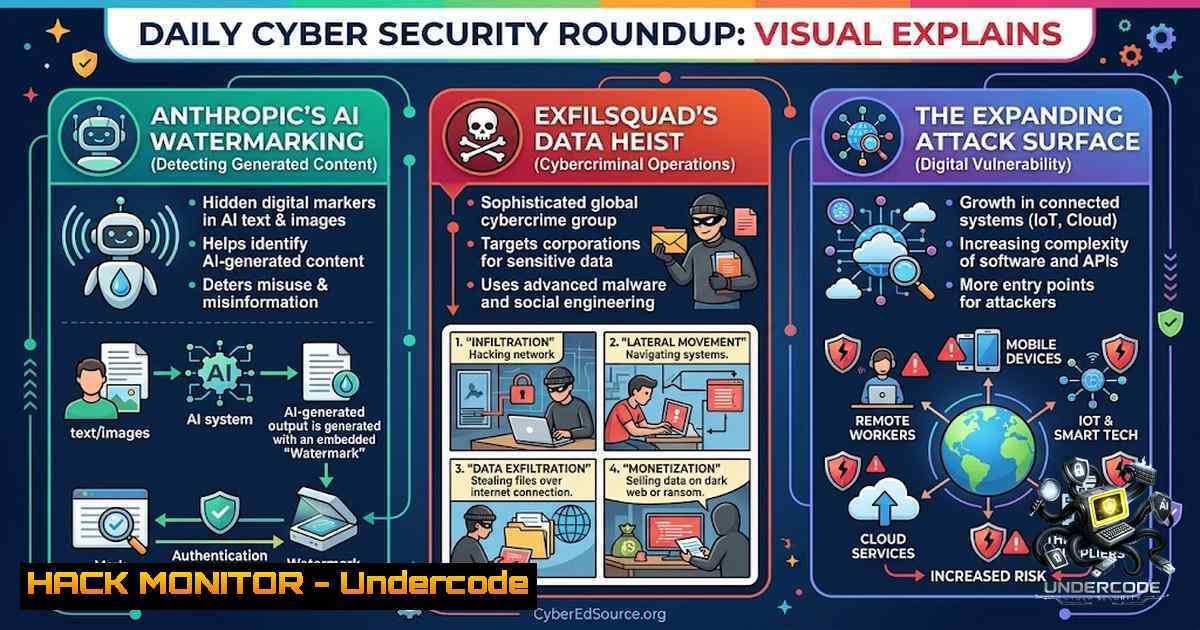
The modern cybersecurity landscape is defined by a paradox: AI-generated content is becoming indistinguishable from human writing, while threat actors are weaponizing misconfigured cloud services to exfiltrate terabytes of sensitive data. This roundup examines four critical developments — Anthropic’s cryptographic watermarking for Claude, the ExfilSquad extortion group’s breach of 13 organizations via Microsoft Power Pages, physical attack vectors against Boeing 737 avionics, and a new ad-tech transparency service called DecryptAds. Together, these stories underscore the need for defense-in-depth strategies that span AI provenance, cloud hardening, supply chain visibility, and even physical security.
Learning Objectives:
- Understand how generative watermarking works at the token-sampling level and how to detect watermarked AI text using statistical signatures.
- Identify misconfigurations in Microsoft Power Pages and Dataverse that lead to unauthorized read access, and implement remediation steps.
- Recognize physical attack vectors against aircraft systems and apply network segmentation principles to critical infrastructure.
- Leverage ads.txt and sellers.json analysis to map ad-tech supply chains and detect malicious or adversarial tracking entities.
You Should Know:
- Anthropic’s Cryptographic Watermarking: How It Works and How to Detect It
Anthropic has announced that it will watermark text generated by its Claude models using an approach based on Google DeepMind’s SynthID-Text. Unlike simple post-processing that adds hidden characters, this method alters the source of randomness during the token-generation process. Large language models generate text by repeatedly sampling the next token from a probability distribution. Watermarking works by modifying this sampling procedure using a cryptographic key and the preceding context to bias token selection in a subtle, statistically detectable way. The resulting text appears normal to human readers but contains a statistical signature that can be measured without access to the underlying model.
Step‑by‑Step Guide to Detecting Watermarked Text:
- Obtain the detection key — Anthropic plans to make the watermark detection key available to authorized parties (e.g., researchers, platforms, regulators). Without the key, detection is infeasible.
- Collect the text — Ensure you have the full generated text. The watermark is embedded across the entire sequence, not in isolated segments.
- Compute the statistical score — Using the key, run a detection algorithm that measures how consistently the token choices align with the watermarked sampling distribution. This typically involves a hypothesis test (e.g., z-score or p-value).
- Interpret the result — If the score exceeds a threshold, the text is statistically likely to have been generated by a watermarked Claude model.
- Automate at scale — Platforms can integrate the detection API to flag AI-generated content for moderation or transparency labeling.
Linux Command (simulated detection using Python):
 Clone a hypothetical watermark detection library
git clone https://github.com/anthropic/watermark-detector
cd watermark-detector
pip install -r requirements.txt
 Run detection on a text file
python detect.py --key watermark_key.pem --input claude_output.txt
Windows Command (PowerShell):
 Invoke a REST API for watermark detection
$body = @{ text = Get-Content -Path .\claude_output.txt -Raw } | ConvertTo-Json
Invoke-RestMethod -Uri https://api.anthropic.com/v1/detect-watermark -Method Post -Body $body -ContentType "application/json"
- ExfilSquad and the Danger of Misconfigured Microsoft Power Pages
Security researchers at Fortra have confirmed that the ExfilSquad extortion group successfully exfiltrated sensitive data from at least 13 organizations, including the City of Atlanta, the UK Department for Education, and District of Columbia Public Schools. The total leaked data amounts to 382.64 GB and 27 million records. The attack vector? Misconfigured Microsoft Power Pages portals that allowed public read access to Dataverse tables. Specifically, when the “Anonymous Users” web role is assigned to a table permission, any visitor can read the table’s data via the Power Pages API at https://<site>/_api/.
Step‑by‑Step Guide to Hardening Power Pages:
- Audit existing Power Pages sites — Use Microsoft’s Power Platform Admin Center to list all active portals.
- Review table permissions — Navigate to each portal’s Security > Table Permissions. Identify any permission where the “Anonymous Users” role is granted Read access.
- Remove or restrict anonymous access — If public read is not absolutely required, remove the Anonymous Users role from the permission. If required, implement additional authentication (e.g., Azure AD B2C).
- Scan for exposed instances — Use automated tools to discover publicly accessible Power Pages. Fortra noted it identified over 10,000 potential instances.
- Monitor Dataverse audit logs — Enable audit logging for Dataverse and review for unusual read patterns, especially from anonymous sessions.
Linux Command (using `curl` to test for exposed API):
 Test if a Power Pages site exposes Dataverse data anonymously
curl -X GET "https://victim-domain.powerappsportals.com/_api/accounts" \
-H "Accept: application/json" \
-H "Content-Type: application/json"
 If this returns data without authentication, the site is vulnerable.
Windows Command (PowerShell):
Invoke-RestMethod -Uri "https://victim-domain.powerappsportals.com/_api/accounts" -Method Get
Mitigation Reference: Microsoft explicitly advises against using the Anonymous Users role in publicly exposed sites.
- Physical Attack Vectors: Hacking a Boeing 737 with a Coin‑Sized Device
Academic researchers have demonstrated that a concealed, coin-sized hardware device can compromise systems on a Boeing 737 when attached to an external port. While safety-critical flight controls are isolated, attackers could spoof air temperature readings, aircraft weight data, and even modify the flight plan to divert the plane. This highlights that cybersecurity is not just about software — physical access to ports and buses remains a critical concern.
Step‑by‑Step Guide to Mitigating Physical Attack Risks:
- Restrict physical access — Implement strict access controls to aircraft during maintenance and on the tarmac.
- Harden external ports — Use port locks or tamper-evident seals on avionic access panels.
- Implement network segmentation — Ensure that non‑critical systems (e.g., passenger Wi‑Fi, entertainment) are isolated from flight‑critical avionics networks.
- Monitor for anomalies — Deploy intrusion detection systems that can flag unexpected data on avionics buses (e.g., ARINC 429, AFDX).
- Regular penetration testing — Include physical attack scenarios in red-team exercises.
-
DecryptAds: Mapping the Ad‑Tech Supply Chain for Privacy and Security
A new free service called DecryptAds scrapes and correlates publicly available files — ads.txt, app-ads.txt, buyers.json, and `sellers.json` — to map the entities tracking users across websites and apps. The service, built by threat researchers, helps identify malicious ad networks, data brokers in adversarial nations, and AI-generated “slop” sites. For example, a search for `espn.com` reveals 143 ad partners and 19 data brokers, many of which collect geolocation and device fingerprints.
Step‑by‑Step Guide to Using DecryptAds:
- Visit `https://decryptads.com`.
- Enter a domain (e.g.,
example.com) in the search bar. - Review the results — The dashboard shows all adtech partners, data brokers, and their declared data collection practices.
- Check for geo‑risk warnings — DecryptAds flags partners based in high‑risk countries like China, Russia, and Cyprus.
- Export the data — Use the export feature to generate a report for compliance or due diligence.
- Monitor changes — Set up periodic scans to detect new partners or changes in the supply chain.
Linux Command (manual `ads.txt` fetch and analysis):
 Fetch ads.txt from a domain
curl -s https://example.com/ads.txt | head -20
 Fetch sellers.json
curl -s https://example.com/sellers.json | jq '.'
 Cross-reference with another domain
diff <(curl -s https://siteA.com/ads.txt) <(curl -s https://siteB.com/ads.txt)
Windows Command (PowerShell):
Invoke-WebRequest -Uri "https://example.com/ads.txt" -OutFile ads.txt
Get-Content ads.txt
- Broader Threat Landscape: Rapid7 Layoffs, LexisNexis Breach, and AI Policy
This week also saw Rapid7 layoffs, a LexisNexis service shutdown following suspicious activity, and an $821 million Pentagon AI contract drawing criticism for prioritizing traditional consulting over commercial AI adoption. Additionally, the FBI is investigating a North Korean IT worker who gained employment at a US federal agency using fraudulent identity. These incidents reinforce the need for rigorous vendor risk management, continuous identity verification, and agile procurement models.
Step‑by‑Step Guide for Vendor Risk Assessment:
- Inventory all third‑party vendors — Maintain a comprehensive list of all external service providers.
- Assess security posture — Request SOC 2, ISO 27001, or equivalent reports.
- Monitor for breaches — Use threat intelligence feeds to track vendor‑related compromises.
- Implement least privilege — Restrict vendor access to only necessary systems and data.
- Conduct regular audits — Review vendor compliance with your security policies.
Linux Command (using `osquery` to detect anomalous processes):
 Detect unexpected outbound connections
osqueryi "SELECT pid, name, remote_address, remote_port FROM process_open_sockets WHERE remote_port NOT IN (80,443);"
Windows Command (PowerShell to check for suspicious scheduled tasks):
Get-ScheduledTask | Where-Object {$_.State -1e "Disabled"} | Format-Table TaskName, State
What Undercode Say:
- Key Takeaway 1: AI watermarking is a significant step toward transparency, but it is not a silver bullet. Adversaries will attempt to strip watermarks or use non‑watermarked models. Organizations should treat watermark detection as one layer in a broader content authentication strategy.
- Key Takeaway 2: The ExfilSquad incident is a textbook example of how a single misconfiguration — leaving a Power Pages table publicly readable — can lead to a catastrophic data breach affecting millions of records. Cloud security hygiene, especially around identity and access management, remains the top priority for defenders.
- Key Takeaway 3: Physical attack vectors against aircraft and critical infrastructure are no longer theoretical. Security teams must expand their scope beyond networks and endpoints to include hardware, ports, and supply chain integrity.
- Key Takeaway 4: DecryptAds democratizes ad‑tech transparency, empowering privacy professionals and security researchers to map the tracking ecosystem. This is a powerful tool for identifying rogue data brokers and malicious ad campaigns.
- Analysis: The common thread across these stories is visibility — whether it’s detecting AI‑generated text, discovering exposed Power Pages, identifying physical tampering, or mapping ad‑tech supply chains. Defenders who invest in continuous monitoring, automated scanning, and threat intelligence will be better positioned to detect and respond to these evolving threats. The shift toward proactive, data‑driven security is no longer optional; it is existential.
Prediction:
- +1 AI provenance will become a regulatory baseline — Within 18 months, major AI providers will adopt watermarking or similar provenance techniques, driven by the EU AI Act and similar legislation in other jurisdictions. This will create a new ecosystem of detection tools and compliance services.
- -1 Misconfigured SaaS platforms will remain a top attack vector — As organizations accelerate cloud adoption, misconfigurations in platforms like Power Pages, SharePoint, and Salesforce will continue to be exploited. Expect more extortion groups to adopt similar tactics.
- +1 Ad‑tech transparency tools will gain mainstream adoption — Services like DecryptAds will evolve into enterprise‑grade solutions, helping organizations comply with privacy regulations and reduce supply‑chain risk.
- -1 Physical attacks on critical infrastructure will increase — The Boeing 737 demonstration lowers the barrier for adversaries. Expect more research and potentially real‑world incidents targeting aviation, maritime, and industrial control systems.
- +1 Convergence of AI and security will accelerate — AI will be used both offensively (to generate convincing phishing and disinformation) and defensively (to detect anomalies and automate responses). The arms race is just beginning.
▶️ Related Video (78% Match):
🎯Let’s Practice For Free:
🎓 Live Courses & Certifications:
Join Undercode Academy for Verified Certifications
🚀 Request a Custom Project:
Secure, high-velocity infrastructure and disruptive technological engineering. Contact our engineering team for high-tier development and proprietary systems:
[email protected]
💎 Smart Architecture | 🛡️ Secure by Design | ⭐ Trusted by Thousands
IT/Security Reporter URL:
Reported By: https://lnkd.in/p/ecPHJyCY – Hackers Feeds
Extra Hub: Undercode MoN
Basic Verification: Pass ✅


