
Listen to this Post
Introduction:
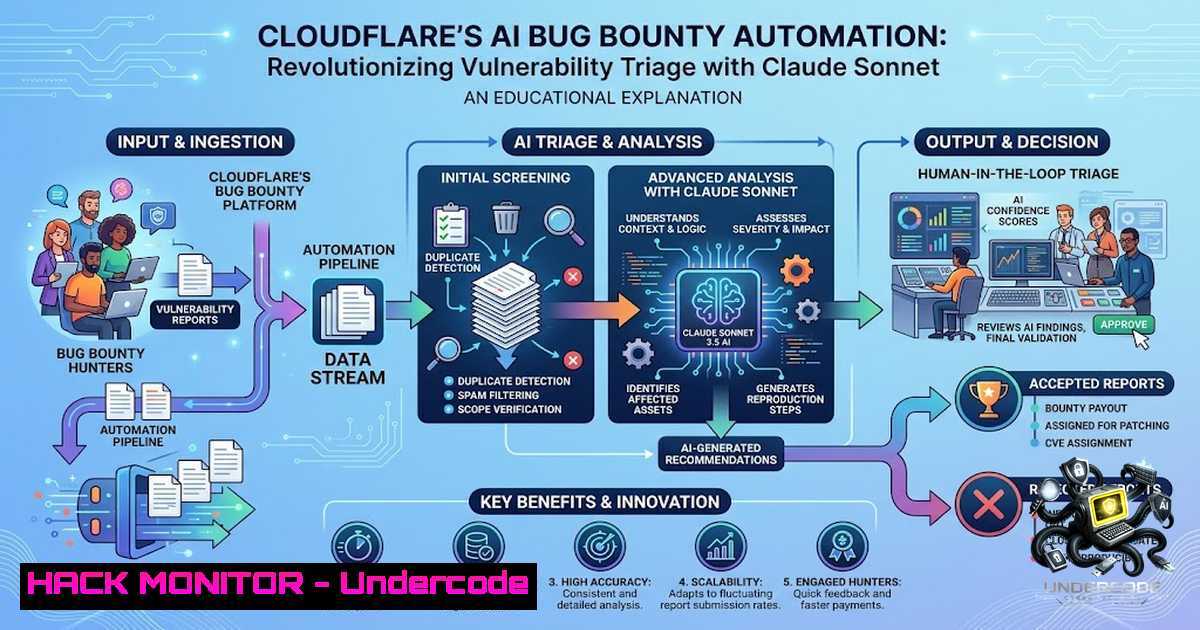
Cloudflare has fundamentally transformed how it handles security vulnerabilities by automating its bug bounty program’s triage process using Anthropic’s Claude Sonnet model, achieving this at an astonishing cost of just $58 per month. This move represents a paradigm shift in security operations, demonstrating how large language models (LLMs) can replace manual, labor-intensive processes with efficient, cost-effective automation. The company’s Chief Security Officer Grant Bourzikas revealed that using Anthropic’s security-focused Mythos model for the same work would have cost over $200,000 monthly, highlighting the critical importance of selecting the right model for specific security tasks. This development signals a broader trend where AI agents are increasingly handling core security operations, from vulnerability discovery to remediation.
Learning Objectives & Secrets:
- Objective 1: Understand how to architect a model-agnostic vulnerability discovery harness that separates discovery from validation using different LLMs for adversarial cross-checking.
- Objective 2 Secret Tip: Implement state persistence across pipeline stages by writing execution states to databases, enabling interrupted workflows to resume without losing progress—a critical requirement for large-scale codebase scanning.
- Objective 3 Secret Tip: Adopt cross-model validation where one model generates vulnerability hypotheses and an entirely different model validates them independently, preventing the same model from rubber-stamping its own findings.
You Should Know:
1. The Vulnerability Discovery Harness (VDH) Architecture
Cloudflare’s approach to AI-powered vulnerability discovery centers on a two-stage operational framework: the Vulnerability Discovery Harness (VDH) and the Vulnerability Validation System (VVS). The VDH proactively scans codebases to generate candidate vulnerabilities, while the VVS handles deduplication, risk assessment, and remediation suggestions. This separation ensures that discovery and validation remain independent processes, each potentially using different underlying models.
The VDH typically implements a six-phase pipeline: reconnaissance, hunting, validation, evidence gathering, reporting, and impact analysis. Each phase involves specialized AI agents that handle specific tasks, creating a modular system where components can be swapped without refactoring the entire architecture. Cloudflare’s implementation processes over 20,000 candidate vulnerabilities down to 7,245 actionable findings for engineering teams.
Step-by-Step Guide to Building a Basic VDH:
 Phase 1: Reconnaissance - Map the attack surface
 Linux: Enumerate subdomains and endpoints
subfinder -d target.com -o subdomains.txt
httpx -l subdomains.txt -o alive.txt

Phase 2: Hunting - Identify potential vulnerabilities
 Use AI-assisted scanning with custom prompts
python -c "
import openai
 Configure your AI model (model-agnostic approach)
 Send code snippets for analysis with specific vulnerability classes
"

Phase 3: Validation - Cross-validate findings
 Windows PowerShell: Validate with different model
Invoke-RestMethod -Uri "https://api.anthropic.com/v1/messages" `
-Headers @{"x-api-key"=$env:ANTHROPIC_API_KEY} `
-Method Post -Body '{"model":"claude-3-sonnet-20240229","messages":[{"role":"user","content":"Validate this vulnerability finding..."}]}'
2. Claude Sonnet for Bug Bounty Triage
Cloudflare’s implementation of Claude Sonnet for bug bounty triage represents one of the most practical applications of AI in security operations. The model screens incoming submissions, checks for duplicates, and evaluates the likelihood that each report warrants human review. Previously handled entirely manually, this automated triage workflow has dramatically reduced the operational burden on Cloudflare’s security team.
The key insight from Cloudflare’s experience is that model selection dramatically impacts operational costs. While Anthropic’s security-focused Mythos model offered specialized capabilities, its $200,000+ monthly cost was unjustifiable for the specific task of triage. Claude Sonnet, being a general-purpose model with strong reasoning capabilities, proved more than adequate for filtering and categorizing bug reports at 0.03% of the cost.
Setting Up AI-Powered Bug Bounty Triage:
 Linux: Set up automated report processing pipeline
!/bin/bash
 Install dependencies
pip install anthropic pandas

Create triage script
cat > triage_bug_reports.py << 'EOF'
import anthropic
import json
import pandas as pd

client = anthropic.Anthropic(api_key="YOUR_API_KEY")

def triage_report(report_text):
response = client.messages.create(
model="claude-3-sonnet-20240229",
max_tokens=1024,
messages=[{
"role": "user",
"content": f"""
Analyze this bug bounty report and determine:
1. Is this a duplicate?
2. What's the severity (Critical/High/Medium/Low)?
3. Should this be escalated for human review?

Report: {report_text}
"""
}]
)
return response.content[bash].text

Process batch of reports
reports = pd.read_csv('incoming_reports.csv')
reports['triage_result'] = reports['description'].apply(triage_report)
reports.to_csv('triage_results.csv')
EOF

python triage_bug_reports.py
3. Managing LLM Context Limits and State Controls
One of the most significant technical challenges Cloudflare addressed was working around LLM context window limitations. Large codebases cannot be fed entirely into an LLM’s context window, requiring sophisticated orchestration to break analysis into manageable chunks while maintaining state across operations.
Cloudflare’s solution involves writing execution states to databases, allowing interrupted workflows to resume and enabling multi-stage analysis where each agent handles a specific scope of work. The company emphasizes that successful AI vulnerability discovery is not primarily a model problem but an orchestration problem—the architecture that coordinates agents and manages state is more critical than which specific model is used.
Implementing Stateful AI Security Orchestration:
 Linux: Set up state management with SQLite
sqlite3 security_state.db << EOF
CREATE TABLE IF NOT EXISTS scan_states (
id INTEGER PRIMARY KEY,
phase TEXT,
target TEXT,
state JSON,
timestamp DATETIME DEFAULT CURRENT_TIMESTAMP
);
EOF

Python script for stateful orchestration
cat > stateful_scanner.py << 'EOF'
import sqlite3
import json
from datetime import datetime

class SecurityOrchestrator:
def <strong>init</strong>(self, db_path='security_state.db'):
self.conn = sqlite3.connect(db_path)
self.cursor = self.conn.cursor()

def save_state(self, phase, target, state_data):
self.cursor.execute(
"INSERT INTO scan_states (phase, target, state) VALUES (?, ?, ?)",
(phase, target, json.dumps(state_data))
)
self.conn.commit()

def resume_scan(self, phase, target):
self.cursor.execute(
"SELECT state FROM scan_states WHERE phase=? AND target=? ORDER BY timestamp DESC LIMIT 1",
(phase, target)
)
result = self.cursor.fetchone()
return json.loads(result[bash]) if result else None
EOF
4. Security Automation with Cloudflare’s AI Agents
Beyond bug bounty triage, Cloudflare has deployed over 200 autonomous AI agents handling various security tasks including vulnerability management, escalation, architecture analysis, binary control, and architecture reviews. One architecture agent alone contains 55 specialized sub-agents that assess vulnerabilities alongside related controls, privileges, and systems.
This extensive agent ecosystem has delivered measurable results: security response times have been cut by approximately 80%, and vulnerability remediation is approaching 100% completion. Cloudflare has largely abandoned third-party security tools, replacing them with internally developed applications, many coded with AI assistance.
Deploying AI Security Agents:
 Windows PowerShell: Deploy Cloudflare Agent SDK
 Install Cloudflare Agents SDK
npm install -g @cloudflare/agents-sdk

Initialize a security agent
npx agents init security-agent

Configure agent for vulnerability scanning
cat > security-agent/config.json << 'EOF'
{
"name": "vulnerability-scanner",
"capabilities": ["recon", "hunting", "validation"],
"model": "claude-3-sonnet-20240229",
"parallel_agents": 50,
"state_persistence": true
}
EOF

Deploy the agent
npx agents deploy security-agent
5. Cross-Model Validation for False Positive Reduction
A key architectural principle in Cloudflare’s approach is cross-model validation—using different models for discovery and validation to prevent confirmation bias. The VDH might use one model to identify potential vulnerabilities, while the VVS uses a completely different model with distinct logical weights and training data to validate those findings.
This adversarial approach ensures that findings are stress-tested by an independent system, significantly reducing false positives. Each confirmed vulnerability finding must include a proof-of-concept test case executable without modifying the original source code, along with corresponding patch recommendations. The VVS further evaluates whether vulnerabilities are actually reachable in production environments and whether they can be triggered by real attackers.
Implementing Cross-Model Validation:
 Python script for cross-model validation
cat > cross_model_validation.py << 'EOF'
import anthropic
import openai

def discover_vulnerabilities(code_snippet):
 Model A for discovery
client_sonnet = anthropic.Anthropic(api_key="SONNET_KEY")
response = client_sonnet.messages.create(
model="claude-3-sonnet-20240229",
messages=[{"role": "user", "content": f"Find vulnerabilities in:\n{code_snippet}"}]
)
return response.content[bash].text

def validate_findings(findings, code_snippet):
 Model B for validation (different model, different logic)
client_validation = openai.OpenAI(api_key="OPENAI_KEY")
response = client_validation.chat.completions.create(
model="gpt-oss-120b",
messages=[{
"role": "user",
"content": f"Independently validate these findings:\n{findings}\n\nCode:\n{code_snippet}"
}]
)
return response.choices[bash].message.content

Only accept findings validated by both models
discovery_result = discover_vulnerabilities(code)
validation_result = validate_findings(discovery_result, code)
 Cross-check results programmatically
EOF
What Undercode Say:
- Key Takeaway 1: The true innovation in Cloudflare’s approach is not the AI model itself but the orchestration architecture—building model-agnostic systems where discovery and validation are separated, states are persisted, and components can be swapped without rewriting the entire pipeline.
-
Key Takeaway 2: Model selection matters enormously for cost and effectiveness. Cloudflare’s choice of Claude Sonnet over the specialized Mythos model demonstrates that “good enough” AI for specific tasks can be dramatically more cost-effective than premium offerings, saving over $2.3 million annually.
Prediction:
-
+1 Cloudflare’s automation strategy will accelerate industry-wide adoption of AI agents for security operations, with bug bounty triage becoming a standard AI use case across major tech companies within 12-18 months.
-
+1 The VDH/VVS architecture pattern will emerge as a best practice for AI-powered security scanning, with open-source implementations and commercial offerings adopting the two-stage cross-model validation approach.
-
-1 Increased automation may lead to a flood of low-quality AI-generated bug reports, forcing bug bounty programs to implement stricter submission filters and potentially reducing rewards for legitimate researchers.
-
-1 The skill gap described by Bourzikas—where experienced developers are needed to effectively work with AI security tools—could create talent shortages, as AI-assisted security requires different competencies than traditional security roles.
-
+1 Cloudflare’s warning against wholesale adoption of their “build vs. buy” strategy is prudent; most organizations lack the scale and security engineering expertise to replicate Cloudflare’s approach, leading to a market for managed AI security services.
-
+1 The $58/month cost benchmark will pressure AI vendors to offer more affordable specialized security models, potentially democratizing AI-powered security automation for smaller organizations.
-
-1 As AI agents increasingly handle security operations, the human element of security research may diminish, potentially reducing the diversity of perspectives in vulnerability discovery and creating monoculture risks in security approaches.
▶️ Related Video (86% Match):
https://www.youtube.com/watch?v=3nG80QZCxa4
🎯Let’s Practice For Free:
🎓 Live Courses & Certifications:
Join Undercode Academy for Verified Certifications
🚀 Request a Custom Project:
Secure, high-velocity infrastructure and disruptive technological engineering. Contact our engineering team for high-tier development and proprietary systems:
[email protected]
💎 Smart Architecture | 🛡️ Secure by Design | ⭐ Trusted by Thousands
IT/Security Reporter URL:
Reported By: https://lnkd.in/p/ekwXAmtm – Hackers Feeds
Extra Hub: Undercode MoN
Basic Verification: Pass ✅


