
Listen to this Post
Introduction:
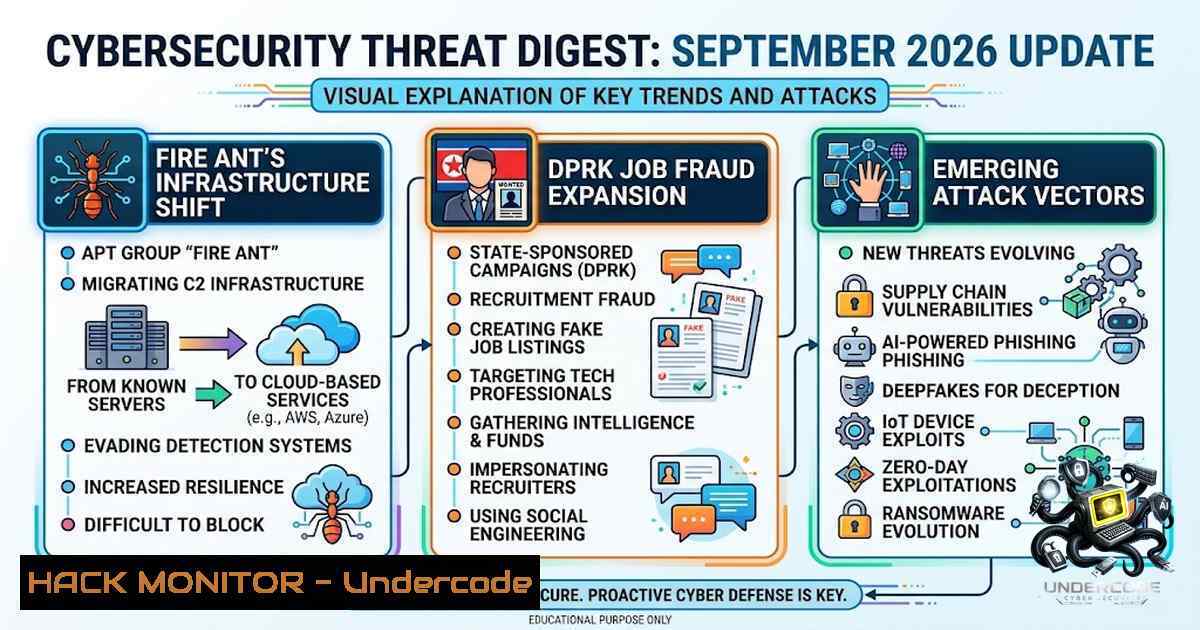
The cybersecurity landscape on September 1, 2026, is defined by a concerning evolution of state-sponsored espionage and financially motivated cybercrime. The China-linked threat actor Fire Ant has strategically shifted its focus from VMware hypervisors to compromising core network infrastructure, including Cisco IOS XR routers and TACACS servers, turning trusted components into covert surveillance platforms. Simultaneously, North Korean IT worker fraud campaigns have expanded beyond the tech sector into healthcare, finance, and sales, creating significant insider threats and compliance risks. These developments, alongside high-profile data breaches and novel malware distribution techniques, underscore the critical need for organizations to reassess their security postures across all layers of their infrastructure.
Learning Objectives & Secrets:
- Objective 1: Understand the Mechanics of Infrastructure-Level Espionage. Learn how advanced persistent threats (APTs) like Fire Ant compromise network routers and authentication servers to intercept traffic, harvest credentials, and blind security logs.
- Objective 2: Identify and Mitigate the Expanding Threat of DPRK IT Worker Fraud. Learn to recognize the indicators of fraudulent remote workers, from VPN usage and identity document anomalies to the use of KVM switches and hardware capture cards.
- Objective 3: Implement Proactive Defenses Against Emerging Malware and Attack Vectors. Discover how to defend against threats like ValleyRAT, which abuse signed binaries and DLL sideloading to bypass traditional security controls, and how to strengthen defenses against voice phishing (vishing) attacks that bypass email filters.
You Should Know:
1. Securing Network Infrastructure Against Fire Ant-Style Espionage
Fire Ant’s campaign represents a significant shift in targeting, moving from virtualized environments to the “trust layer” of network infrastructure. The group compromised Cisco IOS XR routers using purpose-built malware for the control plane. This malware manipulated logging to suppress evidence, hiding the attacker’s tunnel configuration from administrators. The routers were then used to capture packet captures (PCAPs) and upload them to external FTP servers. Furthermore, the group compromised TACACS servers using a toolset named “TacTap,” which injected a malicious library into the authentication process to intercept live sessions and steal credentials. On Linux management hosts, Fire Ant deployed “BridgeAgent,” a backdoor disguised as a Zabbix monitoring agent, to maintain persistence.
To defend against such sophisticated attacks, organizations must treat routers, TACACS servers, and management hosts as critical forensic assets. This involves:
– Hardening Router Configurations: Restrict access to routers using secure protocols like SSHv2, implement strict ACLs, and regularly audit configurations for unauthorized changes.
– Securing TACACS+: Ensure TACACS+ traffic is encrypted, regularly rotate shared secrets, and monitor for unauthorized processes or library injections.
– Enhancing Log Integrity: Implement a centralized, immutable logging solution (e.g., using a SIEM) that collects logs from all network devices to prevent attackers from deleting or suppressing evidence locally.
– Continuous Monitoring: Use network detection and response (NDR) tools to monitor for anomalous GRE tunnels, unusual outbound FTP traffic, or connections to suspicious external IPs.
– Linux Host Hardening: Disable unnecessary services, enforce SELinux/AppArmor, and monitor for unauthorized systemd services or processes masquerading as legitimate tools.
2. Combating North Korean Remote Worker Fraud
The DPRK’s “IT worker scheme” has expanded beyond the technology sector, now targeting healthcare, sales, marketing, and finance. These operatives use stolen or forged identities, VPNs (like Astrill VPN), and proxy services (like IPRoyal Proxy) to mask their true location. In one case, three employees at an Australian healthcare company were flagged after repeatedly connecting through a VPN and presenting fraudulent identity documents. In another, a financial services employee was found to have installed a PiKVM, a device that allows remote control of a computer, likely to connect to a “laptop farm” used to simulate a legitimate work environment. The use of hardware capture cards like Guermok USB to spoof webcam inputs for video interviews has also been observed.
Mitigating this insider threat requires a multi-layered approach that begins at the interview stage:
– Enhanced Background Checks: Conduct thorough verification of identity documents, educational credentials, and previous employment. Be wary of anomalies in documents or a reluctance to participate in video interviews.
– Technical Controls: Monitor for the use of known DPRK-favored VPNs and proxy services. Implement geofencing to restrict access from high-risk regions. Deploy endpoint detection and response (EDR) solutions to detect the installation of unauthorized hardware like PiKVM or TinyPilot.
– Behavioral Analysis: Be alert to unusual work patterns, such as working during non-standard hours, or inconsistencies in communication styles that may indicate the use of AI-assisted interviews.
– Compliance and Sanctions: Stay informed about OFAC sanctions and joint government alerts. Ensure your hiring and procurement processes are compliant with sanctions to avoid legal and financial penalties.
3. Responding to Data Breaches and Extortion Campaigns
The French intellectual property firm Questel fell victim to a “pay or leak” extortion campaign by the ShinyHunters group. The group allegedly published a large dataset containing 1.2 million unique email addresses, along with names, employers, job titles, physical addresses, and phone numbers. Such exposed data is a goldmine for threat actors, enabling phishing, credential stuffing, and targeted attacks against employees, customers, and partners.
In response to a data breach, organizations should:
- Immediate Incident Response: Activate the incident response plan, contain the breach, and engage forensic investigators to determine the scope and impact.
- Credential Reset: Force a password reset for all affected users and mandate multi-factor authentication (MFA).
- Dark Web Monitoring: Subscribe to dark web monitoring services to detect if stolen data appears on criminal forums.
- Customer and Partner Communication: Develop a clear and transparent communication strategy to inform affected parties about the breach and the steps being taken to protect them.
- Legal and Regulatory Compliance: Notify relevant data protection authorities and comply with all applicable breach notification laws.
4. Defending Against Vishing and Social Engineering
Voice phishing (vishing) campaigns are increasingly sophisticated, impersonating trusted brands and exploiting a sense of urgency to trick victims into revealing credentials or payment information. These attacks bypass many email-based security controls, making phone-based verification a critical line of defense. Organizations should implement strict procedures for verifying the identity of callers, especially for executives, finance teams, and during account recovery processes. Training employees to recognize social engineering tactics and to always verify requests through a separate, known channel is essential.
5. Detecting and Preventing ValleyRAT-Style Malware
The ValleyRAT campaign highlights the danger of abusing trusted digital signatures and familiar file formats. Attackers distribute signed adware or legitimate applications (like QN Wallpaper) that, through DLL sideloading, execute malicious code. The signed binary is trusted by the system, allowing the malicious DLL to load and disable security controls like Windows Defender. The malware then establishes persistence and gives attackers full remote control.
Defending against such threats requires moving beyond signature-based detection:
– Application Control: Implement application whitelisting to only allow approved executables to run.
– DLL Monitoring: Monitor for DLL sideloading attempts, where an executable loads a DLL from an unexpected or non-standard location.
– Behavioral Analysis: Use EDR solutions that can detect malicious behavior, such as attempts to disable security services or modify registry keys for persistence.
– File Reputation: Assess files not just by their signing status but also by their reputation, origin, and behavior. Be wary of signed files from less-known publishers.
– User Education: Train users to be cautious about downloading software from untrusted sources, even if it appears to be signed.
What Undercode Say:
- Key Takeaway 1: The Fire Ant campaign is a stark reminder that network infrastructure—often treated as static and secure—is a prime target for sophisticated adversaries. Securing routers, switches, and authentication servers is as critical as securing endpoints and cloud workloads.
- Key Takeaway 2: The expansion of North Korean IT worker fraud into non-IT sectors signals a maturation of the operation. Organizations across all industries must now treat their hiring processes as a security perimeter and implement robust identity verification and monitoring controls.
Prediction:
- -1: The Fire Ant campaign’s success in compromising Cisco IOS XR routers will likely inspire other APT groups to develop similar capabilities, leading to a wave of infrastructure-level compromises across various sectors. Defenders must urgently prioritize the hardening and monitoring of their network devices.
- -1: The Questel data breach, with its 1.2 million exposed email addresses and contact details, will fuel a significant increase in targeted phishing and vishing attacks. Organizations should prepare for a surge in social engineering attempts against their employees and customers.
- +1: The growing awareness of DPRK IT worker fraud, highlighted by joint government alerts, will lead to the development of more sophisticated background checking tools and identity verification services. This will create a new market for solutions designed to detect and prevent this specific type of insider threat.
- -1: The ValleyRAT campaign’s use of signed binaries and DLL sideloading will become a more common technique for malware distribution, rendering traditional antivirus solutions less effective. The industry will need to accelerate its adoption of behavioral-based detection and zero-trust principles.
▶️ Related Video (72% Match):
🎯Let’s Practice For Free:
🎓 Live Courses & Certifications:
Join Undercode Academy for Verified Certifications
🚀 Request a Custom Project:
Secure, high-velocity infrastructure and disruptive technological engineering. Contact our engineering team for high-tier development and proprietary systems:
[email protected]
💎 Smart Architecture | 🛡️ Secure by Design | ⭐ Trusted by Thousands
IT/Security Reporter URL:
Reported By: https://lnkd.in/p/eEtpqpDS – Hackers Feeds
Extra Hub: Undercode MoN
Basic Verification: Pass ✅


