
Listen to this Post
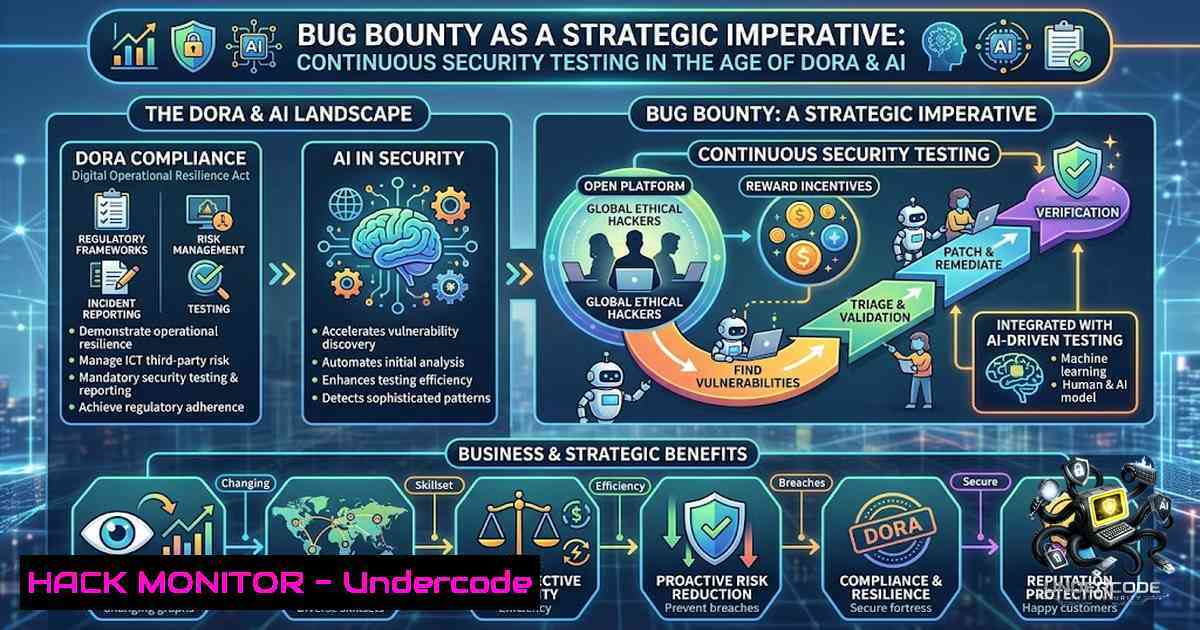
Introduction:
Cybersecurity has evolved beyond point-in-time assessments into a continuous, collaborative journey—a paradigm shift accelerated by regulatory mandates like the Digital Operational Resilience Act (DORA) and the rapid adoption of AI-powered services. For financial institutions operating across 22 countries, the attack surface is vast and constantly expanding, making traditional periodic penetration testing insufficient to address modern threats. Crédit Agricole Personal Finance & Mobility (CAPFM) has embraced bug bounty programs as a strategic complement to traditional security controls, leveraging crowdsourced intelligence to identify vulnerabilities that conventional assessments often miss while building a culture of continuous improvement and resilience.
Learning Objectives & Secrets:
- Objective 1: Understand the strategic value of bug bounty as a continuous testing layer. Learn how crowdsourced security testing complements traditional assessments and aligns with DORA’s requirements for ongoing vulnerability identification and remediation.
-
Objective 2: Master the phased approach to bug bounty scoping. Start with black-box testing of known assets, progressively introduce grey-box testing with authenticated access, and ultimately expand coverage to all exposed attack surfaces—including blind spots like APIs and AI-powered services.
-
Objective 3: Leverage human-in-the-loop triage for efficient vulnerability management. Understand how expert triage teams validate findings, reproduce Proofs of Concept, and provide actionable remediation guidance—reducing internal security team overhead while accelerating time-to-fix.
You Should Know:
- Building a Phased Bug Bounty Program: From Black-Box to AI-Powered Scopes
CAPFM’s approach demonstrates a mature, risk-based methodology for bug bounty implementation. The program began with black-box testing of the most well-known assets, allowing the team to understand the platform and researcher dynamics without being overwhelmed. As confidence grew, grey-box testing was introduced—providing authenticated user access to hunters for critical assets. This progressive expansion required building trust with business stakeholders to grant external researchers access to production-like environments.
The ultimate objective is comprehensive coverage of the entire exposed attack surface. CAPFM is now extending this model to AI-powered services, recognizing that innovation creates value only when it is trusted—and trust requires security embedded from the start.
Step‑by‑step guide for launching a phased bug bounty program:
- Start private and small. Begin with a private program and a limited number of trusted researchers to minimize risk while learning the platform dynamics.
-
Define tight initial scope. Focus on your most critical, well-understood assets first. Clear boundaries prevent researcher confusion and ensure high-quality reports.
-
Establish a reward grid. Set appropriate bounty amounts based on vulnerability severity (CVSS scores) and asset criticality.
-
Monitor and expand progressively. Analyze report quality and response times before adding new scopes. Introduce grey-box testing (authenticated access) for critical assets once trust is established.
-
Add blind spots and AI scopes. Extend coverage to APIs, legacy systems, and AI-powered services as the program matures.
-
The Triage Advantage: Converting Raw Reports into Actionable Intelligence
One of the most critical success factors in bug bounty programs is the triage function. CAPFM emphasizes that YesWeHack’s triage team serves as the “first layer” — validating Proofs of Concept, verifying findings, and translating researcher reports into actionable intelligence. This eliminates the need for internal security teams to spend excessive time deciphering technical reports or engaging in lengthy back-and-forth discussions with hunters.
The structured triage workflow includes metadata enrichment, compliance verification, duplicate detection, and full PoC reproduction. Triage teams provide severity scoring based on CVSS and offer real-world remediation recommendations. With first-response times averaging 5-6 hours, this dramatically accelerates the vulnerability management lifecycle.
Step‑by‑step guide for optimizing triage in your bug bounty program:
- Leverage platform triage services. Utilize the bug bounty platform’s built-in triage team to validate and enrich reports before they reach your internal team.
-
Define clear severity criteria. Establish CVSS-based scoring guidelines and communicate them to both triagers and researchers.
-
Implement report workflows. Use the platform’s vulnerability center to track report status, triage progress, and remediation ownership.
-
Automate duplicate detection. Leverage platform capabilities to identify and filter duplicate submissions before they consume internal resources.
-
Provide feedback loops. Share remediation outcomes with researchers to encourage high-quality future submissions and build community trust.
3. DORA Compliance Through Continuous Crowdsourced Testing
The Digital Operational Resilience Act (DORA), fully applicable since January 2025, mandates that financial entities implement continuous ICT risk management, security testing, and third-party risk oversight. Bug bounty programs align “perfectly” with DORA’s requirements for continuous, independent vulnerability assessment.
DORA requires regular basic ICT testing and, for significant entities, advanced Threat-Led Penetration Testing (TLPT) aligned with the TIBER-EU methodology. Organizations must maintain ICT asset inventories, implement vulnerability management processes, and assess security controls of third-party providers. Bug bounty programs serve as an “always-on” penetration capability that continuously validates security controls and surfaces vulnerabilities missed by periodic assessments.
Step‑by‑step guide for aligning bug bounty with DORA compliance:
- Document your testing framework. Ensure your bug bounty program is formally documented as part of your ICT risk management framework.
-
Maintain comprehensive asset inventory. Use attack surface management tools to identify all exposed assets and ensure they are included in your bug bounty scope.
-
Implement continuous testing. Replace point-in-time assessments with always-on crowdsourced testing to meet DORA’s continuous security requirements.
-
Manage third-party risk. Ensure your bug bounty platform provider meets DORA’s outsourcing requirements, including service-level agreements and audit rights.
-
Track and report incidents. Establish clear timeframes for incident reporting to competent authorities, as required by DORA.
-
Securing the AI Attack Surface: Prompt Injection, Model Poisoning, and Beyond
As CAPFM expands its digital ecosystem with new AI-powered services, extending collaborative testing to AI scopes becomes critical. AI systems introduce unique vulnerabilities that traditional security testing often misses, including prompt injection, jailbreaking, chain-of-thought hijacking, RAG context poisoning, and credential exposure in training data.
Security researchers are developing specialized techniques for AI security testing, including prompt patterns for threat modeling code slices, tracing authorization checks, and conducting negative-space searches for unchecked state-changing operations. AI-powered bug bounty agents can assist with OSINT gathering, subdomain takeover detection, and API security testing.
Step‑by‑step guide for testing AI-powered scopes:
- Map AI attack surfaces. Identify all AI system components exposed to the internet, including APIs, model endpoints, and data pipelines.
-
Test for prompt injection. Use curated prompt injection payloads to test LLM boundaries and filter bypasses.
-
Validate credential storage. Audit AI systems for hardcoded credentials, connection strings, and sensitive data exposure.
-
Test RAG and context poisoning. Assess how malicious input could corrupt retrieval-augmented generation contexts.
-
Implement grey-box AI testing. Provide authenticated access to researchers for comprehensive AI system testing.
-
Linux and Windows Hardening Commands for Continuous Security Posture
Maintaining a strong security posture requires ongoing system hardening across both Linux and Windows environments. Below are essential commands that complement bug bounty programs by reducing the attack surface.
Linux Hardening Commands:
 Update system packages and enable automatic security updates
sudo apt update && sudo apt upgrade -y
sudo apt install unattended-upgrades
sudo dpkg-reconfigure --priority=low unattended-upgrades

Configure firewall - deny all incoming by default, allow only SSH
sudo ufw default deny incoming
sudo ufw allow ssh
sudo ufw enable

Set restrictive permissions on sensitive directories
sudo chmod 700 /root
sudo chmod 600 /etc/shadow
sudo chmod 644 /etc/passwd

Audit and remove excessive sudo rights
sudo grep -r "NOPASSWD" /etc/sudoers.d/

Remove unnecessary packages
sudo apt autoremove --purge
Windows Server Security Hardening (PowerShell):
 Enable Windows Defender real-time protection
Set-MpPreference -DisableRealtimeMonitoring $false

Configure Windows Update settings
 (Use Group Policy or Windows Update settings GUI)

Audit firewall rules
Get-1etFirewallRule | Where-Object {$_.Enabled -eq "True"}

Remove unnecessary services
Get-Service | Where-Object {$<em>.Status -eq "Running" -and $</em>.StartType -eq "Automatic"}
6. API Security Testing Tools and Commands
APIs represent a significant attack surface that bug bounty programs must cover. CAPFM explicitly identifies APIs as “blind spots” that may not be tested annually. Below are essential API security testing tools.
OWASP ZAP API Scanning:
 Passive baseline scan (safe for production)
docker run --rm zaproxy/zap-stable zap-baseline.py -t https://target.com

API scan from OpenAPI specification
docker run --rm zaproxy/zap-stable zap-api-scan.py -t http://target.com/openapi.json -f openapi

Run ZAP in daemon mode with API on port 8080
zap.sh -daemon -port 8080
API Probing with APIProbe:
 Install APIProbe
npm install -g apiprobe

Probe an endpoint
apiprobe https://api.example.com

Specify HTTP method
apiprobe -m POST https://api.example.com/login

Add authentication headers
apiprobe -H "Authorization: Bearer token" https://api.example.com
Specialized API Security Scanner:
 Run comprehensive API security scan
api --target "Company" --domains scope.txt --platform bugcrowd

Scan discovered API endpoints
api --target "Company" -u api_endpoints.txt --platform hackerone
What Undercode Say:
- Key Takeaway 1: Bug bounty is not merely a vulnerability detection mechanism—it is a catalyst for learning, humility, innovation, and resilience. The real value lies not in technology alone but in the human factor: diverse researchers bringing unique mindsets, tools, and skills to uncover vulnerabilities that homogeneous internal teams would likely miss.
-
Key Takeaway 2: The transition from black-box to grey-box testing, and ultimately to AI-powered scope testing, represents a maturity model for security programs. Starting small with private programs, building trust progressively, and expanding coverage based on operational readiness ensures sustainable, high-quality results.
-
Key Takeaway 3: DORA compliance demands continuous, independent validation of security controls—a requirement that bug bounty programs are uniquely positioned to fulfill. As an “always-on” penetration capability, crowdsourced testing provides the continuous assessment that periodic pentests cannot deliver.
-
Key Takeaway 4: The triage function is the unsung hero of successful bug bounty programs. Expert triage teams transform raw researcher reports into actionable intelligence, reducing internal overhead and accelerating remediation timelines from weeks to hours.
-
Key Takeaway 5: AI-powered services introduce novel attack surfaces—prompt injection, model poisoning, RAG context corruption—that require specialized testing methodologies. Extending bug bounty programs to cover AI scopes is not optional but essential for organizations embracing generative AI.
Prediction:
-
+1 Bug bounty programs will become mandatory for DORA-significant entities by 2028, as regulators recognize crowdsourced testing as the most effective mechanism for continuous vulnerability identification and remediation.
-
+1 AI-powered bug bounty hunting agents will revolutionize vulnerability discovery, enabling researchers to cover more ground and identify complex, multi-step attack chains that manual testing currently misses.
-
-1 Organizations that fail to extend bug bounty coverage to AI-powered services will face significant security incidents within 12-18 months, as attackers increasingly target prompt injection and model poisoning vectors.
-
+1 The integration of bug bounty programs with continuous threat exposure management (CTEM) frameworks will become standard practice, creating a five-step cycle of scoping, discovery, prioritization, validation, and remediation that operates 24/7/365.
-
-1 Financial institutions relying solely on periodic penetration testing will struggle to meet DORA’s continuous testing requirements, facing regulatory sanctions and increased cyber risk exposure.
-
+1 Triage automation through AI-assisted PoC reproduction and severity scoring will reduce first-response times from hours to minutes, dramatically accelerating the vulnerability management lifecycle.
▶️ Related Video (76% Match):
https://www.youtube.com/watch?v=8Le4yOKgIIs
🎯Let’s Practice For Free:
🎓 Live Courses & Certifications:
Join Undercode Academy for Verified Certifications
🚀 Request a Custom Project:
Secure, high-velocity infrastructure and disruptive technological engineering. Contact our engineering team for high-tier development and proprietary systems:
[email protected]
💎 Smart Architecture | 🛡️ Secure by Design | ⭐ Trusted by Thousands
IT/Security Reporter URL:
Reported By: https://lnkd.in/p/eQWd6Xuc – Hackers Feeds
Extra Hub: Undercode MoN
Basic Verification: Pass ✅


