Listen to this Post
Introduction:
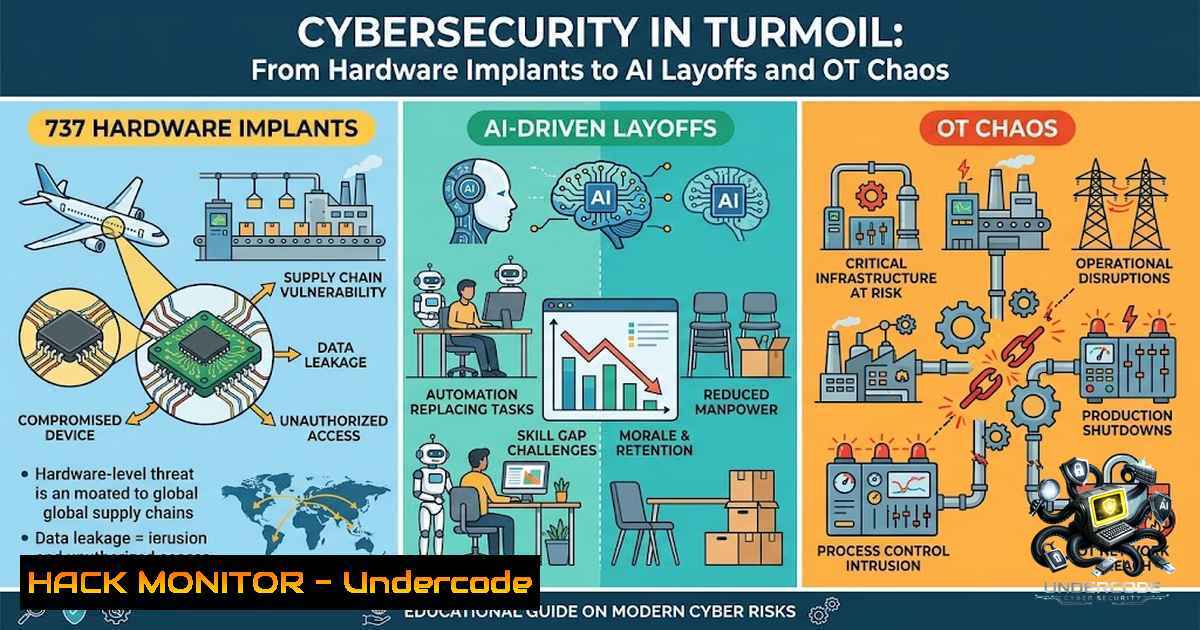
The past week has delivered a stark reminder that cybersecurity vulnerabilities span from the stratosphere to the supermarket. Between a coin-sized device capable of hijacking a Boeing 737’s autopilot, 23 critical vulnerabilities in commercial refrigeration systems, and a major vendor’s 12% workforce reduction in pursuit of AI dominance, the threat landscape is evolving at an unprecedented pace. These events collectively underscore a critical reality: operational technology (OT), aviation systems, and even the business models of security vendors are all under simultaneous siege.
Learning Objectives:
- Understand the technical mechanics and mitigation strategies for the Boeing 737 hardware implant attack
- Analyze the vulnerabilities affecting commercial refrigeration controllers (Copeland XWEB Pro and Danfoss AK-SM 800A) and their OT security implications
- Evaluate the strategic implications of Rapid7’s workforce restructuring and AI-first pivot for the cybersecurity industry
- Identify the risks posed by North Korean IT worker infiltration and in-flight Wi-Fi deauthentication attacks
You Should Know:
- Boeing 737 Hardware Implant: The $100 Coin-Sized Threat
Researchers from UC San Diego and Oberlin College demonstrated a proof-of-concept attack that exposes a critical blind spot in aviation security. The attack uses a Wi-Fi-enabled prototype, roughly the size of a quarter and costing less than $100 to build, which can be attached to an external maintenance port on a Boeing 737 in under 60 seconds.
Once installed, the device sends electrical signals to the aircraft’s internal network, spoofing commands to the Flight Management Computer (FMC). An attacker can manipulate critical flight data including:
– Aircraft weight values (critical for takeoff calculations)
– Outside air temperature readings
– Navigation waypoints and flight plan routes
The researchers spent a decade acquiring thousands of dollars worth of Boeing components for testing and worked closely with Boeing, disclosing parts of their research over six years ago. Boeing has downplayed the practical risk, noting the physical access requirement, but the researchers emphasize that this represents a serious blind spot in aviation security.
Mitigation Commands and Procedures:
Physical Security Hardening (Recommended by Researchers):
 Simple physical mitigation - Epoxy the external access port
 Remove or disable the targeted maintenance port from aircraft
 Implement two-person authentication for external access
The researchers suggest that simply removing the targeted port or plugging it with epoxy would make this attack impossible.
Network Segmentation for Aviation Systems (Conceptual):
 Isolate FMC network from external access ports
 Implement 802.1X port-based authentication for maintenance connections
 Deploy intrusion detection systems monitoring ARINC 429 data buses
 Log all physical access to E&E (Electronics & Equipment) bays
- Commercial Refrigeration System Vulnerabilities: When OT Becomes a Physical Threat
Claroty’s Team82 uncovered severe vulnerabilities in two widely deployed supervisory controllers: the Copeland XWEB Pro and Danfoss AK-SM 800A. These devices coordinate refrigeration equipment in supermarkets, cold-storage facilities, warehouses, and healthcare facilities storing temperature-sensitive pharmaceuticals.
Copeland XWEB Pro: Claroty identified 23 vulnerabilities, with 21 classified as high-severity. These include root-level remote code execution (RCE) flaws allowing complete device compromise.
Danfoss AK-SM 800A: Researchers identified multiple vulnerabilities affecting the embedded web management interface, including an authentication bypass vulnerability tracked as CVE-2026-25085 stemming from a coding logic error.
The attack surface includes:
- Predictable or default credentials
- Internet-exposed management interfaces
- Slow adoption of firmware updates
- Unauthenticated proprietary protocols permitting sensitive operations without encryption
Critical Mitigation Commands:
Firmware Updates (Urgent):
 Copeland XWEB Pro: Upgrade to firmware version 1.13 or later
 Danfoss AK-SM 800A: Upgrade to firmware version R4.3.1 or later
Both vendors have released patches through coordinated vulnerability disclosure.
Network Segmentation (OT Security Best Practices):
 Linux: Isolate OT network using iptables
iptables -A INPUT -i eth0 -p tcp --dport 80 -j DROP  Block HTTP admin access
iptables -A INPUT -i eth0 -p tcp --dport 443 -j DROP  Block HTTPS admin access

Cisco IOS: ACL to restrict management access
access-list 100 deny tcp any any eq 80
access-list 100 deny tcp any any eq 443
access-list 100 permit ip any any

Implement VPN-only access to supervisory controllers
 Deploy jump hosts with MFA for all OT management
Credential Hardening:
 Change all default credentials immediately
 Implement password complexity requirements (minimum 14 characters)
 Enable account lockout after 5 failed attempts
 Rotate credentials every 90 days
3. Rapid7 Layoffs: The AI-First Pivot Reshaping Cybersecurity
Rapid7 announced a 12% workforce reduction affecting approximately 314 employees globally. The restructuring, approved by the board on August 7, follows the appointment of new CEO Wael Mohamed on June 1. The company expects to incur $10-11 million in restructuring charges, primarily from severance.
CEO Wael Mohamed stated: “Rapid7 is a good company ready to be great, but getting there requires clear choices, strong execution, and the discipline to focus on what matters most”. The strategic direction focuses on:
– Deeper investment in detection and response
– Exposure management capabilities
– AI foundation connecting the core platform
Rapid7 has integrated OpenAI’s Trusted Access for Cyber program, using models including GPT-5.5 in Agentic SOC workflows, which has accelerated telemetry triage and reduced false-positive queue times by 25%. The company has also joined Anthropic’s Project Glasswing for defensive engineering and automated vulnerability patching.
Industry Implications:
This restructuring reflects a broader industry trend where cybersecurity vendors are aggressively pivoting toward AI-driven security operations. Security teams should evaluate their vendor ecosystems for similar transitions and assess potential impacts on support, product roadmaps, and service continuity.
- North Korean IT Worker Infiltration: A Federal Agency Breach
The FBI confirmed that a North Korean IT worker successfully gained employment at an unnamed U.S. federal government agency. FBI Deputy Assistant Director Todd Hyman stated: “Last week, we identified a North Korean remote IT worker working for the U.S. federal government”.
Key findings:
- The individual likely worked via a contract position rather than direct federal employment (which requires extensive background checks)
- North Korea deploys thousands of remote IT workers using fraudulent identities to earn wages for the regime and steal intellectual property
- The FBI is investigating the incident and reviewing federal hiring procedures
Defensive Recommendations for Remote Hiring:
 Identity verification procedures
 - Require video interviews with government-issued ID verification
 - Conduct in-person identity confirmation for sensitive roles
 - Utilize third-party background verification services
 - Implement continuous monitoring of remote worker activities
 - Restrict sensitive system access until full verification is complete
- DEF CON Delta Flight Disruption: Wi-Fi Deauthentication in the Sky
Delta Flight 591 from Las Vegas to Atlanta experienced a Wi-Fi deauthentication attack allegedly carried out by passengers returning from DEF CON 34. The incident involved:
– A rogue network named “Delta WiFi Fast” broadcast to impersonate legitimate Delta Wi-Fi
– Forged deauthentication frames repeatedly disconnecting passengers from the legitimate network
– Alleged phishing page collecting personal credentials and Google login data
The cabin crew disabled onboard Wi-Fi for approximately 30 minutes. After landing, federal authorities and airport police boarded the aircraft to question suspects and seize portable Wi-Fi hardware. DEF CON stated: “If one of our attendees was involved, we will ban them from attending in the future and apologize to everyone affected”.
Technical Deep Dive – Deauthentication Attack Mitigation:
Detection and Prevention:
 Linux: Monitor for deauthentication frames using tcpdump
tcpdump -i wlan0 -e -s 0 -c 1000 'wlan subtype deauth'

Windows: Use netsh to capture Wi-Fi events
netsh wlan show wlanreport  Generate detailed Wi-Fi report

Wireshark filter for deauth frames
wlan.fc.type_subtype == 0x0C  Deauthentication frame filter

Enterprise mitigation: Enable Protected Management Frames (PMF)
 PMF (802.11w) protects against forged deauthentication frames
Best Practices for Public Wi-Fi Security:
- Always verify SSID with airline staff before connecting
- Use VPN for all in-flight internet activity
- Enable multi-factor authentication (MFA) on all critical accounts
- Avoid entering sensitive credentials on public Wi-Fi networks
What Undercode Say:
- Aviation security has a physical access blind spot: The Boeing 737 demonstration proves that physical access to external ports remains an underappreciated attack vector. While safety systems may prevent catastrophic outcomes, data manipulation could create operational chaos and erode passenger trust.
-
OT security is no longer optional: The refrigeration system vulnerabilities highlight that cyber-physical attacks are not theoretical—they can spoil food, compromise medical supplies, and disrupt critical supply chains with a few keystrokes.
-
AI is reshaping the cybersecurity industry: Rapid7’s pivot to AI-first operations reflects a fundamental shift. Security teams must prepare for AI-driven threat detection while managing the human cost of industry consolidation.
-
The insider threat extends beyond employees: The North Korean IT worker infiltration demonstrates that remote hiring practices require enhanced verification and continuous monitoring, especially for government and critical infrastructure positions.
-
Wi-Fi attacks are evolving beyond theory: The Delta flight incident proves that Wi-Fi deauthentication and evil twin attacks are practical threats requiring both technical (PMF) and behavioral (user awareness) countermeasures.
-
Vendor viability matters: Rapid7’s restructuring serves as a reminder that security teams must monitor their vendors’ financial health and strategic direction to ensure continued support and product innovation.
Prediction:
-
-1 Boeing 737 hardware attack: Expect increased regulatory scrutiny of physical access controls on commercial aircraft, potentially leading to mandatory port removal or epoxy sealing within 12-18 months. However, the lack of a vendor patch means thousands of aircraft remain vulnerable in the interim.
-
+1 OT security investment surge: The refrigeration vulnerabilities will accelerate OT security spending, particularly in food retail and healthcare supply chains. Expect increased demand for OT-specific security tools and managed detection services.
-
-1 Cybersecurity industry consolidation: Rapid7’s AI pivot and layoffs signal a broader trend where vendors without strong AI capabilities may struggle. This could lead to reduced competition and higher prices for security tools.
-
-1 North Korean IT worker tactics: This federal breach will trigger a wave of enhanced background checks and hiring process reforms, but North Korean IT workers will likely adapt by targeting smaller organizations with less rigorous vetting.
-
+1 Wi-Fi security improvements: The DEF CON incident will accelerate adoption of Protected Management Frames (PMF) in public Wi-Fi networks, though the aviation sector’s slow upgrade cycles mean vulnerabilities will persist for years.
▶️ Related Video (82% Match):
https://www.youtube.com/watch?v=7r_t7wWqDKU
🎯Let’s Practice For Free:
🎓 Live Courses & Certifications:
Join Undercode Academy for Verified Certifications
🚀 Request a Custom Project:
Secure, high-velocity infrastructure and disruptive technological engineering. Contact our engineering team for high-tier development and proprietary systems:
[email protected]
💎 Smart Architecture | 🛡️ Secure by Design | ⭐ Trusted by Thousands
IT/Security Reporter URL:
Reported By: https://lnkd.in/p/e5fuD9Zf – Hackers Feeds
Extra Hub: Undercode MoN
Basic Verification: Pass ✅


