Listen to this Post
Introduction
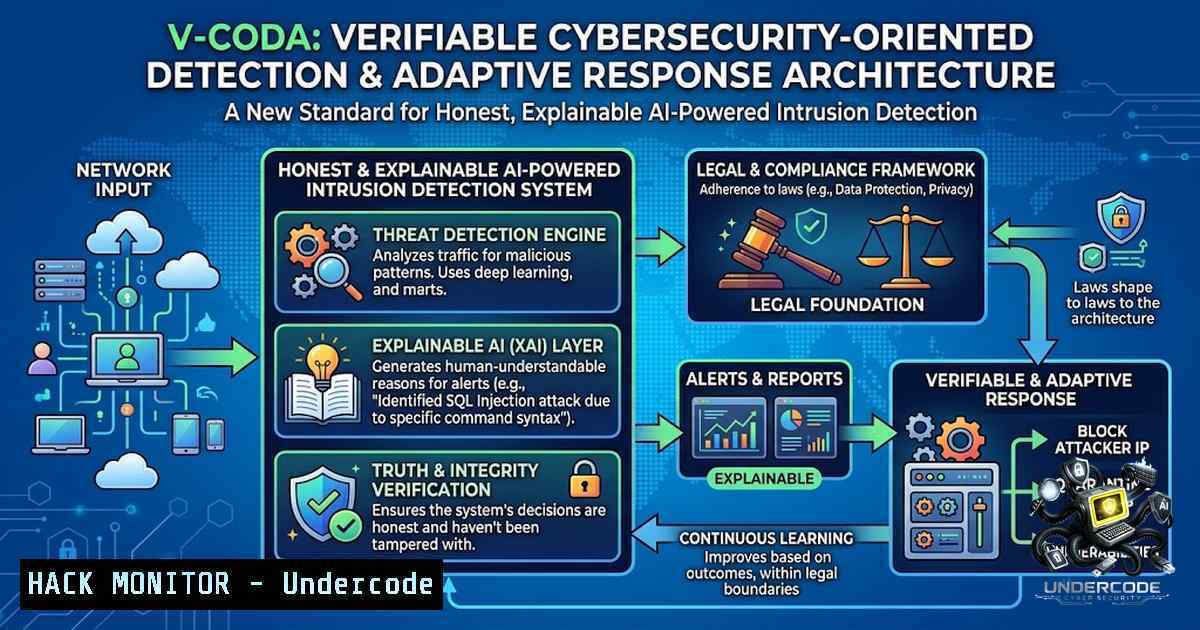
The cybersecurity industry is saturated with AI-powered intrusion detection systems that boast impressive accuracy scores on benchmark datasets yet fail catastrophically when deployed in real operational environments. Most academic Network Intrusion Detection System (NIDS) prototypes stop at “trained a classifier, got an F1 score” — leaving security operations centres (SOCs) with black-box models that cannot explain their decisions, cannot adapt to evolving threats, and cannot be trusted to take autonomous action. V-CODA (Verifiable Cybersecurity-Oriented Detection and Adaptive Response Architecture) directly confronts this problem by building a research-grade hybrid intrusion detection platform that prioritises verifiability, explainability, and safe adaptability over inflated performance claims. This article explores V-CODA’s architecture, deployment workflow, and the broader implications of honest AI in cybersecurity.
Learning Objectives
- Understand the architectural components of a verifiable, hybrid network intrusion detection system combining supervised, deep-learning, and unsupervised anomaly detection models
- Learn how to deploy, configure, and operate V-CODA in a Windows environment, including dataset preparation, model training, and API dashboard access
- Grasp the security principles behind audit-chained decision logging, model integrity verification, self-healing capabilities, and safe adaptive response mechanisms
1. The Detection Architecture: A Multi-Layered Ensemble Approach
V-CODA’s detection engine is built around a validation-trained ensemble that fuses predictions from multiple model families rather than relying on hand-picked thresholds or a single classifier. The architecture processes input data — whether CSV, Parquet, PCAP, live packets, or threat intelligence feeds — through a structured pipeline that includes schema validation, feature compatibility checking, and preprocessing before routing data to parallel detection layers.
Known-Attack Models: The platform employs XGBoost as the primary classifier, supplemented by LightGBM, CatBoost, Random Forest, and Extra Trees. These gradient-boosted and tree-based ensembles provide robust performance on labelled attack data.
Deep Sequence Models: PyTorch-based implementations include Multi-Layer Perceptron (MLP), 1D-CNN, CNN-LSTM, and Transformer encoders. Notably, V-CODA refuses temporal training if reliable sequence order is unavailable, instead of fabricating one — a design choice that prioritises honesty over convenience.
Unsupervised Anomaly Detection: Isolation Forest, autoencoders, and River Half-Space Trees operate without labelled data to identify deviations from normal network behaviour.
Validation-Trained Fusion: A logistic stacking or validation-optimised weighted soft voting mechanism combines all model outputs. This fusion layer is trained on validation data only, preventing leakage and ensuring generalisation.
Threat Reasoning and Explainability: The pipeline concludes with probable MITRE ATT&CK technique mapping, IOC/STIX enrichment, NetworkX-based threat graph correlation, and SHAP-based model explainability.
2. Quick Start: Deploying V-CODA on Windows
V-CODA provides a streamlined PowerShell-based setup for Windows environments. The following step-by-step guide walks through installation, dataset preparation, model training, and API deployment.
Step 1: Environment Setup
Navigate to the project directory and execute the setup script with administrator privileges:
cd C:\path\to\VCODA_Advanced_Full_Project
powershell -ExecutionPolicy Bypass -File .\setup_windows.ps1 -Profile full
..venv\Scripts\Activate.ps1
vcoda system-check
Step 2: Dataset Preparation
Place the NF-UQ-1IDS-v2 dataset (CSV or Parquet format) inside the raw data directory:
data\raw\nf_uq_nids_v2\
Step 3: Data Inspection and Preparation
Verify data integrity and prepare features for training:
vcoda inspect-data --data-dir ".\data\raw\nf_uq_nids_v2"
vcoda prepare-data
Step 4: Model Training
Train supervised, anomaly, and deep learning models sequentially:
vcoda train supervised --task binary
vcoda train supervised --task multiclass
vcoda train anomaly
vcoda train deep --architecture mlp --task binary
vcoda train deep --architecture autoencoder --task binary
vcoda optimise-ensemble
vcoda evaluate
Step 5: Launch API and Dashboard
Start the FastAPI backend and Streamlit dashboard in separate terminals:
 Terminal 1 — API Server
vcoda serve-api

Terminal 2 — Operator Dashboard
vcoda dashboard
| Interface | URL |
|–|–|
| Swagger API Docs | `http://127.0.0.1:8000/docs` |
| Streamlit Dashboard | `http://127.0.0.1:8501` |
3. Safety and Self-Healing: Operational Integrity by Design
V-CODA’s self-healing capabilities represent a significant departure from traditional NIDS deployments. The Self-Healing Manager performs controlled operational recovery rather than unrestricted autonomous modification:
- Detects and quarantines corrupted model artefacts
- Rolls back to the last checksum-valid model version
- Verifies the full SHA-256 audit chain
- Reports stale service heartbeats
- Reverses expired temporary actions
- Preserves drift windows for ADWIN and Page-Hinkley monitoring
Critically, the self-healing system cannot silently retrain supervised models or self-promote model versions. This constraint prevents the platform from inadvertently introducing compromised or degraded models into production.
The response policy, configured in configs/response_policy.yaml, defaults to `recommendation_only` mode. Windows Firewall changes are disabled until explicitly configured, confirmed, and executed with administrator privileges. Model output is never passed to a shell or used to construct arbitrary commands — eliminating a common vector for command injection vulnerabilities.
- Audit Chain and Verifiability: Cryptographic Trust in Security Decisions
Every decision and response action within V-CODA is recorded in an append-only SHA-256 chained audit log. This cryptographic audit trail provides:
- Non-repudiation of security decisions
- Tamper detection through hash chain verification
- Forensic readiness for post-incident analysis
- Regulatory compliance support for audit requirements
Model artefacts are accompanied by checksums and version registry entries, enabling integrity verification at any point. SHAP explanations provide local interpretability for individual predictions, while the audit chain ensures global accountability.
5. Linux Commands for Complementary Security Hardening
While V-CODA is deployed on Windows, security professionals operating in hybrid environments should consider the following Linux commands for complementary network monitoring and system hardening:
Network Traffic Capture and Analysis:
 Capture live traffic for offline analysis
sudo tcpdump -i eth0 -w capture.pcap -C 100 -W 10

Convert PCAP to CSV format for V-CODA ingestion
tshark -r capture.pcap -T fields -e frame.time -e ip.src -e ip.dst -e tcp.srcport -e tcp.dstport -e frame.len -E header=y -E separator=, > traffic.csv
System Hardening:
 Audit open ports and listening services
sudo ss -tulpn

Check for unnecessary services
systemctl list-units --type=service --state=running

Implement fail2ban for brute-force protection
sudo apt-get install fail2ban
sudo systemctl enable fail2ban
Log Monitoring and Integrity:
 Monitor system logs in real-time
sudo tail -f /var/log/syslog | grep -i "failed|error|attack"

Verify file integrity with SHA-256 (mirroring V-CODA's approach)
sha256sum /etc/passwd /etc/shadow /etc/sudoers > baseline_hashes.txt
6. API Security and Configuration Hardening
V-CODA’s FastAPI backend exposes endpoints for model inference, health checks, and system status. Security practitioners should implement the following hardening measures:
API Authentication and Rate Limiting:
 Example: Adding API key authentication to FastAPI
from fastapi import FastAPI, Depends, HTTPException, Security
from fastapi.security import APIKeyHeader

app = FastAPI()
api_key_header = APIKeyHeader(name="X-API-Key")

async def validate_api_key(api_key: str = Security(api_key_header)):
if api_key != os.getenv("VCODA_API_KEY"):
raise HTTPException(status_code=403, detail="Invalid API key")
return api_key

@app.post("/predict")
async def predict(data: dict, api_key: str = Depends(validate_api_key)):
 Prediction logic here
pass
TLS Configuration:
 Recommended uvicorn TLS configuration
uvicorn run:app --host 0.0.0.0 --port 8000 \
--ssl-keyfile=/path/to/private.key \
--ssl-certfile=/path/to/certificate.pem \
--ssl-ca-certs=/path/to/ca_bundle.pem
Environment Isolation:
- Run the API server in a dedicated virtual environment
- Restrict network access to trusted subnets using Windows Firewall
- Store sensitive configuration in environment variables, not version control
What Undercode Say
- Honesty Over Hype: V-CODA’s refusal to ship with a pretrained model or bundled dataset is a refreshing departure from industry norms. The platform forces users to train on their own data and honestly communicates what it can and cannot do. This transparency builds trust and prevents the dangerous overconfidence that plagues many commercial AI security products.
-
Verifiability as a First-Class Citizen: By integrating SHA-256 chained audit logs, SHAP explainability, and model integrity checks, V-CODA transforms intrusion detection from a black-box oracle into an auditable decision-making system. This is particularly valuable for organisations subject to regulatory compliance requirements.
-
Safe Adaptability: The platform’s adaptive response architecture — with drift monitoring, recommendation-only defaults, and human approval gates — demonstrates a mature understanding of the risks associated with autonomous security actions. V-CODA adapts without recklessness.
-
Research-Grade Rigour: The inclusion of multiple model families (XGBoost, LightGBM, CatBoost, PyTorch deep learning, Isolation Forest) and validation-trained ensemble fusion reflects genuine academic depth. This is not a toy project but a serious exploration of what operational AI-powered NIDS could look like.
-
Self-Healing Without Autonomy: The self-healing manager’s ability to detect corruption, quarantine artefacts, and roll back to known-good versions is impressive. Equally important is what it cannot do — silently retrain or self-promote — preventing the platform from becoming an autonomous threat vector.
-
Windows-First Deployment: While the project targets Windows environments, the architecture is fundamentally platform-agnostic. The PowerShell setup scripts and Windows Firewall integration reflect practical operational realities for many enterprise SOCs.
-
Comprehensive Documentation: With dedicated guides covering Windows setup, architecture, dataset preparation, training, evaluation, PCAP analysis, self-healing, API usage, dashboard operation, and troubleshooting, V-CODA sets a high bar for project documentation.
-
Testing and Quality Assurance: The project includes 26 automated tests covering data integrity, security, MITRE mapping, ensemble fusion, deep-model forward passes, checksum rollback, API validation, and response-policy controls. This commitment to testing is essential for any production-oriented security tool.
-
MITRE ATT&CK Integration: Probable MITRE ATT&CK technique mapping bridges the gap between raw detection and actionable threat intelligence, helping analysts understand adversary behaviour rather than just alerting on anomalies.
-
Open Source with Responsible Licensing: The MIT License encourages community contribution and adoption while maintaining clear attribution requirements. The project’s contribution guidelines enforce branch-per-change, test requirements, and a strict policy against committing datasets, credentials, or trained model artefacts.
Prediction
+1 V-CODA’s emphasis on verifiability and explainability will influence the next generation of commercial NIDS products, pushing vendors to move beyond accuracy benchmarks toward transparency and auditability as competitive differentiators.
+1 The project’s validation-trained ensemble fusion approach — combining gradient-boosted trees, deep learning, and unsupervised anomaly detection — represents a template that will be increasingly adopted by security research labs and enterprise SOCs seeking robust, generalisable detection.
+1 The self-healing and audit-chain mechanisms establish a new baseline for operational integrity in AI-powered security tools, potentially influencing regulatory frameworks and compliance standards for AI deployment in critical infrastructure.
-1 Without a bundled dataset or pretrained models, V-CODA requires significant data preparation and computational resources for training, which may limit adoption among smaller organisations or resource-constrained security teams.
-1 The Windows-first deployment focus may alienate the large segment of security professionals operating in Linux-dominated environments, although the architecture itself is platform-agnostic.
+1 The project’s honest approach — refusing to fabricate sequence order, refusing to silently retrain, and communicating limitations transparently — challenges the pervasive marketing culture in AI security and may catalyse a broader movement toward responsible AI in cybersecurity.
+1 As organisations increasingly demand explainable AI for regulatory compliance and incident investigation, V-CODA’s SHAP-based explainability and cryptographic audit trail will become essential features rather than optional enhancements.
+1 The integration of drift monitoring (ADWIN and Page-Hinkley) positions V-CODA to handle concept drift in evolving network environments, a critical capability that many static NIDS solutions lack.
-1 The reliance on the NF-UQ-1IDS-v2 dataset for validation, while academically sound, may not fully represent the diversity of real-world enterprise network traffic, potentially limiting generalisation.
+1 By releasing V-CODA as open source under the MIT License, the project democratises access to research-grade AI-powered intrusion detection, enabling security researchers and practitioners worldwide to experiment, contribute, and build upon the platform.
▶️ Related Video (72% Match):
🎯Let’s Practice For Free:
🎓 Live Courses & Certifications:
Join Undercode Academy for Verified Certifications
🚀 Request a Custom Project:
Secure, high-velocity infrastructure and disruptive technological engineering. Contact our engineering team for high-tier development and proprietary systems:
[email protected]
💎 Smart Architecture | 🛡️ Secure by Design | ⭐ Trusted by Thousands
IT/Security Reporter URL:
Reported By: https://lnkd.in/p/e_8m9cYF – Hackers Feeds
Extra Hub: Undercode MoN
Basic Verification: Pass ✅


