Listen to this Post
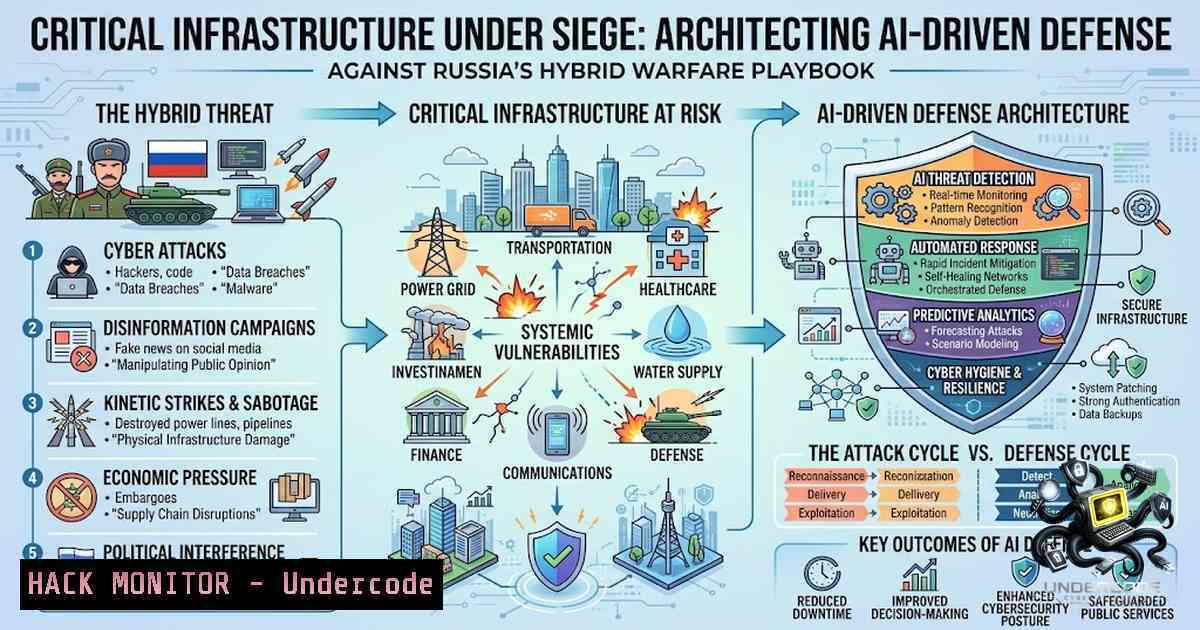
Introduction:
Russia’s hybrid warfare strategy has evolved beyond conventional military engagement into a persistent, multi-domain assault targeting Europe’s critical infrastructure. Recent attacks on Polish energy facilities—where Russian state-sponsored actors leveraged private APN networks, default credentials, and unpatched FortiGate VPNs to breach OT environments—demonstrate that cyberattacks are now capable of causing permanent physical damage to industrial control systems. Defending against this threat requires a fundamental shift from reactive perimeter security to proactive, AI-driven Security Operations Centers (SOCs) that integrate real-time threat detection, rigorous OT/ICS network isolation, and full alignment with NIS2/ProtectEU regulatory frameworks.
Learning Objectives:
- Understand the four pillars of Russian hybrid warfare and their specific implications for OT/ICS environments
- Master the technical implementation of AI-driven SOC architectures for real-time intrusion detection in critical infrastructure
- Learn practical Linux/Windows commands and configuration techniques for hardening OT network perimeters
- Gain actionable insights into NIS2 compliance, supply chain security, and zero-trust principles for industrial control systems
You Should Know:
- The Four Pillars of Russian Hybrid Warfare: From Cyberattacks to Physical Sabotage
Russia’s hybrid campaign against Europe and the Balkans rests on four interconnected threat pillars: cyberattacks on critical infrastructure (OT & IT), physical sabotage, airspace violations, and information warfare. The cyber dimension is the most immediate and technically sophisticated. State-sponsored hacking groups linked to the FSB and GRU—including APT28 (Fancy Bear), Sandworm, and Turla (FSB Center 16)—conduct daily operations across EU member states.
The December 2025 attack on Poland’s energy sector serves as a case study in hybrid warfare execution. On the morning of December 29, coordinated attacks hit at least 30 wind and solar farms, alongside a combined heat and power (CHP) plant supplying heat to nearly half a million people. The attackers gained access to operational technology systems at CHP plants and renewable energy dispatch centers, primarily targeting grid safety and stability monitoring systems. In some cases, ICS devices were irreparably damaged—bricked beyond field restoration.
The attack chain revealed alarming technical sophistication. Adversaries compromised a FortiGate VPN + firewall at a wind farm, then used a Teltonika cellular router on the same network to target a private APN managed by a distribution system operator via an SSH tunnel. They scanned the APN repeatedly and found a WAGO PFC200 programmable logic controller (PLC) at the CHP plant—its web interface accessible via the APN and protected only by default admin credentials. After compromising that controller, the actors used SSH to access the plant’s OT network, then scanned for and found three Siemens PLCs, switching them to STOP mode and shutting down the steam turbine and water treatment system.
Step‑by‑step guide: Hardening OT Network Perimeters
Step 1: Audit Private APN Configurations
 Linux: Scan for exposed APN interfaces
nmap -p 22,23,80,443,502,102 <APN_SUBNET>/24

Windows: Use PowerShell to check for default credentials in PLC configurations
Get-Content -Path "C:\ProgramData\PLC_Configs.cfg" | Select-String "admin|password|default"
Step 2: Enable Client Isolation and Network Segmentation
 Cisco IOS: Configure private VLAN isolation
interface GigabitEthernet0/1
switchport mode private-vlan host
switchport private-vlan host-association 100 101
Step 3: Change Default Credentials and Enforce MFA
 Linux: Force password change for all OT device accounts
chage -d 0 <username>
 Audit FortiGate local user accounts
fnsysctl ls -l /etc/passwd
Step 4: Monitor Traffic Between OT Network and APN Gateway
 Linux: Set up tcpdump for OT network monitoring
tcpdump -i eth0 -1n -s 0 -w ot_traffic_$(date +%Y%m%d).pcap

Windows: Use PowerShell for event log monitoring
Get-WinEvent -LogName Security | Where-Object { $_.Id -in (4624,4625,4672) }
- AI-Driven SOC Architecture: Real-Time Intrusion Detection for OT/ICS Environments
Traditional security operations centers (SOCs) are ill-equipped to handle the unique challenges of OT environments—legacy protocols, air-gapped networks, and the criticality of system availability. AI-driven SOCs address these gaps through multi-agent architectures that perform real-time telemetry analysis across IT, OT, and wireless network domains.
Modern AI-powered SOC platforms integrate intrusion detection systems (IDS), SIEM, and SOC functions using multi-layer AI analysis to deliver real-time threat detection with 80–90% fewer false positives compared to traditional solutions. The Agentic SOC architecture employs hierarchical swarm-orchestrated multi-agent LLM systems for autonomous OT cyber defense. These systems deploy distributed agents that ingest data from Suricata/Zeek, map threats to the MITRE ATT&CK framework, and enable human-in-the-loop response.
Step‑by‑step guide: Deploying an AI-Powered SOC for OT/ICS
Step 1: Deploy Network Monitoring Sensors
 Linux: Install and configure Suricata for OT protocol inspection
apt-get install suricata
suricata -c /etc/suricata/suricata.yaml -i eth0 --af-packet

Configure Zeek for deep packet inspection of industrial protocols
zeek -i eth0 -f "ip or icmp or tcp or udp" -C
Step 2: Implement AI-Driven Threat Detection with Open-Source Tools
 Clone and deploy OneAlert - AI-powered SOC for OT/ICS
git clone https://github.com/mangod12/OneAlert
cd OneAlert
docker-compose up -d
Step 3: Configure MITRE ATT&CK Mapping and Alert Prioritization
// Example: Custom detection rule for OT-specific threats
{
"technique": "T0812 - Default Credentials",
"protocol": "modbus",
"detection": "src_ip == <APN_SUBNET> && dst_port == 502 && payload contains 'admin'"
}
Step 4: Implement Human-in-the-Loop Response Workflows
 Python: Automated alert triage with analyst approval
def triage_alert(alert):
if alert.severity == "CRITICAL" and alert.asset_type == "PLC":
notify_analyst(alert)
return "PENDING_APPROVAL"
else:
auto_respond(alert)
return "AUTO_RESOLVED"
3. NIS2/ProtectEU Compliance: Securing the OT Supply Chain
The NIS2 Directive (Directive (EU) 2022/2555) introduces a risk-based framework with stricter requirements for incident reporting, supply chain oversight, and business continuity. Operators in scope must implement cybersecurity risk-management measures including supply-chain security, encryption, and Zero Trust principles, and report significant incidents through a three-stage timeline.
For OT/ICS environments, NIS2 requires rigorous risk审查 of major interconnected third-party service providers, including managed security service providers (MSSPs). The directive expands its scope to include a broader range of digital services and clarifies supervisory asymmetry between essential and important entities. Industrial operators must now comply with the 24-hour early warning obligation and implement backup and disaster recovery procedures specifically for control systems.
Step‑by‑step guide: Achieving NIS2 Compliance for OT Environments
Step 1: Conduct Supply Chain Risk Assessments
 Linux: Automated vulnerability scanning for OT suppliers
nuclei -t cves/ -t misconfiguration/ -target https://<supplier_ip> -o supply_chain_vulns.txt
Step 2: Implement Zero Trust Architecture
 Windows: Enable network segmentation via Windows Firewall
New-1etFirewallRule -DisplayName "OT Segmentation" -Direction Inbound -LocalPort 102 -Action Block
 Linux: Configure iptables for OT network isolation
iptables -A INPUT -s <OT_SUBNET> -j ACCEPT
iptables -A INPUT -s <IT_SUBNET> -j DROP
Step 3: Deploy Centralized Logging and Monitoring
 Linux: Set up rsyslog for centralized OT logging
echo ". @@<central_syslog_server>:514" >> /etc/rsyslog.conf
systemctl restart rsyslog
Step 4: Establish Incident Response and Recovery Procedures
 Automate backup of PLC configurations
for plc in $(cat plc_list.txt); do
curl -X GET http://$plc/backup -o backup_$plc_$(date +%Y%m%d).cfg
done
4. Gemini Enterprise: Multi-Agent Orchestration for Cybersecurity Operations
Google Cloud’s Gemini Enterprise platform represents a paradigm shift in how security operations can leverage AI agents for autonomous threat detection and response. The platform assigns every agent a unique cryptographic ID (Agent Identity) for complete traceability and auditing, while Agent Gateway provides “air traffic control” to ensure secure interactions between agents and data. Model Armor protects against prompt injection, tool poisoning, and sensitive data leakage.
For cybersecurity practitioners, this means deploying autonomous agents that can execute complex, multi-step security workflows—running for hours or days without constant manual prompting. Agents can be built using natural language or visual interfaces, with human-in-the-loop checkpoints ensuring review and approval at critical decision points.
Step‑by‑step guide: Building Security Agents with Gemini Enterprise
Step 1: Create an Agent with Natural Language
 In Gemini Enterprise Agent Designer:
"Create a security monitoring agent that continuously scans OT network traffic for default credentials, anomalous Modbus commands, and unauthorized SSH sessions. Alert the SOC team and create a Jira ticket for any critical findings."
Step 2: Define Reusable Security Skills
 Skill: OT Threat Triage
inputs:
- alert_data: json
- asset_type: string
actions:
- correlate with threat intelligence
- assign severity (critical/high/medium/low)
- create incident ticket
- notify on-call analyst
Step 3: Deploy Agent with Zero-Trust Verification
 Agent Gateway enforces read-only policies and blocks unauthorized operations
 Each agent action is cryptographically signed and audited
- Vulnerability Exploitation and Mitigation: Lessons from the Polish Energy Sector Attack
The Polish energy sector attack exposed critical vulnerabilities that security teams must address immediately:
- Internet-facing FortiGate VPN portals without MFA—authentication relied on accounts statically defined inside the device’s configuration file
- Credential reuse across sites—one compromised account enabled fleet-wide access
- Default credentials on PLCs—WAGO PFC200 controllers accessed via APN with factory-default admin passwords
- Insufficient OT network segmentation—attackers pivoted from compromised VPN to OT network via SSH
- Inadequate monitoring of APN traffic—attackers scanned APN networks repeatedly without detection
Step‑by‑step guide: Mitigating Critical Vulnerabilities
Step 1: Enforce MFA for All Remote Access
 FortiGate: Configure MFA for VPN users
config user local
edit "vpn_user"
set type password
set passwd <encrypted>
set two-factor enable
next
Step 2: Implement Credential Management and Rotation
 Linux: Force password rotation for all OT device accounts
for user in $(getent passwd | cut -d: -f1); do
chage -M 30 -W 7 $user
done

Windows: Use PowerShell to audit local admin accounts
Get-LocalUser | Where-Object { $_.Enabled -eq $true }
Step 3: Segment OT Networks and Restrict Communications
 Linux: Configure VLAN tagging for OT/IT separation
ip link add link eth0 name eth0.100 type vlan id 100
ip link add link eth0 name eth0.200 type vlan id 200
Step 4: Deploy Canary Files for Early Detection
 Linux: Create canary files to detect unauthorized access
echo "CANARY - DO NOT MODIFY" > /opt/ot/canary_config.cfg
chattr +i /opt/ot/canary_config.cfg
What Undercode Say:
- Key Takeaway 1: Russian hybrid warfare has moved beyond cyber-espionage into destructive, physically damaging attacks on critical infrastructure. The December 2025 Polish energy sector attack demonstrated that adversaries can permanently brick ICS devices, shut down steam turbines, and disrupt water treatment systems—all without triggering electrical outages due to the inherent fail-safe design of power systems.
-
Key Takeaway 2: The attack surface is alarmingly broad and often trivial to exploit. Attackers gained initial access through internet-facing FortiGate VPN portals with no MFA and default credentials. Credential reuse across 30+ sites transformed one compromised account into a fleet-wide compromise. Organizations must treat private APNs as untrusted networks, implement rigorous network segmentation, and enforce centralized identity management with MFA for all remote access.
-
Key Takeaway 3: AI-driven SOCs are no longer optional—they are essential for defending against nation-state adversaries operating at scale. Multi-agent architectures can perform real-time telemetry analysis across IT, OT, and wireless domains, reducing false positives by 80–90% and enabling autonomous threat detection and response. Gemini Enterprise’s cryptographic agent identities and zero-trust verification at every orchestration step represent the future of secure AI deployment in critical infrastructure.
-
Key Takeaway 4: NIS2/ProtectEU compliance requires immediate action on supply chain security, incident reporting, and OT backup/recovery procedures. Organizations must conduct comprehensive audits of private APN configurations, include them in penetration testing and red team exercises, and implement centralized logging and monitoring of all gateway devices.
-
Key Takeaway 5: The human element remains critical. Canary-file detection stopped the wiper malware twice at the CHP plant, forcing attackers to burn 50 minutes recompiling and retrying. This bought valuable time for defenders and highlights the importance of layered detection strategies that don’t rely solely on signature-based identification.
-
Key Takeaway 6: Attribution is complex and multi-layered. CERT Polska’s analysis distinguishes between infrastructure attribution (high confidence) and tooling attribution (low confidence), noting that DynoWiper shows similarities to Sandworm tools but cannot be conclusively attributed. Security teams must focus on detection and response capabilities rather than relying solely on threat intelligence attribution.
Prediction:
-
-1 Russian hybrid warfare operations will intensify across Europe and the Balkans through 2027, with attacks expanding from energy and water infrastructure to transportation, telecommunications, and financial systems. The CIA has already warned European allies that Russia is preparing potential false-flag attacks in Poland and Baltic states.
-
-1 The exploitation of OT/IoT devices will become more sophisticated, with adversaries leveraging AI-generated malware and automated exploitation frameworks. The Polish attack already showed signs of LLM-generated wiper code—a trend that will accelerate as threat actors adopt generative AI for offensive operations.
-
+1 The convergence of AI-driven defense platforms (like Gemini Enterprise) with OT-specific security architectures will create new defensive capabilities that can match the speed and scale of nation-state attacks. Agentic SOCs with autonomous threat hunting and response will become standard for critical infrastructure operators.
-
+1 Regulatory frameworks like NIS2 and ProtectEU will drive widespread adoption of zero-trust architectures and supply chain security measures across European critical infrastructure. This regulatory pressure, combined with high-profile attacks, will accelerate investment in OT security and AI-driven defenses.
-
-1 The skills gap in OT/ICS cybersecurity will worsen as demand for specialized expertise outpaces supply. Organizations will increasingly rely on AI-powered automation to compensate for staffing shortages, but human oversight will remain essential for complex incident response and decision-making.
-
+1 International cooperation on cybersecurity—as demonstrated by the 12-1ation coalition disrupting APT28’s DNS hijacking network—will expand, creating more effective collective defense mechanisms against state-sponsored cyber threats.
-
-1 Critical infrastructure operators who delay implementing MFA, network segmentation, and AI-driven monitoring will face catastrophic operational disruptions. The Polish attack demonstrated that adversaries are patient, well-resourced, and capable of systematically compromising hundreds of sites with relatively simple techniques.
-
+1 The integration of cryptographic agent identities and zero-trust verification into AI platforms will establish new security baselines for autonomous systems, reducing the risk of agent poisoning, prompt injection, and unauthorized data access.
▶️ Related Video (84% Match):
https://www.youtube.com/watch?v=7w1R4OntSx8
🎯Let’s Practice For Free:
🎓 Live Courses & Certifications:
Join Undercode Academy for Verified Certifications
🚀 Request a Custom Project:
Secure, high-velocity infrastructure and disruptive technological engineering. Contact our engineering team for high-tier development and proprietary systems:
[email protected]
💎 Smart Architecture | 🛡️ Secure by Design | ⭐ Trusted by Thousands
IT/Security Reporter URL:
Reported By: https://lnkd.in/p/e-p3NBn5 – Hackers Feeds
Extra Hub: Undercode MoN
Basic Verification: Pass ✅


