
Listen to this Post
Introduction:
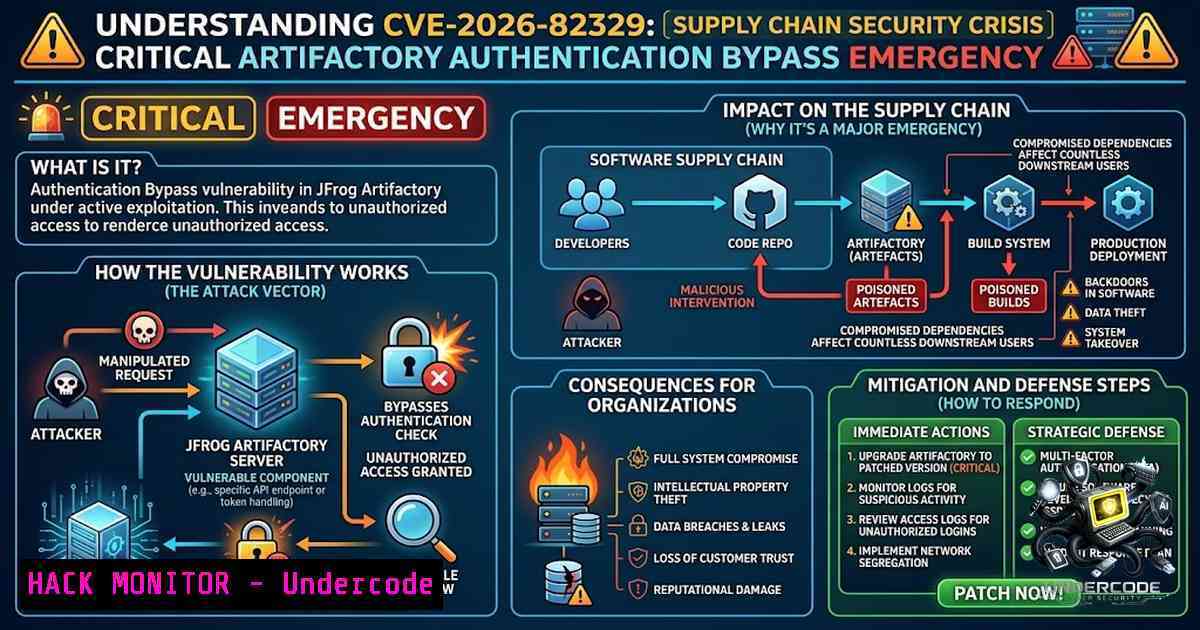
A critical authentication bypass vulnerability in JFrog Artifactory (CVE-2026-82329) is being actively exploited in the wild just days after public disclosure, with attackers minting administrative access tokens against vulnerable self-hosted instances. This flaw, carrying a CVSS score of 9.8 out of 10, allows unauthenticated attackers with network access to obtain full administrative privileges over an organization’s software repository manager—effectively granting control over the entire software supply chain. With Artifactory serving as the central hub for storing and distributing binaries, container images, and software packages, a successful compromise enables attackers to inject malicious code, steal intellectual property, and push poisoned updates downstream to customers.
Learning Objectives & Secrets:
- Objective 1: Understand the Attack Mechanism — Grasp how the authentication bypass works at a technical level, including the “phantom join key” vulnerability in JFrog Access that enables unauthenticated admin token minting.
-
Objective 2: Deploy Immediate Mitigations — Learn the exact patched versions to upgrade to, how to verify your instance’s status, and emergency workarounds if immediate patching is not possible.
-
Objective 3: Hunt for Indicators of Compromise — Master the forensic techniques, log analysis commands, and detection signatures to identify whether your Artifactory instance has already been compromised.
You Should Know:
- Anatomy of the Attack — How the Authentication Bypass Works
The vulnerability resides in JFrog Access, the component responsible for issuing and validating credentials within the Artifactory ecosystem. Under default configurations, self-hosted instances that lack an explicitly configured additional join key receive an implicit “phantom” join key. Attackers can forge a cluster “join” JWT using this predictable key as an HMAC secret.
The exploit chain unfolds in four unauthenticated steps:
- Step 1: Forge a cluster “join” JWT. The bug leaves a blank join key in the trusted verifier set on a default install. `getSigningKey(“”)` = `pkcs7(
, 32)` = 32 bytes of `0x20` — a fully known secret. Attackers sign a valid join JWT with alg=HS256,kid = SHA256(""), andskip_node_registration=true. -
Step 2: Send `POST /access/api/v1/registry/join` (
RegistryNoAuthResource— requiring no authentication). A successful request returns an HTTP 201 with a `SERVICE` token bearing `admin` scope. -
Step 3: Use that token to call `POST /access/api/v1/tokens` with `scope=applied-permissions/admin&audience=` — minting a full administrator platform access token.
-
Step 4: Use the admin token to read the entire server configuration, list and steal every access token, and on Pro/Enterprise versions, create admin users and repositories.
Security researchers at watchTowr confirmed that attackers are using this technique to mint administrator tokens and enumerate users, groups, credential sets, and federated access topologies. As Vercel CEO Guillermo Rauch warned: “It’s an RCE bomb because Artifactory hosts binaries, so you can basically poison everything”.
2. Affected Versions and Patch Status
JFrog released patches on August 28, 2026, with Artifactory version 7.161.20. The vulnerability affects the following self-hosted release branches:
| Affected Versions | Fixed Versions |
|||
| 7.161.0 through 7.161.19 | 7.161.20 |
| 7.146.0 through 7.146.36 | 7.146.38 |
| 7.133.0 through 7.133.28 | 7.133.29 |
| 7.125.0 through 7.125.19 | 7.125.20 |
| 7.117.0 through 7.117.27 | 7.117.28 |
| 7.111.4 through 7.111.21 | 7.111.21 |
JFrog has already applied fixes to all cloud-hosted instances, requiring no action from cloud customers. However, self-hosted customers must upgrade immediately.
3. Emergency Patching — Step-by-Step Guide
For Linux Self-Hosted Instances:
 Step 1: Check current version
curl -s http://localhost:8082/artifactory/api/system/version | grep version

Step 2: Stop Artifactory service
sudo systemctl stop artifactory

Step 3: Backup critical files
sudo cp -r /opt/jfrog/artifactory/var/etc /opt/jfrog/artifactory/var/etc.bak.$(date +%Y%m%d)
sudo cp -r /opt/jfrog/artifactory/var/data /opt/jfrog/artifactory/var/data.bak.$(date +%Y%m%d)

Step 4: Download and install patched version (example for 7.161.20)
wget https://releases.jfrog.io/artifactory/jfrog-pro/jfrog-artifactory-pro-7.161.20.zip
sudo unzip -o jfrog-artifactory-pro-7.161.20.zip -d /opt/jfrog/artifactory/

Step 5: Restart service
sudo systemctl start artifactory
sudo systemctl status artifactory

Step 6: Verify patch applied
curl -s http://localhost:8082/artifactory/api/system/version
For Docker Deployments:
 Pull the patched image
docker pull releases-docker.jfrog.io/jfrog/artifactory-pro:7.161.20

Stop and remove existing container
docker stop artifactory
docker rm artifactory

Re-run with same volumes
docker run -d --1ame artifactory \
-v artifactory_data:/var/opt/jfrog/artifactory \
-p 8081:8081 -p 8082:8082 \
releases-docker.jfrog.io/jfrog/artifactory-pro:7.161.20
4. Detection and Compromise Assessment
If you cannot patch immediately, restrict administrative network access to trusted internal IP addresses. However, given active exploitation, patching remains the only definitive solution.
Check for Indicators of Compromise:
 Linux - Review Artifactory access logs for suspicious POST requests
sudo grep -E "POST /access/api/v1/registry/join" /opt/jfrog/artifactory/var/log/access.log
sudo grep -E "POST /access/api/v1/tokens" /opt/jfrog/artifactory/var/log/access.log

Check for unauthorized token creation
sudo grep -E "Created new token|Token created" /opt/jfrog/artifactory/var/log/artifactory.log

List all active tokens via API (requires existing admin credentials)
curl -u admin:password "http://localhost:8082/access/api/v1/tokens" | jq '.'

Check for unexpected admin users
curl -u admin:password "http://localhost:8082/artifactory/api/security/users" | jq '.[] | select(.admin == true)'

Check system configuration for unauthorized changes
curl -u admin:password "http://localhost:8082/artifactory/api/system/configuration"
Windows Detection Commands (PowerShell):
 Check access logs for suspicious patterns
Select-String -Path "C:\jfrog\artifactory\var\log\access.log" -Pattern "POST /access/api/v1/registry/join"
Select-String -Path "C:\jfrog\artifactory\var\log\access.log" -Pattern "POST /access/api/v1/tokens"

Check for unauthorized tokens
Invoke-RestMethod -Uri "http://localhost:8082/access/api/v1/tokens" -Credential (Get-Credential) | ConvertTo-Json
Key IOCs to Hunt For:
– `POST /access/api/v1/registry/join` requests originating from non-cluster hosts
– Unusual `SERVICE` token generation followed by `admin` scope token creation
– Unexpected new admin users or repository changes
– Outbound connections from Artifactory to unknown external IPs
5. Sigma Rule for Detection
Security teams should deploy the following Sigma rule to detect exploitation attempts:
title: CVE-2026-82329 JFrog Artifactory Admin Token Creation
status: experimental
description: Detects attempts to create administrative tokens in JFrog Artifactory via API
logsource:
product: linux
service: access_log
detection:
selection:
cs-method: 'POST'
cs-uri-query:
- '/access/api/v1/registry/join'
- '/access/api/v1/tokens'
condition: selection
level: critical
6. Long-Term Hardening Recommendations
Beyond immediate patching, implement these security measures:
- Network Segmentation: Ensure Artifactory is not exposed to the public internet unless absolutely necessary. Place it behind a VPN or internal network with strict firewall rules.
-
Configure Explicit Join Keys: Set an explicit, strong join key in your Artifactory configuration to prevent the “phantom” key from being used.
-
Enable Audit Logging: Ensure comprehensive audit logging is enabled and logs are shipped to a centralized SIEM for real-time monitoring.
-
Rotate All Credentials: If any suspicion of compromise exists, rotate all admin passwords, API keys, and access tokens immediately.
-
Review Connected Systems: Audit all systems, build pipelines, and downstream consumers that interact with Artifactory for signs of backdoor access or malicious changes.
7. The Supply Chain Risk Perspective
When attackers gain administrative access to Artifactory, they can do what every engineering team does best—build, ship, and distribute software fast. From there, they can tamper with build pipelines, move laterally into production systems, and potentially push malicious changes downstream to customers. This represents a software supply chain attack of the highest order, similar in severity to the SolarWinds and Log4j incidents. Organizations that fail to patch risk not only their own security but also the security of every customer and partner relying on their software.
What Undercode Say:
- Key Takeaway 1: The speed of weaponization—from disclosure on August 28 to active exploitation observed by August 31—demonstrates that threat actors are monitoring security advisories and moving with unprecedented efficiency. “This moved from disclosure to real-world exploitation with uncomfortable efficiency,” noted watchTowr’s Yordan Ganchev. Organizations must adopt a zero-day readiness posture, assuming that any critical vulnerability will be exploited within 72 hours of disclosure.
-
Key Takeaway 2: The “phantom join key” vulnerability reveals a fundamental design weakness in default configurations of enterprise software. This serves as a critical reminder that default settings are not secure settings. Organizations must conduct regular security reviews of all default configurations, especially for systems that sit at the heart of the software supply chain. The fact that the flaw affects default configurations with no authentication required and no user interaction makes it exceptionally dangerous.
Analysis: This incident underscores the systemic risk posed by centralized software repositories. Artifactory, like GitHub, GitLab, and Nexus, has become a crown jewel target for sophisticated attackers. The JFrog vulnerability is particularly concerning because it requires no credentials, no user interaction, and affects default installations—making it an ideal entry point for mass exploitation campaigns. While broad-scale scanning has not yet been observed, security experts warn that “that is unlikely to stay the case for long”. Organizations running self-hosted Artifactory should treat this as a Code Red incident and prioritize patching above all other tasks. The downstream impact of a successful compromise—poisoned software updates distributed to thousands of customers—could dwarf the immediate breach. As one researcher noted: “Anyone following along knows what comes next: things will get worse”.
Prediction:
- +1 Organizations that patch within the first 48 hours will demonstrate supply chain security maturity and likely avoid compromise, reinforcing the business case for rapid incident response capabilities.
-
-1 Widespread scanning and automated exploitation are expected to commence within the next 7–14 days, dramatically increasing the number of compromised instances.
-
-1 At least one major data breach or software supply chain attack resulting from this vulnerability will be publicly disclosed within the next 30 days, involving a Fortune 500 company.
-
-1 The incident will accelerate regulatory scrutiny of software supply chain security, potentially leading to mandatory patch windows and disclosure requirements for critical infrastructure providers.
-
+1 This event will drive increased adoption of runtime application self-protection (RASP) and zero-trust architecture for CI/CD pipelines, as organizations recognize the inadequacy of perimeter-based security for repository managers.
▶️ Related Video (78% Match):
https://www.youtube.com/watch?v=0J6MjaHIBMI
🎯Let’s Practice For Free:
🎓 Live Courses & Certifications:
Join Undercode Academy for Verified Certifications
🚀 Request a Custom Project:
Secure, high-velocity infrastructure and disruptive technological engineering. Contact our engineering team for high-tier development and proprietary systems:
[email protected]
💎 Smart Architecture | 🛡️ Secure by Design | ⭐ Trusted by Thousands
IT/Security Reporter URL:
Reported By: https://lnkd.in/p/eZsuAdjG – Hackers Feeds
Extra Hub: Undercode MoN
Basic Verification: Pass ✅


