
Listen to this Post
Introduction
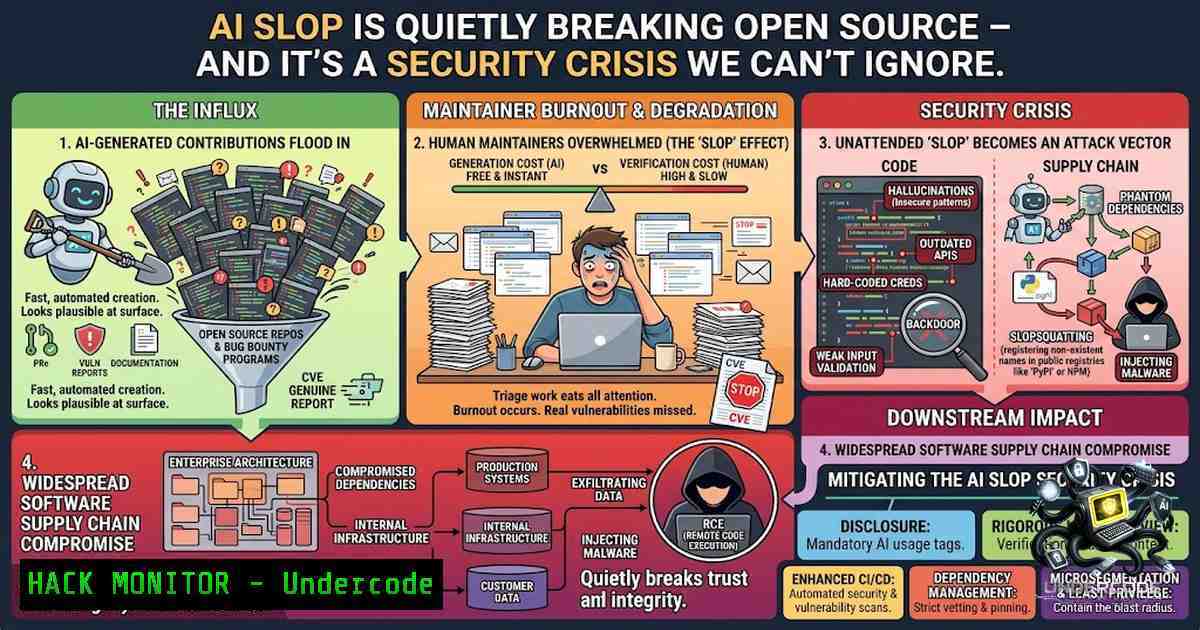
The open-source ecosystem—the foundational infrastructure upon which modern software development is built—is under siege. Not by sophisticated nation-state adversaries or zero-day exploits, but by an avalanche of AI-generated “vulnerability reports” that are confident, well-formatted, and completely fabricated. In 2025, curl’s bug bounty program saw its confirmed-vulnerability rate plummet from a historical 15%+ to below 5%, not because the code got more secure, but because AI-generated noise drowned out legitimate security research. The program shut down entirely in January 2026. This isn’t an isolated incident—it’s a systemic failure that parallels the XZ Utils backdoor in its most dangerous form: maintainer burnout as an attack surface.
Learning Objectives & Secrets
Objective 1: Understand the Scope of the AI Slop Crisis
By the end of this article, you’ll comprehend how AI-generated vulnerability reports and pull requests are overwhelming open-source maintainers, with curl’s valid submission rate dropping from 15% to under 5% in a single year. You’ll recognize this as a supply-chain security risk, not merely an annoyance.
Objective 2 Secret Tip: Detect AI-Generated Vulnerability Reports
AI slop reports share telltale signatures: references to nonexistent functions, fabricated commit hashes, unverifiable patches, and vulnerabilities that cannot be reproduced. They also exhibit stylistic markers—perfect formatting, excessive em dashes, and phrases like “delve” that no human naturally produces on a first draft. Train your security team to spot these patterns before wasting triage hours.
Objective 3 Secret Tip: Implement a Reproducible PoC Gate
Daniel Stenberg’s cardinal rule: “never report a bug unless you understand it and can reproduce it”. Require a reproducible proof of concept for every inbound security report. This single policy would have filtered out 95% of curl’s 2025 submissions.
You Should Know
- The curl Bug Bounty Postmortem – What Actually Happened
curl’s bug bounty program launched in April 2019 and, over its lifetime, confirmed 87 vulnerabilities and paid out over $100,000 in rewards. The downfall began slowly in the second half of 2024 but accelerated dramatically in 2025. By mid-2025, roughly 20% of submissions were AI-generated “slop”—reports that sounded technical but contained nothing useful. The submission volume spiked to eight times the historical norm. The confirmed-vulnerability rate, which had historically hovered above 15%, plummeted to below 5%. “Not even one in twenty was real,” Stenberg wrote.
The maintainers faced an impossible choice: spend hours debunking each AI-generated report or risk missing real vulnerabilities. The never-ending slop submissions took a “serious mental toll” and “hampered our will to live,” Stenberg admitted. The program officially ended on January 31, 2026.
What This Means for Your Organization:
If you depend on open source (and you do), this is a direct threat to your supply chain. curl is installed on virtually every server in the world. When its security program collapses under the weight of AI noise, the entire internet becomes less secure.
Practical Takeaway – How to Triage AI Security Findings:
 Step 1: Require a reproducible PoC for every submission
 Before even reading a report, ask: "Can you provide a working exploit?"

Step 2: Run a quick sanity check on the reported vulnerability
 Example: If someone claims a buffer overflow in curl, verify the function exists
grep -r "vulnerable_function_name" /path/to/curl/source/

Step 3: Use AI detection tools cautiously – they're not foolproof
 But stylistic analysis can help flag suspicious reports
For security teams running bug bounty programs:
- Gate every report on a reproducible proof of concept
- Weight findings by demonstrated exploitability, not volume or confidence
- Protect analyst time by triaging on evidence, not conviction
- Kubernetes Ingress NGINX – A Critical Infrastructure Collapse
If curl’s story is a warning, Kubernetes Ingress NGINX is the catastrophe in progress. In March 2026, Kubernetes will retire Ingress NGINX—a piece of critical infrastructure used by approximately 50% of cloud-1ative environments. There will be no more releases for bug fixes, security patches, or any updates of any kind after the project is retired.
The reason is brutally simple: for the last several years, Ingress NGINX has been maintained solely by one or two people working in their free time. Despite repeated calls for help, the project never received the contributors it desperately needed. The maintainers burned out.
The Security Fallout:
- No security vulnerability patches—any new CVEs discovered remain unmitigated
- CVE-2025-1974 (“IngressNightmare”), CVSS 9.8, enables remote code execution and remains unpatched for deployments still running ingress-1ginx
- Running Ingress NGINX after EOL leaves you and your users vulnerable to attack
- Compliance violations for SOC 2, PCI-DSS, ISO 27001, and HIPAA
Urgent Migration Steps:
 Step 1: Check if you're running Ingress NGINX
kubectl get pods --all-1amespaces --selector app.kubernetes.io/name=ingress-1ginx

Step 2: Audit all existing Ingress resources
kubectl get ingress --all-1amespaces -o yaml > ingress-backup.yaml

Step 3: Install Gateway API CRDs (recommended migration path)
kubectl apply -f https://github.com/kubernetes-sigs/gateway-api/releases/latest/download/standard-install.yaml

Step 4: Use ingress2gateway tool to automate migration
 https://github.com/kubernetes-sigs/ingress2gateway
ingress2gateway --input=ingress-backup.yaml --output=gateway-migration.yaml

Step 5: Deploy Gateway API resources and validate
kubectl apply -f gateway-migration.yaml
kubectl get gateway,httproute --all-1amespaces

Step 6: Keep Ingress NGINX running during cutover, validate traffic, then decommission
Critical Timeline:
- November 11, 2025: Initial retirement announcement
- January 29, 2026: Official steering committee statement
- March 19, 2026: Final release (v1.15.1)
- March 2026: End-of-Life
- March 24, 2026: Repository archived
The Kubernetes Steering Committee’s message is unambiguous: “To be abundantly clear: choosing to remain with Ingress NGINX after its retirement leaves you and your users vulnerable to attack”.
- The Ripple Effect – Ghostty, tldraw, Jazzband, and Beyond
curl and Ingress NGINX are not alone. The AI slop crisis has triggered a cascade of defensive measures across the open-source ecosystem:
Ghostty: Mitchell Hashimoto’s terminal emulator implemented a zero-tolerance policy—submitting bad AI-generated code gets you permanently banned. Hashimoto clarified: “This is not an anti-AI stance. This is an anti-idiot stance”. AI-assisted contributions are only allowed for pre-approved issues and existing maintainers.
tldraw: Steve Ruiz went further, auto-closing all external pull requests. His reasoning cuts to the core: “If writing the code is the easy part, why would I want someone else to write it?”
Jazzband: This cooperative maintaining 84 Python projects with 150M+ monthly downloads shut down after 10 years, citing the unsustainable volume of AI-generated spam PRs and issues as the primary driver.
Log4j: Between July 2024 and November 2025, the project received 32 reports. Then things spiraled: 17 reports in December 2025 alone, 20 in January 2026, and 13 in February.
GitHub’s Response: The platform now allows maintainers to cap the number of concurrent open PRs from external contributors. Maintainers can also restrict PR submissions to existing collaborators.
- AI Slop Vulnerability Reports – How to Spot and Stop Them
AI-generated vulnerability reports have distinct characteristics that security teams can learn to identify:
Red Flags:
- References to functions and methods that do not exist in the codebase
- Fabricated commit hashes and unverifiable patches
- Vague reproduction steps that cannot be executed
- Perfect formatting with extensive bullet points and excessive em dashes
- Flawless English that “no human would naturally produce on their first attempt”
- Confidence without substance—the report sounds technical but contains nothing actionable
The Defense Playbook:
 For security teams receiving vulnerability reports:

<ol>
<li>Automate the "reproducible PoC" gate
Create a triage script that rejects reports without a working exploit</p></li>
<li><p>Verify reported functions exist in the codebase
Example: If a report claims a vulnerability in curl's "vulnerable_function"
grep -rn "vulnerable_function" /path/to/source/ || echo "Function not found - likely AI slop"</p></li>
<li><p>Check for hallucinated commit references
git log --oneline | grep -i "reported_commit_hash" || echo "Commit not found - fabricated"</p></li>
<li><p>Use style analysis cautiously
Reports with perfect formatting but zero substance are suspicious</p></li>
<li><p>Implement a human validation layer
Every report must pass through a human triage analyst before reaching maintainers
The Key Insight: AI can find real vulnerabilities—Theori’s autonomous Xint Code discovered CVE-2026-23479, a critical use-after-free RCE in Redis. The difference between noise and signal is a reproducible proof of concept. Don’t ban AI; gate on evidence.
- The XZ Utils Parallel – Maintainer Burnout as an Attack Vector
The XZ Utils backdoor (CVE-2024-3094, CVSS 10.0) proved that maintainer burnout is a security vulnerability with a CVE number. The backdoor was made possible because a single exhausted maintainer accepted help from a patient and well-resourced stranger.
The AI slop crisis is the same problem from a different angle. When maintainers are drowning in noise, they have no bandwidth to:
– Vet new contributors properly
– Review code contributions thoroughly
– Maintain security patches
– Respond to genuine security reports
The XZ incident is the clearest illustration we have that maintainer burnout is not a wellness issue—it’s a supply-chain security risk. The AI slop crisis accelerates this burnout at scale.
What Organizations Can Do:
- Fund open-source maintainers directly
- Contribute engineering time to critical projects
- Implement sustainable maintenance models
- Support initiatives like the Internet Bug Bounty project
6. What Undercode Say
Key Takeaway 1: The Signal-to-1oise Ratio Has Inverted
For years, open-source security programs operated on the assumption that most submissions were good-faith efforts. That assumption is now false. With curl’s valid rate dropping from 15% to under 5%, the noise now drowns out the signal by a factor of 20 to 1. Security teams must fundamentally rethink how they triage inbound reports—requiring reproducible PoCs is no longer optional; it’s existential.
Key Takeaway 2: Maintainer Burnout Is the Ultimate Attack Surface
The AI slop crisis isn’t just an annoyance—it’s a systemic vulnerability that mirrors the XZ Utils backdoor. When maintainers burn out, they make mistakes. They accept help from strangers without vetting. They miss critical security patches. The Ingress NGINX retirement—affecting 50% of cloud-1ative environments—is the direct result of this dynamic. Organizations that depend on open source must treat maintainer sustainability as a security imperative, not a charitable concern.
Analysis:
The open-source ecosystem is experiencing a classic tragedy of the commons. AI tools have made it trivially easy to generate “contributions” at scale, but the cost of reviewing those contributions still falls on a small, overworked group of volunteers. The math doesn’t work. When 95% of submissions are noise, the system breaks. GitHub’s PR caps and projects’ zero-tolerance policies are band-aids on a bullet wound. The real solution requires systemic change: funding for maintainers, better triage automation, and a cultural shift that values quality over quantity in open-source contributions. Until then, we should expect more curls, more Ingress NGINX retirements, and more XZ-style near-misses. The AI slop crisis isn’t going away—it’s going to get worse before it gets better.
Prediction
+1 The AI slop crisis will accelerate the professionalization of open-source maintenance. Organizations will increasingly fund full-time maintainers for critical projects, creating a more sustainable (and secure) ecosystem. This shift will mirror the evolution of Linux from a hobbyist project to an enterprise-grade platform.
-1 The Ingress NGINX retirement will trigger a wave of unpatched vulnerabilities in production environments. Approximately 50% of cloud-1ative deployments will be exposed to unmitigated CVEs, leading to a significant security incident within 12-18 months.
-1 The collapse of bug bounty programs like curl’s will create a “dark market” for vulnerabilities. Legitimate researchers will have fewer incentives to disclose responsibly, potentially driving more exploits into the hands of malicious actors.
+1 AI-powered vulnerability discovery tools will mature, enabling automated triage that can distinguish between real vulnerabilities and AI slop. This will restore the signal-to-1oise ratio and make bug bounty programs viable again—but only for organizations that invest in the technology.
-1 The cumulative burnout from AI slop will drive more maintainers to abandon critical projects, creating a cascading failure in the open-source supply chain. Projects with single maintainers (the majority) are most at risk.
This article was generated based on reporting from Daniel Stenberg’s curl blog, the Kubernetes Steering Committee, RedMonk analyst Kate Holterhoff, and multiple open-source project announcements. All commands and migration steps are verified against official documentation.
▶️ Related Video (76% Match):
🎯Let’s Practice For Free:
🎓 Live Courses & Certifications:
Join Undercode Academy for Verified Certifications
🚀 Request a Custom Project:
Secure, high-velocity infrastructure and disruptive technological engineering. Contact our engineering team for high-tier development and proprietary systems:
[email protected]
💎 Smart Architecture | 🛡️ Secure by Design | ⭐ Trusted by Thousands
IT/Security Reporter URL:
Reported By: https://lnkd.in/p/ebPd8NhA – Hackers Feeds
Extra Hub: Undercode MoN
Basic Verification: Pass ✅


