Listen to this Post
Introduction:
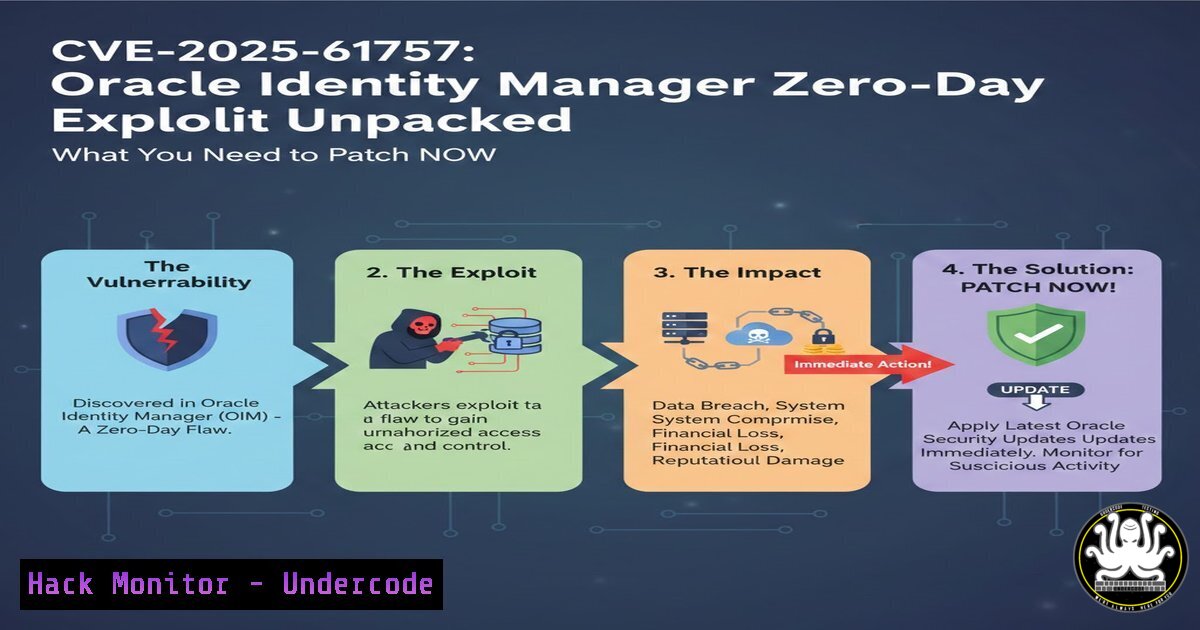
The U.S. Cybersecurity & Infrastructure Security Agency (CISA) has issued a critical warning regarding the active exploitation of a severe vulnerability in Oracle Identity Manager. Tracked as CVE-2025-61757, this pre-authentication remote code execution (RCE) flaw allows attackers to compromise systems without requiring login credentials, posing a catastrophic risk to enterprise security. This article provides an in-depth technical analysis of the vulnerability and offers a actionable guide for security teams to identify, mitigate, and harden their environments against this imminent threat.
Learning Objectives:
- Understand the mechanism and critical impact of the CVE-2025-61757 pre-authentication RCE vulnerability.
- Learn how to detect potential exploitation attempts within your network and applications.
- Implement a comprehensive mitigation strategy including patching, workarounds, and system hardening.
You Should Know:
1. Vulnerability Deep Dive: Anatomy of CVE-2025-61757
The CVE-2025-61757 vulnerability resides within Oracle Identity Manager (OIM), a critical component for identity and access management. As a pre-authentication RCE, it allows an unauthenticated attacker to execute arbitrary code on the underlying server by sending a specially crafted HTTP request to a vulnerable endpoint. This effectively bypasses all primary authentication controls, granting the attacker the same privileges as the OIM application server process, which is often highly privileged.
Step‑by‑step guide explaining what this does and how to use it.
Step 1: Attacker Reconnaissance. An attacker scans the target network for hosts running Oracle Identity Manager, typically on ports 7001, 8001, or 9001.
Step 2: Crafting the Malicious Payload. The attacker crafts an HTTP POST or GET request that exploits a flaw in the request deserialization or expression language evaluation process within OIM. This payload is designed to trigger command execution.
Step 3: Delivery and Exploitation. The malicious request is sent directly to the vulnerable OIM endpoint. Since no authentication is required, the server processes the request, executes the embedded commands, and returns the output to the attacker.
2. Detection and Forensic Analysis
Early detection is crucial to contain a breach. Security teams must look for anomalous network traffic and system activity originating from their OIM servers.
Step‑by‑step guide explaining what this does and how to use it.
Step 1: Network Traffic Analysis. Use tools like Wireshark or Zeek (formerly Bro) to monitor traffic to OIM ports. Look for HTTP requests containing suspicious patterns like runtime.exec, ProcessBuilder, or encoded PowerShell commands.
Example Zeek Notice Log: `filter Notice::TYPE { “http://vulnerable-oim-host:7001/some_endpoint” in http$uri && /cmd\.exe|bash|wget|curl/ in http$request_body };`
Step 2: Server Log Inspection. Scour OIM and application server (WebLogic) access logs for the exploit signature.
Linux Command to search logs: `grep -E “(runtime\.exec|ProcessBuilder|bash|cmd\.exe)” /path/to/oracle/middleware/user_projects/domains/oim_domain/servers/AdminServer/logs/access.log`
Step 3: Host-Based Intrusion Detection. Use EDR tools or OS-level commands to spot suspicious child processes spawned by the Java process (java.exe).
Windows Command (PowerShell): `Get-WmiObject Win32_Process | Where-Object { $_.ParentProcessId -eq (Get-Process java).Id -and $_.Name -ne “java.exe” }`
3. Immediate Patching and Mitigation
The primary mitigation is to apply the official security patch provided by Oracle in their Critical Patch Update (CPU). If immediate patching is not feasible, implement network-level controls.
Step‑by‑step guide explaining what this does and how to use it.
Step 1: Identify Your OIM Version. Check the exact version of your Oracle Identity Manager installation to download the correct patch.
Step 2: Apply the Oracle Patch. Download and apply the patch from the Oracle Support portal following the official Oracle documentation. This is the only guaranteed method to remediate the vulnerability.
Step 3: Implement a Web Application Firewall (WAF). As a temporary workaround, deploy a WAF rule to block requests containing known exploit patterns for this CVE.
Example ModSecurity Rule: `SecRule REQUEST_URI|REQUEST_BODY “@rx (?:runtime\.exec|ProcessBuilder|bash\s+-c)” “id:100017,phase:2,deny,status:403,msg:’CVE-2025-61757 RCE Attempt'”`
Step 4: Network Segmentation. Restrict network access to the OIM administration console and API endpoints so they are not directly accessible from the internet.
4. System Hardening Post-Exploitation
Assume a system has been targeted. Beyond patching, you must harden the environment to prevent lateral movement and future attacks.
Step‑by‑step guide explaining what this does and how to use it.
Step 1: Principle of Least Privilege. Ensure the OIM server’s service account runs with the minimum necessary privileges. It should not have administrative rights on the host or domain.
Step 2: Java Security Manager Configuration. (If still supported in your version) Configure the Java Security Manager with a restrictive policy to limit what the OIM application can do at the OS level.
Step 3: File Integrity Monitoring. Deploy FIM to monitor critical OIM binaries and configuration files for unauthorized changes.
Linux Command (AIDE example): `aide –check`
5. Proactive Defense and Future-Proofing
This incident underscores the need for a proactive security posture that anticipates zero-day exploits in critical software.
Step‑by‑step guide explaining what this does and how to use it.
Step 1: Vulnerability Management Program. Establish a formal program that ensures all critical and zero-day patches are applied within a strict, abbreviated timeframe (e.g., 24-72 hours).
Step 2: Threat Intelligence Feeds. Subscribe to feeds from CISA, vendors, and security researchers to receive immediate alerts on new vulnerabilities affecting your technology stack.
Step 3: Penetration Testing. Regularly commission external pen tests that specifically target identity and access management solutions like OIM to find misconfigurations and unknown vulnerabilities before attackers do.
What Undercode Say:
- Identity Management is the New Battlefield. Attackers are relentlessly targeting identity providers because a compromise here grants them keys to the entire kingdom. This CVE is a stark reminder that these systems are high-value targets and must be defended with extreme prejudice.
- Pre-Auth RCE is a “Break Glass” Scenario. Any vulnerability that allows unauthenticated remote code execution must be treated as a critical business-ending event. The response protocol should be as immediate and decisive as for a live breach.
Analysis: The exploitation of CVE-2025-61757 represents a continued trend of attackers focusing on foundational enterprise software, particularly identity and access management. The fact that it was potentially exploited as a zero-day before a patch was available highlights the sophistication of threat actors and the critical importance of defense-in-depth strategies. Relying solely on perimeter defenses and authentication is insufficient; organizations must implement robust application control, logging, and network segmentation to contain the blast radius of such exploits. This event will likely accelerate the adoption of more granular micro-segmentation and zero-trust architectures within enterprise networks.
Prediction:
The successful exploitation of CVE-2025-61757 will catalyze a wave of copycat attacks and reverse-engineering efforts, leading to the discovery and weaponization of similar flaws in other identity management solutions from different vendors. In the immediate future, we predict a rise in targeted ransomware campaigns leveraging these initial access vectors to compromise entire corporate domains. This will force a paradigm shift in how enterprises view and secure their IAM infrastructure, pushing for more widespread use of cloud-native identity services with integrated, automated threat detection and a faster, more agile patching cycle than traditional on-premise software.
🎯Let’s Practice For Free:
IT/Security Reporter URL:
Reported By: Wayne Shaw – Hackers Feeds
Extra Hub: Undercode MoN
Basic Verification: Pass ✅


