Listen to this Post
Introduction
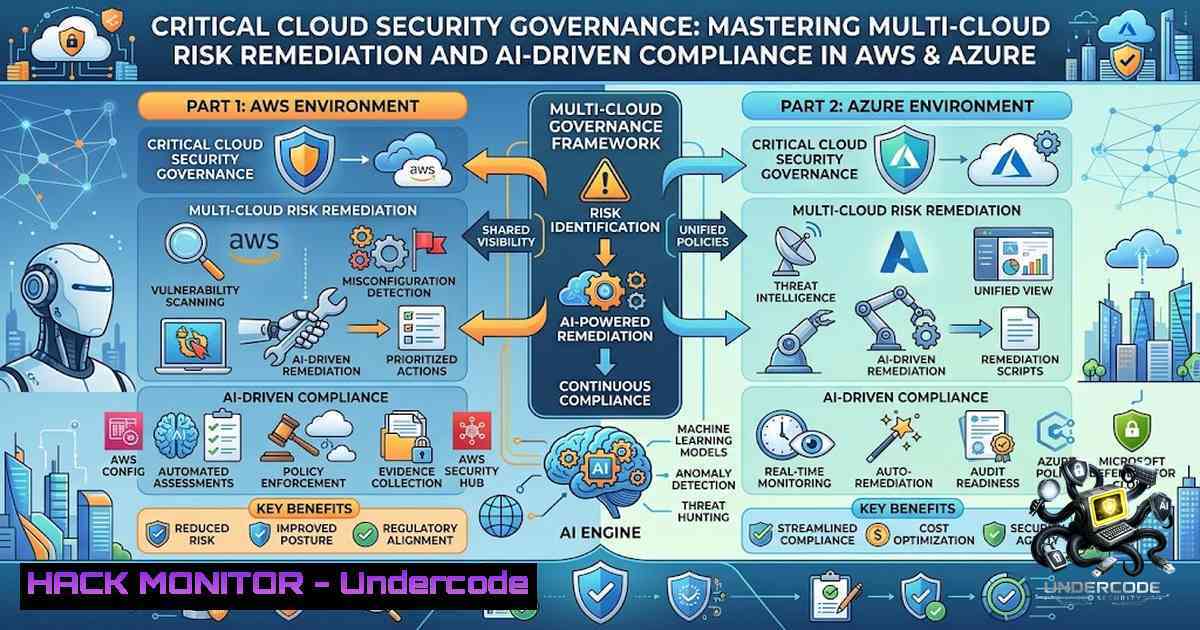
Enterprise cloud security has evolved from reactive perimeter defense to proactive, governance-centric risk management across sprawling multi-cloud estates. As organizations accelerate digital transformation, the complexity of securing AWS and Azure environments—coupled with the proliferation of AI-enabled services—demands leadership that can bridge technical depth with strategic oversight. The Specialist Director, Cloud Security role at KPMG exemplifies this shift, requiring expertise in cloud security posture management, firewall governance, compliance frameworks, and the secure adoption of emerging technologies【7†L6-L9】.
Learning Objectives
- Master the implementation of cloud security governance programs across AWS and Azure, including asset inventory accountability, lifecycle management, and policy compliance enforcement.
- Develop proficiency in defining and tracking cloud security KPIs and KRIs, creating executive dashboards, risk committee materials, and compliance metrics.
- Acquire hands-on skills in configuring cloud security guardrails, identity and access management (IAM) policies, and network security controls using infrastructure-as-code (IaC) tools.
- Understand incident, problem, and service request management within managed services delivery, including escalation protocols and service level commitment adherence.
- Learn to embed security into AI/ML pipelines and cloud transformation initiatives through control frameworks and secure architecture patterns.
You Should Know
- Enterprise Cloud Asset and Firewall Governance: Inventory Accountability and Lifecycle Management
Effective cloud security begins with comprehensive visibility into every resource deployed across AWS and Azure environments. The Specialist Director must establish governance programs that enforce inventory accountability, track lifecycle states (provisioned, active, decommissioned), and ensure policy compliance across virtual machines, containers, serverless functions, and storage buckets【7†L10-L12】.
Step-by-Step Guide: Implementing Asset Inventory and Compliance Scanning
This process ensures continuous discovery, classification, and compliance validation of cloud resources.
Step 1: Enable Cloud Asset Discovery Services
- AWS: Activate AWS Config and AWS Resource Explorer to inventory all resources across regions. Configure AWS Config rules to detect unmanaged or non-compliant resources.
Enable AWS Config in all regions via AWS CLI
aws configservice put-configuration-recorder --configuration-recorder name=default,roleARN=arn:aws:iam::123456789012:role/config-role --recording-group AllSupported=true,IncludeGlobalResourceTypes=true
aws configservice put-delivery-channel --delivery-channel name=default,s3BucketName=my-config-bucket,snsTopicARN=arn:aws:sns:us-east-1:123456789012:config-topic
aws configservice start-configuration-recorder --configuration-recorder-1ame=default
-
Azure: Enable Azure Resource Graph and Azure Policy to perform inventory and compliance assessments across subscriptions.
Query all resources using Azure Resource Graph
Search-AzGraph -Query "resources | project name, type, location, tags, properties" | Format-Table
Assign Azure Policy initiative for security baseline
New-AzPolicyAssignment -1ame "SecurityBaseline" -PolicySetDefinition "/providers/Microsoft.Authorization/policySetDefinitions/1f3afdf9-d0c9-4c3d-847f-89da613e70a8" -Scope "/subscriptions/{subscription-id}"
Step 2: Classify Resources by Criticality and Data Sensitivity
- Apply tags in AWS (
Environment,DataClassification,ComplianceFramework) and Azure (Environment,DataSensitivity,RegulatoryRequirement) to enable automated policy enforcement.AWS: Tag all EC2 instances with classification aws ec2 create-tags --resources i-1234567890abcdef0 --tags Key=DataClassification,Value=Confidential Key=Compliance,Value=HIPAA
Step 3: Implement Continuous Compliance Scanning
- AWS: Use AWS Config Conformance Packs or custom Lambda-backed rules to evaluate resources against CIS benchmarks, NIST 800-53, and PCI-DSS.
- Azure: Use Azure Policy with built-in and custom initiatives to enforce compliance, with remediation tasks for non-compliant resources.
Create a custom Azure Policy definition to restrict public network access
$definition = New-AzPolicyDefinition -1ame "DenyPublicNetworkAccess" -DisplayName "Deny public network access" -Description "Deny resources with public network access" -Policy '{
"if": {
"field": "type",
"in": ["Microsoft.Storage/storageAccounts", "Microsoft.Sql/servers"]
},
"then": {
"effect": "deny"
}
}' -Mode All
Step 4: Establish Risk Acceptance and Exception Governance
- Define a formal risk acceptance workflow where business owners formally accept residual risks with documented mitigations. Use AWS Service Catalog or Azure Blueprints to enforce approved configurations and track exceptions via ticketing systems (e.g., ServiceNow, Jira).
2. Cloud Security KPI/KRI Definition and Executive Reporting
Measuring cloud security effectiveness requires quantifiable metrics that translate technical posture into business risk language. The Specialist Director must define and oversee dashboards that track key performance indicators (KPIs) and key risk indicators (KRIs) across the organization【7†L12-L14】.
Step-by-Step Guide: Building a Cloud Security Metrics Program
Step 1: Define Core Cloud Security KPIs
- Mean Time to Detect (MTTD) and Mean Time to Respond (MTTR) for cloud security incidents.
- Percentage of cloud resources compliant with security baselines (target: >95%).
- Number of critical and high-severity misconfigurations identified per week.
- Percentage of identities with MFA enabled and privileged access reviewed quarterly.
- Coverage of cloud workload protection platforms (CWPP) and cloud security posture management (CSPM) across all accounts/subscriptions.
Step 2: Define Cloud Security KRIs
- Number of publicly exposed storage buckets/databases.
- Percentage of workloads running on outdated or unsupported operating systems.
- Number of firewall rule changes without proper approval.
- Frequency of privilege escalation attempts or anomalous API calls.
- Compliance deviation trend for key frameworks (SOC 2, ISO 27001, NIST).
Step 3: Aggregate Data Using Cloud-1ative and Third-Party Tools
- AWS: Use AWS Security Hub to aggregate findings from AWS Config, GuardDuty, Inspector, and Macie. Create custom insights and integrate with Amazon QuickSight for dashboards.
Enable AWS Security Hub in all regions aws securityhub enable-security-hub --enable-default-standards Get aggregated findings count by severity aws securityhub get-findings --filters '{"SeverityLabel":[{"Value":"CRITICAL","Comparison":"EQUALS"}]}' --query 'Findings[].Id' -
Azure: Use Microsoft Defender for Cloud to collect security recommendations and secure score. Export data to Log Analytics Workspace and visualize with Power BI.
Retrieve secure score for a subscription
Get-AzSecuritySecureScore -SubscriptionId {subscription-id}
Export security recommendations to Log Analytics
$workspace = Get-AzOperationalInsightsWorkspace -ResourceGroupName "security-rg" -1ame "security-workspace"
Set-AzDiagnosticSetting -ResourceId "/subscriptions/{subscription-id}/providers/Microsoft.Security/securityCenter" -WorkspaceId $workspace.ResourceId -Enabled $true
Step 4: Create Executive Dashboards and Risk Committee Materials
- Design dashboards that highlight trends, top risks, remediation progress, and compliance posture. Include a “heat map” of risk by business unit and environment (production, development, staging).
- Prepare quarterly risk committee presentations that articulate the top three cloud security risks, remediation roadmaps, and investment justifications.
- Secure Adoption of Cloud and AI-Enabled Technologies: Guardrails and Control Frameworks
The integration of AI and machine learning into cloud platforms introduces new attack surfaces, including data poisoning, model inversion, and prompt injection. The Specialist Director must establish security baselines and guardrails that enable innovation without compromising security【7†L15-L17】.
Step-by-Step Guide: Embedding Security into AI/ML Pipelines
Step 1: Establish AI Security Policies and Standards
- Define acceptable use policies for AI services (e.g., Amazon Bedrock, Azure OpenAI Service) that address data privacy, model transparency, and output validation.
- Create a secure AI development lifecycle (SAIDL) that includes threat modeling, data sanitization, and red-teaming exercises.
Step 2: Implement Data Protection for AI Training and Inference
- AWS: Use Amazon Macie to discover and classify sensitive data in S3 buckets used for training. Enable S3 Object Lock and versioning to prevent data tampering.
Enable Macie and run sensitive data discovery job aws macie2 enable-macie aws macie2 create-classification-job --1ame "AI-Training-Data-Scan" --s3-job-definition '{"BucketDefinitions":[{"AccountId":"123456789012","Buckets":["ai-training-data"]}]}' --schedule-frequency '{"DailySchedule":{}}' -
Azure: Use Azure Purview to map data lineage and classify sensitive attributes in Azure Data Lake Storage and Azure SQL Database used for ML pipelines.
Register a data source in Azure Purview
Register-AzPurviewDataSource -Endpoint "https://my-purview.purview.azure.com" -1ame "AzureDataLake" -Type "AzureDataLakeStorage" -ResourceGroup "rg-purview" -AccountName "mydatalake"
Step 3: Secure Model Endpoints and API Gateways
- Enforce authentication and authorization for all AI model endpoints using AWS IAM roles, Azure Managed Identities, or API keys with rotation policies.
- Implement rate limiting, input validation, and output filtering to prevent prompt injection and denial-of-service attacks.
AWS: Attach IAM policy restricting Bedrock model invocation
aws iam put-role-policy --role-1ame bedrock-invocation-role --policy-1ame BedrockAccessPolicy --policy-document '{
"Version":"2012-10-17",
"Statement":[{
"Effect":"Allow",
"Action":"bedrock:InvokeModel",
"Resource":"arn:aws:bedrock:us-east-1::foundation-model/anthropic.claude-v2",
"Condition":{"IpAddress":{"aws:SourceIp":"192.168.0.0/16"}}
}]
}'
Step 4: Monitor AI Model Behavior and Drift
- Use AWS CloudTrail and Azure Monitor to log all model API calls. Set up anomaly detection alerts for unusual invocation patterns or output deviations.
- Implement model versioning and rollback capabilities to respond to compromised or degraded models.
- Managed Services Delivery: Incident, Problem, and Service Request Management
The Specialist Director provides management coordination of Cyber Managed Services delivery across multiple engagements, ensuring high-quality service execution【7†L18-L20】. This requires robust incident, problem, and service request management processes with clear escalation paths and service level commitments.
Step-by-Step Guide: Establishing Operational Governance for Managed Security Services
Step 1: Define Incident Response Playbooks for Cloud Environments
- Develop playbooks for common cloud incidents: compromised credentials, data exfiltration, ransomware, and denial-of-service attacks.
- Integrate with SIEM/SOAR platforms (e.g., Splunk, Sentinel, Palo Alto Cortex XSOAR) to automate triage and containment.
AWS: Automate isolation of compromised EC2 instance using Systems Manager
aws ssm send-command --instance-ids i-1234567890abcdef0 --document-1ame "AWS-RunShellScript" --parameters '{"commands":["iptables -A INPUT -s 0.0.0.0/0 -j DROP","systemctl stop sshd"]}'
Step 2: Implement Problem Management and Root Cause Analysis
- Establish a problem management process to identify and address underlying causes of recurring incidents. Use ITIL-aligned frameworks with known error databases (KEDB).
- Conduct post-incident reviews (PIRs) within 48 hours of incident closure, documenting lessons learned and improvement actions.
Step 3: Manage Service Requests and Change Management
- Define a service catalog for cloud security requests (e.g., firewall rule changes, IAM role creation, security group modifications).
- Implement change advisory boards (CABs) for high-risk changes, with automated approval workflows in ServiceNow or Jira.
Azure: Create a service request template for firewall rule changes
Using Azure Logic App to automate approval workflow
This is a conceptual PowerShell snippet for automation
$approvalEmail = "[email protected]"
Send-MailMessage -To $approvalEmail -Subject "Firewall Change Request - Approval Needed" -Body "Change ID: CR-12345, Source IP: 10.0.0.0/16, Destination: 192.168.1.0/24, Port: 443"
Step 4: Coordinate Offshore/Onshore Delivery and Escalation
- Establish shift-left handoff procedures between onshore and offshore teams, including detailed runbooks and knowledge transfer sessions.
- Define escalation matrices with clear triggers (e.g., critical incident > 30 minutes without response escalates to Director).
- Cloud Security Architecture: Embedding Security into Platform Strategy and Transformation
The Specialist Director must partner with cloud, cybersecurity, and architecture leaders to embed security into platform strategy, architecture decisions, and enterprise cloud transformation initiatives【7†L16-L17】.
Step-by-Step Guide: Designing Secure Cloud Architecture Patterns
Step 1: Implement Zero Trust Network Segmentation
- AWS: Use AWS Transit Gateway with route tables to segment VPCs by environment and data classification. Deploy AWS Network Firewall for stateful inspection and intrusion prevention.
AWS: Create Transit Gateway route table for production environment
aws ec2 create-transit-gateway-route-table --transit-gateway-id tgw-1234567890abcdef0
aws ec2 create-transit-gateway-route --transit-gateway-route-table-id rtbl-1234567890abcdef0 --destination-cidr-block 10.0.0.0/16 --transit-gateway-attachment-id attach-1234567890abcdef0
-
Azure: Use Azure Virtual WAN with security virtual appliances (NVAs) and Azure Firewall to enforce micro-segmentation and application-aware policies.
Azure: Deploy Azure Firewall with application rules
$firewall = Get-AzFirewall -1ame "azfw-prod" -ResourceGroupName "network-rg"
$appRule = New-AzFirewallApplicationRule -1ame "Allow-Web" -SourceAddress "10.0.0.0/8" -TargetFqdn ".contoso.com" -Protocol "https:443"
$appRuleCollection = New-AzFirewallApplicationRuleCollection -1ame "AppRules" -Priority 200 -Rule $appRule -ActionType Allow
$firewall.ApplicationRuleCollections = $appRuleCollection
Set-AzFirewall -AzureFirewall $firewall
Step 2: Implement Just-in-Time (JIT) Access and Privileged Identity Management
- AWS: Use AWS IAM Access Analyzer to identify unused permissions and implement least-privilege policies. Deploy AWS Systems Manager Session Manager for JIT administrative access without opening inbound ports.
- Azure: Use Azure Privileged Identity Management (PIM) to enforce JIT activation for privileged roles with approval workflows and time-bound access.
Azure: Configure PIM for a subscription owner role
$role = Get-AzRoleDefinition -1ame "Owner"
$schedule = New-Object -TypeName Microsoft.Azure.Management.Authorization.Models.PrivateLinkAssociationProperties
$schedule.PrivateLink = "Enabled"
Note: Full PIM configuration requires Azure AD Graph API or Azure CLI extensions
az rest --method patch --uri "https://management.azure.com/subscriptions/{subscription-id}/providers/Microsoft.Authorization/roleManagementPolicies?api-version=2020-10-01" --body '{"properties":{"rules":[{"ruleType":"ExpirationRule","isExpirationRequired":true,"maximumDuration":"PT8H"}]}}'
Step 3: Encrypt Data at Rest and in Transit
- Enforce encryption for all storage services (AWS S3, EBS, RDS; Azure Storage, SQL Database) using customer-managed keys (CMKs) with key rotation policies.
- Implement TLS 1.3 for all API endpoints and enforce HTTPS-only access via bucket policies and firewall rules.
AWS: Enforce S3 bucket encryption with bucket policy
aws s3api put-bucket-encryption --bucket my-secure-bucket --server-side-encryption-configuration '{"Rules":[{"ApplyServerSideEncryptionByDefault":{"SSEAlgorithm":"aws:kms","KMSMasterKeyID":"arn:aws:kms:us-east-1:123456789012:key/abcd1234"}}]}'
aws s3api put-bucket-policy --bucket my-secure-bucket --policy '{"Version":"2012-10-17","Statement":[{"Effect":"Deny","Principal":"","Action":"s3:","Resource":"arn:aws:s3:::my-secure-bucket/","Condition":{"Bool":{"aws:SecureTransport":"false"}}}]}'
What Undercode Say
- Cloud security governance is not a one-time implementation but a continuous lifecycle of discovery, classification, remediation, and monitoring. The Specialist Director must treat security as an embedded discipline within cloud engineering and business operations, not a separate silo.
-
AI introduces unprecedented security challenges that demand proactive guardrails. Organizations must extend their security frameworks to cover data pipelines, model endpoints, and inference outputs, with particular attention to data poisoning, model theft, and adversarial attacks.
-
Effective metrics are the cornerstone of executive buy-in and risk communication. KPIs and KRIs must translate technical vulnerabilities into business impact, enabling informed decision-making and resource allocation.
-
Managed services delivery requires operational excellence in incident, problem, and change management. Clear escalation paths, well-documented playbooks, and automated workflows are essential to meet service level commitments and maintain client trust.
-
Zero Trust and least-privilege access are non-1egotiable in modern cloud environments. Implementing JIT access, network segmentation, and continuous identity verification reduces attack surface and limits blast radius of potential breaches.
-
The role demands a blend of technical depth and strategic leadership. Proficiency in AWS and Azure native security tools, combined with the ability to influence engineering, architecture, and business teams, is critical for success【7†L5-L9】.
-
Compliance is not a checkbox but a continuous process. Regulatory requirements (HIPAA, PCI-DSS, GDPR, SOC 2) must be embedded into CI/CD pipelines and infrastructure-as-code to ensure security is built in, not bolted on.
-
AI-enabled technologies will accelerate cloud adoption, but security must keep pace. The Specialist Director must champion secure-by-design principles and ensure that innovation does not outpace risk management capabilities.
Expected Output
Introduction:
The Specialist Director, Cloud Security at KPMG is a pivotal leadership role that drives cloud security governance, risk remediation, and compliance across AWS and Azure environments【7†L5-L9】. This position requires strategic oversight of enterprise cloud asset management, firewall governance, and the secure adoption of AI-enabled technologies, while ensuring operational excellence in managed services delivery【7†L10-L14】. Candidates must possess deep technical expertise in cloud security architecture, incident management, and executive reporting to effectively embed security into enterprise cloud transformation initiatives【7†L15-L20】.
What Undercode Say:
- Continuous governance is the foundation of cloud security success. Establishing robust inventory accountability, policy compliance, and risk acceptance processes ensures visibility and control across sprawling multi-cloud estates【7†L10-L12】.
- Metrics-driven security enables business-aligned risk management. Defining and tracking KPIs and KRIs with executive dashboards translates technical posture into strategic business intelligence, facilitating informed decision-making and resource prioritization【7†L12-L14】.
- Proactive guardrails for AI and emerging technologies are essential. As organizations adopt AI-enabled services, security leaders must establish control frameworks, data protection measures, and monitoring capabilities to mitigate novel threats without stifling innovation【7†L15-L17】.
- Operational excellence in managed services drives client trust and retention. Effective incident, problem, and change management processes, coupled with clear escalation protocols and offshore/onshore coordination, are critical to meeting service level commitments and delivering high-quality outcomes【7†L18-L20】.
Prediction
- +1 Cloud security governance will become increasingly automated and AI-driven, with predictive analytics enabling proactive risk identification and self-healing remediation workflows, reducing manual overhead and improving mean time to resolution.
-
+1 The demand for leaders who can bridge cloud security and AI governance will surge, creating new career pathways and specialized certifications that combine cloud architecture, cybersecurity, and machine learning expertise.
-
-1 The rapid adoption of generative AI in cloud environments will outpace security frameworks, leading to a wave of data breaches and model compromise incidents, prompting regulatory scrutiny and increased compliance burdens for enterprises.
-
-1 Shortage of qualified cloud security leaders with both technical depth and strategic influence will persist, driving up compensation costs and creating competitive talent wars, while leaving many organizations under-secured during critical transformation phases.
-
+1 Integration of security into infrastructure-as-code and CI/CD pipelines will mature, enabling shift-left security practices that detect and remediate misconfigurations before deployment, significantly reducing production risks and operational overhead.
-
-1 Multi-cloud complexity will continue to challenge governance programs, as inconsistent security controls and fragmented visibility across AWS and Azure environments create blind spots that attackers can exploit, necessitating investments in unified CSPM and CNAPP platforms.
▶️ Related Video (76% Match):
https://www.youtube.com/watch?v=0q6bHJVFYQM
🎯Let’s Practice For Free:
🎓 Live Courses & Certifications:
Join Undercode Academy for Verified Certifications
🚀 Request a Custom Project:
Secure, high-velocity infrastructure and disruptive technological engineering. Contact our engineering team for high-tier development and proprietary systems:
[email protected]
💎 Smart Architecture | 🛡️ Secure by Design | ⭐ Trusted by Thousands
IT/Security Reporter URL:
Reported By: Httpsjobsrminecomjobusspecialist Director – Hackers Feeds
Extra Hub: Undercode MoN
Basic Verification: Pass ✅


