Listen to this Post
Introduction:
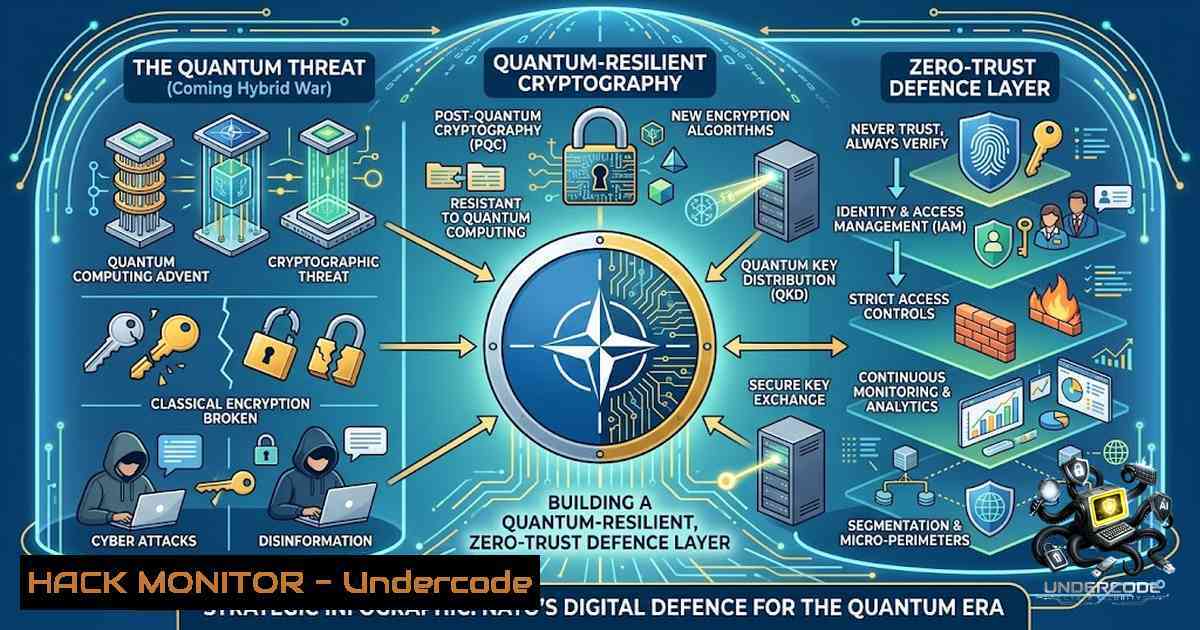
As US intelligence assesses a potential Russian hybrid attack against a NATO member between late 2026 and 2029, the battlefield has decisively shifted to the digital domain. A cyberattack offers the adversary disruption, ambiguity, and escalation control, targeting energy, telecommunications, and military logistics. To counter this, Europe must urgently upgrade its digital core from strategy to operational readiness, building a high-assurance digital trust layer that remains dependable under attack.
Learning Objectives:
- Understand the geopolitical imperative for hardening critical infrastructure against state-sponsored cyber operations.
- Master the implementation of Zero Trust Architecture (ZTA) and Post-Quantum Cryptography (PQC) for enterprise and government systems.
- Acquire hands-on skills in deploying hardware-rooted trust, verifiable credentials, and automated policy enforcement.
You Should Know:
- Fortifying the Digital Core: Zero Trust Architecture (ZTA) in Practice
Moving from perimeter-based security to a Zero Trust model is non-1egotiable. NIST Special Publication 800-207 outlines that a ZTA enables secure authorized access to resources distributed across on-premises and multiple cloud environments, regardless of network location. The core tenet is “never trust, always verify,” enforcing per-session, per-resource access.
To implement a ZTA aligned with NIST SP 800-207, focus on three core components: the Policy Engine (PE), Policy Administrator (PA), and Policy Enforcement Point (PEP). Below is a practical guide to establishing a foundational ZTA using open-source tools on a Linux-based system, creating a mini-SOC that monitors and enforces Zero Trust policies.
Step‑by‑step guide: Deploying a Foundational ZTA with Open-Source Tools
1. Set Up the Linux Environment: Begin with a hardened Linux distribution (e.g., Ubuntu Server 22.04 LTS). Apply all security patches immediately: sudo apt update && sudo apt upgrade -y.
2. Implement Network Monitoring: Deploy a suite of monitoring tools to enforce policy and detect anomalies.
– Install ARPwatch for MAC address tracking: sudo apt install arpwatch -y.
– Install p0f for passive OS fingerprinting: sudo apt install p0f -y.
– Install Snort for intrusion detection: sudo apt install snort -y.
3. Configure a Firewall with Micro-Segmentation: Replace a basic firewall with `nftables` to enforce granular, per-application policies.
– Flush existing rules: sudo nft flush ruleset.
– Create a table for your `inet` filter: sudo nft add table inet zero_trust.
– Add a chain to accept established connections: sudo nft add chain inet zero_trust forward '{ type filter hook forward priority 0; policy drop; }'.
4. Enforce Service-to-Service Authentication with mTLS: For internal services, enforce mutual TLS (mTLS) to ensure that only authenticated services can communicate, a key principle of ZTA. Use tools like `cert-manager` in Kubernetes or `stunnel` for legacy applications to issue and verify client certificates before allowing any data exchange.
- Post-Quantum Cryptography (PQC) Readiness: Preparing for the Quantum Threat
The threat of a cryptanalytically relevant quantum computer (CRQC) is imminent. Adversaries are already employing “harvest now, decrypt later” strategies, stealing encrypted data today with the intent to decrypt it in the future. NIST has standardized quantum-resistant algorithms like CRYSTALS-Kyber (for key exchange) and CRYSTALS-Dilithium (for digital signatures). Organizations must begin PQC migration now, aligning efforts with the NIST Cybersecurity Framework 2.0 and SP 800-53.
Step‑by‑step guide: Conducting a Cryptographic Inventory and PQC Migration Planning
1. Discover and Inventory Cryptographic Assets: Use tools like `openssl` to scan for vulnerable algorithms. For example, to check a server’s TLS ciphers: openssl s_client -connect example.com:443 -cipher 'ECDH' 2>/dev/null | grep -E "Cipher".
2. Inventory Dependencies: Scan your codebase for cryptographic libraries. Use `pip freeze` (Python), `npm list` (Node.js), or `cargo tree` (Rust) to identify dependencies that rely on RSA or ECC.
3. Prioritize High-Value Assets: Map your inventory to your data lifecycle. Prioritize data with long-term secrecy requirements (e.g., government secrets, intellectual property, medical records). NIST recommends starting with high-value assets where the impact of a breach is most severe.
4. Develop a Crypto-Agility Plan: Implement a cryptographic abstraction layer that allows for the swapping of algorithms without rewriting application logic. This is the core of “crypto agility.” NIST’s NCCoE PQC Migration Project provides playbooks for structured migration. Establish a timeline for deprecating quantum-vulnerable cryptography, aligning with NIST’s forthcoming transition guidelines.
- High-Assurance Digital Trust: Verifiable Credentials and Decentralized Identity
To ensure that we know “who or what is acting,” we must move beyond passwords to verifiable credentials (VCs) and decentralized identifiers (DIDs). These W3C standards enable cryptographic proof of identity, authority, and provenance without centralized registries. This is crucial for securing B2B, B2G, and G2G digital identity in supply chains and critical infrastructure.
Step‑by‑step guide: Issuing and Verifying a W3C-Compliant Verifiable Credential
1. Set Up a DID: Create a Decentralized Identifier. This can be done using a library like `@empe/identity` (TypeScript) or `iota_identity` (Rust). A DID Document (e.g., holder_did.json) contains the public key material, which can now be a post-quantum key like Dilithium.
2. Issue a Credential: As an issuer, create a verifiable credential (e.g., a university degree or a security clearance). Sign it using your private key.
3. Verify the Credential: A verifier can then check the cryptographic signature against the issuer’s DID document. This proves the credential is authentic and hasn’t been tampered with.
4. Create a Verifiable Presentation: The holder can combine multiple credentials into a presentation to share with a verifier, again signed to prove holder-binding. This entire process, especially when using PQC algorithms like Dilithium, demonstrates the readiness of production-grade decentralized identity.
4. Hardware-Rooted Trust: Implementing Secure and Measured Boot
A digital trust layer is only as strong as its foundation. Hardware-rooted trust, anchored in a Trusted Platform Module (TPM), is essential to ensure the integrity of the computing environment. Secure Boot prevents unauthorized code from executing, while Measured Boot creates a verifiable audit trail of everything that ran during boot.
Step‑by‑step guide: Configuring Secure Boot and Measured Boot on Linux
1. Enable TPM in BIOS: Ensure your TPM is enabled and activated in your system’s BIOS/UEFI settings.
2. Verify TPM Availability: Check if the TPM is recognized by the OS: `ls /dev/tpm` or dmesg | grep -i tpm.
3. Set Up UEFI Secure Boot Variables: The firmware uses four key databases: Platform Key (PK), Key Exchange Key (KEK), signature database (db), and forbidden signature database (dbx). Manage these using `efi-updatevar` or sbkeysync.
4. Enable Secure Boot: This is typically done in the BIOS. For a Linux distribution like Ubuntu, ensure the `shim-signed` package is installed to allow the kernel to boot with Secure Boot enabled.
5. Implement Measured Boot: The TPM extends measurements into Platform Configuration Registers (PCRs). To verify this, use `tpm2_pcrread` to read the current PCR values and `tpm2_quote` to create a signed attestation of those values. This quote can be sent to a remote verifier to prove the system’s integrity.
- Strengthening Civilian-Military Supply Chains: Software Bill of Materials (SBOM)
The complexity of modern supply chains is a significant vulnerability. To secure dual-use ecosystems and AI systems, we must have end-to-end visibility into the software components we rely on. A Software Bill of Materials (SBOM) and its extension for AI (AIBOM/TAIBOM) provide a structured dependency model and a trust attestation process for verifying component provenance.
Step‑by‑step guide: Generating and Attesting an SBOM
- Generate an SBOM: Use tools like `syft` or `trivy` to generate an SBOM for your container image. For example:
syft <container-image> -o cyclonedx-json > sbom.json. - Sign the SBOM: Sign the generated SBOM file using your organization’s private key to ensure its integrity and authenticity. This creates a “cryptographic evidence” link in the supply chain.
- Attest and Verify: Integrate this signed SBOM into your CI/CD pipeline. Use a framework like the NIST Secure Software Development Framework (SSDF) to enforce policies that prevent a “poisoned base model” from being deployed. The EU Cyber Resilience Act (CRA) is making such practices mandatory.
What Undercode Say:
- Cyber is the New Frontier of Warfare: The intelligence assessment confirms that cyberattacks are a primary tool for testing NATO’s cohesion. A significant cyberattack, or a cumulative series of malicious activities, could be interpreted as an armed attack under 5. This elevates cybersecurity from an IT issue to a matter of national survival.
- The “Digital Core” Must be Invulnerable: The distinction between military and civilian infrastructure is blurring. Defending Europe requires hardening the digital core of governments, critical infrastructure, and industry simultaneously. This is not just a defence requirement; it is the bedrock of industrial competitiveness and sovereign data sharing. The focus must shift from reactive regulation to proactive, tested operational readiness, including cross-domain exercises and defined escalation thresholds.
Prediction:
- -1 Escalation of Cyber Proxy Wars: We will see a significant increase in state-sponsored cyber operations targeting critical infrastructure, not just for espionage, but for pre-positioning and disruption. This will force governments to treat the private sector as an extension of national defence.
- +1 Accelerated PQC and ZTA Adoption: The geopolitical pressure will act as a catalyst, forcing rapid adoption of Post-Quantum Cryptography and Zero Trust Architectures. This will create a massive market for security professionals and next-generation security solutions, turning a defensive necessity into a technological advantage.
- +1 Sovereign Digital Identity as a Geopolitical Tool: The push for verifiable credentials and decentralized identity will lead to the creation of “digital sovereignty” stacks. Nations will view control over their citizens’ and supply chains’ digital identities as a critical component of national security.
- -1 Proliferation of AI-Powered Cyberattacks: AI agents will be weaponized for both attack and defence, creating an asymmetric threat landscape. The need for verifiable AI provenance and AI-specific SBOMs will become critical to ensure that AI systems themselves are not compromised.
- +1 Formalization of Cyber Defence Exercises: Cross-domain cyber defence exercises like NATO’s Cyber Coalition and Locked Shields will become more frequent and more realistic, integrating public and private actors into military operational and tactical planning. These will be essential for testing decision-making under pressure and defining escalation thresholds.
▶️ Related Video (80% Match):
🎯Let’s Practice For Free:
🎓 Live Courses & Certifications:
Join Undercode Academy for Verified Certifications
🚀 Request a Custom Project:
Secure, high-velocity infrastructure and disruptive technological engineering. Contact our engineering team for high-tier development and proprietary systems:
[email protected]
💎 Smart Architecture | 🛡️ Secure by Design | ⭐ Trusted by Thousands
IT/Security Reporter URL:
Reported By: Dr Carsten – Hackers Feeds
Extra Hub: Undercode MoN
Basic Verification: Pass ✅


