
Listen to this Post
Introduction:
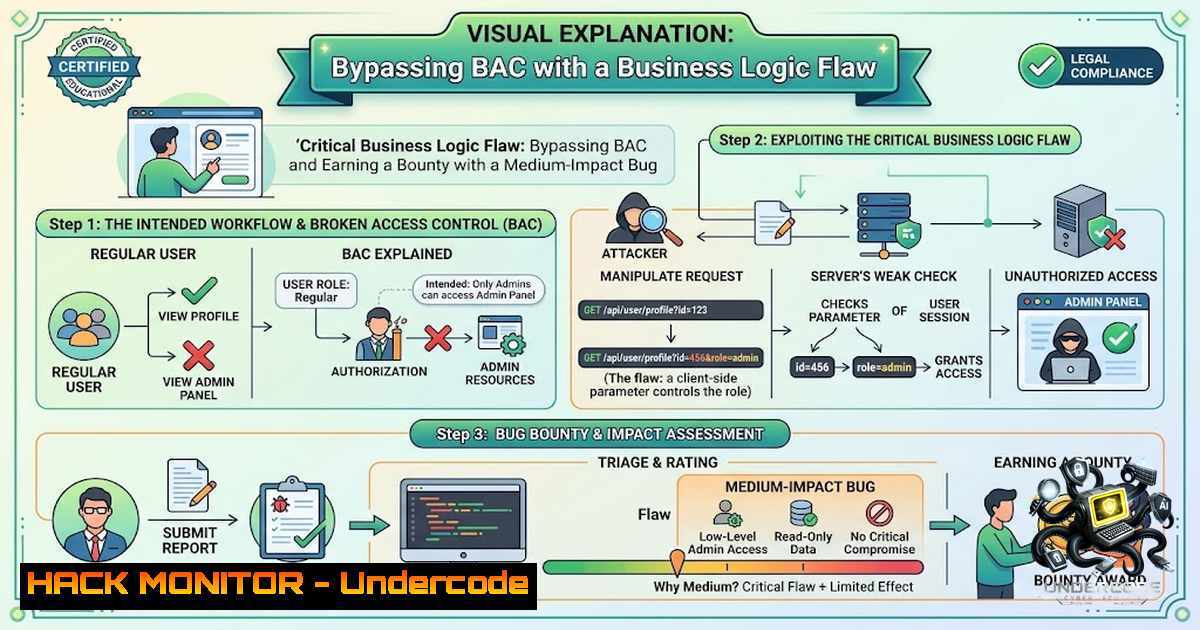
Business logic vulnerabilities represent one of the most dangerous yet underappreciated classes of security flaws in modern web applications. Unlike traditional injection or XSS attacks, these flaws exploit the legitimate functionality of an application to achieve malicious outcomes, often bypassing even the most robust perimeter defenses. When Mohamed Ahmed (ØxMo7areb), a Top 1% TryHackMe user and eWPTv2-certified penetration tester, announced the discovery of a critical bug that yielded a medium bounty, the security community took notice. This article dissects the technical underpinnings of such Business Logic vulnerabilities, explores Broken Access Control (BAC) bypass techniques, and provides a comprehensive guide to identifying, exploiting, and mitigating these risks in enterprise environments.
Learning Objectives & Secrets:
- Objective 1: Master the identification of Business Logic flaws by mapping application workflows and understanding the intended vs. actual state transitions.
- Objective 2 Secret Tip: When testing for BAC, always attempt to alter the HTTP method (e.g., POST to PUT or DELETE) or change the `Content-Type` header. Applications often enforce access controls only on the primary method, leaving alternative methods exposed.
- Objective 3 Secret Tip: Leverage parameter pollution and array manipulation in API requests. For instance, sending `user_id=123&user_id=456` or `user_ids[]=123` can cause the backend to process the last or first value, bypassing checks if the validation logic is flawed.
You Should Know:
- Understanding Broken Access Control (BAC) and Business Logic Mapping
Broken Access Control is a critical vulnerability that allows an attacker to bypass authorization mechanisms, granting them unauthorized access to resources or functions. In the context of business logic, this often manifests as the ability to perform operations reserved for privileged users. To effectively test for this, you must first map the application’s workflow. This involves identifying all user roles, their associated permissions, and the API endpoints or form actions that trigger state-changing operations.
Step‑by‑step guide:
- Step 1: Intercept all requests while performing a high-privilege action (e.g., admin user editing another user’s profile) using Burp Suite.
- Step 2: Create two distinct user sessions: a low-privilege user (standard) and a high-privilege user (admin).
- Step 3: Copy the request from the high-privilege session and replay it using the low-privilege session’s cookie or token.
- Step 4: Observe the server response. If the action succeeds, the BAC is vulnerable.
- Linux Command: Use `curl` to test this manually. `curl -X PUT -H “Cookie: session=low_priv_cookie” -d ‘{“user_id”:2, “role”:”admin”}’ https://target.com/api/users/2`.
- Windows Command: Use `Invoke-WebRequest` in PowerShell:
Invoke-WebRequest -Uri "https://target.com/api/users/2" -Method PUT -Headers @{"Cookie"="session=low_priv_cookie"} -Body '{"user_id":2, "role":"admin"}'.
2. Parameter Manipulation and Business Logic Bypass
Business logic vulnerabilities often arise from the application’s failure to validate that the user is acting on their own resources. For example, an e-commerce platform might allow a user to modify the `price` parameter in a POST request. More sophisticated bypasses involve manipulating the `userId` or `accountNumber` parameters. This is closely related to Insecure Direct Object References (IDOR).
Step‑by‑step guide:
- Step 1: Find a function that retrieves or modifies data based on an identifier (e.g.,
order_id). - Step 2: Change the `order_id` to another user’s order ID.
- Step 3: If the application returns the other order details, you have an IDOR.
- Advanced Tip: Even if the `order_id` is hashed or encoded, you can use a dictionary attack with tools like `hashcat` to decode it or simply remove it to test the default behavior.
- Code Snippet (Python for automated testing):
import requests
target_url = "https://target.com/api/order/123"
headers = {"Cookie": "user_session=low_priv_cookie"}
response = requests.get(target_url, headers=headers)
if response.status_code == 200 and "other_user_data" in response.text:
print("Vulnerability detected!")
3. Race Conditions and State-Transfer Attacks
Race conditions occur when two or more concurrent operations attempt to modify the same resource in a way that leads to unexpected results. For instance, a user could exploit a race condition to redeem a single-use coupon code multiple times. The core challenge is that applications often check the availability of a resource, then wait for a database commit to finalize the state, leaving a small window for exploitation.
Step‑by‑step guide:
- Step 1: Identify a critical function that performs a state transfer (e.g.,
transfer funds,redeem coupon,add balance). - Step 2: Send multiple concurrent requests to this function at the exact same time using tools like `Turbo Intruder` in Burp Suite or `ab` (Apache Bench).
- Step 3: Check if the total balance or coupon count reflects only one successful transaction. If multiple transactions succeed, a race condition exists.
- Linux Command: `ab -1 100 -c 100 -p post_data.txt -T “application/x-www-form-urlencoded” https://target.com/api/redeem`.
- Mitigation: Implement optimistic locking using version numbers or timestamps in the database update query.
4. API Security and Misconfigured Object-Level Authorization
Modern applications heavily rely on REST and GraphQL APIs. A common misconfiguration is the lack of object-level authorization checks. This means the API may authenticate the user but fail to authorize whether that user has the right to access the requested object. This is particularly dangerous in GraphQL because an attacker can nest queries to fetch unrelated data.
Step‑by‑step guide (GraphQL Testing):
- Step 1: Intercept a GraphQL request and examine the query structure.
- Step 2: Modify the query to request different `id` values or use the `__typename` introspection field.
- Step 3: Example of a GraphQL query:
query { user(id: "123") { name, email, posts { title, content } } }. Change the `id` to `456` to test if you can access that user’s data. - Tool Config: Use `graphql-path-enum` to recursively enumerate all possible paths in the API.
- Mitigation: Implement a strict authorization layer using a middleware that checks the relationship between the authenticated user and the requested resource for every single query.
5. Exploiting and Reporting Business Logic Flaws
Once you discover a business logic flaw, the exploitation must be documented with a clear Proof of Concept (PoC). This demonstrates the impact, which is often financial loss, data leakage, or privilege escalation. The report should outline the steps to reproduce, the impact, and the remediation. As Mohamed Ahmed noted, even a critical bug might be classified as “Medium” by the vendor’s bounty program, but the impact assessment is key to a successful negotiation.
Step‑by‑step guide for reporting:
- Step 1: Record a complete video walkthrough of the exploit.
- Step 2: Write a concise report covering: , Description, Steps to Reproduce, Impact, and Remediation.
- Step 3: Include the HTTP requests/responses as evidence.
- Step 4: If the program is slow to respond, use public disclosure policies (if allowed) to motivate action, as referenced in the “Bug writeup out now” post, which suggests a proactive sharing approach to educate the community.
6. Hardening Applications Against Logic Attacks
Mitigating business logic flaws requires a shift from traditional security testing. You must incorporate threat modeling during the design phase. Use the STRIDE model to identify potential threats to your workflows. Implement robust server-side validations that assume all client-side inputs are malicious. For instance, never trust the client for price calculations; always retrieve the price from the server’s database based on the product ID.
Hardening Steps:
- Implement an “Authorization Matrix” that clearly defines which roles can access which actions.
- Use immutable state patterns where an operation is applied as a delta on the previous state, preventing race conditions.
- Conduct regular “pair-testing” sessions where developers and testers review the business logic flow.
- Configuration Example (Apache): Use `mod_security` to enforce strict validation rules for incoming requests, such as
SecRule ARGS "user_id" "@gt 0" "id:1,deny,status:403".
What Undercode Say:
- Key Takeaway 1: Business logic vulnerabilities are not just “bugs” in code; they are conceptual flaws in the design of the application’s workflow. To find them, you must understand the business objective of each function and ask, “What can go wrong if this validation is missing?”
- Key Takeaway 2: The bounty classification (e.g., “Medium”) doesn’t always reflect the criticality of the flaw. A “Medium” business logic bug could lead to massive financial losses if exploited at scale, highlighting the need for security researchers to articulate business impact rather than solely technical severity.
- Analysis: Mohamed Ahmed’s announcement underscores a growing trend in the offensive security community: the shift towards complex, logic-based bug hunting. With automated scanners failing to detect these flaws, the human element of penetration testing becomes even more valuable. The research community is now focusing on creating detailed writeups to share knowledge, a practice that accelerates the learning curve for junior testers. The integration of this knowledge into training courses like eWPT and practical certifications is vital for the next generation of pentesters.
Expected Output:
Introduction:
Business logic vulnerabilities remain a blind spot for many traditional security tools, enabling attackers to abuse application features in ways developers never anticipated. Leveraging Broken Access Control (BAC) and parameter manipulation, attackers can bypass critical authorization checks without triggering conventional alert systems. This article explores the discovery and exploitation of such flaws, as demonstrated by Mohamed Ahmed, to provide a detailed roadmap for modern bug hunters.
What Undercode Say:
- Key Takeaway 1: The essence of business logic exploitation lies in understanding the application’s state machine and testing every possible permutation of legitimate actions.
- Key Takeaway 2: The journey from finding a critical bug to receiving a bounty, even if classified as “Medium,” is a learning milestone that highlights the importance of comprehensive technical documentation.
Prediction:
- +1 The continuous publication of high-quality write-ups will exponentially increase the average skill level of the red team community, making enterprise applications more resilient over time.
- +1 Certifications and training courses (eWPT, eJPT) are adapting to include advanced logic-based testing modules, preparing testers for real-world challenges.
- -1 As detection systems evolve, attackers will shift focus to even more obscure logical workflows, such as AI-managed decisions, creating a cat-and-mouse game that could lead to unforeseen systemic risks.
- +1 The collaborative approach, as seen in sharing “Medium” bounty stories, fosters a more transparent security culture, encouraging organizations to prioritize security over secrecy.
▶️ Related Video (80% Match):
🎯Let’s Practice For Free:
🎓 Live Courses & Certifications:
Join Undercode Academy for Verified Certifications
🚀 Request a Custom Project:
Secure, high-velocity infrastructure and disruptive technological engineering. Contact our engineering team for high-tier development and proprietary systems:
[email protected]
💎 Smart Architecture | 🛡️ Secure by Design | ⭐ Trusted by Thousands
IT/Security Reporter URL:
Reported By: https://lnkd.in/p/eXQwrsja – Hackers Feeds
Extra Hub: Undercode MoN
Basic Verification: Pass ✅


