
Listen to this Post
Introduction:
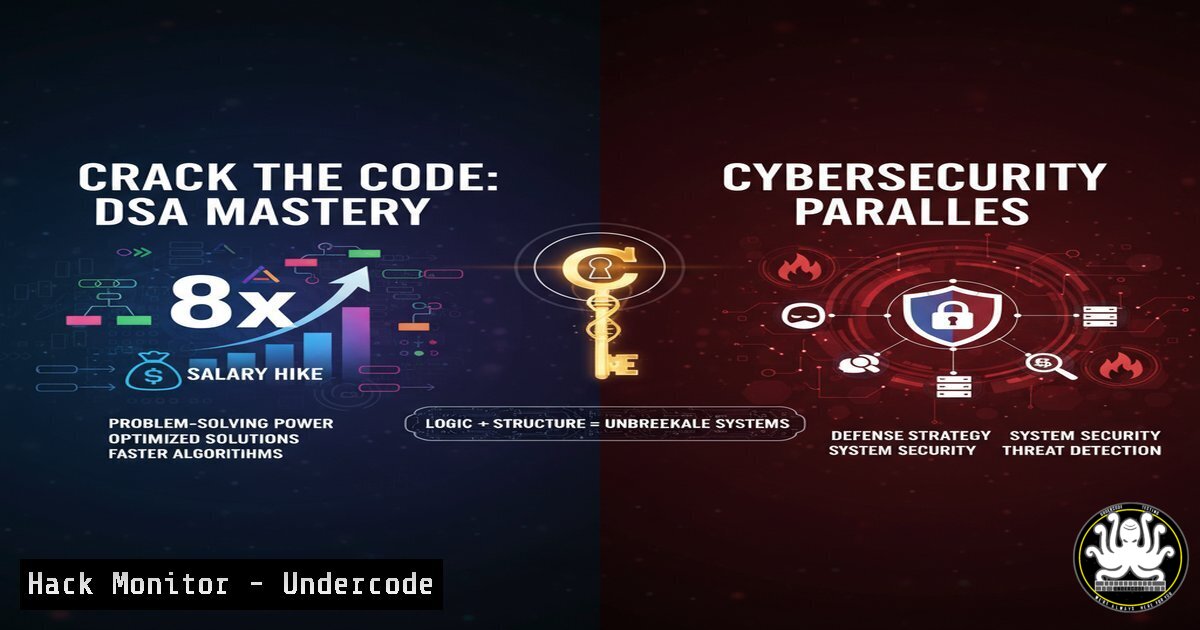
In the competitive landscape of high-stakes tech hiring, the ability to solve complex Data Structures and Algorithms (DSA) problems under pressure is a proven differentiator, directly correlating to exponential career growth and salary increments. This same pattern-recognition and systematic problem-solving methodology is the bedrock of effective cybersecurity, where professionals must rapidly identify attack signatures and mitigate vulnerabilities. The mental models required to deconstruct a coding challenge are directly transferable to deconstructing a cyber attack, making DSA proficiency a critical, albeit often overlooked, foundational skill for security engineers.
Learning Objectives:
- Understand the core DSA patterns that enable efficient problem-solving in both technical interviews and security incident response.
- Learn to apply algorithmic thinking to analyze logs, detect anomalies, and automate security tasks using command-line tools.
- Develop a methodology for pressure-testing your own code and systems, mirroring the interview environment to build resilience.
You Should Know:
- The Pattern Recognition Engine: Grep & Awk for Log Analysis
Just as recognizing a “Sliding Window” pattern can solve a DSA problem, recognizing a pattern in a log file can identify a breach. The `grep` and `awk` commands are your first line of defense.
 Example 1: Find failed SSH login attempts (Brute-force pattern)
grep "Failed password" /var/log/auth.log | awk '{print $11}' | sort | uniq -c | sort -nr

Example 2: Extract unique IPs making suspicious POST requests to a login endpoint
awk '/POST \/login/ {print $1}' /var/log/nginx/access.log | sort | uniq -c | sort -nr | head -10
Step-by-step guide:
What it does: The first command scans the authentication log for all “Failed password” entries, extracts the IP address (field 11), sorts them, counts unique occurrences (uniq -c), and then sorts again numerically in reverse order to show the most frequent offenders. This is the “Frequency Counter” pattern applied to log analysis.
How to use it: Run this on any Unix-based system with sudo privileges to view the auth log. The second output helps identify potential credential stuffing attacks by showing IPs bombarding your login page.
- Algorithmic Efficiency in Security Scripting: Process and Network Analysis
Inefficient code (O(n²)) can cripple a security monitoring tool. Understanding efficiency is key. Use these commands to analyze system resources and network connections efficiently.
 Example 3: Find the top 5 processes by CPU usage (Quickselect/Heap pattern)
ps aux --sort=-%cpu | head -6

Example 4: List all established network connections and count by state (Hash Map pattern)
netstat -an | grep ESTABLISHED | awk '{print $6}' | sort | uniq -c

Example 5: Monitor file system changes in a directory in real-time (Event Loop pattern)
inotifywait -m -r /path/to/critical/dir

Example 6: Scan for open ports on a target machine efficiently
nmap -sS -T4 <target_ip>

Example 7: Perform a vulnerability scan with a defined script
nmap --script vuln <target_ip>
Step-by-step guide:
What it does: The `ps aux` command lists all processes. Sorting by CPU and taking the top 5 is an efficient way to spot resource-hogging processes, potentially indicating crypto-mining malware. The `netstat` command lists network connections, and the pipeline counts how many are in the `ESTABLISHED` state, giving a snapshot of network load.
How to use it: Run `ps aux –sort=-%cpu` directly in your terminal. For netstat, it’s often pre-installed. `inotifywait` requires the `inotify-tools` package and is invaluable for detecting real-time file changes from ransomware or intruders.
3. Dynamic Programming for Web Vulnerability Assessment
Dynamic Programming (DP) solves complex problems by breaking them down. Similarly, assessing a web application’s security involves breaking it down into testable components.
 Example 8: Use curl to test for HTTP Security Headers
curl -I https://example.com | grep -i "strict-transport-security|x-frame-options|x-content-type-options"

Example 9: Automate SQL injection parameter testing with a wordlist (Combinatorics pattern)
for param in $(cat wordlist.txt); do
curl -s "http://testphp.vulnweb.com/listproducts.php?$param=1' OR '1'='1" | grep -i "error|sql"
done

Example 10: Basic directory brute-forcing with ffuf (Binary Search pattern)
ffuf -w /usr/share/wordlists/dirb/common.txt -u https://example.com/FUZZ

Example 11: Test for Cross-Site Scripting (XSS) in a reflected parameter
curl -s "https://example.com/search?q=<script>alert('XSS')</script>"

Example 12: Check for Open Redirect vulnerabilities
curl -s -L "https://example.com/redirect?url=https://evil.com" | grep -i "evil.com"
Step-by-step guide:
What it does: The first `curl` command checks for the presence of critical security headers that mitigate attacks like clickjacking and MIME sniffing. The loop demonstrates a primitive but conceptual SQLi fuzzer, testing multiple parameters with a payload.
How to use it: Replace `example.com` with your target URL. The for-loop is a basic template and should be used ethically on systems you own or have permission to test. Tools like `ffuf` are more efficient for real-world assessments.
- Mastering the “Two Pointer” Technique with Packet Analysis
The “Two Pointer” technique, often used for searching pairs in a sorted array, is analogous to correlating events from two different data sources in a Security Information and Event Management (SIEM) system.
 Example 13: Capture a limited number of packets to a file
tcpdump -c 100 -w capture.pcap

Example 14: Read the capture file and filter for HTTP traffic
tcpdump -r capture.pcap -A 'tcp port 80'

Example 15: Follow a TCP stream to reconstruct a session
tcpdump -r capture.pcap -A 'tcp and host <target_ip>'

Example 16: Analyze the pcap file with tshark for specific fields
tshark -r capture.pcap -T fields -e ip.src -e ip.dst -e http.request.uri

Example 17: Monitor live traffic for DNS queries
tcpdump -i any -n 'port 53'
Step-by-step guide:
What it does: `tcpdump` is a powerful command-line packet analyzer. Capturing packets (-w) allows for offline analysis. Reading the file (-r) and applying filters (e.g., tcp port 80) lets you focus on specific protocols, mimicking the “Two Pointer” technique by comparing source and destination traffic.
How to use it: Run `tcpdump -c 100 -w capture.pcap` to start a capture. You may need sudo privileges. Use Wireshark’s `tshark` for more advanced, scriptable field extraction.
5. Binary Exploitation: The Ultimate “Under Pressure” Debugging
This is the final boss of DSA-style thinking in cybersecurity—reverse engineering a binary to find a memory corruption vulnerability, much like solving a complex, unseen LeetCode hard problem.
 Example 18: Disassemble a binary to view its assembly code
objdump -d /bin/ls | head -50

Example 19: Check for security mitigations on a binary
checksec --file=/usr/bin/vim

Example 20: Debug a program with GDB and set a breakpoint at main
gdb /path/to/binary
(gdb) break main
(gdb) run

Example 21: Examine the memory mapping of a running process
cat /proc/$(pidof binary)/maps

Example 22: Use ltrace to trace library calls
ltrace /path/to/binary

Example 23: Use strace to trace system calls
strace -f /path/to/binary

Example 24: Pattern creation and offset calculation for buffer overflows
/usr/share/metasploit-framework/tools/exploit/pattern_create.rb -l 100
/usr/share/metasploit-framework/tools/exploit/pattern_offset.rb -l 100 -q <EIP_value>

Example 25: Simple Python fuzzing script skeleton
!/usr/bin/env python3
import socket
target = "127.0.0.1"
port = 9999
buffer = b"A"  100
s = socket.socket(socket.AF_INET, socket.SOCK_STREAM)
s.connect((target, port))
s.send(buffer)
s.close()
Step-by-step guide:
What it does: `objdump` reveals the assembly-level instructions of a program. `checksec` shows which security features (like ASLR or NX) are enabled. `gdb` is the debugger used to control execution and analyze crashes. The Metasploit pattern tools help precisely calculate offsets for exploit development.
How to use it: These are advanced commands. Start by analyzing simple, purposefully vulnerable binaries from practice environments like OverTheWire or Exploit Education. Always use these skills ethically and legally.
What Undercode Say:
- DSA is Cybersecurity Fundamentals: The logical rigor and pattern-based thinking honed by mastering Data Structures and Algorithms are not just for passing FAANG interviews; they are the fundamental cognitive framework required for advanced cybersecurity tasks, from malware analysis to developing robust defensive scripts.
- Pressure Testing is Non-Negotiable: The high-pressure environment of a technical interview is a direct analog to a live security incident. Developing the mental fortitude to code and problem-solve under duress in a controlled setting (like interview prep) builds the resilience needed to respond effectively during a real-world breach.
The synergy between DSA and cybersecurity is profound and often underestimated. The individual who methodically practices breaking down and solving algorithmic challenges is training the same mental muscles used to deconstruct a sophisticated cyber attack. Viewing security through the lens of DSA transforms it from a memorization of tools and CVEs into a dynamic discipline of problem-solving, making professionals not just tool users, but strategic thinkers capable of defending against novel threats.
Prediction:
The future of both software engineering and cybersecurity hiring will increasingly prioritize demonstrable, pressure-tested problem-solving skills over pedigree or years of experience. As AI automates more routine coding and security tasks, the human value will shift to the strategic application of core principles—the very “patterns” that DSA instills. We will see a convergence in interview processes, where security roles will incorporate more live, practical exploit/mitigation challenges, and development roles will place a greater emphasis on secure coding practices under time constraints, solidifying DSA’s role as the universal technical competency.
🎯Let’s Practice For Free:
IT/Security Reporter URL:
Reported By: Mahima Mahendru – Hackers Feeds
Extra Hub: Undercode MoN
Basic Verification: Pass ✅


