Listen to this Post
Introduction:
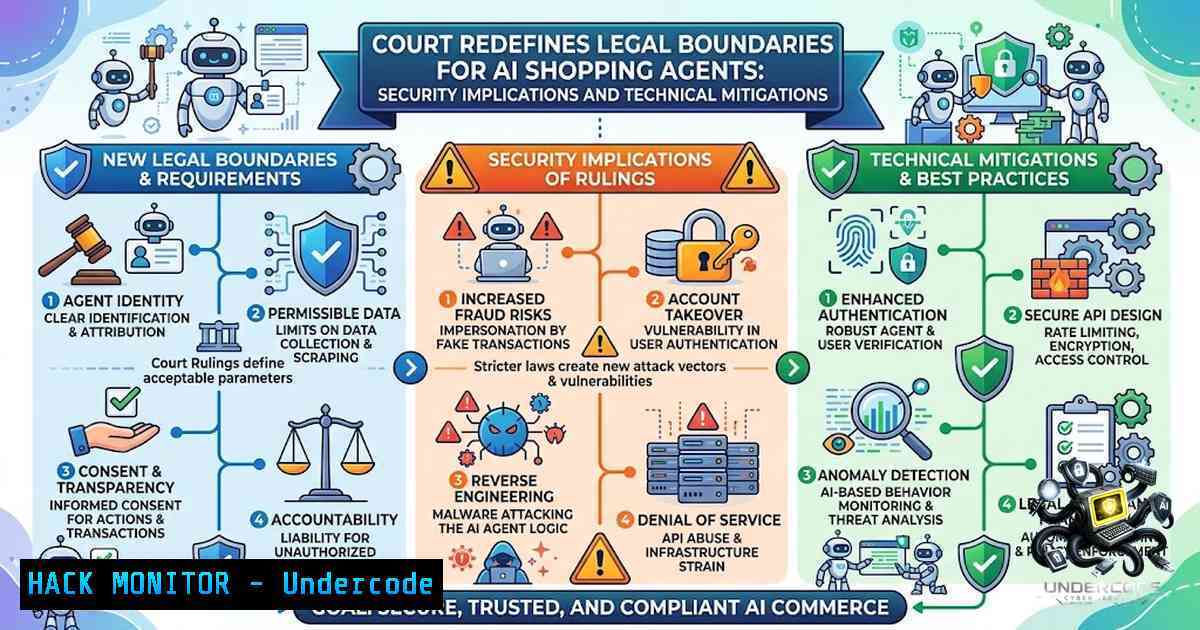
The Ninth Circuit’s recent ruling in Amazon v. Perplexity has fundamentally altered the legal landscape for automated web agents, establishing that users who direct AI shopping assistants are legally responsible for the access—not the AI company’s servers. This decision effectively moves the battleground from federal anti-hacking statutes to commercial terms of service, forcing security teams to rethink how they detect, rate-limit, and monetize agent-based traffic. For defenders, the ruling means that traditional CFAA-based blocking mechanisms are no longer sufficient, requiring a shift toward authentication-layer controls, behavioral analytics, and granular policy enforcement.
Learning Objectives:
- Understand the legal distinction between user-directed agents and autonomous systems under the Computer Fraud and Abuse Act (CFAA).
- Identify technical methods for detecting AI agent traffic across web applications and API endpoints.
- Implement rate-limiting, fingerprinting, and behavioral controls to mitigate automated shopping agents without relying on anti-hacking statutes.
You Should Know:
1. The Court’s Reasoning and Its Technical Implications
The Ninth Circuit held that when a customer directs Perplexity’s Comet browser to log into Amazon and make purchases, the customer—not Perplexity—is the party accessing Amazon’s computers. The court emphasized that screenshots travel from the customer’s machine to Perplexity, instructions travel back, and the request reaches Amazon from the customer’s browser. This client-side architecture was critical: Perplexity’s servers do not communicate directly with Amazon’s.
For security practitioners, this ruling underscores the importance of distinguishing between first-party authenticated sessions and third-party server-to-server interactions. A user-agent string alone no longer provides reliable legal grounds for blocking; instead, you must examine the entire request chain. From a technical standpoint, this means implementing client-side JavaScript instrumentation to detect headless browsers, automation frameworks, and remote debugging protocols.
Step-by-step guide to detecting AI agents via browser fingerprinting:
- Inspect navigator.webdriver property: Automated browsers typically set this to
true. Use client-side JavaScript to check `navigator.webdriver` and report anomalous values to your backend. - Analyze user-agent inconsistencies: Compare the user-agent against known patterns for headless Chrome (e.g.,
HeadlessChrome). Implement server-side regex matching to flag these. - Check for missing plugins or fonts: Legitimate browsers have a predictable set of plugins and fonts; automated agents often skip these. Use `navigator.plugins.length` and canvas fingerprinting.
- Monitor WebGL renderer information: Automated environments often use software rendering. Query `gl.getParameter(gl.RENDERER)` to detect virtualization.
- Log and correlate: Forward all anomalies to a SIEM with a risk score; block if score exceeds threshold.
2. Rate Limiting as the Primary Defense
With CFAA off the table for user-directed agents, rate limiting becomes the frontline control. The ruling effectively compels companies to treat AI agents as commercial partners or adversaries, depending on terms of service. Rate limits must be nuanced: distinguish between human browsing, authenticated API access, and unknown agents. Implement sliding window counters with adaptive thresholds based on session behavior.
Step-by-step guide to configuring NGINX rate limiting for API endpoints:
- Define a limit zone: `limit_req_zone $binary_remote_addr zone=api_limit:10m rate=10r/s;`
2. Apply to location blocks: `location /api/ { limit_req zone=api_limit burst=20 nodelay; proxy_pass http://backend; }`
3. Add logging: `log_format limit ‘$remote_addr – $limit_req_status’; access_log /var/log/nginx/rate_limit.log limit;`
4. Test with siege: `siege -c 50 -t 10s http://yoursite.com/api/endpoint` to validate burst handling. - Monitor and adjust: Use Prometheus metrics to track rejected requests and fine-tune rates per endpoint.
3. Terms of Service Enforcement via API Gateways
Since the court expressly left contract and tort claims open, API gateways must now enforce terms of service programmatically. This involves checking API keys, OAuth tokens, and custom headers against allowed agent lists. Implement a deny-list for known agent user-agents and an allow-list for trusted partners.
Step-by-step guide to configuring AWS API Gateway for agent detection:
- Create a usage plan with API keys for legitimate partners.
- Set up a custom authorizer Lambda that checks the `User-Agent` header against a DynamoDB table of approved agents.
- Return 403 Forbidden if the agent is not recognized, with a custom message referencing terms of service.
- Log all denials to CloudWatch for audit trails.
- Deploy a canary release to test policies before full rollout.
4. Behavioral Analytics for Agent Identification
Beyond simple headers, behavioral analysis can identify agents that mimic human browsing. Monitor click patterns, mouse movements, and time-on-page. Implement machine learning models that score sessions based on deviation from human baselines.
Step-by-step guide to implementing behavioral heuristics in JavaScript:
- Collect mouse events: `document.addEventListener(‘mousemove’, (e) => { sendEvent(e.clientX, e.clientY); });`
2. Calculate movement speed: Compute Euclidean distance between consecutive mouse positions over time; humans have variable speeds, automation is often linear. - Track scroll behavior: Humans scroll with pauses; automation scrolls at constant velocity. Measure `window.scrollY` changes at 100ms intervals.
- Send aggregated metrics to backend every 5 seconds via beacon API: `navigator.sendBeacon(‘/analytics’, data);`
5. Run anomaly detection using Z-score or isolation forest on aggregated session data.
5. Session Isolation and Sandboxing
To protect legitimate users from agent-induced abuse, implement session isolation. This ensures that automated actions do not degrade performance or trigger account lockouts for human users. Use containerization to run each session in a separate browser context.
Step-by-step guide to session isolation with Docker and Selenium:
- Launch a Selenium Grid with separate containers per session: `docker run -d -p 4444:4444 selenium/standalone-chrome`
2. Assign unique session IDs using `driver.getSessionId()` and map them to user accounts. - Implement resource limits via Docker CPU/memory constraints: `–cpus=”0.5″ –memory=”512m”`
4. Isolate network namespaces to prevent cross-session interference: `docker run –1etwork=none …`
5. Terminate idle sessions after 30 minutes using `driver.quit()` and Docker cleanup scripts.
6. API Security and Token Rotation
With agents potentially using stolen session tokens, implement short-lived JWTs and refresh tokens. Require proof-of-possession (DPoP) to bind tokens to client certificates or public keys, making token replay more difficult.
Step-by-step guide to implementing DPoP with Spring Security:
- Add DPoP filter that validates `DPoP` header containing JWT with `htm` (HTTP method) and `htu` (URI).
- Verify signature using the client’s public key submitted during authentication.
- Reject requests where the `htu` does not match the actual request URI.
- Set access token expiration to 5 minutes, refresh tokens to 24 hours.
- Log all token validation failures for forensic analysis.
What Undercode Say:
- Key Takeaway 1: The CFAA no longer provides a reliable shield against user-directed AI shopping agents; legal defenses must pivot to contract and commercial terms.
- Key Takeaway 2: Technical controls such as rate limiting, behavioral analytics, and session isolation are now the primary means of managing agent traffic.
Analysis:
The Ninth Circuit’s decision reflects a broader trend of courts interpreting computer access laws narrowly, favoring user agency over platform control. This places the burden squarely on businesses to architect their systems for agent detection and enforcement at the application layer. Expect a surge in demand for WAF rules that inspect not just headers but also behavioral patterns. Security teams should prioritize integrating client-side telemetry with backend ML models to distinguish humans from automation. Additionally, legal departments must update terms of service to explicitly address automated agents, including penalties for violation. The ruling also opens the door for third-party agent management platforms that negotiate access on behalf of users, creating a new ecosystem of “agent brokers.” For defenders, this means preparing for sophisticated agents that mimic human behavior more convincingly, requiring continuous model retraining. Finally, the commercial implications are significant: companies may choose to monetize agent access via premium APIs, turning a threat into a revenue stream.
Prediction:
- +1 Increased investment in AI-driven bot detection and behavioral analytics startups, as traditional signature-based WAFs become obsolete.
- -1 Continued litigation over terms of service violations, leading to legal uncertainty and increased compliance costs for e-commerce platforms.
- +1 Emergence of standard API specifications for AI agent authentication, similar to OAuth, creating interoperability and clear access rules.
- -1 Potential for adversarial evasion techniques that defeat current behavioral models, requiring constant model updates and data labeling efforts.
- +1 Shift toward “agent-friendly” APIs that provide structured data for shopping assistants, reducing the need for scraping and improving user experience.
- -1 Risk of account takeover via compromised agent sessions, as agents store credentials and session cookies that become high-value targets.
▶️ Related Video (82% Match):
🎯Let’s Practice For Free:
🎓 Live Courses & Certifications:
Join Undercode Academy for Verified Certifications
🚀 Request a Custom Project:
Secure, high-velocity infrastructure and disruptive technological engineering. Contact our engineering team for high-tier development and proprietary systems:
[email protected]
💎 Smart Architecture | 🛡️ Secure by Design | ⭐ Trusted by Thousands
IT/Security Reporter URL:
Reported By: https://lnkd.in/p/e374Vmsp – Hackers Feeds
Extra Hub: Undercode MoN
Basic Verification: Pass ✅


