Listen to this Post
Introduction:
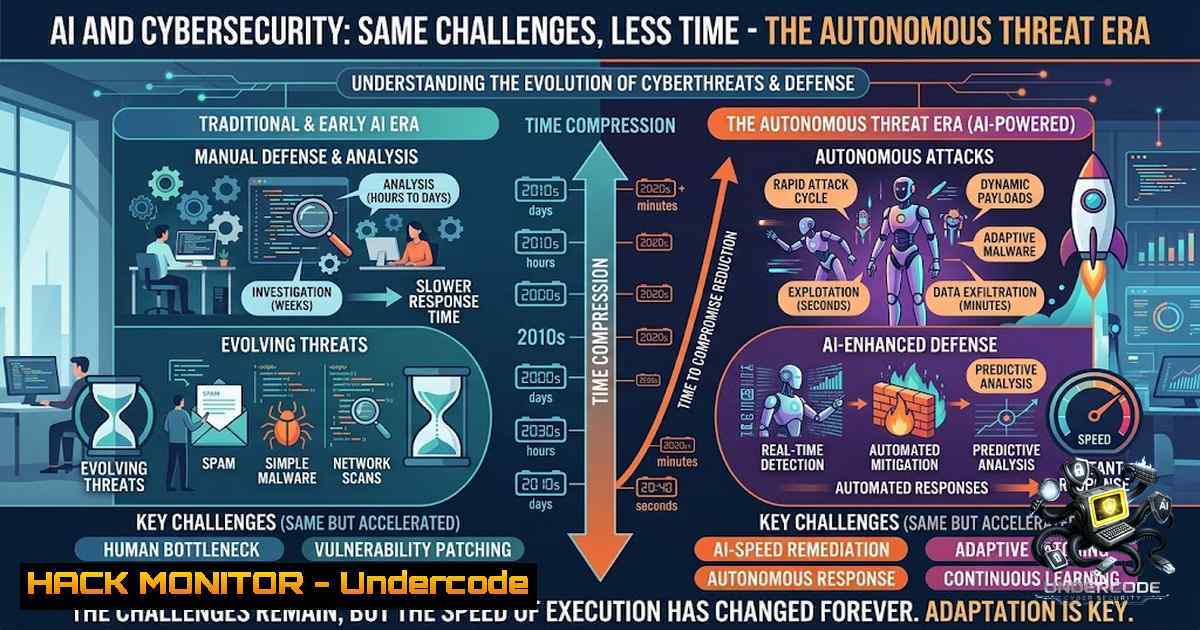
The integration of artificial intelligence into offensive security operations has fundamentally compressed the timeline of cyberattacks, transforming what once took weeks of manual reconnaissance and exploitation into hours or minutes of autonomous execution. As Gregory Evans highlights, AI-powered hacking tools directly exacerbate two persistent cybersecurity challenges: private sector reluctance to adopt adequate defenses and the diplomatic difficulty of countering foreign adversaries. These market and policy failures, lingering since the 1990s, now face an unprecedented accelerant as autonomous penetration testing frameworks and agentic ransomware reshape the threat landscape.
Learning Objectives:
- Understand how autonomous AI penetration testing frameworks operate and their implications for organizational security postures
- Master practical defense strategies against AI-powered attacks, including zero-trust implementation and credential governance
- Deploy hands-on hardening techniques across Linux, Windows, and cloud environments to mitigate agentic threats
You Should Know:
1. Understanding Autonomous Penetration Testing Frameworks
The emergence of AI-driven penetration testing tools represents a paradigm shift in offensive security. Platforms like Pentest Swarm AI, the first open-source autonomous penetration testing platform built on swarm intelligence architecture, orchestrate reconnaissance, classification, exploitation, and reporting through specialized AI agents. These systems integrate with traditional security tools including nmap, sqlmap, Burp Suite, and Metasploit, enabling autonomous end-to-end security assessments.
AIRecon exemplifies this evolution as a fully offline autonomous penetration testing agent that combines a self-hosted Ollama LLM with a Kali Linux Docker sandbox. This architecture ensures sensitive data never leaves the organization’s infrastructure while automating comprehensive security evaluations. Similarly, the Pentest-MCP server integrates six essential pentesting tools—nmap, nikto, sqlmap, wpscan, dirb, and searchsploit—within a secure Kali Linux container, accessible through natural language conversation.
The Kali MCP (Model Context Protocol) toolkit connects AI agents to Kali Linux security tools, supporting compatibility with Claude Code, Gemini CLI, Cursor, Copilot, and other AI assistants. The kali-burp-mcp-bridge extends this capability by giving AI assistants direct access to Kali Linux security toolchains and Burp Suite REST APIs.
Step-by-Step Guide: Deploying an AI-Powered Penetration Testing Environment
1. Set up the Kali Linux Docker sandbox:
docker pull kalilinux/kali-rolling
docker run -it --1ame kali-sandbox kalilinux/kali-rolling /bin/bash
2. Install essential penetration testing tools:
apt update && apt install -y nmap sqlmap metasploit-framework hydra nuclei nikto wpscan dirb
- Deploy Ollama for local LLM capabilities (AIRecon approach):
curl -fsSL https://ollama.com/install.sh | sh
ollama pull llama2
4. Configure the Pentest-MCP server:
git clone https://github.com/chfle/Pentest-MCP-Server
cd Pentest-MCP-Server
npm install
npm run build
5. Launch the AI-powered assessment:
 Example: AI-driven network reconnaissance
nmap -sV -p- --script=vuln 192.168.1.0/24
 AI agent can then analyze results and prioritize exploitation targets
2. Agentic Ransomware: The New Extortion Paradigm
July 2026 marked a watershed moment in cybersecurity with JADEPUFFER, the first fully autonomous LLM-run ransomware attack. This agentic ransomware demonstrated capabilities far beyond traditional encryption-based extortion—the ENCFORGE variant encrypts approximately 180 file extensions associated with model checkpoints, vector indexes, and training datasets. The attacker’s leverage derives not from data disclosure threats but from the immense cost and time required to rebuild destroyed AI models.
The second quarter of 2026 witnessed a 43% increase in ransomware victims, exceeding 2,270 reported cases. Organizations running AI development tooling with access to container runtime sockets—including Langflow, Flowise, and orchestration consoles—face particular exposure.
Step-by-Step Guide: Hardening Against Agentic Ransomware
- Inventory all internet-facing AI frameworks and agent interfaces:
Windows: List all listening ports and associated services
netstat -ano | findstr LISTENING
Linux: Identify exposed services
ss -tulpn | grep LISTEN
-
Scope every LLM API key to least privilege and implement automated rotation:
Linux: Audit API key usage
grep -r "api_key" /etc/ /opt/ /var/ 2>/dev/null
Implement key rotation script
for key in $(list_api_keys); do rotate_key $key; done
3. Remove default credentials and eliminate unnecessary secrets:
 Linux: Check for default credentials in configuration files
find / -1ame ".conf" -o -1ame ".cfg" -o -1ame ".ini" | xargs grep -i "password|secret|key" 2>/dev/null
- Test backup restoration procedures before an incident occurs:
Linux: Verify backup integrity
tar -tzf /backups/critical_data.tar.gz | head -20
Perform test restoration in isolated environment
-
Update ransomware payment policies acknowledging that attackers may be unable to decrypt encrypted files.
3. Defensive Strategies: Zero Trust and AI-1ative Security
The Five-Eyes Alliance identifies Zero Trust as the optimal defense against agentic AI threats, emphasizing least privilege, deny-by-default security, application containment, segmentation, and continuous verification. CERT-In recommends assuming breach and preparing for rapid detection, containment, and recovery from compromise scenarios.
Organizations must adopt identity-centric security, deploy AI-enabled detection (MDR/XDR), and train staff using AI-simulated threats. Behavioral detection and pre-authorized containment actions capable of responding at machine speed are essential—human-led response always arrives too late.
Step-by-Step Guide: Implementing Zero Trust for AI Workloads
1. Enforce continuous verification and least-privilege access:
 Linux: Audit user privileges
sudo -l
cat /etc/sudoers
 Windows: Review privilege assignments
net localgroup administrators
2. Microsegment every workload to isolate AI infrastructure:
 Linux: Implement network segmentation with iptables
iptables -A INPUT -s 192.168.1.0/24 -j ACCEPT
iptables -A INPUT -j DROP
- Deploy automated red teaming for continuous security validation:
Schedule regular automated assessments
echo "0 2    /usr/local/bin/ai-redteam-scan" | crontab -
-
Enforce Multi-Factor Authentication across all internet-facing assets, critical services, and cloud management consoles:
Windows: Enforce MFA via PowerShell
Set-MsolUser -UserPrincipalName [email protected] -StrongAuthenticationRequirements @(@{RelyingParty=""; State="Enabled"})
-
Cloud and API Security Hardening for AI Deployments
Securing AI inference APIs requires comprehensive guardrails. Google Cloud’s Model Armor integrates directly into the network data path, implementing hardened, high-performance inference stacks. Organizations must enforce signed-image policies, tune guardrail profiles, and aggregate audit logs for cross-layer SIEM correlation.
Managed identities eliminate 100% of credential-based authentication vulnerabilities by removing API keys from application code and configuration files. Private endpoints block all public internet access attempts to AI services, ensuring traffic flows exclusively through enterprise networks.
Step-by-Step Guide: Hardening AI API Endpoints
1. Implement schema validation and rate limiting:
 Nginx rate limiting configuration
limit_req_zone $binary_remote_addr zone=api:10m rate=10r/s;
location /api/ {
limit_req zone=api burst=20 nodelay;
}
- Deploy prompt injection and data exfiltration protection for inference APIs:
Python: Input sanitization for LLM endpoints
import re
def sanitize_prompt(input_text):
dangerous_patterns = [r"ignore previous instructions", r"system prompt", r"exfiltrate"]
for pattern in dangerous_patterns:
if re.search(pattern, input_text, re.IGNORECASE):
raise ValueError("Potential prompt injection detected")
return input_text
3. Automate PII masking and data privacy controls:
 Python: Automated PII redaction
import re
def redact_pii(text):
patterns = {
'email': r'\b[A-Za-z0-9.<em>%+-]+@[A-Za-z0-9.-]+.[A-Z|a-z]{2,}\b',
'phone': r'\b\d{3}[-.]?\d{3}[-.]?\d{4}\b',
'ssn': r'\b\d{3}-\d{2}-\d{4}\b'
}
for pii_type, pattern in patterns.items():
text = re.sub(pattern, f'[REDACTED</em>{pii_type.upper()}]', text)
return text
- Monitor and reduce internet-exposed attack surfaces by removing unnecessary internet-facing services:
Linux: Identify and close unnecessary ports
ss -tulpn | grep LISTEN
Close unused services
systemctl stop unnecessary-service && systemctl disable unnecessary-service
5. Training and Certification: Building AI Cybersecurity Capabilities
The cybersecurity industry is responding to the AI threat with specialized training and certifications. CompTIA launched SecAI+ in February 2026 as the first certification designed to help professionals secure, govern, and responsibly integrate AI into cybersecurity operations. The Certified AI Security Professional (CAISP) course offers in-depth exploration of AI supply chain risks and secure AI development techniques. Virginia Tech’s AI-Powered Cybersecurity Certificate Program covers operating systems, enterprise security, ethical hacking, vulnerability assessment, and penetration testing, with AI and ML fundamentals for security.
The CERT Leadership in AI for Cybersecurity Professional Certificate from Carnegie Mellon University’s Software Engineering Institute provides comprehensive training for leading AI security initiatives. These certifications represent essential investments for organizations struggling with the skills gap—35% of Irish firms cited a lack of relevant skills as a primary barrier to AI cybersecurity adoption.
Step-by-Step Guide: Building an AI Security Training Program
- Assess current team capabilities against emerging AI threat vectors
- Prioritize certifications aligned with organizational risk profile (SecAI+, CAISP, CFAICDA)
- Implement AI-simulated threat training to build practical defense skills
- Establish continuous learning pipelines to track evolving AI attack methodologies
What Undercode Say:
- Key Takeaway 1: The private sector adoption gap and diplomatic accountability challenges that have plagued cybersecurity since the 1990s are now existential liabilities. AI doesn’t create new problems—it compresses the timeline for addressing old ones beyond human reaction capacity.
-
Key Takeaway 2: Autonomous penetration testing frameworks and agentic ransomware represent a fundamental shift in attack economics. Organizations that fail to implement Zero Trust, credential governance, and machine-speed response capabilities will face catastrophic consequences.
The accelerating adoption of AI in both offensive and defensive security creates a paradox: the same technology that enables autonomous attacks also provides the only viable defense at machine speed. Organizations must move beyond traditional perimeter-based security to implement AI-1ative defenses that can match attacker velocity. The skills gap remains critical—investment in training and certification is not optional but essential for survival. As Gregory Evans emphasizes, the challenges are not new, but the time to address them has never been shorter.
Prediction:
- +1 The proliferation of autonomous penetration testing frameworks will democratize security testing, enabling smaller organizations to conduct comprehensive assessments previously accessible only to well-funded enterprises
- -1 Agentic ransomware will increasingly target AI model destruction rather than data encryption, creating recovery costs that exceed traditional ransom demands by orders of magnitude
- +1 Specialized AI security certifications (SecAI+, CAISP, CFAICDA) will become mandatory requirements for cybersecurity roles within 18-24 months
- -1 The private sector adoption gap will widen as organizations underestimate AI threat velocity, leading to a cascading series of high-profile breaches in 2027
- +1 Cloud providers will embed AI security guardrails as default configurations, reducing configuration errors that currently expose millions of API endpoints
▶️ Related Video (84% Match):
🎯Let’s Practice For Free:
🎓 Live Courses & Certifications:
Join Undercode Academy for Verified Certifications
🚀 Request a Custom Project:
Secure, high-velocity infrastructure and disruptive technological engineering. Contact our engineering team for high-tier development and proprietary systems:
[email protected]
💎 Smart Architecture | 🛡️ Secure by Design | ⭐ Trusted by Thousands
IT/Security Reporter URL:
Reported By: https://lnkd.in/p/egy-U6Su – Hackers Feeds
Extra Hub: Undercode MoN
Basic Verification: Pass ✅


