Listen to this Post
Introduction
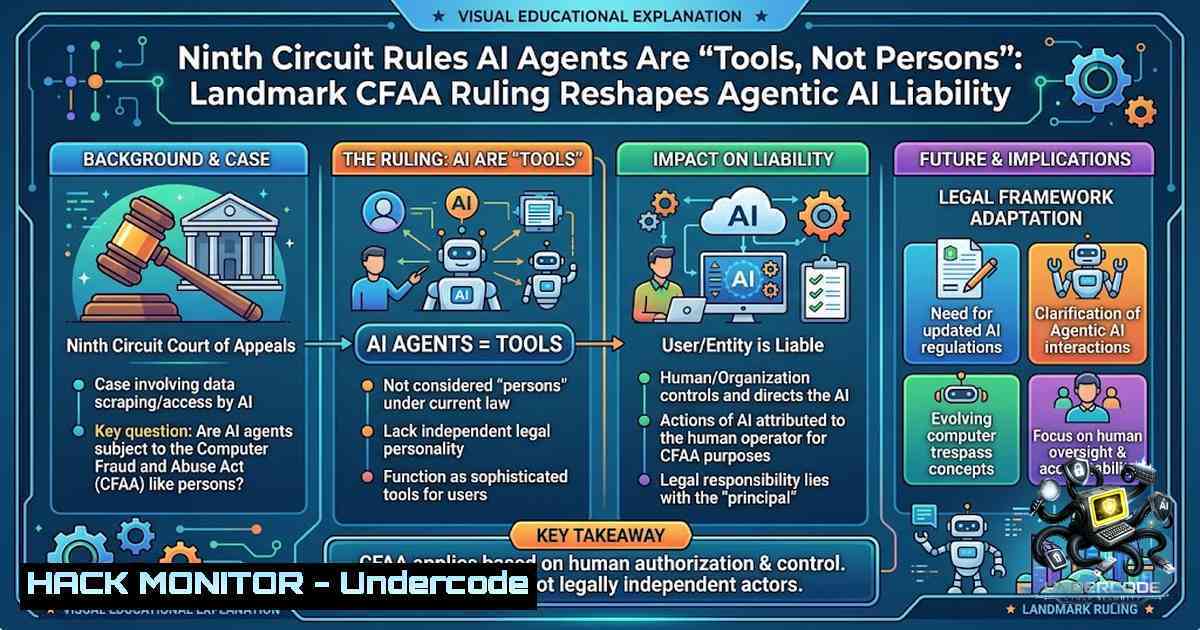
On August 4, 2026, the U.S. Court of Appeals for the Ninth Circuit issued a landmark decision in Amazon.com Services, LLC v. Perplexity AI, Inc., vacating a preliminary injunction that had barred Perplexity’s AI-powered Comet browser from interacting with Amazon’s website. The ruling addresses a question of first impression: whether an AI “agent” that assists a user in navigating a website constitutes unauthorized “access” under the Computer Fraud and Abuse Act (CFAA). The panel held that it does not—concluding that it is the user, not the AI tool, who “accesses” the website for statutory purposes. This decision establishes a critical framework for how courts will treat AI software in the context of digital access, with profound implications for AI developers, platform operators, and the future of agentic commerce.
Learning Objectives
- Understand the Ninth Circuit’s statutory interpretation of “access” under the CFAA and its application to AI agents
- Analyze the technical architecture distinguishing user-initiated agentic tools from direct server-to-server access
- Identify compliance strategies for AI developers and platform operators in the wake of the ruling
- Evaluate the legal and commercial implications for agentic AI deployment across e-commerce platforms
- The CFAA and the “Access” Question: A Textual Analysis
The CFAA, the principal federal anti-hacking statute, prohibits intentionally accessing a “protected computer” without authorization or in excess of authorized access. The statute’s text punishes “whoever . . . intentionally accesses” a protected computer—and “whoever” means a person. The Ninth Circuit’s reasoning rested on this textual point: the Assistant “is a tool, not a person for statutory purposes”.
The court further emphasized that Perplexity’s servers do not directly communicate with Amazon’s infrastructure. When a user directs the Assistant to perform a task on Amazon.com—such as finding a product—the Assistant takes screenshots of the user’s browser view, sends those screenshots to Perplexity’s servers for analysis, and receives navigation instructions in return. Critically, the user’s browser (not Perplexity’s servers) communicates directly with Amazon’s servers at all times. The Assistant cannot operate independently but relies on both user direction and server-side instructions.
The court distinguished this case from precedents like Facebook v. Power Ventures, where direct server-to-server interaction was a central factor. The panel also noted that adopting Amazon’s broad interpretation could inadvertently expose individual users to criminal liability—a result the court was unwilling to facilitate.
Technical Deep Dive: User-Agent Strings and Browser Identification
Amazon had informed Perplexity that its AI products would not be authorized to interact with the Amazon Store. Perplexity declined to use a “user-agent string” that would have allowed Amazon to identify and block the Assistant. A user-agent string is an HTTP header that identifies the browser and operating system to the web server. Developers can modify this string to disguise automated tools as legitimate browsers—a practice Amazon alleged Perplexity employed by disguising Comet as a normal Chrome browser.
Linux Command to Inspect User-Agent Strings:
curl -I https://www.amazon.com | grep -i "user-agent"
Python Script to Rotate User-Agents:
import requests
from fake_useragent import UserAgent

ua = UserAgent()
headers = {'User-Agent': ua.random}
response = requests.get('https://www.amazon.com', headers=headers)
print(response.status_code)
Windows PowerShell Equivalent:
Invoke-WebRequest -Uri https://www.amazon.com -Headers @{"User-Agent"="Mozilla/5.0 (Windows NT 10.0; Win64; x64) AppleWebKit/537.36"}
- Technical Architecture: How Agentic AI Interacts with Web Platforms
Understanding the technical architecture was central to the court’s ruling. Perplexity’s Comet browser includes an optional agentic AI feature referred to as the “Assistant”. The architecture operates as follows:
- User Initiation: The user directs the Assistant to perform a task on Amazon.com
- Screen Capture: The Assistant takes screenshots of the user’s browser view
- Server Processing: Screenshots are sent to Perplexity’s servers for analysis
- Instruction Return: Navigation instructions are returned to the Assistant
- Direct Communication: The user’s browser communicates directly with Amazon’s servers
The court found this architecture significant because Perplexity itself never directly accesses Amazon’s systems—the user’s browser does. The Electronic Frontier Foundation (EFF), which filed an amicus brief joined by Mozilla and other organizations, successfully argued that AI intent should be ascribed to the user. The court explicitly credited this filing, noting that EFF’s explanation “articulates the nature of the system most clearly”.
Step-by-Step: Implementing a User-Initiated Agentic Browser Tool
For developers building similar tools, the architecture should follow this pattern to maintain legal defensibility:
Step 1: Ensure all actions are user-initiated—the agent should not perform any autonomous action without explicit user command.
Step 2: Keep all direct server communication originating from the user’s browser, not from backend servers.
Step 3: Process data server-side only after receiving user-authorized screenshots or inputs.
Step 4: Maintain transparency with platforms by using identifiable user-agent strings unless legally permissible otherwise.
Step 5: Document the user-initiated nature of all automated actions for compliance and legal defense purposes.
- Compliance Strategies for AI Developers and Platform Operators
For AI Developers
The ruling provides legal certainty for user-directed agents—those where the software acts as a clear extension of the user’s intent. However, the court kept its opinion narrow and specifically disclaimed applicability to other facts or laws related to data access and agentic AI. Key considerations include:
- User Direction: Ensure agents operate only upon explicit user commands
- Architectural Separation: Maintain direct user-to-platform communication rather than server-to-server access
- Transparency: Consider using identifiable user-agent strings to avoid claims of deception
- Terms of Service Compliance: Review platform terms for contractual obligations beyond statutory claims
For Platform Operators
The ruling limits the CFAA as a tool to block agentic AI. Platforms may need to rely on other legal theories or technical measures:
- Contractual Claims: Terms of service violations may provide alternative causes of action
- Technical Controls: Implement bot detection and rate limiting rather than relying solely on legal injunctions
- User Education: Inform users about authorized vs. unauthorized tools
API Security and Bot Detection Configuration
Nginx Rate Limiting to Mitigate Automated Access:
limit_req_zone $binary_remote_addr zone=amazon_api:10m rate=10r/m;
server {
location /api/ {
limit_req zone=amazon_api burst=5 nodelay;
proxy_pass https://api.amazon.com/;
}
}
AWS WAF Bot Control Rule (JSON):
{
"Name": "BotControlRule",
"Priority": 10,
"Action": { "Block": {} },
"VisibilityConfig": {
"SampledRequestsEnabled": true,
"CloudWatchMetricsEnabled": true,
"MetricName": "BotControlRule"
},
"Statement": {
"ManagedRuleGroupStatement": {
"VendorName": "AWS",
"Name": "AWSManagedRulesBotControlRuleSet"
}
}
}
Linux iptables Rate Limiting:
iptables -A INPUT -p tcp --dport 443 -m hashlimit \
--hashlimit-1ame amazon_bot --hashlimit-above 10/minute \
--hashlimit-burst 5 -j DROP
- The Commercial Stakes: Agentic Commerce and Platform Control
The ruling has significant commercial implications. Agentic AI represents a fundamental shift in how users interact with e-commerce platforms—allowing software to browse, compare, and purchase on behalf of users. For Amazon, this threatens the carefully curated shopping experience it has spent years designing, from search ranking to recommendations. An agent that bypasses these layers strips the retailer of influence and ad revenue.
The court’s decision effectively opens the door to agentic commerce. As one commentator noted, “If an agent acting on a user’s instruction is legally the user, then platforms lose one of their sharpest tools for keeping third-party agents out”. Amazon has been building its own agentic layer, putting Alexa inside the search bar as it races to own the shopping agent rather than be bypassed.
China’s largest platforms have already gone furthest, replacing the search bar with AI agents that shop for users—a preview of where Western retail may be heading. Alibaba has wired its own model directly into Taobao for end-to-end agentic shopping.
- The Liability Gap: Autonomous Agents and Future Uncertainty
While the ruling stabilizes the current ecosystem for shopping assistants and browser-based agents, it leaves a structural liability gap for future autonomous agents that operate independently of direct user input. The court acknowledged that “there is little to no existing caselaw directly dealing with how to ascribe responsibility for AI agents”.
Critical questions remain unanswered:
- Who is liable when an autonomous agent causes harm? Treating the agent as the user has consequences well beyond a shopping cart
- What happens when agents operate without continuous user direction? The ruling explicitly does not address this scenario
- Can platforms revoke access through cease-and-desist letters? Under Power Ventures, such revocation may constitute unauthorized access
Vulnerability Assessment for Agentic AI Deployments
Nmap Scan for Exposed API Endpoints:
nmap -p 443 --script http-title,ssl-cert target.com
OpenVAS Vulnerability Scan:
openvas-cli --target target.com --scan-type full
API Security Testing with OWASP ZAP:
zap-cli quick-scan --self-contained --spider -r target.com/api/
What Undercode Say
- Key Takeaway 1: The Ninth Circuit’s ruling establishes that user-directed AI agents are legally treated as tools operated by users, not independent actors accessing protected computers under the CFAA. This provides critical legal certainty for AI developers building browser-based agentic tools.
-
Key Takeaway 2: The decision does not immunize all AI agents—autonomous agents operating without continuous user direction remain in a legal gray area, and platform operators retain other tools including contractual claims and technical countermeasures to protect their platforms.
The ruling represents a significant victory for innovation and consumer choice, but it also highlights the urgent need for clearer legislative frameworks governing agentic AI. As one court observer noted, “thorny questions of AI ‘intent’ were irrelevant to this case, because the Assistant is a tool, not a person”. However, as AI agents become more autonomous, the distinction between tool and actor will blur, demanding new legal paradigms. The decision also reinforces the importance of the EFF’s ongoing work defending developers against overbroad CFAA claims. For now, builders of user-directed agents can proceed with greater confidence, but they must remain vigilant about architectural choices, transparency, and evolving platform terms. The commercial race to agentic commerce is on—and the legal landscape is only beginning to take shape.
Prediction
- +1 The ruling will accelerate innovation in agentic AI by reducing litigation risk for user-directed shopping assistants, potentially unlocking billions in venture capital investment in the sector over the next 12–18 months.
-
+1 Platform operators will increasingly shift from legal blocking to technical countermeasures (bot detection, rate limiting, behavioral analysis), driving growth in the cybersecurity and anti-bot technology market.
-
-1 The liability gap for autonomous agents will lead to high-profile litigation within 2–3 years when an independent AI agent causes significant harm, potentially prompting congressional action to amend the CFAA or create new regulatory frameworks.
-
-1 Amazon and other major platforms may respond by tightening terms of service and implementing more aggressive technical barriers, potentially fragmenting the web into walled gardens that restrict agentic access.
-
+1 The EFF’s victory in this case strengthens the broader movement for user-controlled computing and may influence future rulings on web scraping, data ownership, and digital rights.
▶️ Related Video (76% Match):
https://www.youtube.com/watch?v=0dQOM5FkV5I
🎯Let’s Practice For Free:
🎓 Live Courses & Certifications:
Join Undercode Academy for Verified Certifications
🚀 Request a Custom Project:
Secure, high-velocity infrastructure and disruptive technological engineering. Contact our engineering team for high-tier development and proprietary systems:
[email protected]
💎 Smart Architecture | 🛡️ Secure by Design | ⭐ Trusted by Thousands
IT/Security Reporter URL:
Reported By: https://lnkd.in/p/eD8tBNTS – Hackers Feeds
Extra Hub: Undercode MoN
Basic Verification: Pass ✅


