Listen to this Post
Introduction
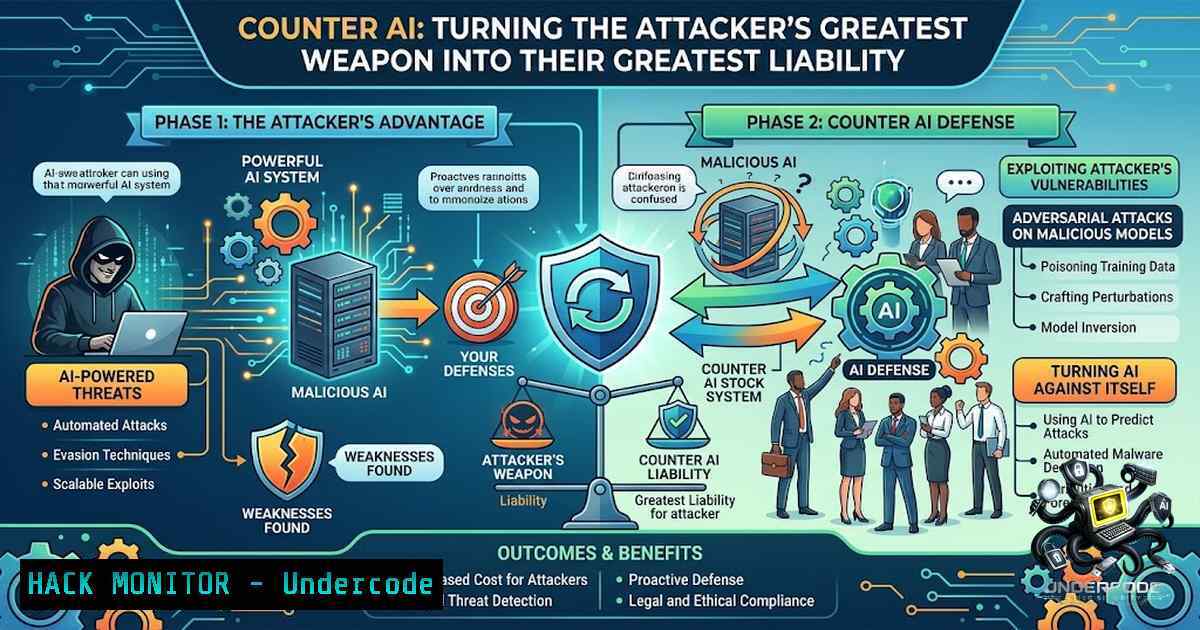
The cybersecurity industry has witnessed a dramatic power shift: AI-powered attacks now compress the cyber kill chain from weeks to minutes, with average breakout times dropping to under 30 minutes and the fastest cases measured in seconds. Yet this very reliance on AI by adversaries creates a paradoxical vulnerability—an opportunity for defenders to deploy Counter AI strategies that transform attacker automation from a force multiplier into an exploitable weakness. The shift from speed-centric to control-centric cyber defense represents not merely an incremental improvement but a fundamental reimagining of how organizations secure their digital assets in an era where human-speed defense no longer suffices.
Learning Objectives
- Understand the “cybersecurity speed gap” and how AI has compressed attack timelines from days to minutes
- Master Counter AI defensive techniques including adversarial machine learning defense, context bombing, and AI-against-AI frameworks
- Implement practical defensive measures across Linux, Windows, and cloud environments to detect and neutralize AI-powered threats
- Deploy advanced zero trust architectures with AI-1ative identity and access controls for non-human actors
- Apply “attack to defend” methodologies through adversary emulation and continuous validation
You Should Know
- Understanding the AI Speed Gap: Why Traditional Defense Fails
AI-enabled adversaries are demonstrating an ability to move far faster than defenders that rely on human speed, compressing the lifecycle of attacks from weeks or days into hours and minutes. According to Booz Allen’s threat report, attackers can now discover and weaponize vulnerabilities in minutes instead of weeks—many vulnerabilities are exploited within 24 hours of public disclosure, often before organizations even know they’re exposed.
The fundamental problem lies in traditional defense operating models that follow a linear sequence: detect, investigate, decide, respond. At AI speed, there isn’t time to understand an intrusion before responding. What used to require coordinated teams working for days can now be carried out by a single operator in minutes. This paradigm shift requires a parallel, compressed defense model where detection, investigation, and response occur simultaneously.
Practical Assessment Commands:
To assess your organization’s exposure to the speed gap, start with these foundational checks:
Linux – Identify Unpatched Vulnerabilities:
 Check for packages with known vulnerabilities (Debian/Ubuntu)
apt list --upgradable 2>/dev/null | grep -v "Listing" | wc -l

Check for CVEs affecting installed packages (requires vulnscan)
vulnscan -a | grep -E "CRITICAL|HIGH" | head -20

Identify open ports that could be entry points
sudo netstat -tulpn | grep LISTEN | awk '{print $4}' | cut -d: -f2 | sort -1 | uniq
Windows – Assess Exposure Window:
 Check patch levels and installation dates
Get-HotFix | Sort-Object InstalledOn | Select-Object -Last 10

Identify services running with high privileges
Get-Service | Where-Object {$<em>.Status -eq "Running"} | ForEach-Object {
Get-WmiObject Win32_Service -Filter "Name='$($</em>.Name)'" |
Select-Object Name, StartName
}

Check for suspicious scheduled tasks (potential persistence)
Get-ScheduledTask | Where-Object {$_.State -1e "Disabled"} | Select-Object TaskName, State
2. Counter AI Defense Framework: The Three-Layered Approach
Counter AI defense operates across three distinct layers of the AI stack: cybersecurity attacks, adversarial machine learning attacks, and adversarial AI attacks. Each layer requires specific defensive techniques:
Layer 1: Cybersecurity Defense — Protects the infrastructure hosting AI systems through traditional security controls augmented with AI-speed detection.
Layer 2: Adversarial Machine Learning Defense — Uses machine learning methods to detect and mitigate attacks targeting data and model layers, including adversarial example detection, input sanitization, and model certification.
Layer 3: Adversarial AI Defense — Implements AI-against-AI security paradigms through generative origin intelligence, adversarial dual-model discrimination, dynamic sandboxing, reinforcement-driven deception, and secure lifecycle governance.
Implementing AI-against-AI Defense:
Linux – Deploy Adversarial Input Detection:
 Example: Input sanitization for ML models using adversarial detection
import numpy as np
from scipy.spatial.distance import cdist

def detect_adversarial_input(sample, training_data, threshold=0.85):
"""
Detect potential adversarial inputs by measuring distance from
legitimate training distribution.
"""
distances = cdist([bash], training_data, metric='euclidean')
min_distance = np.min(distances)
return min_distance > threshold, min_distance

Monitor API endpoints for anomalous inputs
 Log all inputs with anomaly scores for forensic analysis
Windows – Implement Model Integrity Monitoring:
 Monitor model file integrity with PowerShell
$modelPath = "C:\Models\production_model.pkl"
$baselineHash = (Get-FileHash -Path $modelPath -Algorithm SHA256).Hash

Create scheduled task to verify integrity hourly
$action = New-ScheduledTaskAction -Execute "powershell.exe" -Argument <code>"-Command `"if ((Get-FileHash -Path '$modelPath' -Algorithm SHA256).Hash -1e '$baselineHash') { `
Write-EventLog -LogName Security -Source 'ModelIntegrity' -EventId 1001 -Message 'Model tampering detected' }</code>""
Register-ScheduledTask -Action $action -TaskName "ModelIntegrityCheck" -Trigger (New-ScheduledTaskTrigger -Hourly -At 0)
- Context Bombing: Turning AI Safety Guardrails Against Attackers
Context bombing is an emerging defensive technique that uses prompt injections to trigger AI safety guardrails and disrupt malicious AI-powered hacking agents. By injecting carefully crafted context into environments where attacker AI agents operate, defenders can cause these agents to trigger their own safety mechanisms, effectively derailing automated attacks.
This technique exploits the very safety features designed to prevent AI misuse—when an attacker’s AI agent encounters specific trigger patterns, its built-in guardrails activate, halting the attack sequence. Tests across five leading AI models showed a sharp drop in successful attack runs when context bombing was deployed.
Implementation Guide:
Step 1: Identify AI Agent Entry Points
Map all API endpoints, web forms, and data ingestion points where AI agents might interact with your systems.
Step 2: Deploy Context Bombs
 Example: Context bomb deployment script
def deploy_context_bombs(target_endpoints, trigger_phrases):
"""
Deploy context bombs to API endpoints that may be targeted by AI agents.
"""
for endpoint in target_endpoints:
 Inject trigger patterns into response headers, error messages,
 and API responses that would cause AI agents to trip safety guardrails
inject_payload = {
"X-Response-Context": f"SECURITY_VIOLATION_DETECTED: {trigger_phrases[bash]}",
"error": f"Access denied. {trigger_phrases[bash]}",
"metadata": {
"audit_trigger": trigger_phrases[bash]
}
}
 Deploy to endpoint configuration
deploy_to_endpoint(endpoint, inject_payload)
return "Context bombs deployed successfully"
Step 3: Monitor for Trigger Events
 Linux - Monitor logs for AI agent trigger events
tail -f /var/log/nginx/access.log | grep -E "SECURITY_VIOLATION|Access denied" |
while read line; do
echo "[bash] Potential AI agent trigger at $(date): $line"
 Trigger automated response workflow
done
- Zero Trust for AI Agents: Identity and Access Control at Machine Speed
In AI environments, non-human actors—AI agents, automated scripts, and machine-to-machine services—are increasingly making or triggering decisions. These AI agents need identities, context-aware access controls, and continuous validation just like human users. Every API should authenticate automated agents before allowing them to connect, act, or move data.
Zero Trust Implementation Steps:
Linux – Implement Service-to-Service Authentication:
 Generate service account credentials for AI agents
openssl req -1ew -1ewkey rsa:2048 -days 365 -1odes -x509 -keyout agent.key -out agent.crt -subj "/CN=ai-agent-$(hostname)"

Configure mTLS for API endpoints
 Add to nginx configuration:
 ssl_client_certificate /etc/nginx/trusted_ca.crt;
 ssl_verify_client on;

Implement token-based authentication with short-lived JWTs
cat > /etc/agent-auth.conf << EOF
{
"token_lifetime": 300,
"rotation_interval": 3600,
"allowed_agents": ["$(hostname)-agent", "monitoring-agent"]
}
EOF
Windows – Implement Conditional Access for AI Services:
 Create managed service accounts for AI agents
New-ADServiceAccount -1ame "AI-Agent-$(hostname)" -DNSHostName "$(hostname).domain.local"

Configure Group Policy for least privilege
Set-ADServiceAccount -Identity "AI-Agent-$(hostname)" -PrincipalsAllowedToRetrieveManagedPassword @("Domain Computers")

Implement adaptive access policies
$policy = @{
Name = "AI-Agent-Access-Policy"
Conditions = @{
DeviceCompliance = $true
RiskLevel = "Low"
UserRisk = "Low"
}
Controls = @{
Grant = "RequireMultiFactorAuthentication"
Session = @{
SignInFrequency = 3600
PersistentBrowser = $false
}
}
}
5. Attack to Defend: Proactive Adversary Emulation
“Attack to Defend” is a proactive approach that uses continuous validation, adversary emulation, and control testing to uncover weaknesses and attack paths before attackers do. Rather than waiting for threats to emerge, organizations apply the same techniques adversaries use to strengthen defenses.
Step-by-Step Adversary Emulation:
Step 1: Deploy an Adversary Emulation Platform
 Install and configure adversary emulation tools on Linux
git clone https://github.com/redcanaryco/atomic-red-team.git
cd atomic-red-team
./setup.sh

Run initial atomic tests
python3 atomic.py -t T1046 -p linux  Network Service Discovery
python3 atomic.py -t T1059 -p linux  Command and Scripting Interpreter
python3 atomic.py -t T1078 -p linux  Valid Accounts
Step 2: Continuous Validation with Automated Attack Simulation
 Example: Automated attack path mapping
import networkx as nx
import subprocess

def map_attack_paths(target_network):
"""
Map potential attack paths through the network using
automated reconnaissance and vulnerability correlation.
"""
 Simulate attacker reconnaissance
scan_results = subprocess.run(
['nmap', '-sV', '-p-', target_network],
capture_output=True, text=True
)

Build attack graph
G = nx.DiGraph()
for service in parse_scan_results(scan_results.stdout):
G.add_node(service['host'])
for vulnerability in service['vulnerabilities']:
G.add_edge(service['host'], vulnerability['target'],
weight=vulnerability['severity'])

Identify critical attack paths
critical_paths = nx.all_simple_paths(G, 'external', 'crown_jewel')
return list(critical_paths)
Step 3: Implement Defensive Tradecraft Mapping
 Map identified attack paths to defensive controls
 Example: Implementing detection rules for common AI-era attack techniques

Add Sigma rules for AI-assisted attack detection
cat > /etc/sigma/rules/ai-assisted-attacks.yml << EOF
title: AI-Assisted Attack Detection
status: experimental
description: Detects patterns consistent with AI-assisted attacks
logsource:
category: process_creation
product: linux
detection:
selection:
CommandLine|contains:
- '--ai'
- '--model'
- '--llm'
condition: selection
level: high
EOF

Deploy detection rules
sigma2splunk -r /etc/sigma/rules/ai-assisted-attacks.yml
- AI-1ative Defense Products: Vellox and the Future of Cyber Defense
Booz Allen’s Vellox product suite exemplifies the shift to AI-1ative defense, built to fight AI with AI. The suite includes five core products:
- Vellox Reverser: Automates malware reverse engineering and threat intelligence, turning weeks of analysis into minutes
- Vellox Ranger: Autonomous detection engineering that maps customer environments to surface and block adversary activity, reducing dwell time and false positives
- Vellox Striker: Emulates the AI-powered adversary to assess security gaps and train models to detect sophisticated threats
- Vellox Navigator: Continuous monitoring and compliance automation in real time
- Vellox Responder: Autonomous threat remediation across cloud, infrastructure, and application layers
These products are fueled by over 30 years of technology, tradecraft, and adversarial insights, trained on real adversary behaviors drawn from elite cyber operators. As Andrew Turner noted: “We didn’t just study the AI-powered adversary—we built it, to defeat it”.
Integration Commands:
Linux – Integrate AI-1ative Detection:
 Deploy agent-based detection with automated response
curl -s https://api.vellox.example.com/deploy-agent | bash

Configure automated threat response
cat > /etc/vellox/config.yaml << EOF
detection:
model: "ransomware_detection_v3"
confidence_threshold: 0.85
response:
actions:
- isolate_host
- capture_memory
- notify_soc
escalation_timeout: 60
EOF

Start continuous monitoring
systemctl enable vellox-agent
systemctl start vellox-agent
Windows – Deploy AI-1ative Protection:
 Download and install Vellox agent
Invoke-WebRequest -Uri "https://api.vellox.example.com/agent/windows/installer.msi" -OutFile "vellox-agent.msi"
msiexec /i "vellox-agent.msi" /quiet /norestart

Configure autonomous remediation policies
New-VelloxPolicy -1ame "AutomatedContainment" -Action "Contain" -Trigger "RansomwareDetection" -Confidence 0.90

Enable real-time compliance monitoring
Enable-VelloxNavigator -Scope "EntireEnterprise" -Interval 300
What Undercode Say:
- The AI speed gap is the defining cybersecurity challenge of our era — attackers now move from initial access to lateral movement in under 30 minutes, compressing what once took weeks into moments. Traditional defense models built for human-speed responses are obsolete.
-
Counter AI represents a fundamental strategic shift from reactive to proactive defense — by turning attacker automation into a liability through techniques like context bombing and adversarial ML defense, defenders can reclaim the advantage. The growing reliance of attackers on AI creates exploitable vulnerabilities in their own attack chains.
The analysis reveals that organizations must fundamentally rewire their cyber operating models for AI speed. This means shifting human judgment upstream, empowering AI-speed containment, and adopting a continuous “attack to defend” posture. Survey data shows 79% of federal cyber leaders are extremely or very concerned about AI-enabled attacks, yet only 6% consider themselves fully prepared. This gap between awareness and readiness represents both a critical risk and a significant opportunity.
Organizations that successfully implement Counter AI strategies—combining adversarial emulation, zero trust for AI agents, context bombing, and AI-1ative detection—will not only survive the AI-era threat landscape but gain a decisive advantage. Those that fail to adapt will find themselves increasingly outpaced by adversaries operating at machine speed, their traditional defenses rendered ineffective against attacks that unfold faster than human response times allow.
Prediction:
- +1 Organizations that invest in Counter AI capabilities will see a 40-60% reduction in mean time to detect (MTTD) and mean time to respond (MTTR) within 12-18 months, as AI-1ative defense systems outpace traditional SOC operations.
-
-1 Organizations failing to adopt AI-speed defense strategies will experience a 3-5x increase in successful breaches by 2028, as attackers leverage increasingly sophisticated AI tools that overwhelm human-paced security teams.
-
+1 The context bombing technique will emerge as a standard defensive control within 24 months, with major security vendors incorporating prompt-injection-based defenses into their product offerings.
-
-1 The cybersecurity skills gap will widen significantly as traditional security professionals struggle to adapt to AI-1ative defense paradigms, creating a talent shortage that disproportionately affects organizations with limited resources.
-
+1 AI-against-AI defense frameworks will become the new normal, with autonomous defensive AI agents operating alongside human analysts to provide 24/7/365 protection at machine speed.
-
-1 Attackers will develop countermeasures to context bombing and other Counter AI techniques within 12-18 months, initiating a new arms race in the AI security domain that will require continuous innovation from defenders.
-
+1 Regulatory frameworks will increasingly mandate AI-1ative defense capabilities for critical infrastructure and government systems, accelerating adoption and creating standardization in the market.
-
-1 Organizations that treat AI defense as a “set and forget” solution will face catastrophic failures, as adaptive AI attackers evolve faster than static defensive deployments.
-
+1 The integration of AI-1ative defense with zero trust architectures will create a synergistic effect, where continuous validation and automated response dramatically reduce the attack surface available to adversaries.
-
-1 The cost of cyber insurance will skyrocket for organizations unable to demonstrate AI-speed defense capabilities, potentially making coverage unaffordable or unavailable for laggards.
▶️ Related Video (86% Match):
https://www.youtube.com/watch?v=lem8FItY_pQ
🎯Let’s Practice For Free:
🎓 Live Courses & Certifications:
Join Undercode Academy for Verified Certifications
🚀 Request a Custom Project:
Secure, high-velocity infrastructure and disruptive technological engineering. Contact our engineering team for high-tier development and proprietary systems:
[email protected]
💎 Smart Architecture | 🛡️ Secure by Design | ⭐ Trusted by Thousands
IT/Security Reporter URL:
Reported By: Shirin Aminifar – Hackers Feeds
Extra Hub: Undercode MoN
Basic Verification: Pass ✅


