Listen to this Post
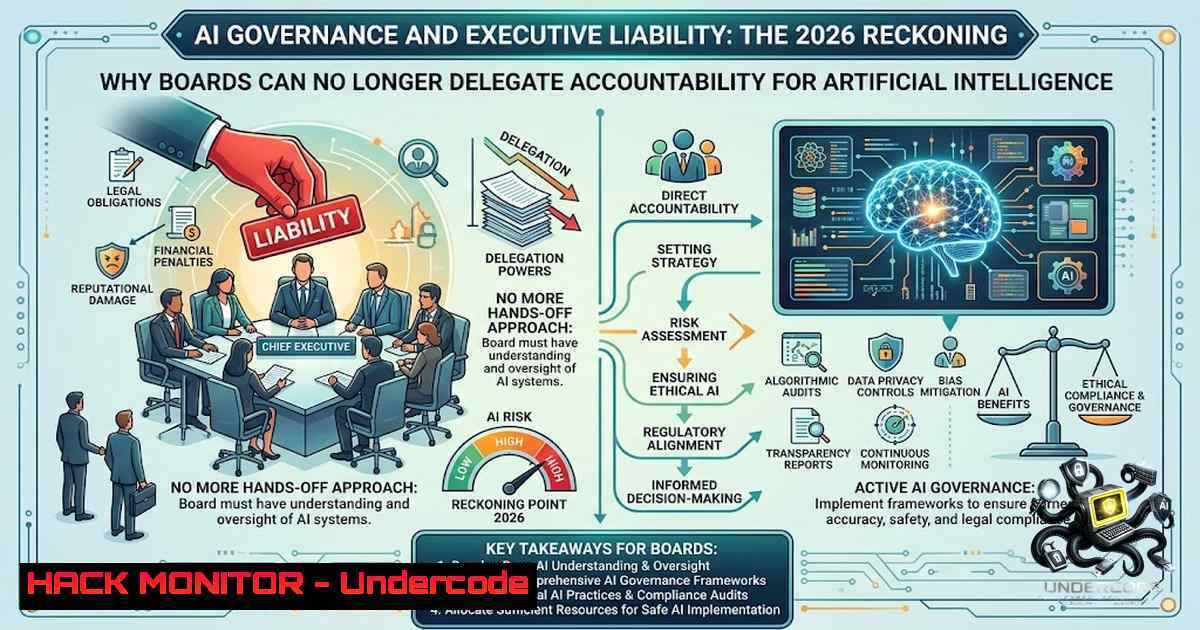
Introduction:
Artificial intelligence systems are now making consequential decisions faster than most organizations can govern them, and the liability is landing on executives who never approved the deployment. From biased hiring algorithms to autonomous cybersecurity tools that cause collateral damage, the question is no longer whether AI creates liability—it is who is personally accountable when it fails. In 2026, the convergence of the EU AI Act’s enforcement phase, SEC cyber disclosure rules, and emerging D&O insurance exclusions has transformed AI governance from a best practice into a non-delegable board-level duty that carries personal liability for directors and officers.
Learning Objectives:
- Understand the regulatory landscape of AI governance in 2026, including EU AI Act enforcement, SEC disclosure requirements, and state-level AI legislation
- Identify the key liability exposure areas for executives, including Shadow AI, AI washing, and autonomous system failures
- Learn how to implement a defensible board-level AI oversight framework with documented governance controls
- Navigate the evolving D&O and cyber insurance landscape for AI-related risks
- Apply practical technical controls and compliance checklists to mitigate AI risk across the enterprise
You Should Know:
- The Regulatory Tsunami: EU AI Act, SEC Rules, and the Duty of Care
The EU AI Act (Regulation (EU) 2024/1689) is no longer a political project—it is operational law. As of August 2, 2026, transparency obligations under 50 became fully applicable, and the first enforcement actions are now within sight. Under 99, the most serious violations—including prohibited AI practices—can result in fines of up to €35 million or 7% of global annual turnover, whichever is higher. High-risk AI systems, which include those used in recruitment, employment decisions, credit scoring, critical infrastructure, and biometric identification, face the most demanding compliance requirements including risk management, data governance, technical documentation, record-keeping, human oversight, accuracy, robustness, and cybersecurity.
For boards, the critical point is that compliance is ongoing—not a one-time certification but a continuous governance responsibility requiring periodic review and documented oversight. Directors should treat AI risk with the same rigor applied to financial, legal, and operational risks. The board’s non-transferable obligation to supervise the company, specifically with regard to compliance with the law, now extends explicitly to AI governance.
In the United States, the SEC’s cybersecurity disclosure rules, effective December 2023, require public companies to report material cybersecurity incidents on Form 8-K within four business days of determining materiality, and to describe their cybersecurity risk management, strategy, and governance annually in their 10-K. The SEC’s 2026 examination priorities reveal a significant shift: concerns about cybersecurity and AI have displaced cryptocurrency as the industry’s dominant risk topic. A cybersecurity incident caused by insider misuse of AI—known as Shadow AI—must be assessed for disclosure under SEC rules.
Step-by-Step Guide: Building a Compliant AI Governance Program
- Conduct a comprehensive AI inventory – Identify all AI systems in use across the organization, including those embedded in SaaS platforms, developed internally, and used by third-party vendors.
-
Classify AI systems by risk tier – Map each system to the EU AI Act’s risk categories: unacceptable (prohibited), high-risk (heavily regulated), limited risk (transparency obligations), and minimal risk.
-
Establish a board-level AI oversight committee – Assign clear ownership of AI governance at the management level and define where AI oversight sits at the board level. Draft a committee charter that assigns AI oversight and lists director expertise.
-
Implement documented oversight mechanisms – Maintain risk assessments, technical documentation, audit logs, and human oversight measures for all high-risk AI systems.
-
Develop AI policies and controls – Create acceptable-use policies, vendor management requirements, and disclosure controls for AI use.
-
Conduct regular tabletop exercises – Simulate AI failure scenarios to test governance structures, escalation procedures, and incident response capabilities.
-
The Insurance Gap: Why Your D&O Policy Probably Won’t Cover AI Liability
A common misconception is that a standalone cyber insurance policy provides adequate cover for AI-related liability. In practice, the two are distinct. Cyber insurance is primarily designed to respond to data breaches, network interruptions, and privacy-related claims arising from unauthorized access or system failures. AI liability, by contrast, encompasses a far broader category of potential harm: algorithmic bias, model malfunction, flawed automated decision-making, intellectual property infringement, reputational damage caused by AI-generated content, and professional errors embedded in AI-assisted advice or services.
Insurers have recently begun to include sub-limits and exclusions for AI-related losses under cyber, professional indemnity, and D&O policies. In January 2026, the Insurance Services Office issued three new generative AI exclusions for commercial general liability—endorsements CG 40 47, CG 40 48, and CG 35 08. Policyholders should not expect AI exclusions to be limited to cyber and media liability policies and should especially be on the lookout for new AI exclusions in their D&O and E&O policies.
The concept of “silent AI” risk—AI-related risks that are neither explicitly covered nor excluded under insurance policy wordings—creates significant exposure for both policyholders and insurers. Existing cyber coverage may not equate to AI liability protection.
Step-by-Step Guide: Auditing Your AI Insurance Coverage
- Map existing insurance policies – Review cyber, TE&O, D&O, and general liability policies against current and planned AI use cases.
-
Identify coverage gaps – Determine where coverage is clear, where it is ambiguous, and where exclusions have already been introduced.
-
Negotiate at renewal – Policyholders should negotiate to limit AI exclusions at renewal rather than waiting for a claim to find that core protections were hollowed out.
-
Consider AI-specific riders – Some insurers introduced “AI Security Riders” in 2026 that require proof of red-teaming and documented risk assessments before extending coverage.
-
Document AI governance frameworks – Disclosure-based endorsements make the adequacy of a business’s AI governance a consideration in whether cover responds at all.
-
Shadow AI: The Invisible Risk That Executives Are Personally Accountable For
Shadow AI is any AI tool, model, agent, integration, or endpoint processing enterprise data without IT or security approval. The scope is wider than most security leaders assume. AI now ships embedded inside browsers, IDEs, SaaS suites, and CI/CD pipelines by default. A developer pasting a database schema into a browser copilot, an employee using an unapproved generative AI tool for report writing, or an AI agent autonomously accessing sensitive systems—these are all Shadow AI scenarios that create regulatory exposure and personal liability for executives.
The exposure is not the tool itself but the unmonitored data flows, files uploaded to browser copilots, API keys leaking through SaaS AI features, and sensitive context passed to unmanaged model endpoints. Traditional AppSec and CloudSec tools were not designed to discover models, inspect prompts, govern AI identities, or trace inference-time data access.
Shadow AI was treated as an internal IT or security issue. In 2026, it becomes an external assurance issue, driven by regulation. A cybersecurity incident caused by insider misuse of AI must be assessed for disclosure under SEC rules, and the four-business-day disclosure clock starts at the materiality determination—not at detection of the incident.
Step-by-Step Guide: Discovering and Controlling Shadow AI
Linux Commands for Shadow AI Discovery:
 Scan for running AI agent processes
ps aux | grep -E "(llm|ollama|langchain|autogen|crewai|openai|anthropic|claude|gemini)"

Check for unauthorized containerized AI workloads
docker ps -a | grep -E "(llm|ai|model|inference|agent)"

Identify unusual network traffic to AI service APIs
sudo tcpdump -i any -1 port 443 | grep -E "(api.openai|api.anthropic|generativelanguage)"

Find local LLM runners and model files
find / -1ame ".gguf" -o -1ame ".bin" -o -1ame "model.pt" 2>/dev/null

Check for browser-based AI extensions (Chrome)
ls ~/.config/google-chrome/Default/Extensions/ | grep -E "(copilot|grammarly|ai|assistant)"

Audit sudoers for AI-related permissions
sudo cat /etc/sudoers | grep -E "(ai|llm|model|inference)"
Windows PowerShell Commands for Shadow AI Discovery:
 Find running AI-related processes
Get-Process | Where-Object {$_.ProcessName -match "llm|ollama|python|node|ai|agent"}

Check for AI tools in Program Files
Get-ChildItem -Path "C:\Program Files", "C:\Program Files (x86)" -Recurse -ErrorAction SilentlyContinue | Where-Object {$_.Name -match "ai|llm|copilot|assistant"}

Audit installed applications for AI tools
Get-WmiObject -Class Win32_Product | Where-Object {$_.Name -match "ai|llm|copilot|assistant"}

Check for unauthorized browser extensions
Get-ChildItem -Path "$env:LOCALAPPDATA\Google\Chrome\User Data\Default\Extensions" -ErrorAction SilentlyContinue

Scan for AI-related scheduled tasks
Get-ScheduledTask | Where-Object {$_.TaskName -match "ai|llm|model|inference"}

Identify open connections to AI service endpoints
netstat -ano | findstr "443" | findstr "api.openai api.anthropic generativelanguage"
- The AI Governance Frameworks: NIST AI RMF, ISO 42001, and the EU AI Act
In 2026, AI governance rests on three pillars: ISO/IEC 42001 (the certifiable management-system standard), the EU AI Act (the world’s first comprehensive AI law), and the NIST AI Risk Management Framework (the leading voluntary playbook). These frameworks are complementary, not competing.
The NIST AI RMF organizes AI risk work into four functions: Govern, Map, Measure, and Manage. It is voluntary but widely referenced in US procurement. ISO 42001 is the only certifiable standard of the three, providing independent, auditable proof of AI management maturity to customers and regulators. The EU AI Act is mandatory law focused on AI products by risk tier.
For organizations building a compliant AI governance program, the most significant practical difference is that firms often over-invest in one framework at the expense of operational readiness under another. The three frameworks overlap heavily—running them on one cross-mapped control library means most evidence satisfies all three at once.
Step-by-Step Guide: Implementing a Cross-Mapped AI Governance Program
- Start with ISO 42001 – Leverage existing ISO 27001 ISMS work, as ISO 42001 shares its management-system structure.
-
Map to the EU AI Act – Use the NIST AI RMF’s flexible risk management approach to identify and treat AI risk, then map controls to EU AI Act requirements.
-
Establish a tiered AI registry – Categorize use cases by risk (Low, Medium, High, Prohibited) and ensure the board approves high-stakes deployments.
-
Implement continuous monitoring – Deploy AI asset discovery, runtime prompt inspection, and least-privilege AI identity governance.
-
Maintain AI-BOM lineage – Create and maintain an AI Bill of Materials for audit evidence.
-
The 90-Day Governance Checklist: Five Actions Every Organization Must Take
Based on the RRAG Q2 2026 Webinar Series from Apogee Global RMS, every organization should take the following five actions in the next 90 days:
- Establish a board-approved AI use policy – Having a board-approved AI use policy demonstrates that directors have discharged their duty of care on this topic. The absence of a policy is a governance red flag.
-
Create a full AI system inventory – Boards should confirm that a complete inventory of AI systems exists, clear ownership of compliance is assigned, and escalation and accountability structures are effective.
-
Run a baseline risk assessment – Organizations should run a baseline risk assessment covering all AI use cases, with particular attention to high-risk systems.
-
Form an AI steering committee – Establish a diverse AI steering committee with executive-level involvement and clear charter.
-
Conduct AI tabletop exercises – Simulate AI failure scenarios to test governance structures, escalation procedures, and incident response capabilities. Tabletop exercises are now a governance expectation, not a discretionary practice.
What Undercode Say:
-
AI governance is no longer optional – The EU AI Act’s enforcement phase, SEC disclosure rules, and emerging case law have made AI oversight a non-delegable board duty. Directors who rely solely on management assurances without independent oversight are not meeting the implied governance standard.
-
Personal liability is real and escalating – Landmark rulings, including a May 2026 German court decision holding a medical company liable for erroneous AI chatbot responses, confirm that the “AI did it” defense does not hold up. The SDNY has ruled that organizations cannot escape legal liability by blaming generative AI errors. Executives who fail to implement documented oversight are personally exposed.
-
Insurance is not a safety net – The ISO’s January 2026 generative AI exclusions and the spread of AI-specific exclusions across D&O and E&O policies mean that existing coverage may not respond to AI-related claims. Organizations must audit their insurance programs and negotiate at renewal.
-
Shadow AI is the next frontier of risk – AI adoption has outrun control in most enterprises. Shadow AI was an internal IT issue; in 2026, it becomes an external assurance issue driven by regulation. CISOs and boards must treat Shadow AI with the same rigor applied to privileged access and insider threats.
-
Technical controls are essential – Organizations must deploy AI asset discovery, runtime prompt inspection, least-privilege AI identity governance, and AI-BOM lineage for audit evidence. The tools exist—the question is whether boards are demanding their implementation.
-
Documentation is the new currency of compliance – Documented oversight, risk assessments, and governance decisions are now the evidence that regulators, auditors, and courts will examine. Organizations that cannot prove their governance will be the first to face enforcement actions.
Prediction:
-
+1 The EU AI Act’s enforcement will create a new class of AI compliance officers and board-level AI committees, driving demand for specialized legal and technical expertise across all regulated industries.
-
-1 The first wave of SEC enforcement actions related to Shadow AI incidents will occur within 12-18 months, targeting companies that failed to disclose material AI-related cybersecurity incidents.
-
-1 D&O insurance premiums will increase significantly for companies with inadequate AI governance, and some carriers will begin requiring AI red-teaming and documented risk assessments as conditions of coverage.
-
+1 ISO 42001 certification will become the de facto standard for enterprise AI governance, similar to how ISO 27001 became table stakes for information security, creating a competitive advantage for certified organizations.
-
-1 The “silent AI” exposure will result in the first major insurance coverage disputes within 24 months, as policyholders and insurers disagree on whether legacy policies cover AI-related losses.
-
+1 AI governance frameworks will converge, with the NIST AI RMF, ISO 42001, and EU AI Act becoming interoperable through cross-mapped control libraries, reducing compliance burden for organizations that implement them correctly.
-
-1 Boards that fail to establish documented AI oversight will face shareholder derivative lawsuits, with plaintiffs arguing that directors breached their fiduciary duty by allowing ungoverned AI systems to operate.
▶️ Related Video (74% Match):
https://www.youtube.com/watch?v=2l4CDMiIXdQ
🎯Let’s Practice For Free:
🎓 Live Courses & Certifications:
Join Undercode Academy for Verified Certifications
🚀 Request a Custom Project:
Secure, high-velocity infrastructure and disruptive technological engineering. Contact our engineering team for high-tier development and proprietary systems:
[email protected]
💎 Smart Architecture | 🛡️ Secure by Design | ⭐ Trusted by Thousands
IT/Security Reporter URL:
Reported By: Gottehrer Ai – Hackers Feeds
Extra Hub: Undercode MoN
Basic Verification: Pass ✅


