Listen to this Post
Introduction:
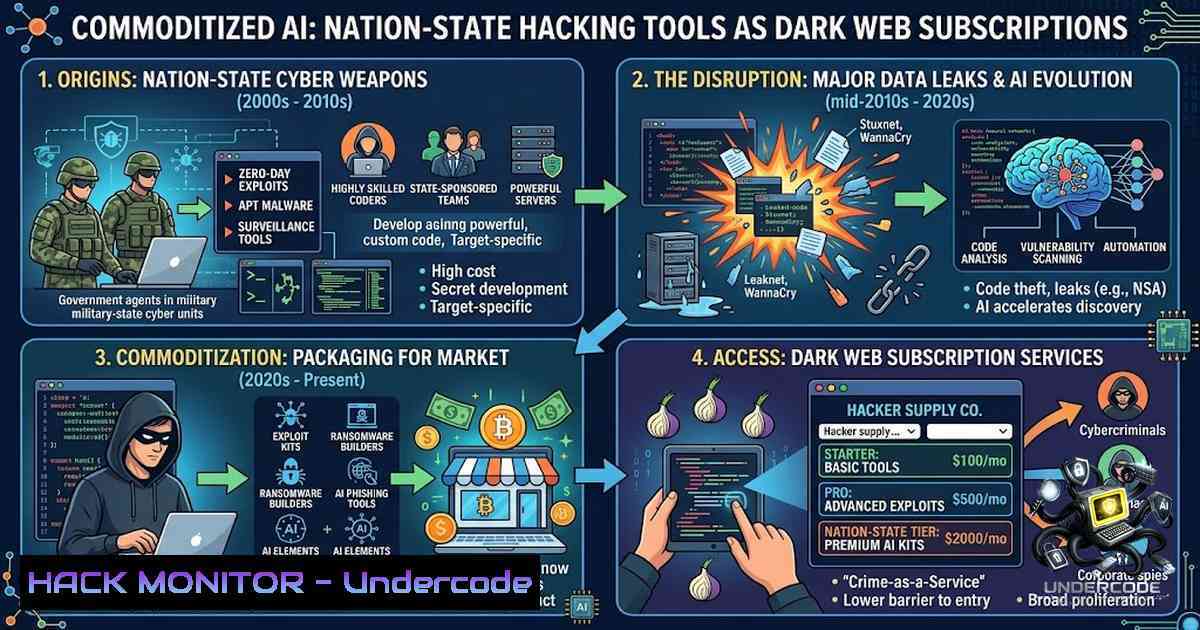
The democratization of artificial intelligence has a dark underbelly. According to a recent report by cybersecurity firm Trellix, criminal actors are now systematically offering a range of AI-powered hacking tools and related services on underground forums. This shift marks a critical inflection point: sophisticated, nation-state-grade attack planning and signature-bypassing capabilities are no longer the exclusive domain of elite cyber units but are becoming commoditized, cheap, and accessible to anyone with a cryptocurrency wallet. As Victor Tsao aptly noted, the weaponization of constraint-free LLMs and prompt injection techniques against deployed AI agents fundamentally alters the entire threat model for organizations worldwide.
Learning Objectives:
- Understand the current landscape of commoditized AI hacking tools available on dark web forums.
- Identify the specific categories of AI-powered threats, including weaponized LLMs and AI-enabled identity fraud.
- Learn practical mitigation strategies, including technical commands and configuration steps, to defend against prompt injection and AI-augmented attacks.
You Should Know:
- The Criminal AI-as-a-Service Ecosystem and Its Tool Families
The underground market for malicious AI has rapidly evolved from hype to a structured, operationalized economy. An analysis by Halcyon of 4,000 entries across 77 Telegram channels, 20 dark web forums, and five underground markets revealed a staggering 3,810% increase in posts mentioning AI tools, jumping from just 38 in December 2025 to 1,486 in February 2026. This surge is not just noise; it represents a fully commercialized ecosystem with tiered pricing, freemium models, automated Telegram bot storefronts, and redundant distribution channels.
The tools for sale roughly fall into four main categories:
- Weaponized LLMs (Dark LLMs): These are AI models stripped of ethical guardrails. “WormGPT” remains a market leader, with new versions like “WormGPT 4” being marketed as unrestricted hacking assistants. Other variants such as “FraudGPT,” “Evil-GPT,” and “MessiahGPT” are also prevalent.
- AI-Enabled Identity Fraud: This includes voice and video deepfakes capable of bypassing KYC checks and selfie-recognition systems. These tools can be trained on as little as three seconds of audio.
- AI-Augmented Malware and Infrastructure: Beyond text generation, this includes AI-powered call centers supporting 25 languages and even Metamorphic Crypters designed to evade signature-based detection.
- Jailbroken and Stolen AI Services: The cheapest and most common offering, starting at just 10 cents for a stolen ChatGPT account.
Step-by-Step Guide: Defending Against AI-Augmented Threats
To counter this new wave of threats, organizations must adopt a layered defense strategy.
- Harden Endpoints Against Polymorphic Malware: Traditional signature-based antivirus is insufficient against AI-generated or metamorphic malware.
– On Windows: Implement and enforce Attack Surface Reduction (ASR) rules via Microsoft Defender to block common Office-application-based attacks. Use PowerShell to enable rules: Set-MpPreference -AttackSurfaceReductionRules_Ids 75668C1F-73B5-4CF0-BB93-3ECF5CB7CC84 -AttackSurfaceReductionRules_Actions Enabled.
– On Linux: Deploy AppArmor or SELinux to confine application permissions. Regularly audit running processes with `ps aux –forest` and monitor for unusual network connections using ss -tulpn.
- Combat AI-Enabled Social Engineering: The barrier to creating convincing phishing and vishing campaigns is now virtually zero.
– Implement Multi-Factor Authentication (MFA) resistant to phishing, such as FIDO2 security keys.
– Establish a strict verification protocol for any financial or sensitive requests, especially those received via phone or email, requiring out-of-band confirmation.
– Conduct regular social engineering drills that include deepfake audio scenarios to train employees.
- The Escalating Threat of Prompt Injection Against AI Agents
While commodity AI tools lower the barrier for basic attacks, the weaponization of prompt injection represents a sophisticated, high-impact threat vector against organizations deploying AI agents. Researchers have documented full kill chains—initial access, persistence, lateral movement, and data exfiltration—executed entirely through crafted text inputs. The OWASP Top 10 for LLM Applications 2026 maintains Prompt Injection as a top-tier threat, with a wider definition of the attack surface.
Threat actors are weaponizing indirect prompt injection, embedding malicious instructions in external documents that are processed by AI agents. Proofpoint has documented such methods being marketed for up to $150 per month. This allows attackers to manipulate AI agents into performing unauthorized actions, such as exfiltrating sensitive data or executing malicious code.
Step-by-Step Guide: Mitigating Prompt Injection in Your AI Stack
Eliminating prompt injection is a challenge, but its impact can be significantly reduced through architectural and operational controls.
1. Implement Strict Input/Output Filtering:
- Deploy a lightweight, rule-based pre-filter to scan all user inputs for known injection patterns (e.g., “ignore previous instructions”, “system prompt”, Base64/ROT13 encoded adversarial payloads).
- Implement output filtering to prevent the AI agent from returning sensitive information or executing dangerous commands.
2. Prioritize System Instructions:
- Design a robust system prompt (meta-prompt) that explicitly instructs the model to prioritize system-level commands over any conflicting user input.
- Use a sandboxed execution environment for any code generated by the LLM. Avoid using
exec(),eval(), or similar functions on LLM-generated output.
3. Conduct Adversarial Red Teaming:
- Use tools like Microsoft’s PyRIT (Python Risk Identification Tool) to automate red teaming and simulate prompt injection attacks against your AI agents.
- Continuously refine your system prompts and filters based on the results of these red team exercises.
3. Hardening the Cloud Against AI-Driven Credential Theft
The commoditization of stolen AI services and credentials is a major driver of the underground market. Attackers are not just buying jailbroken LLMs; they are purchasing vast quantities of stolen API keys and compromised cloud accounts to power their operations at scale.
Step-by-Step Guide: Cloud Hardening for API Security
1. Enforce Strict Identity and Access Management (IAM):
- Implement the principle of least privilege. Ensure that API keys and service accounts have only the permissions they absolutely need.
- Rotate API keys regularly and automate this process where possible. Use a secrets management solution (e.g., HashiCorp Vault, AWS Secrets Manager).
2. Monitor for Anomalous Usage:
- Set up anomaly detection on cloud billing and API usage logs. A sudden spike in requests or unusual geographic access patterns are key indicators of compromise.
- On AWS, use CloudTrail and GuardDuty to monitor for suspicious API calls. On Azure, utilize Microsoft Defender for Cloud.
3. Network Segmentation and Zero Trust:
- Adopt a Zero Trust architecture. Do not trust any user or system by default, even those inside the network perimeter.
- Segment your cloud environment using Virtual Private Clouds (VPCs) and security groups to limit lateral movement.
What Undercode Say:
- Key Takeaway 1: The cyber threat landscape has fundamentally shifted. The barrier to entry for sophisticated attacks is now dangerously low. The “script kiddie” of yesterday is now an “AI-augmented script kiddie” capable of launching complex, multi-stage attacks with the help of commoditized AI tools. This changes the game for defenders who must now prepare for a surge in both the volume and sophistication of attacks.
- Key Takeaway 2: Defending against this new paradigm requires a multi-layered strategy that combines traditional security hygiene (MFA, patching, endpoint protection) with new, AI-specific defenses. Organizations must treat their AI agents as a new, highly vulnerable attack surface. Continuous red teaming, robust system prompt engineering, and strict input/output filtering are no longer optional but essential.
Analysis:
The trend is clear: AI is rapidly becoming a commodity in the cybercriminal underground. The shift from isolated jailbreaks to a structured “Criminal AI-as-a-Service” market means that attacks will become faster, more scalable, and more difficult to attribute. While the initial wave of AI-generated malware may still be detectable, the operational efficiency gains for attackers are undeniable. The industry must respond with equal agility, embedding AI-driven defenses and proactive threat hunting into their core security operations. The era of “business as usual” in cybersecurity is over.
Prediction:
- -1: The commoditization of AI hacking tools will lead to a significant increase in the number of ransomware and data breach incidents, particularly targeting small to medium-sized businesses that lack the resources for advanced AI defenses. The “noise” generated by a flood of low-skill attackers will fatigue security teams, making it harder to detect and respond to sophisticated, targeted intrusions.
- +1: The growing threat will accelerate the adoption of AI-powered defensive technologies. We will see a surge in the development and deployment of autonomous AI red teaming tools and AI-driven threat detection systems, creating a new, high-demand niche for security professionals skilled in both cybersecurity and AI.
▶️ Related Video (84% Match):
🎯Let’s Practice For Free:
🎓 Live Courses & Certifications:
Join Undercode Academy for Verified Certifications
🚀 Request a Custom Project:
Secure, high-velocity infrastructure and disruptive technological engineering. Contact our engineering team for high-tier development and proprietary systems:
[email protected]
💎 Smart Architecture | 🛡️ Secure by Design | ⭐ Trusted by Thousands
IT/Security Reporter URL:
Reported By: https://lnkd.in/p/eum5WrAd – Hackers Feeds
Extra Hub: Undercode MoN
Basic Verification: Pass ✅


