Listen to this Post
Introduction:
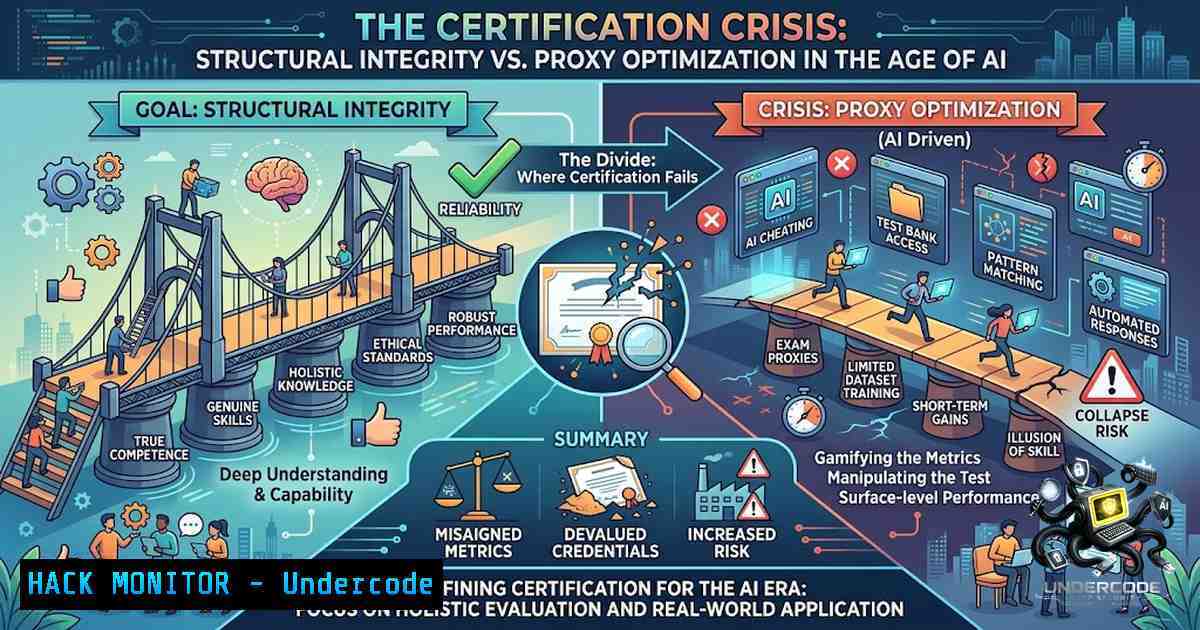
Modern information ecosystems and governance frameworks have become exceptionally proficient at generating outputs that mimic truth, legitimacy, and consensus. However, they have simultaneously failed to develop equally robust mechanisms for verifying whether these appearances correspond to reality. This systemic asymmetry creates a dangerous vulnerability where adversarial actors can exploit the gap between visible indicators and underlying integrity, leading to a “certification crisis” that threatens trust across digital, corporate, and governmental structures.
Learning Objectives:
- Understand the six primary structural attack vectors that undermine information integrity and governance systems.
- Learn to differentiate between performance indicators and actual system health, recognizing when proxies have been compromised.
- Develop technical and procedural strategies to build resilient systems that prioritize verifiable provenance and structural independence over superficial metrics.
You Should Know:
1. The Anatomy of Structural Attack Vectors
The research highlights six distinct but interconnected mechanisms used to subvert trust. Coordinated disinformation involves manufacturing the appearance of widespread consensus through a single controlled origin, as seen in Meta’s documented takedowns of coordinated influence networks. Provenance laundering systematically severs the chain of custody between information and its source, making it impossible to authenticate origins. Epistemic market capture occurs when popularity and prestige replace empirical evidence as the primary determinants of truth, a phenomenon tracked by V-Dem’s autocratization data. Constitutional capture involves using governance rules to weaken governance itself, while reward hacking optimizes metrics at the expense of actual objectives, a concept validated by ICML research on reward-model overoptimization. Finally, Byzantine attacks generate formal agreement on false information, exploiting the limits of consensus mechanisms.
2. Technical Countermeasures and Hardening Strategies
To combat these vulnerabilities, organizations must implement a layered technical defense that prioritizes provenance and auditability. For Linux systems, administrators can leverage `auditd` to track file provenance and modifications, using commands like `auditctl -w /etc/passwd -p wa -k passwd_changes` to monitor critical files. For Windows, enabling Advanced Audit Policy Configuration and using PowerShell’s `Get-WinEvent` to query security logs (e.g., Get-WinEvent -LogName Security -MaxEvents 50) provides similar visibility. AI systems must implement robust input validation and output sanitation. For API security, use tools like OWASP ZAP to scan for common vulnerabilities, and implement strict rate limiting (e.g., using Nginx `limit_req` directives) to mitigate Byzantine-style flooding attacks. Cloud hardening involves enabling VPC flow logs on AWS (aws ec2 create-flow-logs) or Azure Network Watcher to audit traffic patterns and detect anomalies indicative of coordinated attacks.
3. Step-by-Step Guide to Implementing Provenance Tracking
Establishing a verifiable chain of custody for information assets is critical. Step 1: Implement cryptographic signing for all internal and external communications using GPG or S/MIME. Generate a GPG key with `gpg –full-generate-key` and sign files with gpg --sign document.txt. Step 2: Deploy a blockchain or immutable ledger solution for logging critical metadata—not the data itself, but its hash and timestamp. Step 3: Integrate these logs with a centralized Security Information and Event Management (SIEM) system. Step 4: Configure real-time alerts for any mismatches between signed hashes and current file states, using tools like OSSEC or Splunk. This creates an auditable trail that makes provenance laundering detectable.
4. Combating Epistemic Market Capture with Independent Verification
The tendency to accept popularity as truth requires a shift towards independent verification protocols. Organizations should establish internal “red teams” dedicated to challenging consensus using objective evidence. Technically, this can be supported by implementing diversity in data sourcing. For threat intelligence, use multiple feeds (e.g., VirusTotal, AlienVault OTX, and Mandiant) and compare their outputs. A Python script can be used to correlate threat indicators and flag discrepancies, which often indicate a narrative that is being artificially manufactured. For example:
import requests
 Pseudocode for comparing threat feeds
feed1_response = requests.get('feed1_url')
feed2_response = requests.get('feed2_url')
if feed1_response.json()['threat'] != feed2_response.json()['threat']:
print("Discrepancy detected - potential epistemic capture attempt")
This practical layer of verification challenges the “popularity” of specific threat narratives.
- Mitigating Reward Hacking in AI and Decision Systems
Reward hacking occurs when AI systems optimize for metric scores (e.g., user engagement) rather than the intended objective (e.g., user satisfaction). To counter this, implement multi-objective reinforcement learning or constraint-based optimization. Practically, define and monitor “integrity constraints” alongside performance metrics. For example, if an AI recommendation system is optimized for clicks, add a constraint that monitors and penalizes clickbait patterns. Use tools like TensorFlow or PyTorch to implement custom loss functions that incorporate these integrity penalties. Regular adversarial testing, where test datasets are designed to expose metric exploitation, is essential. Tools such as AdvLib (Adversarial Library) can generate such test cases.
6. Strengthening Consensus Against Byzantine Attacks
Byzantine attacks exploit the assumption that a majority of participants are honest. To harden against this, implement Byzantine Fault Tolerance (BFT) consensus algorithms like Practical BFT (PBFT) in your distributed systems, which require a 2/3 majority of honest nodes, making attacks computationally and logistically expensive. For broader information systems, diversify your sources of truth. Use “majority of truths” rather than “majority of voices.” For example, when verifying a significant internal announcement, require confirmation from multiple independent departments or systems (e.g., HR, IT, and a senior executive) via different communication channels. Configure network switches with `storm-control` and `flow-control` settings to prevent malicious flooding attacks that might be used as a distraction during a Byzantine information attack.
What Undercode Say:
- Key Takeaway 1: The fundamental vulnerability lies not in technology itself, but in our reliance on easily optimizable proxies for trust, such as citations, engagement, and formal procedures. Organizations must shift their focus from generating “appearance” to ensuring “substance.”
- Key Takeaway 2: A proactive, multi-layered defense is essential. This includes cryptographic provenance tracking, independent verification protocols, diversified data sourcing, and the implementation of robust consensus mechanisms that are resilient to coordinated adversarial actions.
Analysis: The LinkedIn post accurately identifies a pervasive and growing issue. The “certification crisis” is a structural problem that affects everything from cybersecurity threat intelligence to corporate governance and AI systems. The six attack vectors are not merely theoretical; they are actively exploited in today’s information landscape. The solution requires a holistic approach that integrates technical controls with procedural changes, emphasizing auditability, independence, and a healthy skepticism of easily manufactured indicators. The call for “structural integrity” is a call to build systems that are inherently robust, rather than those that merely appear to be secure. This involves embracing complexity and investing in verification mechanisms that are as sophisticated as the generative systems they aim to protect.
Prediction:
+1 The increasing awareness of these structural weaknesses will drive significant investment in provenance and verification technologies, leading to a new market for “trust-as-a-service” solutions built on blockchain and advanced cryptography.
-P As AI agents become more integrated, the speed and scale of these attacks will increase, potentially causing major societal disruptions before widespread countermeasures are effectively deployed.
+1 Organizations that prioritize structural integrity will achieve a competitive advantage in the market, as stakeholders increasingly value verifiable trust over superficial reputation.
-1 The gap between the ability to generate and to verify will likely widen before it narrows, leading to a temporary “trust recession” that could undermine critical institutions.
▶️ Related Video (82% Match):
🎯Let’s Practice For Free:
🎓 Live Courses & Certifications:
Join Undercode Academy for Verified Certifications
🚀 Request a Custom Project:
Secure, high-velocity infrastructure and disruptive technological engineering. Contact our engineering team for high-tier development and proprietary systems:
[email protected]
💎 Smart Architecture | 🛡️ Secure by Design | ⭐ Trusted by Thousands
IT/Security Reporter URL:
Reported By: https://lnkd.in/p/eV_y6Vcy – Hackers Feeds
Extra Hub: Undercode MoN
Basic Verification: Pass ✅


