
Listen to this Post
Introduction:
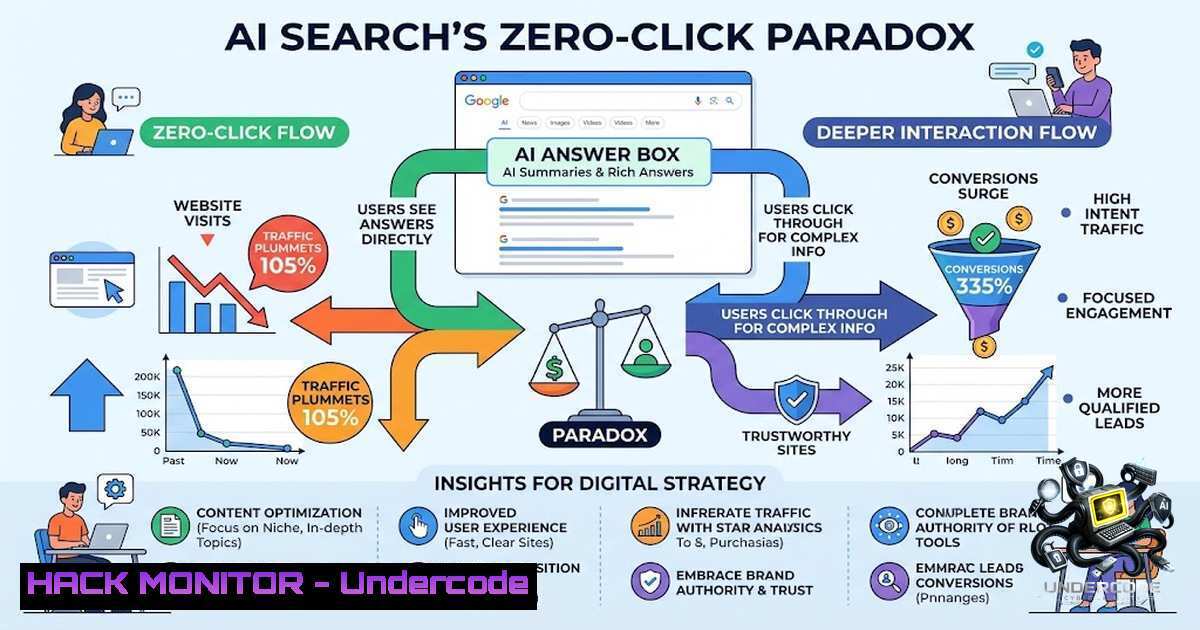
The rise of generative AI in search is fundamentally rewiring the digital economy—and the latest first-party data from Brainlabs offers the clearest evidence yet of both sides of the zero-click equation. Across 54 high-traffic advertiser clients, organic sessions fell 10.5% (from 140.1 million to 125.4 million) following the broad rollout of Google AI Overviews in September 2025. Yet paradoxically, AI-driven key events—purchases, signups, and deep engagement—surged 335%, with AI-referred visitors converting at 1.5x the rate of organic search traffic. The message is clear: traffic volume is no longer the metric that matters most.
Learning Objectives & Secrets:
- Objective 1: Master AI Referral Attribution in GA4 – Learn to isolate and measure traffic from ChatGPT, Gemini, Perplexity, Claude, and Copilot using custom channel groups and regex patterns, so you can quantify exactly how much high-intent traffic AI platforms are sending your way.
-
Objective 2 (Secret Tip): Track Key Events, Not Just Sessions – Brainlabs’ 335% surge in key events came from tracking actions that actually matter—purchases, newsletter signups, and full-page scrolls. Set up GA4 key events for meaningful conversions and compare event rates across referral sources to identify where your highest-value traffic originates.
-
Objective 3 (Secret Tip): Optimize for AI Citation, Not Just Ranking – Being cited within an AI Overview delivers 35% higher organic CTR and 91% higher paid CTR compared to competitors left out of the summary. Structure content in concise, declarative paragraphs with question-based headings and scannable formats to maximize your chances of being extracted and cited.
You Should Know:
1. The Traffic Decline Is Real—and Accelerating
Brainlabs’ 14-month study (January 2025 – April 2026) found that once AI Overviews appeared on at least 30% of Google search results in September 2025, an “inflection point” occurred. Organic traffic fell from roughly 20 million sessions per month to under 15 million across the sample. Overall, 46 of 54 clients experienced declines. And the trendline suggests it will only get worse: AI Overview penetration continues to grow, meaning traffic erosion is a function of exposure, not a one-time shock.
Other studies confirm the severity. Ahrefs found that AI Overviews now reduce click-through rates for top-ranking pages by an average of 58%. A randomized field experiment showed a 39.8% decrease in organic clicks when summaries are shown. Pew Research found that users clicked on traditional results in just 8% of searches with an AI summary, versus 15% without one. The “zero-click” share of searches increased from 56% to 69% between 2024 and 2025.
Step‑by‑step: How to Monitor Your Own Traffic Impact
- Open Google Search Console and navigate to the “Performance” report.
- Filter by date range—compare pre-AIO period (e.g., January–August 2025) vs. post-AIO period (September 2025–present).
- Export click and impression data for your top 100 queries.
- Identify queries where impressions increased but clicks decreased—these are your zero-click “alligator graphs”.
- Calculate your zero-click rate per query: (Impressions – Clicks) / Impressions × 100.
- Segment by query type—informational queries typically show the largest losses, while navigational and transactional queries show less impact.
- Track month-over-month trends to see if erosion is accelerating.
Linux/Windows Command for Bulk URL Analysis:
 Linux: Bulk fetch Search Console data via Google Analytics Reporting API (gcloud)
gcloud auth application-default login
curl -X POST -H "Authorization: Bearer $(gcloud auth print-access-token)" \
"https://analyticsdata.googleapis.com/v1beta/properties/GA4_PROPERTY_ID:runReport" \
-d '{"dimensions":[{"name":"pagePath"}],"metrics":[{"name":"sessions"},{"name":"conversions"}],"dateRanges":[{"startDate":"2025-01-01","endDate":"2025-08-31"}]}'
2. The Conversion Upside: AI Visitors Are Higher-Intent
Here’s the counterintuitive finding that changes everything: while organic traffic fell, AI-driven key events rose 335%, and AI referrals converted at 1.5x the rate of organic search. Brainlabs theorizes this reflects an evolving persona for AI searchers—initially casual or educational, but increasingly commercial in intent.
Multiple independent studies corroborate this. Microsoft Clarity found AI-sourced visitors convert to sign-ups at 1.66% compared to 0.15% from organic search—an 11-fold advantage. Similarweb data showed ChatGPT referrals convert at 11.4% versus 5.3% for organic search across ecommerce sites. Perplexity and Gemini users convert 3–6x higher than ChatGPT users, though they send fewer visitors overall.
The key takeaway: AI referral traffic is typically 1.5–3x more valuable per visit than organic search traffic. But with AI referrals still representing only ~0.7% of web traffic versus 17.1% for organic search, the volume gap is enormous. The tradeoff: you’re losing 10x the volume but gaining higher-quality visitors. The net revenue impact? For many businesses, it may be neutral or even positive—Brainlabs found “no pronounced decline in commercial effects” despite the traffic drop.
Step‑by‑step: How to Track and Compare AI Referral Conversion Rates in GA4
- Go to GA4 Admin → Data display → Channel groups and create a new custom channel group.
2. Add a new channel called “AI Referral.”
- Set the condition to `Source matches regex` with this pattern:
chatgpt.com|chat.openai.com|perplexity.ai|claude.ai|gemini.google.com|copilot.microsoft.com
-
Drag the AI channel above “Referral” and “Organic” so it claims those sessions first.
- Go to Reports → Acquisition → Traffic acquisition and apply the AI channel segment.
- Add key events as a metric—ensure your conversions (purchases, signups, form submissions) are marked as key events in GA4.
- Compare conversion rates: Divide key events by sessions for AI Referral vs. Organic Search.
- Build an Exploration report with dimensions: Session source, Session medium; metrics: Sessions, Key events.
-
Export monthly data to track trends over time—Brainlabs saw AI sessions ramp up 163% during their study period.
-
The Citation Premium: Being Featured in AI Overviews Changes Everything
If your content is cited within an AI Overview, you don’t just survive—you thrive. A study analyzing 3,119 search terms found that websites cited within AI Overviews enjoy 35% higher organic CTR and 91% higher paid CTR compared to competitors not cited. In other words, being inside the AI summary reverses the traffic loss and delivers better-than-baseline performance.
This creates a new imperative: Answer Engine Optimization (AEO) . The goal is no longer just to rank—it’s to be extracted, cited, and featured within AI-generated answers. With AI Overviews now appearing in 39% of Google searches and penetration continuing to grow, the citation premium will only become more valuable.
Step‑by‑step: How to Optimize Content for AI Citation
- Adopt an “answer-first” structure—start every page or section with a direct, clear answer to the primary query, then expand with depth and examples.
- Use question-based headings (H2/H3) that reflect how people naturally ask questions.
- Write concise, declarative paragraphs that answer one question each—LLMs favor short, high-value blocks of text.
- Include “Key Takeaways” sections with bullet-point summaries—these provide ready-made snippets that AI systems can easily extract.
- Implement structured data (FAQ schema, HowTo schema) to help crawlers understand content hierarchy.
- Build citability by publishing original definitions, checklists, short tables, and referencing third-party standards or academic frameworks.
- Add statistics, dates, and verifiable data—LLMs favor grounded, authoritative sources.
- Break long-form content into self-contained sections with clear H2/H3 headings.
4. Diversification Is No Longer Optional
The Brainlabs data reveals a structural shift: organic search remains the dominant traffic source by volume, but its share is eroding while AI referrals—though still small—are growing in value. The smartest response is channel diversification:
- Build first-party data (email lists, loyalty programs, direct traffic) so you’re not solely dependent on search referrals.
- Invest in Google Discover—Define Media Group found Discover traffic grew 30% and now rivals web search traffic for many publishers.
- Monitor brand mentions in AI responses—not just clicks. Share of voice in AI-generated answers is becoming a new KPI.
- Don’t abandon SEO—organic search still sends 17.1% of web traffic vs. 0.7% from genAI. But evolve your SEO into AEO.
5. The Measurement Framework Must Change
The old playbook—maximize sessions, optimize for clicks—is broken. Brainlabs’ data proves that traffic alone is an incomplete measure of visibility and performance. Marketers need a new measurement framework:
- Track key events per channel, not just session volume.
- Compare revenue per visit across referral sources—AI traffic may deliver higher ROI despite lower volume.
- Monitor zero-click rate (impressions vs. clicks) as a leading indicator of AI Overview penetration.
- Measure share of voice in AI citations—are you being referenced in ChatGPT, Gemini, and Perplexity responses?
- Track branded search lift—does AI visibility drive direct navigation later?
What Undercode Say:
- Key Takeaway 1: The Brainlabs data resolves the AI search paradox—traffic is down 10.5% but conversions are up 335%, meaning AI-referred visitors are 1.5x more likely to convert than organic searchers. The net revenue impact may be neutral or even positive for many businesses, despite the doomsday narratives.
-
Key Takeaway 2: The citation premium is real and powerful—being featured in AI Overviews delivers 35% higher organic CTR. This means AEO (Answer Engine Optimization) is not optional; it’s the new SEO. Structure your content for extraction, not just ranking, and you can actually benefit from the AI search revolution rather than being victimized by it.
Analysis: The AI search transition represents a fundamental rewiring of the discovery economy. For the past two decades, “more traffic” was the universal metric of success. That era is ending. The new reality is quality over quantity—fewer visitors, but higher intent, deeper engagement, and better conversion outcomes. Businesses that adapt their measurement frameworks, optimize for AI citation, and diversify their traffic sources will thrive. Those that cling to session-volume metrics will panic over declining numbers while missing the fact that their revenue may be holding steady or growing. The smart money is on AEO, first-party data, and conversion-centric analytics. The traffic-first SEO playbook is officially dead.
Prediction:
- +1 Brands that invest in AEO and structured, answer-first content will see their AI citation rates increase 2–3x over the next 18 months, capturing the citation premium and offsetting organic traffic losses.
-
-1 Publishers and ecommerce sites that continue optimizing purely for traditional SEO rankings—without adapting to AI extraction—will see organic traffic declines accelerate beyond 20% as AI Overview penetration exceeds 50% of all searches.
-
+1 AI referral traffic volume will grow exponentially (163% in Brainlabs’ study) as ChatGPT, Gemini, and Perplexity become primary discovery tools for commercial-intent queries—converting at 1.5–3x organic rates.
-
-1 The “zero-click” rate for informational queries will exceed 75% by 2027 as AI Overviews become the default answer format, rendering traditional organic click metrics nearly obsolete for non-transactional content.
-
+1 The rise of AI search will accelerate the shift toward first-party data and direct audience relationships, benefiting brands that build email lists, loyalty programs, and owned channels over those reliant on search intermediaries.
▶️ Related Video (86% Match):
https://www.youtube.com/watch?v=0Mkx1gEz_Gk
🎯Let’s Practice For Free:
🎓 Live Courses & Certifications:
Join Undercode Academy for Verified Certifications
🚀 Request a Custom Project:
Secure, high-velocity infrastructure and disruptive technological engineering. Contact our engineering team for high-tier development and proprietary systems:
[email protected]
💎 Smart Architecture | 🛡️ Secure by Design | ⭐ Trusted by Thousands
IT/Security Reporter URL:
Reported By: https://lnkd.in/p/eFhsqh39 – Hackers Feeds
Extra Hub: Undercode MoN
Basic Verification: Pass ✅


