Listen to this Post
Introduction
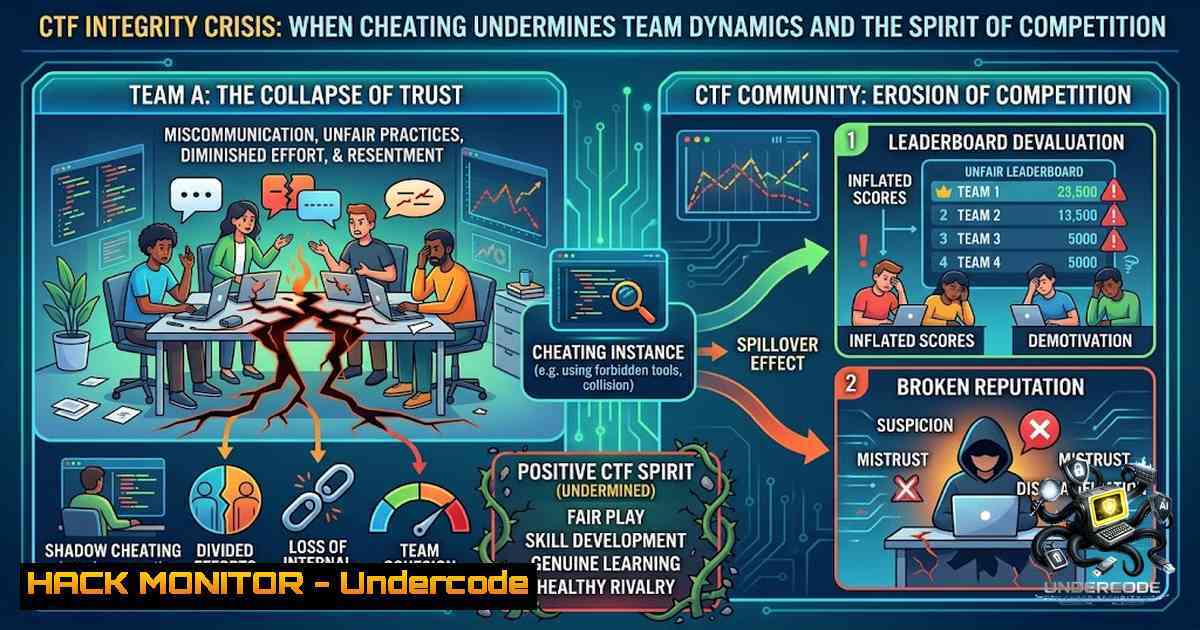
In the high-stakes arena of Capture The Flag (CTF) competitions, where cybersecurity professionals hone their skills through real-world problem-solving, the line between collaborative learning and unethical shortcuts has become increasingly blurred. The recent 0xV01D CTF 2026 V2 incident involving Team M0DUL0 from the Malaysia Hardware Hacking Community (MHHC) has exposed a critical vulnerability not in code, but in team ethics, serving as a cautionary tale for the global cybersecurity training ecosystem about the dangers of AI-assisted cheating during live competitions.
Learning Objectives
- Understand the implications of integrity breaches in CTF competitions and their impact on team reputation
- Identify technical measures that competition organizers can implement to detect and prevent AI-assisted cheating
- Develop strategies for building resilient, ethically-grounded cybersecurity teams that prioritize skill development over rankings
You Should Know
- The Anatomy of a CTF Cheating Incident and Its Detection
The 0xV01D CTF 2026 V2 incident unfolded when an unnamed team member utilized AI tools to solve challenges autonomously, bypassing the learning process that defines legitimate competition participation. Modern CTF platforms have evolved sophisticated anti-cheating mechanisms, including behavioral analytics, keystroke pattern analysis, and solution similarity scoring. When the organizers flagged suspicious activity and requested an interrogation session, the offending member’s failure to appear compounded the integrity breach.
Technical Countermeasures for CTF Organizers
Organizers can implement several detection mechanisms:
Linux-based Monitoring Script (for on-premise CTF servers):
!/bin/bash
 Monitor process execution patterns for suspicious AI tool usage
watch -1 5 'ps aux | grep -E "python|node|java|gcc" | grep -v grep | wc -l'
 Track network connections to external AI APIs
sudo tcpdump -i eth0 -1 'host api.openai.com or host anthropic.com or host cohere.ai'
Windows PowerShell Monitoring Command:
 Monitor active network connections to known AI endpoints
Get-1etTCPConnection | Where-Object {$_.RemoteAddress -match "api.openai|anthropic|cohere"} | Format-Table
 Track process execution history
Get-WinEvent -FilterHashtable @{LogName='Security'; ID=4688} | Select-Object TimeCreated, Message
Browser Extension Detection:
Organizers can deploy browser extensions that restrict copy-paste operations, disable developer tools during active challenges, and log all network requests to external services. These measures, while not foolproof, create a meaningful deterrent.
2. The Technical Architecture of AI-Assisted CTF Solutions
Understanding how AI is exploited in CTF contexts requires examining the typical workflow. Participants often feed challenge descriptions, code snippets, and error messages into large language models (LLMs), requesting complete solutions or step-by-step exploitation guides. This creates a cascade of compromised learning outcomes.
Common Exploitation Vectors:
- Code Injection Challenges: AI models can generate payload scripts (SQL injection, XSS, buffer overflow) based on vulnerability descriptions
- Cryptography: LLMs can implement encryption/decryption routines, solving complex mathematical puzzles that require manual effort
- Reverse Engineering: While limited, some AI models can analyze assembly code patterns and suggest decompilation strategies
CTF Organizer Response Protocol
Competition administrators should establish a clear incident response framework:
Step 1: Suspend Team Participation
Upon flagging suspicious activity, immediately freeze the team’s ability to submit new flags while preserving evidence.
Step 2: Forensic Analysis
Collect and analyze:
- Timestamp logs of all submissions
- IP address correlation with known AI service endpoints
- Solution originality scoring against known AI-generated outputs
Step 3: Structured Interrogation
Conduct individual interviews with team members, comparing solution methodologies and verifying technical understanding through follow-up questions.
 Example forensic collection script for CTF servers
sudo journalctl --since "2026-08-15 12:00:00" --until "2026-08-16 23:59:59" | grep -i "flag" > /var/log/ctf_submissions.log
 Extract IP addresses involved
sudo zgrep -oE '([0-9]{1,3}.){3}[0-9]{1,3}' /var/log/nginx/access.log | sort | uniq -c | sort -1r
3. Building Ethical CTF Teams: The M0DUL0 Model
Team M0DUL0’s captain, Undercode, intentionally stepped back to test whether his team could compete independently—a leadership experiment that succeeded in demonstrating self-sufficiency but failed in exposing underlying integrity vulnerabilities. The post-incident removal of responsible members highlights the need for formal team governance structures.
Recommended Team Governance Framework:
- Member Onboarding: Require all members to sign a code of conduct agreement
- Pre-Competition Briefing: Conduct mandatory sessions covering competition rules and ethical expectations
- Real-Time Accountability: Designate a competition integrity officer within each team
- Post-Competition Debriefing: Review performance with transparency, celebrating legitimate wins and addressing failures
Technical Team Preparation Example:
 Ethical CTF practice module for team members
class CTFChallenge:
def <strong>init</strong>(self, challenge_name, difficulty):
self.name = challenge_name
self.difficulty = difficulty
self.solution_attempts = []

def attempt_solution(self, approach, is_ai_assisted=False):
if is_ai_assisted:
print(f"WARNING: {self.name} requires manual reasoning for learning purposes")
return False
self.solution_attempts.append(approach)
return True

def verify_learning(self):
if len(self.solution_attempts) >= 3 and all(not a['ai'] for a in self.solution_attempts):
return "Verified learning progress achieved"
return "Recommend additional manual practice"
- The Role of AI in Cybersecurity Education: A Double-Edged Sword
The incident at 0xV01D CTF 2026 V2 underscores a broader debate about AI integration in security training. While LLMs can accelerate learning through instant explanations and code examples, they also create tempting shortcuts that undermine the struggle-based learning essential for skill retention.
Best Practices for AI-Enhanced Learning (Without Cheating):
- Post-Competition Analysis: Use AI to generate alternative solutions after the competition ends
- Challenge Research: Leverage AI for understanding concepts (e.g., “Explain ROP chains in buffer overflows”)
- Code Review: Ask AI to review your manual solution and suggest optimizations
- Practice Environments: Use AI only in non-competitive, sandboxed learning contexts
 Example: Using AI responsibly for post-CTF learning
 Generate a learning summary of challenges solved
echo "Analyze the following challenge solution and explain the exploit chain:" | \
curl -s -X POST https://api.openai.com/v1/chat/completions \
-H "Authorization: Bearer $OPENAI_API_KEY" \
-H "Content-Type: application/json" \
-d '{"model":"gpt-4","messages":[{"role":"user","content":"'"$(cat challenge_solution.md)"'"}], "max_tokens":2000}'
5. Impact on Team Dynamics and Long-Term Performance
The M0DUL0 incident demonstrates that cheating has cascading consequences beyond immediate disqualification. The team’s legitimate members (like Naufal Afif, who achieved significant solo contributions) suffered reputational damage through association. Competition organizers now maintain blacklists of offending teams, affecting future participation opportunities.
Psychological and Operational Impact:
- Loss of Trust: Team members who follow rules lose confidence in their colleagues
- Resource Waste: Time spent by organizers on investigation could have been used for competition development
- Reduced Learning Outcomes: Members who rely on AI during competitions fail to develop critical problem-solving muscles
Recovery Strategy for Affected Teams:
- Public Acknowledgment: Transparently address the incident (as M0DUL0 did)
2. Member Vetting: Implement stricter screening processes
- Skill Verification: Conduct internal mock CTFs to assess genuine capability
- Rebuilding Reputation: Over time, demonstrate integrity through consistent performance
What Undercode Say
- Integrity Over Victory: The team’s ranking is meaningless if achieved through dishonest means. True growth comes from legitimate struggle and learning from failures.
- Shared Accountability: Team leaders must implement systems that make individual cheating difficult and create culture where peer pressure encourages ethical behavior.
The decision to publicly address the cheating incident demonstrates mature leadership. By taking responsibility while also removing offending members, the captain has protected the team’s core values while allowing remaining members to continue their growth. This transparency paradoxically strengthens the team’s reputation among those who value integrity—the organizations and professionals who matter most for future career opportunities.
The incident also highlights a concerning trend: the increasing sophistication of AI tools that make cheating detection more challenging for organizers. As LLMs become more capable, competition platforms must evolve their detection mechanisms, potentially leading to a technological arms race between cheat developers and security professionals.
Prediction
+1: This incident will accelerate the development of AI-resistant CTF challenges, including dynamic problem generation that changes per participant and human-proctored practical exams alongside automated scoring.
+1: Teams that implement formal ethical governance structures will gain competitive advantage as organizers increasingly favor integrity over raw performance metrics in final rankings.
-1: The ease of access to powerful AI tools may discourage newcomer participation in CTF events, as less-experienced participants feel disadvantaged compared to those who use AI assistance undetected.
+1: The cybersecurity industry will begin treating CTF integrity records as part of professional credentialing, similar to academic integrity checks, creating a permanent incentive for honest participation.
-1: If detection mechanisms cannot keep pace with AI capabilities, some CTF platforms may face existential threats to their legitimacy, potentially fragmenting the competitive cybersecurity training ecosystem.
▶️ Related Video (82% Match):
🎯Let’s Practice For Free:
🎓 Live Courses & Certifications:
Join Undercode Academy for Verified Certifications
🚀 Request a Custom Project:
Secure, high-velocity infrastructure and disruptive technological engineering. Contact our engineering team for high-tier development and proprietary systems:
[email protected]
💎 Smart Architecture | 🛡️ Secure by Design | ⭐ Trusted by Thousands
IT/Security Reporter URL:
Reported By: https://lnkd.in/p/eBMQzaAv – Hackers Feeds
Extra Hub: Undercode MoN
Basic Verification: Pass ✅


