Listen to this Post
Introduction:
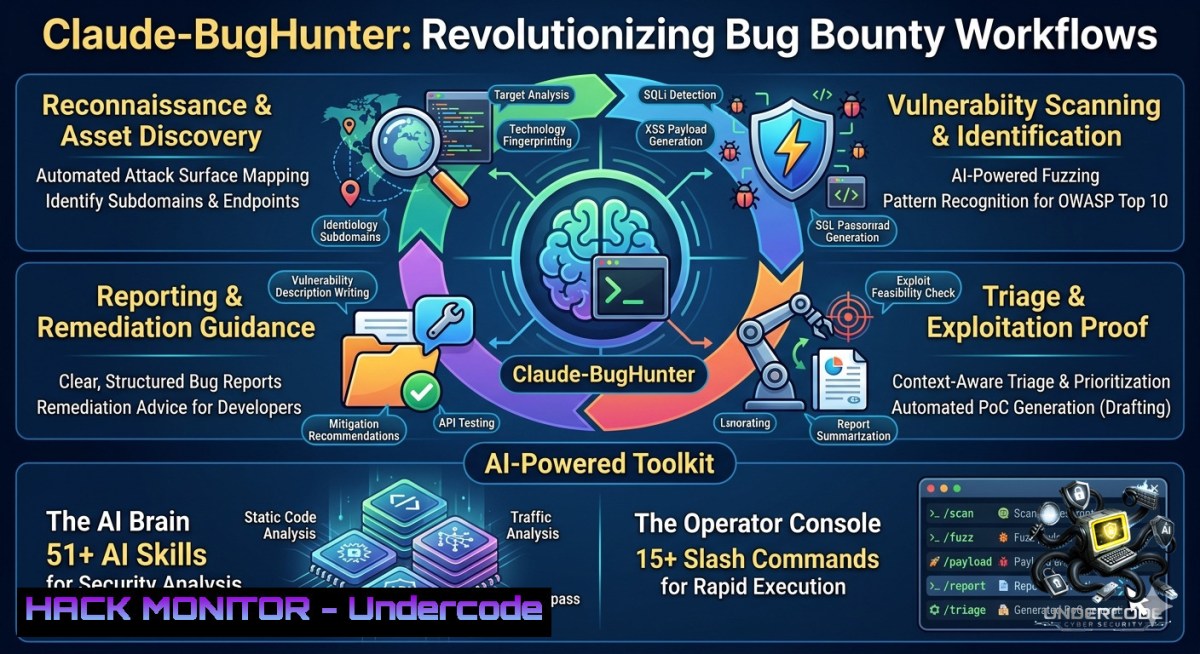
AI-assisted coding tools like Claude Code are evolving beyond simple code generation. When combined with structured security research methodologies—such as the Claude-BugHunter framework—these tools can automate reconnaissance, triage, validation, and reporting. This integration creates a repeatable, disciplined workflow that transforms raw findings into actionable, high-impact bug bounty submissions.
Learning Objectives:
– Implement AI-driven reconnaissance and vulnerability hunting using prebuilt Claude skills and slash commands.
– Apply a structured validation gate to filter false positives and prioritize exploitable issues.
– Automate evidence handling and reporting to streamline red-team and bug bounty engagements.
You Should Know
1. Setting Up Claude-BugHunter for AI-Assisted Reconnaissance
Claude-BugHunter (https://lnkd.in/dButNn5S) provides 51 specialized skills covering subdomain enumeration, endpoint discovery, and technology fingerprinting. To start, clone the repository and integrate it with your Claude Code environment.
Step‑by‑step setup:
1. Clone the repo: `git clone https://github.com/sachinsharm/Claude-BugHunter.git` (verify actual URL; the LinkedIn link redirects).
2. Install dependencies: `pip install -r requirements.txt` (includes requests, beautifulsoup4, nmap, etc.).
3. Configure your Claude API key: `export CLAUDE_API_KEY=”your-key-here”`.
4. Load the skills bundle: `claude load skills/ –all`.
5. Run initial passive recon on a target domain (scope-authorized only):
claude run skill:subdomain_enum --target example.com --output recon.json
Linux/Windows commands for manual verification:
– Linux: `dig example.com NS`, `subfinder -d example.com -o subs.txt`
– Windows: `nslookup -type=NS example.com`, `Resolve-DnsName example.com -Type ANY`
2. Mastering Slash Commands for Automated Triage
The framework includes 15 slash commands that orchestrate multi‑step workflows—like `/triage` for filtering duplicates and `/validate` for impact scoring.
Step‑by‑step triage example:
1. After collecting findings, run: `/triage findings.json –confidence high –impact critical`
2. The command cross‑references 681 disclosed‑report patterns to eliminate known false positives.
3. Outputs a prioritized list with CVSS scores and exploitability estimates.
4. Use `/chaining` to suggest attack sequences across multiple low‑severity issues.
Custom slash command creation:
Edit `commands/triage.yaml` to add your own logic:
name: my_validate
steps:
- check_scope: true
- test_exploitability: poc.py
- generate_evidence: screenshots/
3. Exploiting 24 Vulnerability Classes with Pattern Matching
The repository maps 24 vulnerability classes (e.g., IDOR, XSS, SSTI, SSRF, SQLi) to regex patterns and payload generation rules. This turns AI into an active exploitation assistant.
Step‑by‑step exploitation workflow for SQLi:
1. Identify a parameter: `claude run skill:param_discovery –url https://target.com/search?q=test`
2. Launch SQLi pattern scan: `/exploit sql_injection –param q –technique boolean`
3. Claude generates tailored payloads:
' OR '1'='1' --
' UNION SELECT username, password FROM users --
4. Validate via time‑based blind: `/validate sql_injection –delay 5 –threshold 200ms`
Manual Linux/Windows commands:
– Linux (sqlmap): `sqlmap -u “https://target.com/search?q=test” –batch –technique B`
– Windows (PowerShell with Invoke-SqlInjection.ps1): `Invoke-SqlInjection -Url “https://target.com/search?q=test” -Param “q”`
4. Validation Gate: From Finding to Proof‑of‑Concept
The validation mindset described in the post uses five critical questions (exploitable? in scope? real impact? provable? worth reporting?). Claude-BugHunter automates this gate.
Step‑by‑step validation script:
1. Run `/gate findings.json –output validated.json`
2. The gate checks scope via `scope.txt` (user‑provided asset list).
3. Attempts lightweight PoC generation: `/poc generate –finding “IDOR on /api/user/123″`
4. If PoC succeeds, captures evidence as annotated screenshots or Burp logs.
5. Rejects findings that fail any gate, logging reasons to `rejected.log`.
Example gate configuration (YAML):
validation_rules:
- question: "Is it exploitable?"
check: "poc.exit_code == 0"
- question: "Is asset in scope?"
check: "asset in scope_list"
5. Reporting Automation and Evidence Hygiene
Claude-BugHunter structures final reports with attack chains, impact statements, and remediation steps. Evidence handling ensures screenshots and logs are sanitized and hashed.
Step‑by‑step report generation:
1. After validation, run: `/report validated.json –template bugcrowd –output report.md`
2. The report includes:
– Executive summary (AI‑generated)
– Step‑by‑step reproduction with timestamps
– Proof‑of‑concept code blocks
– Raw HTTP requests/responses
3. Evidence hygiene: `/hygiene –strip-metadata –hash logs/ –output clean_evidence.zip`
4. Submit directly via API: `/submit –platform hackerone –api-key $H1_TOKEN`
Linux hash verification:
sha256sum clean_evidence.zip > evidence.hash
gpg --verify evidence.hash
6. Integrating External Red‑Team Tools (Nmap, Burp, Nuclei)
The framework supports custom tool hooks. You can trigger external scanners and ingest their output into Claude’s workflow.
Step‑by‑step integration:
1. Configure `tools/nmap_config.yaml`:
command: "nmap -sV -p- {target} -oX nmap_output.xml"
parser: "xml_to_json.py"
2. Run `/external nmap –target 10.10.10.0/24`
3. Parse results into Claude’s native format: `claude import nmap_output.json –type service_discovery`
4. For API security: `/external postman –collection api_collection.json –env prod`
5. Cloud hardening checks: `/external prowler –aws-profile default`
Windows alternative (PowerShell):
Invoke-WebRequest -Uri "https://target.com/api/health" | /validate --status-code 200
7. Responsible Testing and Scope Enforcement
The post emphasizes authorization. Claude-BugHunter includes guardrails to prevent testing out‑of‑scope assets.
Step‑by‑step scope enforcement:
1. Create `allowed_domains.txt` and `blocked_ips.txt`.
2. Run `/scope –allow-list allowed_domains.txt –block-list blocked_ips.txt`
3. Any recon command automatically checks targets against these lists.
4. Log violations to `scope_violations.log` for audit.
5. Configure automatic alerts: `/notify –on-violation –email [email protected]`
Verification command:
claude run skill:check_scope --target example.com --strict --auto-block
What Undercode Say:
– Key Takeaway 1: AI will not replace skilled security researchers, but those who master structured AI workflows (like Claude-BugHunter) will operate at significantly higher velocity and accuracy.
– Key Takeaway 2: The validation gate—asking five critical questions before reporting—is the most underrated component. It separates noise from genuine impact and builds researcher credibility.
Analysis (10 lines):
Undercode’s perspective highlights a critical shift in offensive security. The days of relying purely on manual fuzzing or fully automated scanners are fading. Instead, hybrid workflows where AI handles pattern matching, context aggregation, and report drafting—while humans drive methodology, scope awareness, and ethical boundaries—are emerging as the new standard. The Claude-BugHunter repo exemplifies this by providing not just tools but a process discipline. The 681 disclosed‑report patterns act as a crowdsourced knowledge base, reducing duplicate efforts. The 24 vulnerability classes ensure coverage across OWASP Top 10 and beyond. Importantly, the emphasis on evidence hygiene and clean reporting addresses a pain point for bug bounty programs: low‑quality submissions. By enforcing structured gates, the framework increases the likelihood of valid, well‑documented findings being accepted and paid. This ultimately raises the bar for the entire ecosystem, pushing both researchers and platforms toward more professional, repeatable security testing.
Prediction:
– +1 AI‑assisted bug hunting will become standard within 18–24 months, with platforms like HackerOne and Bugcrowd offering native AI workflow integrations and premium bounties for AI‑structured reports.
– +1 Open‑source frameworks like Claude-BugHunter will accelerate democratization of advanced red‑team techniques, lowering entry barriers for junior researchers while enabling senior analysts to focus on zero‑day discovery.
– -1 Increased reliance on AI validation gates may lead to over‑filtering of creative or chained vulnerabilities that don’t fit existing pattern databases, requiring continuous human oversight.
– -1 Attackers will also adopt similar AI workflows to automate vulnerability discovery at scale, potentially increasing the volume of zero‑day exploits before defenders can react.
▶️ Related Video (80% Match):
🎯Let’s Practice For Free:
🎓 Live Courses & Certifications:
[Join Undercode Academy for Verified Certifications](https://undercode.co.uk/certifications/)
🚀 Request a Custom Project:
Secure, high-velocity infrastructure and disruptive technological engineering. Contact our engineering team for high-tier development and proprietary systems:
[[email protected]](mailto:[email protected])
💎 Smart Architecture | 🛡️ Secure by Design | ⭐ Trusted by Thousands
IT/Security Reporter URL:
Reported By: [Yildizokan Cybersecurity](https://www.linkedin.com/posts/yildizokan_cybersecurity-bugbounty-redteam-share-7467874398893641728-XV7i/) – Hackers Feeds
Extra Hub: Undercode MoN
Basic Verification: Pass ✅
🔐JOIN OUR CYBER WORLD [ CVE News • HackMonitor • UndercodeNews ]
[💬 Whatsapp](https://undercode.help/whatsapp) | [💬 Telegram](https://t.me/UndercodeCommunity)
📢 Follow UndercodeTesting & Stay Tuned:
[𝕏 formerly Twitter 🐦](https://x.com/undercodeupdate) | [@ Threads](https://www.threads.net/@undercodetesting) | [🔗 Linkedin](https://www.linkedin.com/company/undercodetesting/) | [🦋BlueSky](https://bsky.app/profile/undercode.bsky.social)


