Listen to this Post
Introduction:
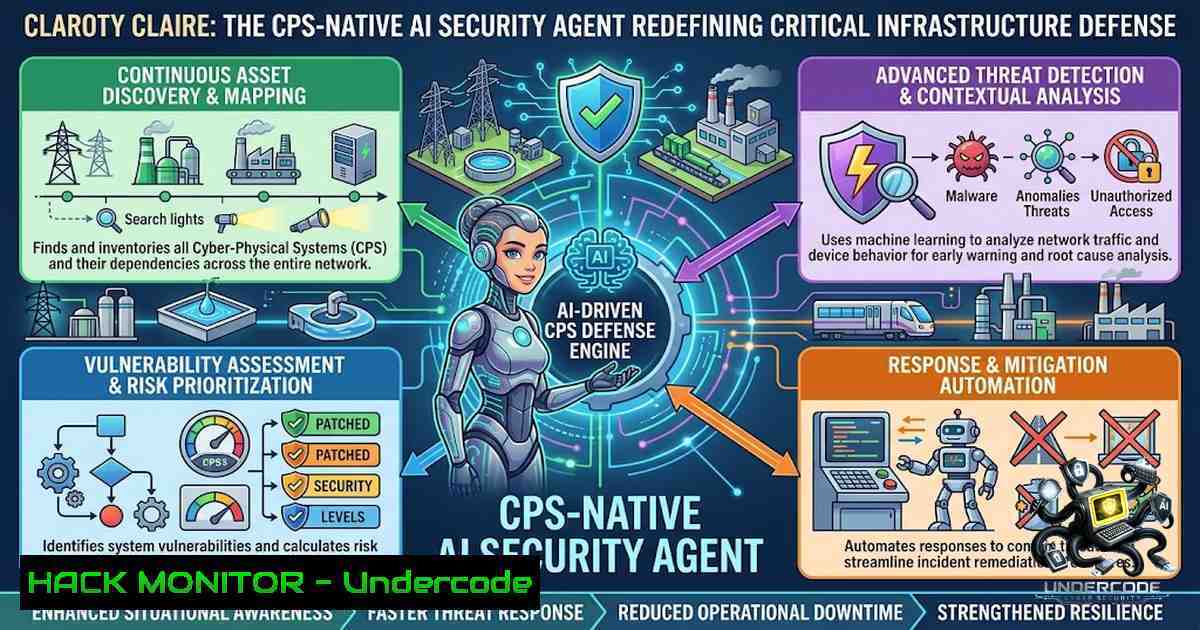
The convergence of operational technology (OT), the Internet of Things (IoT), and the Internet of Medical Things (IoMT) has created a complex cyber-physical systems (CPS) landscape where traditional security tools fall dangerously short. As the White House launches the Gold Eagle initiative to accelerate vulnerability triage using frontier AI models, organizations managing critical infrastructure face an unprecedented challenge: processing torrents of vulnerability disclosures without disrupting the physical processes that keep hospitals running, power grids stable, and manufacturing lines operational. Claroty Claire emerges as the industry’s first CPS-1ative AI security agent, purpose-built to bridge the operational experience gap by delivering context-driven visibility, AI-powered prioritization, and agentic actions that respect the unique constraints of cyber-physical environments.
Learning Objectives:
- Understand the fundamental differences between traditional IT security and CPS security, including why CVSS scores and patch-first strategies fail in operational environments
- Learn how CPS-1ative AI models, trained on domain-specific data, enable accurate asset identification, risk prioritization, and automated remediation across OT, IoT, and IoMT environments
- Master practical techniques for implementing AI-driven exposure management, including attack path analysis, zone-based asset classification, and compliance automation
You Should Know:
1. Understanding CPS-1ative AI: Why Context Trumps Speed
Traditional AI security solutions prioritize rapid output and general-purpose threat detection. However, in CPS environments—spanning manufacturing lines, surgical suites, power grids, and building management systems—speed without context is a liability. A firmware update that takes down a production line for 30 minutes can cost millions. A patch that reboots a medical device mid-procedure can be life-threatening.
Claroty Claire is powered by the world’s most advanced CPS language model, trained on over a decade of industry expertise and the largest CPS data lake. This domain-specific language model (DSLM) understands OT protocols, physical consequences, and process context in ways that general-purpose LLMs cannot. The training data encompasses more than 40 million protected assets, 20,000+ deployed sites, and 6,500+ unique OEM and medical device manufacturers across 50+ sectors and 60+ countries.
Step-by-Step Guide: Implementing CPS-1ative Asset Discovery
Step 1: Deploy passive network monitoring to discover all CPS assets without disrupting operations. Use tools like `nmap` with specific OT protocol scans:
nmap -sU -p 161 --script snmp-info 192.168.1.0/24
Step 2: For industrial environments, utilize proprietary protocol identification. Example using Modbus discovery:
nmap --script modbus-discover -p 502 192.168.1.0/24
Step 3: Leverage Claroty’s CPS Library—the industry’s first AI-driven global standard for correctly identifying assets that transmit imprecise or conflicting product codes. The CPS-ID naming convention provides precise identity for devices even when they use proprietary, decade-old protocols.
Step 4: Implement Agentic Dynamic Discovery to identify previously invisible assets. Claire automatically recommends zone assignments and hardening measures when new assets are discovered.
Windows Command for Asset Inventory:
Get-WmiObject -Class Win32_ComputerSystem | Select-Object Manufacturer, Model, TotalPhysicalMemory
Get-Service | Where-Object {$_.Status -eq "Running"} | Select-Object Name, DisplayName
2. AI-Driven Vulnerability Prioritization: Moving Beyond CVSS
Generic CVSS rankings are dangerously inadequate for CPS environments. A critical-rated vulnerability in a non-critical asset may require no action, while a medium-severity flaw in a safety instrumented system demands immediate attention. Claire replaces reliance on generic scoring with tailored, context-rich recommendations that evaluate vulnerabilities against physical process context, attack paths, and asset criticality.
Step-by-Step Guide: Contextual Risk Prioritization
Step 1: Map all assets to business functions. Create an asset criticality matrix:
Criticality Level | Asset Type | Business Impact | Downtime Tolerance
Critical | PLC | Production Stop | 0 minutes
High | HMI | Process Control | 15 minutes
Medium | Sensors | Data Collection | 60 minutes
Low | HVAC | Comfort | 240 minutes
Step 2: Implement attack path analysis. Claire prioritizes exposures that pose the greatest risk to operational uptime by analyzing potential attack vectors through the network.
Step 3: Use the Exploit Prediction Scoring System (EPSS) alongside CVSS for more accurate risk assessment:
 Example API call to fetch EPSS scores
curl -X POST https://api.first.org/epss/v2/scores \
-H "Content-Type: application/json" \
-d '{"cve": ["CVE-2024-12345"]}'
Step 4: Integrate threat intelligence from Team82 research, which analyzes more than 200 attacks carried out by 20+ threat-actor groups against CPS across multiple industries.
Linux Command for Vulnerability Assessment:
 Using OpenVAS for vulnerability scanning
gvm-cli --gmp-username admin --gmp-password password socket --xml \
"<create_task><name>OT_Scan</name><target id='target-id'/></create_task>"

Using Nmap for service enumeration
nmap -sV -p 1-65535 --open 192.168.1.0/24
3. Agentic Action: Autonomous Remediation with Human Oversight
Claire isn’t just another dashboard or chatbot—it’s an agentic form of specialized security experts. By leveraging human-in-the-loop orchestration, Claire can autonomously take trusted actions while maintaining human oversight for critical decisions. This represents a paradigm shift from dashboard-centric operations to agentic security operations where AI assists with actions under human supervision.
Step-by-Step Guide: Configuring Agentic Response
Step 1: Define response playbooks for different threat scenarios:
playbook:
name: "ICS_Compromise_Response"
triggers:
- alert_type: "Unauthorized_Modbus_Write"
- severity: "Critical"
actions:
- isolate_asset: true
- notify_soc: true
- generate_incident_report: true
require_approval: true
Step 2: Configure automated asset mapping to regulatory frameworks and OEM-approved patch levels to achieve continuous compliance:
 Example: Mapping assets to NERC CIP compliance
def map_to_compliance(asset, framework="NERC_CIP"):
compliance_map = {
"PLC": "CIP-007 R1",
"RTU": "CIP-007 R2",
"HMI": "CIP-007 R3"
}
return compliance_map.get(asset.type, "Unknown")
Step 3: Implement alert insights—Claire produces actionable recommendations with evidence and confidence scores for every alert, reducing triage time and distinguishing between sanctioned changes and early-stage compromises.
Windows PowerShell for Automated Response:
 Example: Automated alert response script
$alert = Get-EventLog -LogName Security -InstanceId 4624 -1ewest 1
if ($alert.TimeGenerated -gt (Get-Date).AddMinutes(-5)) {
Send-MailMessage -To "[email protected]" -Subject "Critical Alert" -Body $alert.Message
Start-Process "C:\Tools\respond.exe" -ArgumentList "-isolate $alert.MachineName"
}
4. Operationalizing Gold Eagle and National-Level Intelligence
The White House Gold Eagle initiative brings frontier AI models into national cybersecurity defense to accelerate vulnerability triage and cross-sector coordination. However, for organizations heavy in CPS, finding vulnerabilities is only the first step. Claire operationalizes high-volume intelligence from initiatives such as Gold Eagle, turning raw vulnerability feeds into safe, prioritized execution across the xDome platform.
Step-by-Step Guide: Integrating National-Level Intelligence
Step 1: Subscribe to vulnerability feeds from NVD, CISA, and sector-specific ISACs:
 Fetch CISA Known Exploited Vulnerabilities
curl -s https://www.cisa.gov/sites/default/files/feeds/known_exploited_vulnerabilities.json | \
jq '.vulnerabilities[] | select(.vendorProject == "Siemens")'
Step 2: Use Claire’s natural language query capabilities to interrogate complex operational environments:
"Show me all assets running firmware versions affected by the latest ICS-CERT advisory"
"What is the attack path from the corporate network to the safety PLC in Zone 3?"
Step 3: Implement AI-generated dashboards and reports in seconds—just describe what you need, and the Claroty xDome platform builds it for you:
"Generate a compliance report for NERC CIP-007 showing all assets with outstanding patches"
- Securing the Expanding Attack Surface: IoT, IoMT, and Beyond
AI is rapidly expanding the CPS attack surface. In robotics alone, the total addressable market for humanoid robots is projected to reach $38 billion by 2035, with more than 250,000 humanoid robot shipments expected in 2030, almost all for industrial use. Each new connected device represents a potential entry point for adversaries. Team82 research shows that attackers are moving away from targeted attacks against specific entities and instead leveraging classes of internet-facing CPS assets to compromise at scale.
Step-by-Step Guide: IoMT and IoT Security Hardening
Step 1: Implement network segmentation using VLANs and firewalls:
 Linux: Configure VLAN for IoT devices
ip link add link eth0 name eth0.100 type vlan id 100
ip addr add 192.168.100.1/24 dev eth0.100
ip link set up dev eth0.100

Configure iptables to restrict IoT traffic
iptables -A FORWARD -i eth0.100 -o eth0 -j DROP
iptables -A FORWARD -i eth0 -o eth0.100 -m state --state ESTABLISHED,RELATED -j ACCEPT
Step 2: Deploy continuous threat detection with Claroty CTD for on-premise environments or xDome for cloud-based protection. xDome offers multiple AI-driven asset discovery methods to gain visibility based on what’s best for your unique environment.
Step 3: Implement zone-based security policies. Claire automatically recommends zone assignments and hardening measures for new assets.
Windows Firewall Rules for IoT Segmentation:
New-1etFirewallRule -DisplayName "Block IoT to Corporate" -Direction Outbound -LocalAddress 192.168.100.0/24 -RemoteAddress 192.168.1.0/24 -Action Block
New-1etFirewallRule -DisplayName "Allow IoT to Internet" -Direction Outbound -LocalAddress 192.168.100.0/24 -RemoteAddress Any -Action Allow
6. Continuous Compliance and Audit Automation
Manual compliance preparation in CPS environments is labor-intensive and error-prone. Claire reduces the manual burden of audit preparation with automated asset mapping to regulatory frameworks and OEM-approved patch levels. Organizations can achieve continuous compliance across frameworks including NERC CIP, HIPAA, IEC 62443, and GDPR.
Step-by-Step Guide: Automating Compliance Reporting
Step 1: Define compliance frameworks and mapping rules:
compliance_frameworks = {
"NERC_CIP": ["CIP-002", "CIP-003", "CIP-005", "CIP-007", "CIP-009"],
"IEC_62443": ["IEC-62443-2-1", "IEC-62443-3-3", "IEC-62443-4-2"],
"HIPAA": ["Security Rule", "Privacy Rule", "Breach Notification Rule"]
}
Step 2: Generate automated compliance dashboards:
-- Example query for compliance reporting
SELECT asset_name, firmware_version, oem_recommended_patch,
CASE WHEN firmware_version >= oem_recommended_patch THEN 'Compliant' ELSE 'Non-Compliant' END as compliance_status
FROM asset_inventory
WHERE asset_type IN ('PLC', 'RTU', 'HMI', 'Medical_Device');
Step 3: Schedule automated audit reports using Claroty xDome’s AI-powered reporting—generate comprehensive compliance documentation in seconds with natural language descriptions.
What Undercode Say:
- CPS security cannot be treated as IT security with a different label. The physical consequences of digital errors demand a fundamentally different approach to vulnerability management, prioritization, and remediation. Generic CVSS scores and patch-first strategies actively harm operational resilience.
-
Domain-specific AI is the only viable path forward. General-purpose LLMs lack the contextual understanding required for CPS environments. Claire’s training on 40M+ assets, 6,500+ OEM vendors, and Team82 threat research represents the minimum viable dataset for trustworthy CPS AI.
-
The agentic model transforms security operations. Moving from dashboard-centric to agentic security operations—where AI assists with actions under human supervision—represents a fundamental shift in how security teams will operate. This is not about replacing humans but augmenting their capabilities at machine speed.
-
Compliance becomes continuous, not episodic. Automated asset mapping to regulatory frameworks and OEM-approved patch levels transforms compliance from a periodic headache into a continuous, verifiable state. This reduces audit preparation time from weeks to minutes.
-
The attack surface is expanding faster than defenses can scale. With robotics markets projected to reach $38 billion by 2035 and AI accelerating the threat lifecycle, organizations need AI-1ative defenses that can keep pace. Claire represents a proactive step toward closing the visibility-insight-action loop at machine speed.
Prediction:
-
+1 The CPS-1ative AI security agent market will experience explosive growth, with Gartner predicting that by 2028, 40% of CPS protection platforms will incorporate domain-specific AI agents, up from less than 5% in 2025.
-
+1 Organizations that adopt CPS-1ative AI agents will reduce mean time to remediation (MTTR) for critical vulnerabilities by 70-80%, as automated prioritization and orchestrated remediation eliminate manual triage bottlenecks.
-
-1 The proliferation of AI-driven vulnerability scanning from initiatives like Gold Eagle will overwhelm organizations without AI-1ative exposure management, creating a “disclosure gap” where vulnerabilities are identified but cannot be safely remediated.
-
+1 Regulatory frameworks will increasingly mandate AI-assisted exposure management for critical infrastructure, with NERC, FDA, and EU agencies expected to release guidance on CPS AI agents by 2027.
-
-1 Attackers will rapidly adopt AI to identify and exploit CPS vulnerabilities at scale, with Team82 research already documenting a shift toward opportunistic, class-based attacks on internet-facing CPS assets. Organizations without AI-1ative defenses will face existential risk.
-
+1 The integration of Claire with the Claroty Platform—encompassing asset inventory, exposure management, network protection, secure access, and threat detection—will create a comprehensive CPS security fabric that reduces total cost of ownership by 40-50% compared to point solutions.
▶️ Related Video (86% Match):
https://www.youtube.com/watch?v=1gy6kOCa1_4
🎯Let’s Practice For Free:
🎓 Live Courses & Certifications:
Join Undercode Academy for Verified Certifications
🚀 Request a Custom Project:
Secure, high-velocity infrastructure and disruptive technological engineering. Contact our engineering team for high-tier development and proprietary systems:
[email protected]
💎 Smart Architecture | 🛡️ Secure by Design | ⭐ Trusted by Thousands
IT/Security Reporter URL:
Reported By: Randyguerette Share – Hackers Feeds
Extra Hub: Undercode MoN
Basic Verification: Pass ✅


