Listen to this Post
Introduction:
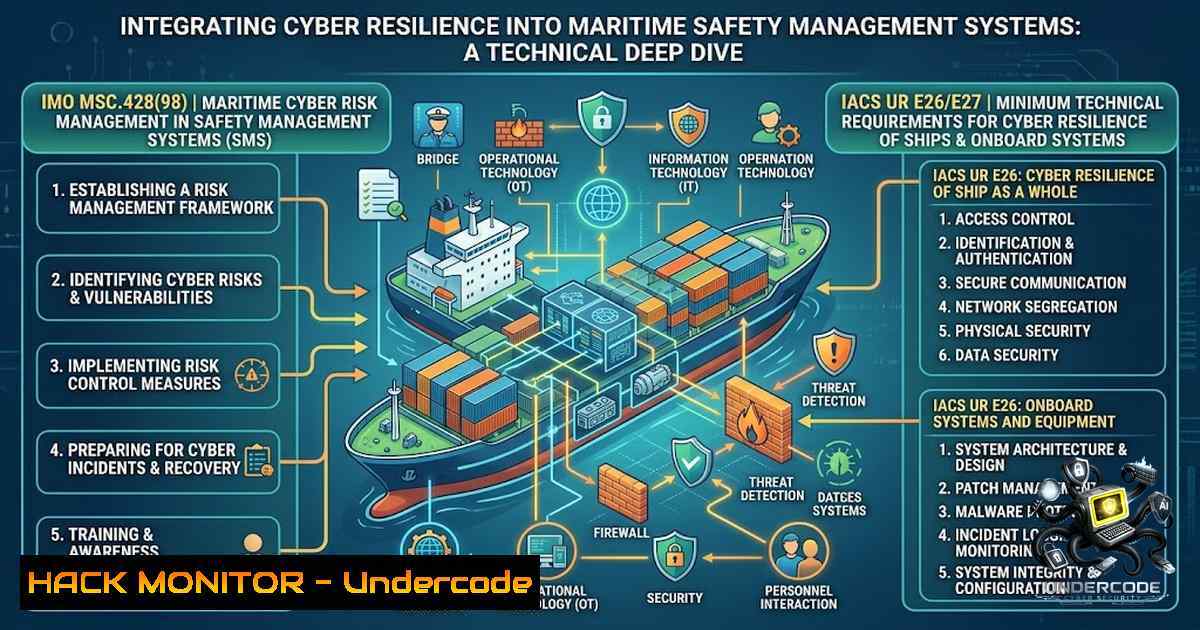
The maritime industry has reached an inflection point where cybersecurity is no longer an operational overhead managed solely by shore-based IT departments but a core safety mandate embedded within the Safety Management System (SMS). Regulatory frameworks such as IMO Resolution MSC.428(98) and the International Association of Classification Societies (IACS) Unified Requirements E26 and E27 have fundamentally elevated cyber resilience to a mandatory component of vessel seaworthiness and safety compliance. This article provides a comprehensive technical guide for maritime IT engineers, port captains, and chief engineers on integrating military-grade cyber governance into vessel operations, covering risk assessment methodologies, network segmentation strategies, crew training protocols, and the future implications of Maritime Autonomous Surface Ships (MASS) and AI-driven defense.
Learning Objectives:
- Understand the regulatory landscape of maritime cybersecurity, including IMO Resolution MSC.428(98) and IACS UR E26/E27, and their implications for Safety Management Systems.
- Master practical techniques for conducting cyber risk assessments alongside traditional seaworthiness inspections.
- Implement network isolation and segmentation strategies to separate Operational Technology (OT) from Information Technology (IT) onboard vessels.
- Develop and execute continuous crew training and cyber hygiene programs aligned with ISM Code requirements.
- Prepare for the future of autonomous shipping and AI-assisted navigation through proactive cyber resilience measures.
You Should Know:
- Regulatory Foundations: IMO Resolution MSC.428(98) and the ISM Code
Adopted on 16 June 2017, IMO Resolution MSC.428(98) affirms that an approved safety management system must take into account cyber risk management in accordance with the objectives and functional requirements of the International Safety Management (ISM) Code. The resolution recognizes the urgent need to raise awareness of cyber risk threats and vulnerabilities to support safe and secure shipping that is operationally resilient to cyber risks. It encourages Administrations to ensure that cyber risks are appropriately addressed in safety management systems no later than the first annual verification of the company’s Document of Compliance after 1 January 2021.
Practical Implementation – Integrating Cyber Risk into SMS:
To comply with MSC.428(98), shipping companies must amend their SMS to include cyber risk management. This involves:
- Policy Amendment: Update the safety and environmental protection policy to explicitly address cybersecurity.
- Risk Assessment Procedures: Incorporate cyber risk assessments into the existing risk management processes, identifying threats to IT and OT systems and assessing potential consequences.
- Roles and Responsibilities: Clearly define roles, tasks, and responsibilities for onshore staff and onboard crew regarding cyber risk management.
- Training and Competence: Establish a cyber security training program to ensure competence assurance for all personnel.
- Incident Response: Develop procedures for normal operation and emergency situations, including cyber incident response plans.
Step‑by‑Step Guide: Conducting a Cyber Risk Audit alongside Seaworthiness Inspections
- Asset Inventory: Document all connected devices onboard, including navigation systems (ECDIS, GPS), communication systems (Satcom, VHF), engine control systems, and crew welfare networks.
- Threat Identification: Identify potential cyber threats (e.g., ransomware, phishing, unauthorized access) and vulnerabilities (e.g., unpatched systems, default credentials, lack of network segmentation).
- Impact Assessment: Evaluate the potential consequences of a cyber incident on safety, environment, and operations. For example, a compromised ECDIS could lead to grounding.
- Control Implementation: Select and implement risk control measures based on the IMO’s guidelines (MSC-FAL.1/Circ.3/Rev.3), which emphasize a risk-based approach.
- Documentation: Integrate the findings and controls into the SMS documentation, ensuring traceability and continuous improvement.
-
IACS Unified Requirements E26 and E27: Cyber Resilience by Design
Building upon the IMO resolution, IACS has established two Unified Requirements that set minimum standards for cyber resilience:
- UR E26 – Cyber Resilience of Ships: Applies to the ship as a collective entity, aiming to ensure the secure integration of both OT and IT equipment into the vessel’s network during the design, construction, commissioning, and operational life of the ship. It covers five key aspects: equipment identification, protection, attack detection, response, and recovery.
- UR E27 – Cyber Resilience of On-Board Systems and Equipment: Focuses on ensuring system integrity is secured and hardened by third-party equipment suppliers. It provides requirements for the interface between users and computer-based systems, as well as product design and development requirements for new devices.
These URs apply to new ships contracted for construction on or after 1 January 2024 (or 1 July 2024, depending on the classification society). They are grounded in the IEC 62443 standard, representing a significant shift toward engineering cybersecurity into vessels from the design phase.
Step‑by‑Step Guide: Implementing Network Isolation and OT/IT Segmentation
Proper network segmentation is critical for maritime cyber resilience. It limits how attackers can move between systems and prevents everyday users from accidentally interfering with critical operations.
- Architecture Design: Design a network architecture that logically or physically separates OT, IT, and public networks. Create separate VLANs for:
– Operational Technology (OT): Engine controls, navigation, propulsion, ballast, and cargo systems.
– Information Technology (IT): Crew internet, email, administrative systems, and passenger networks (if applicable).
– Public/Passenger Networks: Guest Wi-Fi and entertainment systems.
2. Access Control: Implement strict access control lists (ACLs) and firewall rules between VLANs. Allow only necessary communication.
3. Remote Access: Control every remote access pathway into the OT network through a dedicated jump host or broker. Ensure access is logged, time-limited, and tied to a specific purpose.
4. Asset Discovery: Identify every connection that touches OT data or OT-adjacent platforms and document what they actually connect to.
Technical Configuration Example (Cisco IOS-like syntax):
! Create VLANs
vlan 10
name OT_Network
vlan 20
name IT_Network
vlan 30
name Guest_Network

! Assign ports to VLANs
interface GigabitEthernet0/1
switchport access vlan 10
!
interface GigabitEthernet0/2
switchport access vlan 20

! Configure Access Control List (ACL) to restrict OT access
access-list 101 deny ip any 10.10.10.0 0.0.0.255
access-list 101 permit ip any any

! Apply ACL to IT VLAN interface
interface Vlan20
ip access-group 101 in
Linux Commands for Network Segmentation Verification:
 View routing table
route -1

Check open ports and listening services
netstat -tulpn

Scan for active devices on the network (use with caution)
nmap -sn 192.168.1.0/24

Verify firewall rules (iptables)
iptables -L -1 -v
Windows Commands for Network Auditing:
 Display network adapter configuration
ipconfig /all

View active network connections
netstat -an

Test connectivity and trace route
ping 192.168.1.1
tracert 192.168.1.1

List firewall rules
netsh advfirewall firewall show rule name=all
3. Unified Governance: Establishing Clear Accountability
Just as naval forces operate under unified command and compliance standards, shipping lines must establish clear accountability across all levels. This includes:
- Shore-side Leadership (CISO/IT Director): Overall responsibility for cyber strategy, policy, and compliance.
- Port Captains: Overseeing cyber risk management at the port level, ensuring vessels under their purview meet SMS requirements.
- Ship Captains: Ultimate responsibility for the safety and security of the vessel, including cyber incidents.
- Chief Engineers: Responsible for the technical implementation of cyber controls on OT systems.
Step‑by‑Step Guide: Developing a Cyber Governance Framework
- Define Roles: Document specific cyber responsibilities for each role in the SMS.
- Establish Communication Channels: Create clear reporting lines for cyber incidents, from the vessel to shore.
- Regular Audits: Conduct regular cyber audits alongside traditional safety inspections.
- Incident Response Plan: Develop and test a cyber incident response plan that integrates with the existing emergency response procedures.
4. Continuous Crew Training and Cyber Hygiene
Crew cybersecurity training is an essential part of the cybersecurity risk management requested by IMO Resolution MSC.428(98). Training should be aligned with the ISM Code and cover:
- Phishing Awareness: Recognizing and reporting suspicious emails.
- Password Hygiene: Using strong, unique passwords and enabling multi-factor authentication (MFA) where possible.
- USB Device Security: Avoiding the use of untrusted USB drives on critical systems.
- Social Engineering: Understanding tactics used by attackers to gain unauthorized access.
- Incident Reporting: Knowing how to report a suspected cyber incident.
Step‑by‑Step Guide: Implementing a Cyber Awareness Program
- Needs Assessment: Identify the specific cyber risks relevant to your fleet and crew roles.
- Curriculum Development: Develop training materials that are accessible and engaging for all crew members, regardless of their technical background.
- Delivery: Conduct regular training sessions, including onboarding, annual refreshers, and drills.
- Evaluation: Test crew knowledge through quizzes, simulated phishing exercises, and tabletop exercises.
- Continuous Improvement: Update training content based on emerging threats and lessons learned from incidents.
5. Future Outlook: Autonomous Ships and AI-Driven Defense
As the maritime industry advances toward Maritime Autonomous Surface Ships (MASS) and AI-assisted navigation, cyber resilience will define operational survival. MASS rely heavily on interconnected digital systems, introducing new types of risks. Cyber-attacks on autonomous vessels could lead to accidents such as grounding, collisions, and loss of propulsion control.
Preparing for MASS and AI-Driven Defense:
- Embedding Security by Design: Incorporate cybersecurity into the design phase of autonomous systems, as mandated by IACS UR E26/E27.
- AI-Powered Threat Detection: Implement AI and machine learning algorithms to detect anomalies and potential cyber-attacks in real-time.
- Resilience Engineering: Design systems with redundancy and fail-safe mechanisms to ensure safety even during a cyber incident.
- Regulatory Evolution: Stay abreast of evolving regulations and guidelines for MASS cybersecurity.
Technical Consideration – Securing AI Models:
AI models used in navigation and decision-making are vulnerable to adversarial attacks. Consider the following:
- Data Integrity: Ensure the integrity of training data to prevent model poisoning.
- Model Hardening: Implement techniques such as adversarial training to make models more robust.
- Continuous Monitoring: Monitor AI model performance for signs of tampering or drift.
What Undercode Say:
- Key Takeaway 1: Cyber resilience is no longer optional; it is a mandatory component of vessel seaworthiness, driven by IMO Resolution MSC.428(98) and IACS UR E26/E27. Shipping lines must integrate cyber risk management directly into their Safety Management Systems, treating it with the same rigor as traditional safety hazards.
- Key Takeaway 2: The future of maritime operations lies in autonomous ships and AI-assisted navigation, where cyber resilience will define operational survival. Proactive measures—embedding military-grade governance, strict network isolation, and continuous crew training—are essential to secure digital transformation for the decades ahead.
Analysis:
The maritime industry is undergoing a profound digital transformation, but this progress brings significant cyber risks. The regulatory landscape has evolved rapidly, with IMO and IACS setting clear expectations for cyber resilience. However, compliance is not a one-time effort; it requires a strategic, ongoing commitment to embed cybersecurity into the operational DNA of every shipping company. The integration of cyber risk into the SMS is a critical first step, but it must be supported by technical measures such as network segmentation, robust access controls, and continuous monitoring. Furthermore, the human element remains a critical vulnerability, necessitating comprehensive and continuous crew training. As the industry moves toward MASS and AI-driven systems, the stakes will only increase, making proactive cyber resilience a competitive differentiator and a necessity for survival.
Prediction:
- +1 The mandatory integration of cyber risk management into SMS will drive significant investment in maritime cybersecurity solutions, creating a multi-billion dollar market for OT security, network monitoring, and training platforms over the next five years.
- +1 IACS UR E26/E27 will accelerate the adoption of secure-by-design principles in shipbuilding, leading to more resilient vessels and reducing the attack surface for future fleets.
- -1 The rapid adoption of autonomous and AI-driven systems without commensurate security maturity will lead to high-profile cyber incidents involving MASS, potentially causing environmental disasters and loss of life, which will trigger even stricter regulations.
- -1 A significant skills gap in maritime cybersecurity will persist, leaving many shipping lines vulnerable despite regulatory mandates, as they struggle to find and retain qualified personnel to manage and operate secure systems.
- +1 AI-driven threat detection and response systems will become standard onboard vessels, enabling real-time anomaly detection and automated incident response, significantly reducing the dwell time of attackers.
- -1 The convergence of IT and OT networks, if not properly segmented, will continue to be a primary attack vector, with ransomware attacks on vessel control systems becoming more frequent and damaging.
- +1 International collaboration on maritime cyber threat intelligence sharing will improve, enabling faster identification and mitigation of global threats to the shipping industry.
- -1 The cost of compliance and cyber insurance premiums will rise sharply, potentially forcing smaller shipping operators out of business or into risky non-compliance.
- +1 Continuous crew training and cyber hygiene programs will evolve into mandatory, standardized certifications, similar to STCW, ensuring a baseline level of cyber awareness across the global seafarer workforce.
- +1 The development of standardized security baselines for marine equipment, driven by UR E27, will improve the overall security posture of the supply chain, making it harder for attackers to compromise vessels through third-party components.
▶️ Related Video (70% Match):
🎯Let’s Practice For Free:
🎓 Live Courses & Certifications:
Join Undercode Academy for Verified Certifications
🚀 Request a Custom Project:
Secure, high-velocity infrastructure and disruptive technological engineering. Contact our engineering team for high-tier development and proprietary systems:
[email protected]
💎 Smart Architecture | 🛡️ Secure by Design | ⭐ Trusted by Thousands
IT/Security Reporter URL:
Reported By: Seungbeom Ko – Hackers Feeds
Extra Hub: Undercode MoN
Basic Verification: Pass ✅


