Listen to this Post
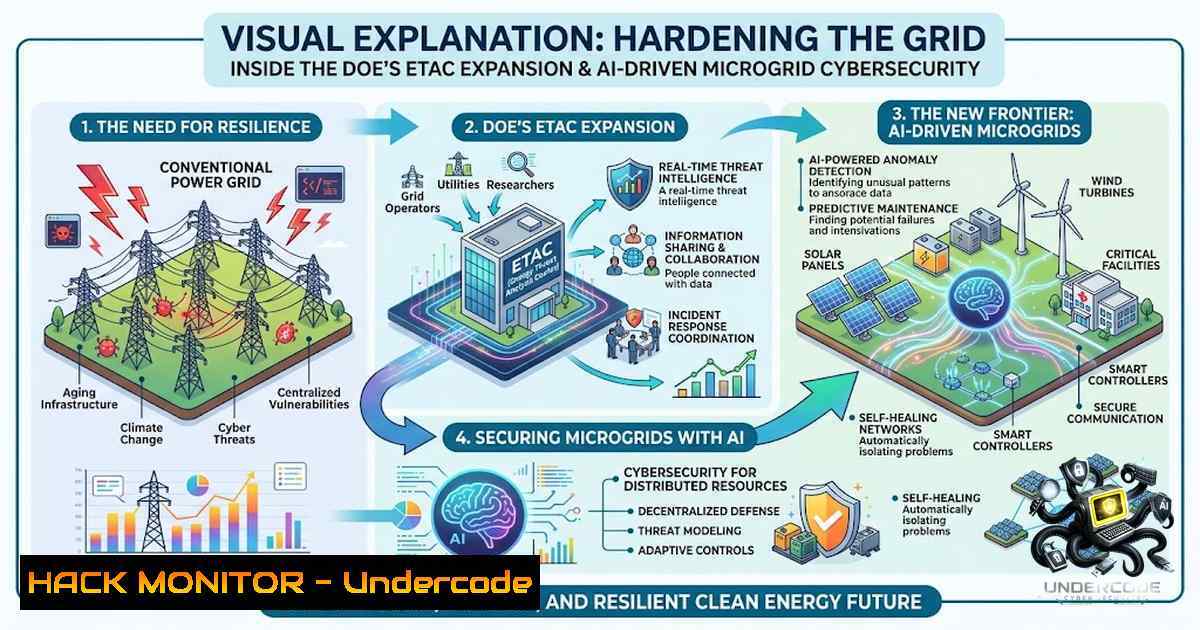
The convergence of artificial intelligence, critical minerals, and distributed energy resources is reshaping the U.S. energy landscape—but it is also creating an expansive attack surface that nation-state actors and cybercriminals are actively probing. As the Department of Energy’s Office of Cybersecurity, Energy Security, and Emergency Response (CESER) breaks ground on the new Energy Resilience Building (ERB) at the National Laboratory of the Rockies (NLR)—the future home of the expanding Energy Threat Analysis Center (ETAC)—the imperative to harden microgrid architectures, secure AI data hubs, and operationalize threat intelligence has never been more urgent. This article dissects the technical capabilities being deployed at ETAC, the role of the Community Microgrid Assistance Partnership (C-MAP) in securing remote and industrial energy systems, and provides actionable commands, configurations, and step-by-step tutorials for security professionals tasked with defending the grid.
Learning Objectives:
- Understand the operational model and threat-analysis framework of the DOE’s ETAC, including its public-private partnership structure and integration of government intelligence with industry data.
- Master the configuration of hardened microgrid architectures using secure-by-design principles, Zero Trust segmentation, and AI-driven anomaly detection.
- Apply practical Linux, Windows, and network security commands to assess vulnerabilities, implement mitigations, and participate in cyber range exercises simulating adversarial tactics against energy infrastructure.
You Should Know:
- The ETAC Operational Model: Fusing Intelligence with Industry Data for Actionable Threat Mitigation
The Energy Threat Analysis Center is not a traditional security operations center; it is a public-private partnership that convenes experts from DOE, five national laboratories (including Idaho National Laboratory, Lawrence Livermore, and NLR), and private energy sector companies to collectively identify, analyze, and mitigate cyber threats. ETAC’s core value proposition lies in its ability to integrate industry-provided data and operational context with government intelligence, producing actionable threat analysis and mitigation strategies that keep pace with modern, rapidly evolving cyber threats. The center operates with three key goals: crafting a holistic common operating picture of threats, delivering timely analysis and recommendations, and helping industry and government prioritize vulnerabilities to inform critical infrastructure protection.
For security engineers and analysts, engaging with ETAC’s framework means adopting a threat-informed defense posture. This involves continuous threat characterization, vulnerability assessment, impact analysis, and risk calculation—all of which are components of NLR’s cybersecurity threat analysis methodology. To operationalize this approach, organizations should implement the following:
- Threat Intelligence Integration: Deploy a threat intelligence platform (TIP) that ingests STIX/TAXII feeds from government sources (e.g., CISA, DOE) and correlates them with internal SIEM data. Configure your SIEM to consume ETAC-recommended Indicators of Compromise (IoCs) and adversary Tactics, Techniques, and Procedures (TTPs).
- Vulnerability Management Automation: Implement a continuous vulnerability scanning regimen using tools like OpenVAS or Tenable, with a focus on OT-specific protocols (Modbus, DNP3, IEC 61850). Schedule scans to run during maintenance windows and prioritize patches based on CVSS scores and exploitability.
Step‑by‑Step Guide: Setting Up a Threat-Informed SIEM Correlation Rule (Linux-based)
This guide assumes a Linux-based SIEM (e.g., Elastic Stack, Wazuh) receiving logs from energy management systems.
- Install and configure Wazuh manager and agent on your security analytics server:
curl -s https://packages.wazuh.com/key/GPG-KEY-WAZUH | apt-key add -
echo "deb https://packages.wazuh.com/4.x/apt/ stable main" | tee /etc/apt/sources.list.d/wazuh.list
apt-get update && apt-get install wazuh-manager
systemctl start wazuh-manager
-
Create a custom decoders and rules file for ETAC-recommended threat signatures:
<!-- /var/ossec/etc/decoders/local_decoder.xml -->
<decoder name="etac-threat">
<prematch>ETAC_IOC</prematch>
</decoder>
-
Add a rule to trigger alerts when ETAC-published IoCs are detected:
<!-- /var/ossec/etc/rules/local_rules.xml -->
<rule id="100100" level="12">
<if_sid>100001</if_sid>
<match>ETAC_IOC</match>
<description>ETAC threat indicator detected - immediate action required</description>
</rule>
4. Restart the Wazuh manager to apply changes:
systemctl restart wazuh-manager
- Validate the rule by sending a test log entry:
logger "ETAC_IOC: Suspicious Modbus traffic from IP 10.0.0.5"
Verify the alert appears in the Wazuh dashboard or
/var/ossec/logs/alerts/alerts.log. This enables your security team to receive real-time notifications of ETAC-identified threats, facilitating rapid response. -
Securing Microgrids with C-MAP Technical Assistance: Hardened Architectures for AI Data Hubs and Critical Minerals
The Community Microgrid Assistance Partnership (C-MAP), administered by NLR with support from DOE national laboratories, provides funding, access to technical experts, and educational resources to energy providers in remote and electrically isolated areas. Recent C-MAP solicitations have expanded to target data centers and critical-mineral operations in remote regions, reflecting the strategic importance of co-locating AI compute hubs with energy-intensive mineral extraction and processing. Energy Field Security’s proposal to integrate microgrids with large-load consumers at Uravan exemplifies this trend, highlighting the need for architectures that are both resilient and cyber-secure.
Hardening microgrid architectures requires a defense-in-depth strategy that encompasses network segmentation, secure remote access, and AI-driven anomaly detection. Pure Watt’s hardened architectures, as referenced in the post, likely involve ruggedized, low-latency control systems with built-in cryptographic attestation and secure boot. To implement such protections:
- Network Segmentation with VLANs and Firewalls: Isolate OT networks (e.g., PLCs, RTUs, inverters) from IT networks using VLANs and stateful inspection firewalls. Implement 802.1X authentication for all network devices.
- Secure Remote Access: Deploy a jump host with multi-factor authentication (MFA) and session recording for all remote maintenance activities. Use SSH with key-based authentication and disable password logins.
- AI-Driven Anomaly Detection: Implement machine learning models to baseline normal operational behavior and detect deviations indicative of cyberattacks (e.g., command injection, false data injection). Use tools like TensorFlow or PyTorch to train models on historical SCADA data.
Step‑by‑Step Guide: Configuring a Hardened Jump Host for Microgrid Remote Access (Linux)
This guide sets up a secure jump host (bastion) for accessing OT devices.
- Install a minimal Linux distribution (e.g., Ubuntu Server) on a dedicated VM or physical appliance.
2. Harden SSH configuration:
nano /etc/ssh/sshd_config
Set the following parameters:
PermitRootLogin no
PasswordAuthentication no
PubkeyAuthentication yes
AllowUsers admin_user
MaxAuthTries 3
ClientAliveInterval 300
ClientAliveCountMax 0
- Generate an SSH key pair for each authorized administrator on their local machine:
ssh-keygen -t ed25519 -C "admin_user@jump_host"
-
Copy the public key to the jump host:
ssh-copy-id -i ~/.ssh/id_ed25519.pub admin_user@<jump_host_ip>
-
Install and configure `fail2ban` to protect against brute-force attempts:
apt-get install fail2ban
cp /etc/fail2ban/jail.conf /etc/fail2ban/jail.local
nano /etc/fail2ban/jail.local
Enable the `
` jail and set <code>bantime = 3600</code>, <code>findtime = 600</code>, <code>maxretry = 3</code>.</p></li>
<li><p>Enable audit logging to record all user sessions:
[bash]
apt-get install auditd audispd-plugins
auditctl -w /var/log/auth.log -p wa -k ssh_audit
-
Configure the jump host to forward only necessary ports to the OT network (e.g., 502 for Modbus TCP):
iptables -A FORWARD -p tcp --dport 502 -j ACCEPT
iptables -A FORWARD -j DROP
Restrict forwarding to specific source IPs using `-s` flags.
-
Test the setup by attempting an SSH connection:
ssh -i ~/.ssh/id_ed25519 admin_user@<jump_host_ip>
Verify that password authentication is rejected and only key-based login succeeds.
-
Leveraging the ARIES Cyber Range for Adversary Emulation and Incident Response Training
The Advanced Research on Integrated Energy Systems (ARIES) Cyber Range at NLR provides a foundational control system modeling and simulation environment to quickly validate analytic tools, deploy adversarial TTPs, and conduct training in a secure, instrumented setting. This cyber range is a critical component of ETAC’s capability to test mitigation strategies and prepare industry defenders for real-world attacks. For security teams, engaging with such ranges—or building emulated environments—is essential for developing and refining incident response playbooks.
Step‑by‑Step Guide: Emulating a Man-in-the-Middle Attack on a Modbus Network Using Kali Linux
This tutorial demonstrates how to use open-source tools to simulate an adversary intercepting and manipulating Modbus traffic, a common attack vector against microgrids.
- Set up a virtual network with at least three VMs: a Modbus client (master), a Modbus server (slave) simulating a PLC, and an attacker machine running Kali Linux.
- On the Kali attacker machine, install the `scapy` and `pymodbus` libraries:
pip install scapy pymodbus
-
Enable IP forwarding on the attacker machine to act as a man-in-the-middle:
echo 1 > /proc/sys/net/ipv4/ip_forward
-
Use `arpspoof` to redirect traffic between the client and server through the attacker machine:
arpspoof -i eth0 -t <client_ip> <server_ip>
arpspoof -i eth0 -t <server_ip> <client_ip>
(Run these in separate terminals.)
- Create a Python script using Scapy to intercept and modify Modbus packets:
from scapy.all import from scapy.layers.modbus import ModbusADURequest, ModbusADUResponse</li> </ol> <p>def packet_callback(packet): if packet.haslayer(ModbusADURequest): Log the request print(f"Intercepted request: {packet[bash].fields}") Modify the request (e.g., change function code or data) Forward the modified packet elif packet.haslayer(ModbusADUResponse): Log and optionally modify the response print(f"Intercepted response: {packet[bash].fields}") sniff(filter="tcp and port 502", prn=packet_callback, store=0)- Execute the script and observe the intercepted Modbus traffic. This exercise demonstrates how an attacker could manipulate setpoints or disable safety functions.
- Implement detection rules in your SIEM to flag anomalies, such as unexpected function codes or rapid sequence of writes.
- After the exercise, stop ARP spoofing and restore normal network operation.
-
Implementing Zero Trust Architecture for Distributed Energy Resources (DER)
The integration of DERs—solar PV, battery storage, and EV chargers—into microgrids introduces numerous endpoints that can be compromised. A Zero Trust Architecture (ZTA) assumes no implicit trust and requires continuous verification of every access request. CESER’s research and development efforts emphasize threat-informed deployment of innovative tools, aligning with ZTA principles.
Step‑by‑Step Guide: Enforcing Micro-Segmentation with Open Source Firewalls (pfSense)
- Deploy pfSense as a virtual or physical firewall to segment your DER network.
2. Define VLANs for different DER categories:
- VLAN 10: Solar Inverters
- VLAN 20: Battery Storage Controllers
- VLAN 30: EV Charging Infrastructure
- VLAN 40: Management Network
- Create firewall rules to permit only necessary communication:
– Allow VLAN 40 (Management) to access VLAN 10, 20, 30 on specific ports (e.g., SSH, HTTPS for configuration).
– Block all inter-VLAN traffic by default.
– Allow outbound internet access only for firmware updates from trusted repositories.
4. Enable stateful inspection and logging for all rules.
5. Configure pfSense to use RADIUS or LDAP for centralized authentication of administrators, enforcing MFA.
6. Schedule regular reviews of firewall logs and rule sets to ensure least-privilege access.5. Hardening Windows-Based SCADA and HMI Systems
Many energy control systems run on Windows-based Human-Machine Interfaces (HMIs) and SCADA servers. These are prime targets for adversaries due to their exposure and the prevalence of Windows vulnerabilities.
Step‑by‑Step Guide: Securing a Windows SCADA Server
- Apply the latest security patches and enable automatic updates (staggered to avoid disruption).
2. Disable unnecessary services and protocols:
- Open `services.msc` and disable
Print Spooler, `Remote Desktop Services` (if not needed), `Server` (if not sharing files), and `Workstation` (if not joining domains).
- Configure Windows Firewall to block all inbound traffic except for essential SCADA ports:
– Open `wf.msc` and create inbound rules allowing only specific IPs/subnets on ports like 502 (Modbus), 44818 (EtherNet/IP), and 443 (HTTPS for web interfaces).
4. Enable Windows Defender Application Control (WDAC) or AppLocker to whitelist only approved executables:
– Create a baseline policy using `Set-AppLockerPolicy` in PowerShell.
5. Implement local Group Policy to enforce strong password policies and account lockout thresholds.
6. Install and configure a host-based intrusion detection system (HIDS) like Sysmon:.\Sysmon.exe -accepteula -i
Configure Sysmon to log process creation, network connections, and file changes, forwarding logs to a central SIEM.
7. Regularly review security logs using `Event Viewer` or PowerShell:Get-WinEvent -LogName Security | Where-Object { $<em>.Id -eq 4624 -or $</em>.Id -eq 4625 }This command retrieves successful and failed logon attempts, aiding in detecting brute-force or credential-stuffing attacks.
What Undercode Say:
- Key Takeaway 1: The expansion of ETAC and the ERB at NLR marks a paradigm shift from reactive to proactive energy sector defense, leveraging public-private intelligence fusion to counter increasingly sophisticated threats from nation-states and criminals.
- Key Takeaway 2: Securing the convergence of AI data hubs, critical minerals, and microgrids requires a multi-layered approach integrating Zero Trust segmentation, hardened remote access, and continuous AI-driven anomaly detection—capabilities that C-MAP and ETAC are actively advancing through technical assistance and cyber range exercises.
Analysis: The strategic co-location of AI data centers with critical mineral extraction sites creates a high-value target that adversaries will inevitably seek to disrupt. The C-MAP proposal by Energy Field Security, focusing on large-load consumers at Uravan, underscores the need for microgrid architectures that are not only resilient to physical and cyber threats but also capable of sustaining operations under sustained attack. The ETAC’s threat-informed methodology, combined with the ARIES Cyber Range’s emulation capabilities, provides a robust framework for testing and validating defensive measures. However, the success of these initiatives hinges on widespread industry adoption of hardened configurations and continuous workforce training—areas where CESER’s workforce development programs play a pivotal role. The integration of AI-driven anomaly detection into microgrid control systems offers a promising avenue for early threat detection, but it must be carefully deployed to avoid false positives that could disrupt critical operations.
Prediction:
- +1 The expansion of ETAC and the ERB will accelerate the development of standardized, interoperable security frameworks for microgrids, reducing fragmentation and enabling faster threat information sharing across the energy sector.
- +1 AI-powered threat hunting and automated response will become standard features in next-generation microgrid controllers, dramatically reducing mean time to detection (MTTD) and mean time to response (MTTR) for cyber incidents.
- -1 The increasing digitization and interconnection of DERs will inevitably lead to a major, publicly disclosed cyberattack on a U.S. microgrid within the next 24–36 months, exposing critical vulnerabilities in legacy equipment and forcing rapid regulatory changes.
- -1 The shortage of cybersecurity professionals with OT and energy domain expertise will continue to hamper effective implementation of ETAC-recommended mitigations, leaving many smaller operators exposed.
- +1 C-MAP’s technical assistance programs will foster a new generation of energy security specialists, bridging the workforce gap and embedding security-by-design principles into microgrid projects from inception.
▶️ Related Video (76% Match):
🎯Let’s Practice For Free:
🎓 Live Courses & Certifications:
Join Undercode Academy for Verified Certifications
🚀 Request a Custom Project:
Secure, high-velocity infrastructure and disruptive technological engineering. Contact our engineering team for high-tier development and proprietary systems:
[email protected]
💎 Smart Architecture | 🛡️ Secure by Design | ⭐ Trusted by ThousandsIT/Security Reporter URL:
Reported By: David Moran – Hackers Feeds
Extra Hub: Undercode MoN
Basic Verification: Pass ✅🔐JOIN OUR CYBER WORLD [ CVE News • HackMonitor • UndercodeNews ]
📢 Follow UndercodeTesting & Stay Tuned:


