Listen to this Post
Introduction:
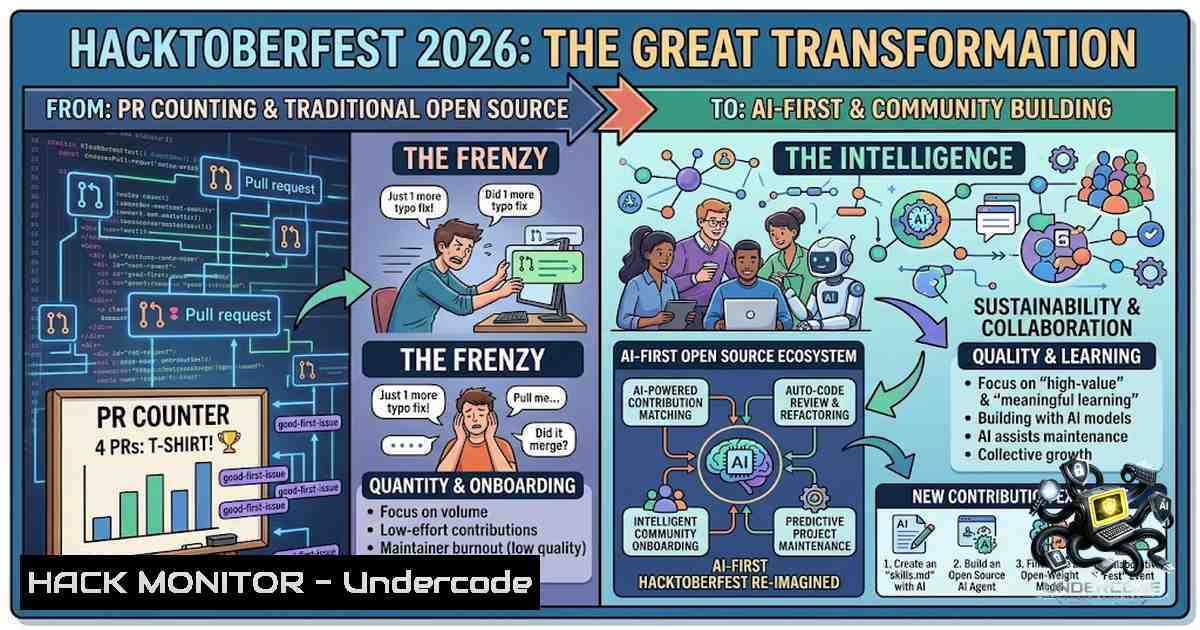
Hacktoberfest 2026 marks a paradigm shift in how the world engages with open source. For the first time in its history, the global celebration is moving away from counting pull requests (PRs) and toward hands-on learning with open-source and open-weight AI. With over 300 in-person “Fests” worldwide and a parallel online event, this year’s initiative—led by Major League Hacking (MLH) and DEV in partnership with DigitalOcean—aims to equip developers with the tools and knowledge to experiment, build, and innovate with transparent AI systems. The shift addresses a growing crisis: AI-generated low-effort PRs have flooded maintainers with unprecedented noise, threatening the sustainability of open source itself. By prioritizing meaningful learning over mechanical contributions, Hacktoberfest 2026 redefines participation as a journey of discovery rather than a numbers game.
Learning Objectives & Secrets:
- Objective 1: Master Open-Weight Model Fundamentals – Gain hands-on experience with open-weight AI models, understanding their architecture, licensing, and deployment trade-offs compared to proprietary alternatives. Secret tip: Start with models like Llama, Mistral, or Gemma—focus on inference pipelines before attempting fine-tuning.
- Objective 2: Build Your First Open-Source Agent – Develop a functional AI agent using open-source frameworks (e.g., LangChain, AutoGPT) and contribute it to a community repository. Secret tip: Design your agent with modular tool-calling and memory—maintainers prioritize reusability over novelty.
- Objective 3: Fine-Tune an Open-Weight Model on Community Data – Learn parameter-efficient fine-tuning (PEFT) techniques like LoRA or QLoRA to adapt a model to a specific domain or task. Secret tip: Use a small, high-quality dataset (500–1,000 examples) and validate with a clear evaluation metric—over-tuning on large datasets wastes compute and degrades generalization.
You Should Know:
- Why Hacktoberfest Dropped PR Counting—And What Replaced It
Hacktoberfest began as a simple challenge: open four pull requests in October and earn a t-shirt. That model introduced thousands of developers to open source. But as the ecosystem matured, maintainers faced burnout from low-effort contributions—typo fixes, documentation tweaks, and automated spam. With AI tools now capable of generating plausible PRs at scale, the signal-to-1oise ratio became untenable.
This year, instead of counting PRs, participants write their first `skills.md` file, build an open-source agent, fine-tune a model, or pursue any project that sparks curiosity. The emphasis is on high-value, meaningful learning—not metrics. The new format reframes open source as a philosophy of transparency and collective ownership, not a transaction.
Step‑by‑Step: How to Transition from PR-Driven to Project-Driven Participation
1. Identify your AI interest – Choose between model fine-tuning, agent development, or prompt engineering.
2. Set up your environment – Install Python 3.10+, Git, and a package manager (pip/conda). Clone a starter repository from the Hacktoberfest GitHub organization.
3. Write your `skills.md` – Document your current AI/ML knowledge, tools you use, and what you aim to learn. This replaces the PR as your “contribution” record.
4. Select an open-weight model – Visit Hugging Face or Ollama to download a model (e.g., meta-llama/Llama-3.2-3B). Run a basic inference test:
 Linux/macOS
pip install transformers torch
python -c "from transformers import pipeline; print(pipeline('text-generation', model='meta-llama/Llama-3.2-3B')('Hello, world'))"
Windows users: Use WSL2 or install PyTorch with CUDA support via `pip install torch torchvision torchaudio –index-url https://download.pytorch.org/whl/cu118`.
5. Build or fine-tune – Follow the official Hacktoberfest tutorials or community guides to complete your project.
6. Share your work – Post your project on DEV.to or GitHub with the `Hacktoberfest2026` tag and submit your `skills.md` to the official repository.
- Hosting a Fest: Infrastructure, Logistics, and Tech Stack
A “Fest” is an official, in-person Hacktoberfest event lasting up to 12 hours, designed to bring local developer communities together. Anyone—from university clubs to corporate teams—can host a Fest and receive stickers, swag, and funding to cover event costs. Organizers apply via the MLH host portal and follow a comprehensive organizer guide.
From a technical standpoint, hosting a successful Fest requires:
– Reliable Wi-Fi – Expect 20–100 attendees; provision for 5–10 Mbps per user.
– Local model caching – Set up an Ollama or vLLM server on a local machine to avoid bandwidth bottlenecks during model downloads.
– Pre-configured environments – Provide USB drives or a local network share with Docker images containing pre-downloaded models and dependencies.
– Backup power – Ensure battery packs and extension cords are available for laptop users.
Step‑by‑Step: Fest Hosting Technical Checklist
- Apply early – Visit https://organize.mlh.com/host/hacktoberfest-2026 to submit your application.
- Review the organizer guide – Access https://mlh.gitbook.io/mlh-hacktoberfest-organizer-guide for detailed logistics.
- Choose a venue – Secure a space with capacity for your expected attendance, projectors, and breakout rooms.
- Prepare local AI resources – On a dedicated server, run:
Install Ollama (Linux/macOS)
curl -fsSL https://ollama.ai/install.sh | sh
Pull a popular open-weight model
ollama pull llama3.2:3b
Start the server
ollama serve
Windows: Use Docker Desktop with the Ollama container or install via WSL2.
- Create a shared drive – Upload starter notebooks, datasets, and model configs to a local network share or a private S3 bucket with presigned URLs.
- Test the setup – Run a mock session with 5–10 people to identify bottlenecks.
- Promote your Fest – Use the official Hacktoberfest branding and social media templates to attract attendees.
3. Open-Source AI Security: Hardening Models and Agents
Deploying open-weight models and agents introduces unique security challenges. Model weights can be poisoned during fine-tuning; agents with tool-calling capabilities can execute arbitrary commands if not sandboxed. Hacktoberfest 2026 encourages participants to build securely from the start.
Key vulnerabilities to address:
- Prompt injection – Malicious inputs that override system instructions.
- Model theft – Unauthorized access to fine-tuned weights.
- Data leakage – Training on sensitive or PII-containing datasets.
- Supply chain attacks – Compromised dependencies in your agent’s stack.
Step‑by‑Step: Securing Your Open-Source AI Project
- Sanitize inputs – Implement input validation and filtering. Use a library like `guardrails-ai` to enforce output constraints.
- Sandbox agent execution – Run agents in isolated containers (Docker with `–read-only` and
--cap-drop=ALL). Example:docker run --rm --read-only --cap-drop=ALL -v /tmp/workspace:/workspace my-agent:latest
- Encrypt model weights at rest – Use `gpg` or AWS KMS to encrypt fine-tuned models before storing them.
gpg --symmetric --cipher-algo AES256 model.safetensors
- Audit dependencies – Run `pip-audit` or `safety check` on your
requirements.txt:pip install pip-audit pip-audit -r requirements.txt
- Implement rate limiting – For agent APIs, use Redis or a simple token bucket to prevent abuse.
- Log all interactions – Store prompts, responses, and tool calls in a secure, append-only log for post-hoc analysis.
4. Cloud Infrastructure for Open-Weight AI: Cost-Effective Deployment
Running open-weight models in the cloud can be expensive if not optimized. Hacktoberfest participants can leverage spot instances, serverless GPUs, and model quantization to reduce costs.
Recommended cloud strategies:
- Use spot/preemptible instances – AWS Spot, GCP Preemptible, or Azure Spot VMs offer 60–90% discounts.
- Quantize models – Convert FP16 weights to INT8 or INT4 using `bitsandbytes` or `llama.cpp` to reduce VRAM requirements.
- Leverage model parallelism – Distribute large models across multiple GPUs with DeepSpeed or FSDP.
- Cache frequently used models – Use a local or regional cache (e.g., Hugging Face Hub cache with `HF_HOME` environment variable) to avoid repeated downloads.
Step‑by‑Step: Deploying an Open-Weight Model on AWS Spot
- Launch a spot instance – Use the AWS CLI:
aws ec2 request-spot-instances --instance-count 1 --type one-time --launch-specification file://spec.json
Where `spec.json` defines an `g4dn.xlarge` (NVIDIA T4) instance with a Deep Learning AMI.
- SSH into the instance – `ssh -i your-key.pem ubuntu@
`
3. Install dependencies:
sudo apt update && sudo apt install python3-pip nvidia-driver-470
pip install transformers accelerate bitsandbytes
4. Load a quantized model:
from transformers import AutoModelForCausalLM, AutoTokenizer
model = AutoModelForCausalLM.from_pretrained("meta-llama/Llama-3.2-3B", load_in_4bit=True)
tokenizer = AutoTokenizer.from_pretrained("meta-llama/Llama-3.2-3B")
5. Set up auto-shutdown – Use a cron job to terminate the instance after 6 hours to avoid runaway costs:
echo "0 /6 /usr/local/bin/aws ec2 terminate-instances --instance-ids $(curl -s http://169.254.169.254/latest/meta-data/instance-id)" | crontab -
- Building Open-Source Agents: Frameworks, Tools, and Best Practices
Open-source agents are a core focus of Hacktoberfest 2026. These systems use LLMs to plan, reason, and execute actions via tools (APIs, databases, code interpreters). Popular frameworks include LangChain, AutoGPT, and DSPy.
Agent architecture essentials:
- Planner – The LLM that decides which tools to call and in what order.
- Tool registry – A set of callable functions with descriptions.
- Memory – Short-term (conversation history) and long-term (vector database) storage.
- Executor – The component that runs tool calls and returns results to the planner.
Step‑by‑Step: Creating a Simple Open-Source Agent with LangChain
1. Install LangChain:
pip install langchain langchain-community langchain-ollama
2. Set up Ollama (as in Section 2) and pull a model.
3. Define tools:
from langchain.tools import tool
@tool
def multiply(a: float, b: float) -> float:
"""Multiply two numbers."""
return a  b
4. Create the agent:
from langchain.agents import create_react_agent, AgentExecutor
from langchain_ollama import ChatOllama
llm = ChatOllama(model="llama3.2:3b")
agent = create_react_agent(llm, [bash], prompt)
executor = AgentExecutor(agent=agent, tools=[bash], verbose=True)
5. Run the agent:
result = executor.invoke({"input": "What is 15 times 23?"})
print(result)
6. Containerize your agent – Write a `Dockerfile` that installs dependencies and runs a FastAPI server exposing the agent via REST endpoints.
7. Submit your agent – Push the code to a public GitHub repository and share it with the Hacktoberfest community.
What Undercode Say:
- Key Takeaway 1 – Hacktoberfest 2026 is not a rejection of open source contribution but a maturation of it. By shifting from PR counts to project-based learning, the event addresses the sustainability crisis caused by AI-generated noise while simultaneously embracing AI as a tool for builders, not spammers.
- Key Takeaway 2 – The move to open-weight AI is a strategic bet on transparency. In an era where proprietary models dominate, Hacktoberfest 2026 democratizes access to cutting-edge AI by providing the infrastructure, community, and educational resources needed for anyone to experiment with and contribute to open artificial intelligence.
Analysis: This year’s format is a direct response to the inflationary pressure AI tools have placed on open source maintenance. By removing the PR incentive, Hacktoberfest eliminates the perverse incentive to generate low-quality contributions. Simultaneously, it redirects that energy toward building with AI—a field that desperately needs open alternatives to prevent vendor lock-in. The success of this model hinges on two factors: the quality of educational materials provided and the willingness of maintainers to engage with project-based contributions rather than code-only patches. If executed well, Hacktoberfest 2026 could become a blueprint for other open-source programs grappling with AI disruption. The involvement of MLH—with its extensive hackathon organizing experience—adds credibility and operational muscle. However, the shift also risks alienating developers who valued the simplicity of the PR challenge. Clear communication and low-friction onboarding will be critical.
Prediction:
- +1 – The Fest model will increase global participation by 40–60% over 2025, as in-person events lower the barrier for newcomers who find online contribution intimidating.
- +1 – Open-weight AI adoption will accelerate as thousands of developers gain hands-on experience, leading to more community-driven model improvements and novel agent architectures.
- -1 – Maintainers may initially struggle to evaluate project-based submissions, as they lack the standardized review processes that PRs provided. This could create a new form of bottleneck.
- -1 – Without the PR metric, some corporate sponsors may find it harder to quantify ROI, potentially reducing funding for future editions unless alternative engagement metrics are developed.
- +1 – The emphasis on `skills.md` and learning portfolios will create a new credentialing pathway for developers, similar to how GitHub contributions became de facto resumes—but more substantive and verifiable.
▶️ Related Video (84% Match):
🎯Let’s Practice For Free:
🎓 Live Courses & Certifications:
Join Undercode Academy for Verified Certifications
🚀 Request a Custom Project:
Secure, high-velocity infrastructure and disruptive technological engineering. Contact our engineering team for high-tier development and proprietary systems:
[email protected]
💎 Smart Architecture | 🛡️ Secure by Design | ⭐ Trusted by Thousands
IT/Security Reporter URL:
Reported By: https://lnkd.in/p/eEmKy67H – Hackers Feeds
Extra Hub: Undercode MoN
Basic Verification: Pass ✅


