
Listen to this Post
Introduction:
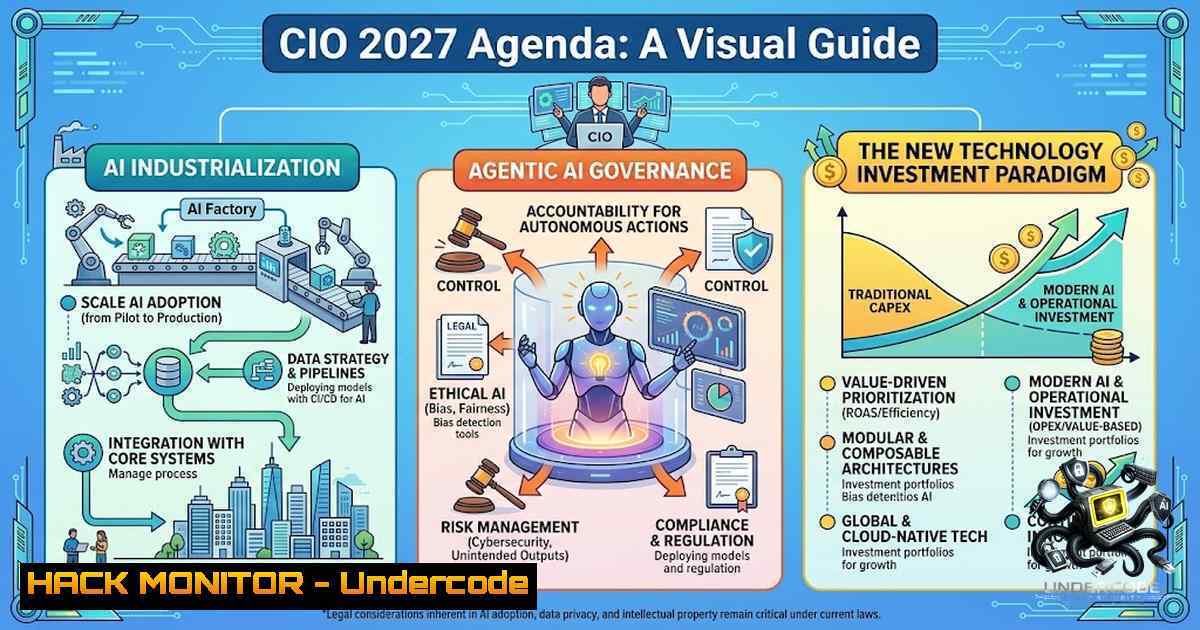
The Gartner 2027 CIO and Technology Executive Survey provides a comprehensive view of CIO priorities and the evolving technology landscape, drawing on insights from technology leaders worldwide. As organizations navigate an increasingly complex operating environment shaped by geopolitical change and rapid AI advancement, the conversation has shifted decisively from experimentation to what Gartner calls “industrialisation of AI”. The mandates for 2026–2027 are clear: tame agent sprawl, mitigate shadow AI risk, and build a robust, platform-agnostic control plane.
Learning Objectives & Secrets:
- Objective 1: Master AI Investment Benchmarking – Understand how peers are investing in and prioritizing AI, with 87% of CIOs planning to increase AI and generative AI budgets. Learn to benchmark your organization’s technology spending against global averages and sector-specific trends.
-
Objective 2 Secret Tips: Industrialize AI with FinOps Integration – 63% of CIOs expect increased financial scrutiny on AI ROI by 2027. Secret: Implement FinOps, unified governance, and real-time cost monitoring to transform AI cost management from short-term expense compression into long-term value optimization. This dynamic balance between cost and innovation is what separates successful AI programs from failed experiments.
-
Objective 3 Secret Tips: Build an Agentic AI Control Plane – With more than 40% of agentic AI projects expected to be canceled by the end of 2027 on cost, the secret is establishing a platform-agnostic control plane before deployment. This means creating centralized policies for agent permissions, data access, cost thresholds, and performance monitoring that work across multiple AI vendors and open-source models.
You Should Know:
1. AI Investment Strategy: From Experimentation to Industrialization
The era of AI proof-of-concepts is ending. Gartner’s data reveals that 90% of organizations will have deployed AI by 2027, yet only 12% are fully AI-ready with the necessary data quality and scalable architectures. This gap represents both risk and opportunity.
To industrialize AI, CIOs must move beyond siloed deployments. The 2027 benchmark shows that cloud spending will exceed $1 trillion, with 90% adopting hybrid cloud strategies. AI integration in cloud strategies is projected to reach 90% by 2030, up from less than 10% today. This means every cloud investment must now include an AI readiness assessment.
Linux Command – AI Infrastructure Monitoring:
 Monitor GPU utilization across AI training clusters
watch -1 1 nvidia-smi

Check containerized AI workload resource consumption
docker stats --1o-stream --format "table {{.Name}}\t{{.CPUPerc}}\t{{.MemUsage}}"

Audit cloud AI service costs (AWS example)
aws ce get-cost-and-usage --time-period Start=2026-08-01,End=2026-08-24 --granularity DAILY --filter '{"Dimensions":{"Key":"SERVICE","Values":["SageMaker","Bedrock"]}}'
Windows Command – AI Resource Auditing:
 Monitor GPU usage on Windows AI workstations
nvidia-smi

Check AI model server performance
Get-Counter "\Process(python)\% Processor Time"

Audit Azure AI service costs
az consumption usage list --billing-period-1ame 202608 --query "[?contains(instanceName, 'openai')]"
2. Sourcing Strategies Amid Geopolitical Change
Geopolitical fragmentation is reshaping technology sourcing. Sovereign cloud is projected to reach $80 billion with 35.6% growth. CIOs must now evaluate vendor risk through multiple lenses: supply chain resilience, data sovereignty compliance, and export control exposure.
Step-by-Step Vendor Risk Assessment:
- Map all AI/cloud vendors against geopolitical risk categories (US, EU, China, others)
- Conduct data residency audits for each vendor’s processing locations
3. Implement multi-vendor redundancy for critical AI services
- Establish exit strategies with data portability requirements in contracts
5. Review sovereign cloud options for regulated industries
Tool Configuration – Vendor Risk Scoring (Open Source):
 Using OWASP Dependency-Check for supply chain vulnerability scanning
dependency-check --scan ./vendor-dependencies/ --format HTML --out report.html

Check for known vulnerabilities in container images used by vendors
trivy image --severity HIGH,CRITICAL vendor-registry/ai-model:latest

Audit API gateway for vendor traffic patterns
kubectl top pods -1 api-gateway | grep vendor
3. Agentic AI Governance: Taming the Sprawl
Agentic AI—autonomous AI agents that execute tasks without human intervention—is the next frontier. Gartner found only 17% of organizations have deployed AI agents, but adoption is accelerating rapidly. Without governance, agent sprawl creates security, cost, and compliance nightmares.
Step-by-Step Agentic AI Control Plane Implementation:
- Discovery: Inventory all AI agents in production, development, and shadow IT
- Permission Modeling: Define role-based access controls for each agent type
- Cost Throttling: Set spending limits per agent per hour/day
- Monitoring: Deploy observability for agent decisions and actions
- Audit Logging: Maintain immutable logs of all agent activities
- Kill Switch: Implement emergency stop capability for rogue agents
API Security Configuration – Agent Authentication:
 Generate API keys with limited scope for AI agents
openssl rand -base64 32 | tr -d '\n' > agent_key.txt

Configure rate limiting for agent APIs (NGINX example)
limit_req_zone $binary_remote_addr zone=agentapi:10m rate=10r/s;

Implement JWT validation for agent-to-agent communication
 Python snippet for JWT verification
import jwt
try:
decoded = jwt.decode(token, public_key, algorithms=['RS256'])
except jwt.InvalidTokenError:
 Reject agent request
pass
Windows PowerShell – Agent Activity Monitoring:
 Monitor agent process activity
Get-Process | Where-Object {$_.ProcessName -match "agent|ai|model"} | Select-Object Name, CPU, WorkingSet

Audit Windows event logs for agent-related security events
Get-WinEvent -LogName Security | Where-Object {$_.Message -match "agent"} | Select-Object TimeCreated, Message
4. AI Talent Retention and Workforce Transformation
Gartner’s research reveals a critical warning: half of enterprises that lack a comprehensive AI people strategy will lose their top AI talent to competitors by 2027. Additionally, 49% of data and analytics leaders have established business outcome-driven metrics, but 75% risk losing their C-level position by 2027 if they cannot become strategic partners in the AI journey.
AI Talent Retention Strategy:
| Strategy | Implementation | Success Metric |
|-||-|
| AI Skills Mapping | Inventory current vs. needed AI capabilities | 90% role coverage |
| Continuous Learning | Weekly AI training hours | 4+ hours/employee/week |
| Career Pathways | Define AI specialist vs. AI-enabled tracks | 80% retention |
| Ethical AI Training | Mandatory bias/security modules | 100% completion |
Linux Command – AI Training Environment Setup:
 Set up isolated Python environment for AI training
python3 -m venv ai_training_env
source ai_training_env/bin/activate
pip install torch transformers accelerate

Version-lock dependencies to prevent supply chain attacks
pip freeze > requirements.lock
5. Cloud Hardening for AI Workloads
With 90% of organizations adopting hybrid cloud by 2027, securing AI workloads across multi-cloud environments is paramount. Gartner advises investing in advanced protections, including quantum-enhanced security technologies.
Cloud Hardening Checklist for AI Deployments:
- [ ] Encrypt all AI model weights at rest and in transit
- [ ] Implement confidential computing for sensitive training data
- [ ] Deploy Web Application Firewalls (WAF) for AI API endpoints
- [ ] Enable DDoS protection for exposed inference services
- [ ] Conduct regular penetration testing on AI pipelines
- [ ] Implement zero-trust architecture for all AI service access
Terraform Configuration – Secure AI Infrastructure:
 AWS VPC with private subnets for AI training
resource "aws_vpc" "ai_vpc" {
cidr_block = "10.0.0.0/16"
enable_dns_hostnames = true
}

resource "aws_security_group" "ai_training" {
name = "ai-training-sg"
ingress {
from_port = 22
to_port = 22
protocol = "tcp"
cidr_blocks = ["10.0.0.0/8"]  Only internal access
}
egress {
from_port = 0
to_port = 0
protocol = "-1"
cidr_blocks = ["0.0.0.0/0"]
}
}
What Undercode Say:
- Key Takeaway 1: The 2027 CIO agenda is defined by the industrialization of AI—moving from isolated experiments to enterprise-wide, governed, and cost-optimized AI deployments. The organizations that succeed will treat AI not as a technology project but as a business transformation initiative with clear ROI metrics and robust governance.
-
Key Takeaway 2: Agentic AI governance and talent retention are the two biggest hidden risks. With 40%+ of agentic AI projects facing cancellation and half of companies losing top AI talent, CIOs must prioritize building control planes and people strategies simultaneously. Technology without talent is infrastructure without purpose.
Analysis: The Gartner 2027 CIO Survey signals a maturation of the AI market. The initial hype cycle is giving way to pragmatic implementation focused on measurable business outcomes. CIOs who excel will be those who balance three competing forces: accelerating AI adoption, maintaining security and governance, and managing costs under increasing financial scrutiny. The shift from “can we build it?” to “can we operate it sustainably?” represents a fundamental change in how technology leaders approach innovation. Furthermore, the integration of sustainability metrics into CIO compensation—with 25% of pay tied to sustainable technology impact by 2027—adds another dimension to decision-making. This is no longer just about technical capability; it’s about responsible, cost-effective, and secure technology leadership in an era of unprecedented complexity. The 2027 benchmark data provides the roadmap; execution is where winners will be distinguished from laggards.
Prediction:
- +1 AI industrialization will drive a new wave of consolidation, with 60%+ of enterprises standardizing on 2-3 AI platforms by 2028, reducing fragmentation and improving security postures.
-
+1 The agentic AI control plane market will emerge as a $10B+ category by 2028, with major cloud providers and specialized vendors competing for enterprise governance workloads.
-
-1 Organizations that fail to implement AI cost governance will experience budget overruns of 200-300% on AI initiatives, leading to forced project cancellations and executive turnover.
-
+1 The convergence of AI and cloud security will create new roles—AI Security Architects—with average salaries exceeding $300K by 2027, reflecting the criticality of securing AI pipelines.
-
-1 Geopolitical fragmentation will increase technology sourcing costs by 15-25% for multinational enterprises as they navigate conflicting regulatory regimes and trade restrictions.
-
+1 Small, task-specific AI models will be used three times more than general-purpose LLMs by 2027 as organizations minimize compute costs and reduce operational overhead.
-
-1 The AI talent war will intensify, with enterprises in non-tech sectors facing 40% higher attrition rates for AI specialists compared to tech-1ative companies, widening the digital divide across industries.
▶️ Related Video (80% Match):
https://www.youtube.com/watch?v=0ZzYst_FT9o
🎯Let’s Practice For Free:
🎓 Live Courses & Certifications:
Join Undercode Academy for Verified Certifications
🚀 Request a Custom Project:
Secure, high-velocity infrastructure and disruptive technological engineering. Contact our engineering team for high-tier development and proprietary systems:
[email protected]
💎 Smart Architecture | 🛡️ Secure by Design | ⭐ Trusted by Thousands
IT/Security Reporter URL:
Reported By: https://lnkd.in/p/epF9_YUH – Hackers Feeds
Extra Hub: Undercode MoN
Basic Verification: Pass ✅


