
Listen to this Post
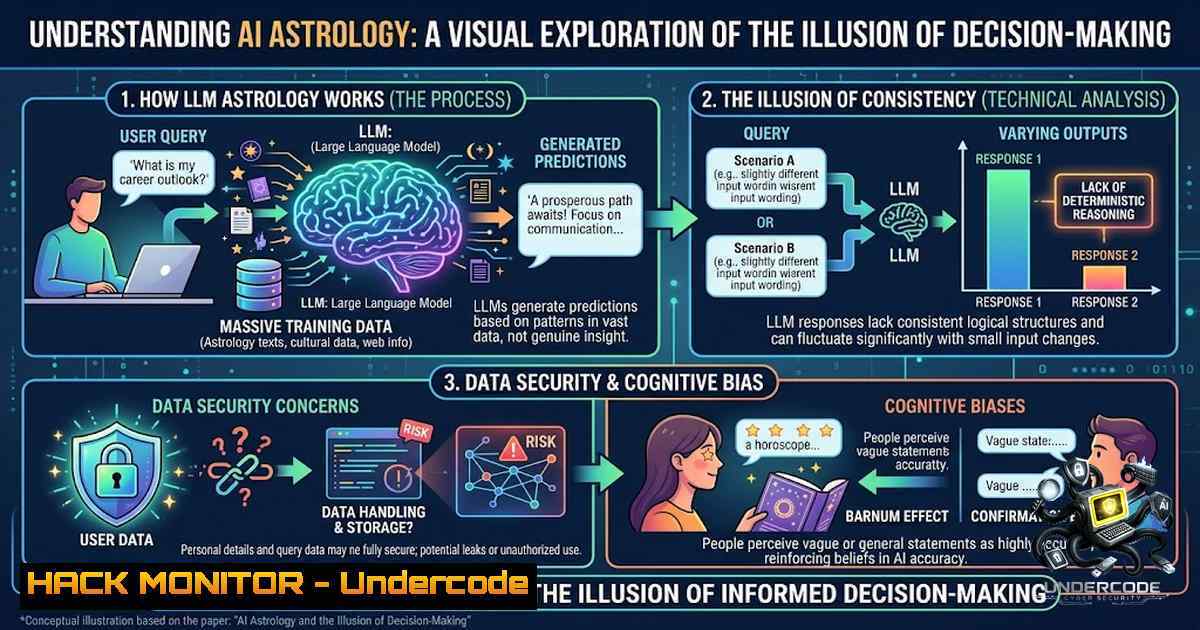
Introduction:
The integration of Large Language Models (LLMs) into domains traditionally reserved for human intuition, such as astrology and career counseling, presents a unique intersection of artificial intelligence and cognitive psychology. While these models can rapidly generate structured outputs based on birth data, they lack the inherent capability for causal verification or conclusion preservation across different phrasings. This article explores the technical vulnerabilities exposed by using AI for decision-making, focusing on prompt sensitivity, data privacy implications, and the architecture required for trustworthy AI deployment, while providing actionable cybersecurity and IT hardening steps for professionals deploying similar systems.
Learning Objectives & Secrets:
- Objective 1: Understanding Prompt Sensitivity – Learn how minor linguistic variations in user input can lead to diametrically opposed outputs from the same AI model, highlighting the lack of factual grounding.
- Objective 2: Securing Personal Data (Secret Tip) – Implement end-to-end encryption and strict data minimization policies for Personally Identifiable Information (PII) like birth data to prevent data leakage in cloud environments.
- Objective 3: Building Trust Boundaries (Secret Tip) – Establish a separation between deterministic calculations (e.g., astronomical positions) and generative outputs by versioning retrieval-augmented generation (RAG) pipelines to ensure auditability.
You Should Know:
1. The Technical Anatomy of Prompt Sensitivity
The core issue observed in the post is the model’s failure to preserve logical conclusions across paraphrased prompts. In technical terms, this is a manifestation of the model’s stochastic nature and its training objective, which maximizes likelihood of next-token prediction rather than logical consistency.
- What this does: It reveals that the model does not create a stable internal “world state” but rather generates a path through a high-dimensional probability space. Changing two words alters the attention weights, leading to a different probability distribution and thus a different output.
- How to test it (Linux/Windows): You can replicate this behavior using Python and the OpenAI API or a local LLM like Llama 2.
import openai

def ask_question(prompt):
response = openai.ChatCompletion.create(
model="gpt-4",
messages=[{"role": "user", "content": prompt}],
temperature=0.7  Even with lower temps, variation exists
)
return response.choices[bash].message.content

Test the inconsistency
print(ask_question("Should I accept this job? (Focus on growth)"))
print(ask_question("Would it be safer to stay? (Focus on stability)"))
– Security Implication: This inconsistency is a security risk in systems relying on AI for “guardrails” (e.g., content moderation). Adversarial prompting can bypass safety filters simply by rephrasing, as the model lacks hard-coded rule verification.
- Data Privacy and Cloud Hardening for Sensitive Queries
The post highlights the necessity of protecting “birth data and intimate conversations.” In a cloud-1ative architecture (GCP, AWS, Azure), this data must be treated as regulated PII.
- What this does: Implements encryption in transit and at rest, and utilizes Virtual Private Cloud (VPC) Service Controls to prevent data exfiltration.
- Step‑by‑step guide (GCP Focus):
- Enable VPC Service Controls: Create a perimeter around your Vertex AI or Cloud Run services to restrict data movement.
- Implement Data Loss Prevention (DLP): Use Cloud DLP to inspect API requests for sensitive patterns (date of birth) before they reach the LLM.
- Audit Logging: Ensure all API requests are logged to Cloud Audit Logs for security monitoring.
Enable required APIs
gcloud services enable cloudapis.googleapis.com dlp.googleapis.com
Create a DLP inspection template
gcloud dlp inspect-templates create --display-1ame=birth-data-inspector --info-types=DATE_OF_BIRTH
3. API Security and Tokenization Strategy
To bridge the gap between deterministic calculations and generative AI, architects must use tokenization to anonymize user data before passing it to the LLM.
- What this does: Replaces sensitive birth data with a temporary token. The deterministic algorithm (e.g., chart calculation) runs on the raw data, but the LLM only receives the calculated results (which are less sensitive) and the user query.
- Step‑by‑step guide (Linux):
- Generate Token: `openssl rand -hex 32` to generate a secure token.
- Proxy Layer: Build a Python middleware that intercepts the request, strips PII, and passes only the astrological “attributes” (e.g., Sun Sign) to the LLM. This mitigates the risk of the LLM memorizing sensitive information.
Pseudo-code for middleware
token = generate_token()
raw_data = request.json
calculation = calculate_chart(raw_data['birth_date'])
safe_prompt = f"Given these traits: {calculation}, answer: {raw_data['question']}"
Send safe_prompt to LLM
4. Vulnerability Exploitation: Prompt Injection via “Shifting Perspectives”
The observed behavior of shifting advice based on wording is a critical vulnerability for decision-support systems. An attacker can manipulate the “perspective” context to force the model to generate unethical or dangerous advice without overcoming system prompts.
- Mitigation Strategy: Implement a “Fact-Checking” layer separate from the generative layer. This is a deterministic verification module that flags outputs containing unsubstantiated causal claims.
- Command-Line Check (Windows/Linux): Use `curl` to test the model’s consistency by automating the two questions and calculating a “Divergence Score.”
Using curl to query an API endpoint curl -X POST https://your-llm-endpoint.com/v1/chat \ -H "Content-Type: application/json" \ -d '{"prompt":"Should I accept this job?"}' curl -X POST https://your-llm-endpoint.com/v1/chat \ -H "Content-Type: application/json" \ -d '{"prompt":"Would it be safer to stay?"}' - If the advice conflicts, the system should automatically generate a warning label: “Output is highly sensitive to prompt phrasing.”
- Building a Trustworthy AI Framework (The Four-Layer Architecture)
To comply with the author’s demand for a trustworthy design, we must separate the components: -
Deterministic Calculation: Running immutable code (no ML) for astronomical calculations (e.g., Python’s `ephem` or `skyfield` library).
- Versioned Retrieval: Connecting the system to a vector database (e.g., Pinecone or Milvus) that only contains tradition-specific texts, allowing the model to cite sources.
- Constrained Explanation: Using a “Chain of Thought” (CoT) filter that forces the model to explain how it reached a conclusion, but does not allow it to offer final “life decisions.”
- Claim Verification: Integrating a web-search API to verify facts (e.g., “If the model claims Jupiter is in the 10th house, verify the astronomical ephemeris independently”).
Step‑by‑step guide (Python):
from skyfield.api import load

def calculate_planet_position(jd):
eph = load('de421.bsp')
earth = eph['earth']
planet = eph['jupiter']
astrometric = earth.at(jd).observe(planet)
 This is deterministic and versioned
return astrometric.radec()

This result is then sent to the LLM as a factual string, not an interpretation.
6. The Cognitive Closure Attack (UX Security)
The article notes that “coherent language provides temporary cognitive closure.” In cybersecurity, this is a “Deepfake for the Mind.” The system appears correct, reducing user skepticism.
- Hardening the User Experience: Introduce a “Confidence Interval” meter. Since LLMs are probabilistic, the interface should display a “Perspective Shift Stability” score. If two prompts yield different answers, the UI should flag it as “Low Confidence.”
- Tutorial: Implement a simple API check that evaluates the response similarity (e.g., using `cosine_similarity` on embeddings) for opposite prompts. If similarity > 0.9, output is stable. If < 0.6, output is unstable.
What Undercode Say:
- Key Takeaway 1: The AI is a reflection of our language, not a reflection of reality. The technical inconsistency is a feature of the transformer architecture (temperature + stochastic sampling), not a bug, and must be treated as an uncontrolled variable in critical decision-making.
- Key Takeaway 2: Data security is paramount. The “feeling of personalisation” is achieved through processing intimate data. Without a DLP strategy and VPC controls, this data is vulnerable to training data extraction attacks, where adversaries can reconstruct training data via prompts.
Analysis:
The underlying issue is the misalignment between the functional capability of an LLM (text generation) and the user’s expectation (objective advice). From a systems engineering perspective, the current “Ask AI” paradigm is unsafe for high-stakes queries because it lacks a self-consistency validation module. The research benchmark (36.7%) mentioned in the post suggests that even advanced models struggle with multi-turn symbolic reasoning. The solution lies not in “fixing” the AI, but in building a middleware layer that enforces deterministic verification before the AI’s output is rendered to the user. This is akin to adding a firewall to a network—it filters out the “bad packets” (unverified claims) before they reach the endpoint.
Prediction:
- +1 There will be a rise in “AI Validation Middleware” startups that offer API security checks specifically designed to detect prompt-induced drift, increasing the reliability of enterprise AI.
- +1 Regulators (like the EU AI Act) will mandate “Consistency Reporting” for consumer-facing AI, requiring developers to publish divergence metrics for common queries.
- -1 We will see an increase in “AI Hallucination Heists,” where threat actors exploit prompt sensitivity to manipulate AI financial advisors into generating favorable (but incorrect) market predictions to sway retail investors.
- -1 Unless encryption is prioritized, a major breach of a “spiritual AI” platform will expose millions of users’ intimate psychological data, leading to a crisis of trust in cloud-based AI services.
- +1 The integration of deterministic calculations (ephemeris) with RAG will become the gold standard, leading to a hybrid architecture where “facts” are sourced from code and “interpretations” are sourced from text, allowing for clear liability separation.
▶️ Related Video (72% Match):
🎯Let’s Practice For Free:
🎓 Live Courses & Certifications:
Join Undercode Academy for Verified Certifications
🚀 Request a Custom Project:
Secure, high-velocity infrastructure and disruptive technological engineering. Contact our engineering team for high-tier development and proprietary systems:
[email protected]
💎 Smart Architecture | 🛡️ Secure by Design | ⭐ Trusted by Thousands
IT/Security Reporter URL:
Reported By: https://lnkd.in/p/e9uY4VrD – Hackers Feeds
Extra Hub: Undercode MoN
Basic Verification: Pass ✅


