
Listen to this Post
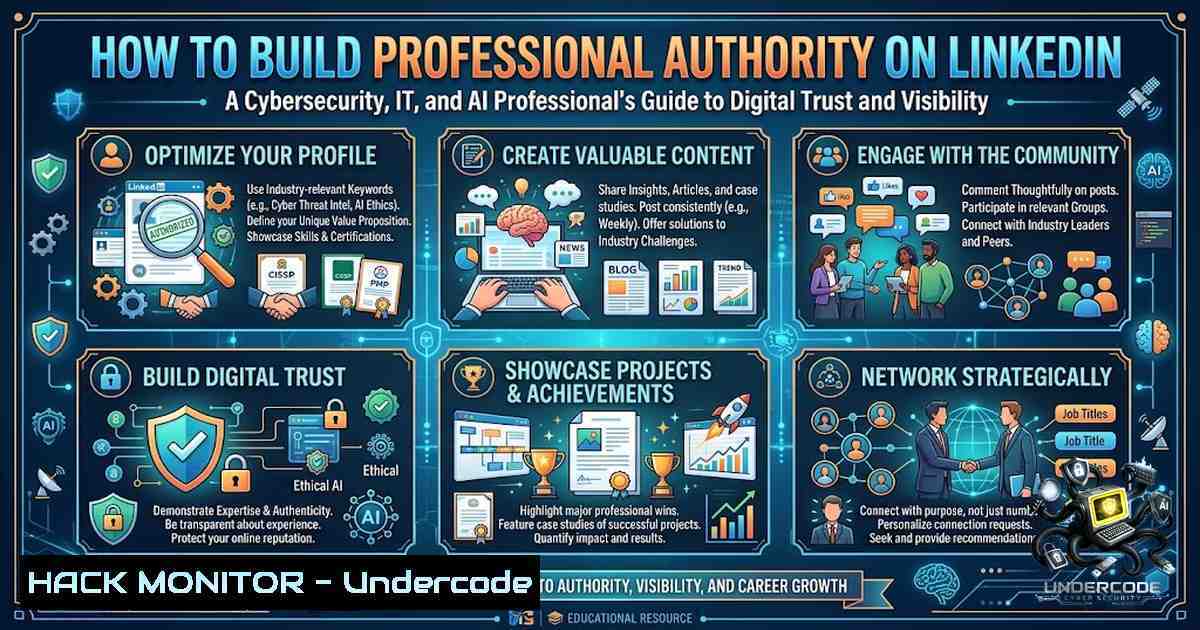
Introduction:
In the rapidly evolving domains of cybersecurity, IT infrastructure, and Artificial Intelligence, professional credibility is the most valuable currency. However, merely having a polished profile and a list of certifications does not automatically translate to trust or visibility within the industry. This guide deconstructs the unwritten rules of professional networking and technical authority, bridging the gap between passive online presence and active, value-driven engagement that attracts opportunities, talent, and partnerships in the tech sector.
Learning Objectives & Secrets:
- Objective 1 (The Etalase Upgrade): Learn how to transform your LinkedIn profile from a static résumé into a dynamic “technical storefront” that showcases your specific problem-solving capabilities, using advanced media and featured content.
- Objective 2 Secret Tips (The Value-First Principle): Discover how to provide technical value before asking for anything. This involves sharing actionable vulnerability insights, configuration scripts, or incident response lessons that demonstrate your expertise.
- Objective 3 Secret Tips (Strategic Engagement): Master the art of “thoughtful commenting” to initiate high-level technical discussions, moving beyond generic praise to analyze code, architecture decisions, or threat models.
You Should Know:
1. Hardening Your Professional Profile (The Technical Storefront)
Your profile is the first security assessment a potential employer or client conducts. It must be fortified with clear evidence of your capabilities.
Step‑by‑step guide:
- Optimize Your Headline: Instead of “Cybersecurity Analyst,” use “Helping CISOs reduce breach risk by 40% via Zero-Trust Architecture & Cloud Hardening.”
- Use the “Featured” Section: Showcase your technical portfolios. If you are a developer or cloud engineer, embed links to your GitHub repositories showcasing scripts like the one below.
- Activate Creator Mode: This shifts your focus to content distribution, allowing you to connect with a broader audience interested in your technical insights.
Tutorial / Commands:
To demonstrate practical skills relevant to your profile’s “About” section, you might share a script. Here is a basic Bash script for checking sudo privileges and system logs—a simple way to show you understand Linux security fundamentals.
!/bin/bash
 Security Check Script - Demonstrates basic system auditing skills
 Usage: ./audit_system.sh

echo "=== System Audit: $(date) ==="

Check sudo permissions
echo "Checking Sudo Privileges..."
sudo -v &> /dev/null
if [ $? -eq 0 ]; then
echo "User has sudo access."
else
echo "User does not have sudo access."
fi

Display last 10 failed login attempts
echo "Last 10 Failed Login Attempts:"
grep "Failed password" /var/log/auth.log | tail -1 10

Check for active listening ports
echo "Active Listening Ports:"
sudo netstat -tulpn | grep LISTEN
- Building Trust via Value-First Content (The Zero-Trust Principle)
Don’t just advertise your services; provide proof. This mirrors the Zero-Trust principle: “Never trust, always verify.”
Step‑by‑step guide:
- Share Insights: Write posts dissecting recent CVEs, offering mitigation strategies.
- The “Secret Tip”: Before asking for a connection or a meeting, comment on a prospect’s post with a specific technical question or a resource (e.g., “Great point on cloud misconfigurations. Here is a Terraform module I used to remediate S3 bucket public access”).
- Use Case Studies: Anonymize a past project and walk through your methodology. For example, explaining a penetration testing engagement.
Code Snippet:
Share a Python snippet that automates checking for cloud vulnerabilities (AWS S3 Bucket Permission Check).
import boto3
import json
from botocore.exceptions import ClientError

Example of automating cloud security checks (value-driven content)
 Demonstrates practical skills in AWS security (IAM & S3)

def check_s3_bucket_acl(bucket_name):
s3 = boto3.client('s3')
try:
response = s3.get_bucket_acl(Bucket=bucket_name)
grants = response['Grants']
for grant in grants:
if 'URI' in grant['Grantee'] and 'AllUsers' in grant['Grantee']['URI']:
print(f"[-] WARNING: {bucket_name} is publicly accessible.")
return False
print(f"[+] SUCCESS: {bucket_name} is private.")
return True
except ClientError as e:
print(f"Error: {e}")
return False

Replace with a relevant bucket name
 check_s3_bucket_acl('my-private-bucket')
- The Power of Thoughtful Comments (Network Packet Analysis)
Commenting is to networking what packet analysis is to network troubleshooting. It reveals the intent and quality of the connection.
Step‑by‑step guide:
- Analyze the Content: Read the post thoroughly. Don’t just skim.
- Add Value: If a post is about AI, comment on the specific model or dataset used. If it’s about security, ask about the threat actor’s TTPs (Tactics, Techniques, and Procedures).
- The “Secret Tip”: Use comments to correct misinformation respectfully. This establishes you as a subject matter expert.
Tutorial:
If someone posts about a recent ransomware attack, your comment could be: “Interesting analysis. Have you considered the potential lateral movement paths via SMB protocol if the segmentation wasn’t properly configured? I often see this in legacy environments.”
4. Consistency and AI/IT Tool Configuration
Viral content is like a DDoS attack—it’s a short burst of attention. Consistency is like building a resilient infrastructure; it ensures longevity.
Step‑by‑step guide:
- Tooling: Use AI tools to help you stay consistent.
- Content Calendar: Schedule your posts.
- Configuration: Use RSS feeds or Feedly to stay updated on cybersecurity news, then schedule a weekly “Security Roundup” post summarizing key threats.
Commands:
To show IT prowess, share a command that helps manage your digital reputation or research.
 Using curl to fetch the latest CVE trends from an API
 This demonstrates proactive security research

curl -s "https://services.nvd.nist.gov/rest/json/cves/2.0?resultsPerPage=5" | jq '.vulnerabilities[].cve.id'
5. Building Meaningful Relationships (Zeroth-Trust Networking)
Treat relationships like firewall rules—they should be explicitly allowed, not just open by default.
Step‑by‑step guide:
- Quality over Quantity: Connect with peers in your specific niche.
- The “Secret Tip”: Use a tool like Hunter.io to find the email of a CISO you admire, then send a personalized email referencing a specific piece of their content.
- Follow-up: Just like applying a patch, follow up after a connection to ensure the relationship remains “secure” and strong.
6. Demonstrating Proof, Not Promises (Exploitation & Mitigation)
Case studies are your “Proof of Concept” (PoC). They are the exploits of your success.
Step‑by‑step guide:
- Write a Case Study: Detail a vulnerability you fixed, a breach you contained, or a system you optimized.
- Structure: Problem → Analysis → Solution → Results.
- Use Data: “Reduced incident response time from 48 hours to 2 hours.”
Code Snippet:
A simple SQL query to show you understand database security principles (e.g., SQL Injection mitigation).
-- Secure Query Example (Parameterized query concept in PHP/Java)
-- Avoid: SELECT  FROM users WHERE username = '$username';
-- Use:
SELECT  FROM users WHERE username = ?; -- Parameterized
7. Leveraging LinkedIn Features (Strategic Upgrades)
- Newsletter: Start a newsletter on “AI Security & LLM Threats.”
- Creator Mode: Enables you to be found for your specific expertise.
- Live Events: Host a “Security Q&A” session.
Command:
To show your technical depth, share a Windows PowerShell command for checking Active Directory users.
 Windows Command: Check Active Directory for inactive users
 Demonstrates sysadmin/security skills

Get-ADUser -Filter  -Properties LastLogonDate | Where-Object {$_.LastLogonDate -lt (Get-Date).AddDays(-30)} | Select-Object Name, LastLogonDate
What Undercode Say:
Key Takeaway 1: Professional networking is an infrastructure project. It requires configuration (profile), maintenance (consistency), and monitoring (engagement). Just as we patch systems, we must continuously update our professional persona to reflect current capabilities and market needs.
Key Takeaway 2: Trust is the ultimate firewall. Without trust, technical skills are unseen and unrewarded. By giving value first—through scripts, insights, and helpful comments—you establish a reputation that filters out “noise” and attracts high-value opportunities. This is analogous to building a reputation where your word is the most reliable protocol in the room.
Analysis:
The core message of the post focuses on the misconception that mere activity equals opportunity. In cybersecurity and tech, this translates to the difference between being a passive observer and an active contributor. The “secrets” revolve around strategic positioning, similar to a red-team exercise: you must probe the environment (LinkedIn), identify your target audience (the right connections), and deliver a payload (your value) that resonates. It moves beyond marketing psychology into a structured approach to digital relationship management, directly correlating to how security professionals assess, exploit, and secure systems.
Prediction:
- P: Professionals who treat their online presence as a high-performance security operations center (SOC) will see a 30% increase in relevant leads and job offers in the next 18 months. They will successfully pivot from “job seekers” to “attractors.”
-
P: The demand for “thought leadership” content specifically tailored to niche technical topics (e.g., AI security, Quantum Cryptography) will skyrocket. Those who post consistently on these topics will establish themselves as the go-to experts.
-
N: In the next two years, generic, non-technical, or self-promotional content will face severe algorithmic suppression or audience fatigue, rendering profiles that rely on “likes” obsolete.
-
P: The integration of AI tools to automate content generation will evolve. The “Secret Tip” will become the ability to provide human oversight and technical verification of AI-generated content, solidifying the expert’s authority.
-
N: Individuals who fail to adapt and continue to spam generic connection requests without offering technical value will find their reputations “quarantined” in professional networks.
▶️ Related Video (70% Match):
https://www.youtube.com/watch?v=0Bl6ymsIHdk
🎯Let’s Practice For Free:
🎓 Live Courses & Certifications:
Join Undercode Academy for Verified Certifications
🚀 Request a Custom Project:
Secure, high-velocity infrastructure and disruptive technological engineering. Contact our engineering team for high-tier development and proprietary systems:
[email protected]
💎 Smart Architecture | 🛡️ Secure by Design | ⭐ Trusted by Thousands
IT/Security Reporter URL:
Reported By: https://lnkd.in/p/eQCfGfxt – Hackers Feeds
Extra Hub: Undercode MoN
Basic Verification: Pass ✅


