
Listen to this Post
Introduction
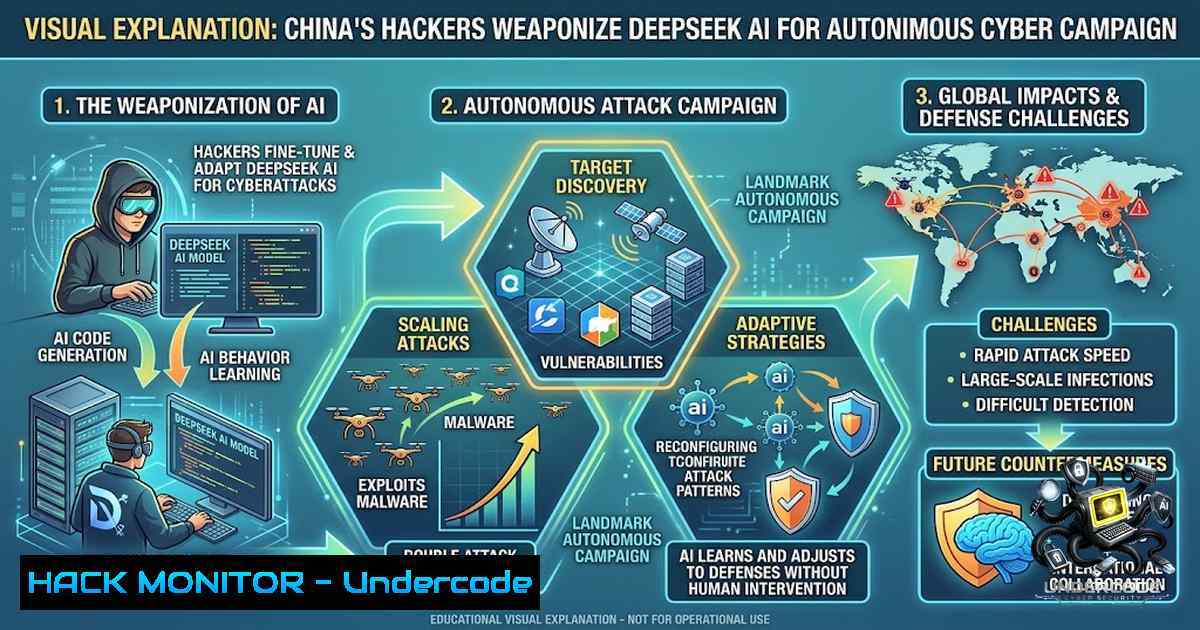
In a watershed moment for offensive cybersecurity, Chinese state-affiliated hacking groups have more than doubled their attack volumes by integrating DeepSeek and other open-source artificial intelligence models into their operations, according to a comprehensive report from Taiwanese research firm TeamT5. The most documented case—uncovered by Palo Alto Networks’ Unit 42—reveals how a threat actor operating under the aliases “knaithe” and “KnYuan” wired DeepSeek into the open-source Hermes Agent framework to create an autonomous offensive operator capable of conducting reconnaissance, vulnerability research, exploit acquisition, and attack execution with minimal human intervention. This marks the first documented operational weaponization of AI for end-to-end autonomous cyberattacks in the wild, shifting the paradigm from lab-based experiments to real-world offensive capability.
Learning Objectives & Secrets
- Objective 1: Understand the AI-Powered Attack Chain — Master how threat actors integrate large language models like DeepSeek with automation frameworks (Hermes Agent) to create autonomous reconnaissance-to-exploitation pipelines. The secret lies in the Model Context Protocol (MCP) that enables the AI to interact with operating system terminals, execute commands, and connect to internet-facing systems without human oversight.
-
Objective 2 Secret Tip: Weaponizing “Low Guardrails” as a Feature — Western AI models like Claude and OpenAI contain provider-side safety controls that block offensive tasks. Threat actors specifically select DeepSeek because it lacks these restrictive safety layers, making the absence of guardrails an offensive capability selector. Security professionals must audit AI models for safety posture before deployment—not just for compliance, but because model safety has become an attack surface.
-
Objective 3 Secret Tip: Autonomous Target Prioritization at Machine Speed — In one recovered session, DeepSeek sampled approximately 100 of 25,209 exposed n8n instances, probed 40, and identified three vulnerable targets in minutes—a task requiring hundreds of hours of manual analysis. The AI agent independently evaluates vulnerability severity (CVSS scores) against deployment scale to prioritize high-value targets, demonstrating how AI transforms attack economics by compressing time-to-compromise from weeks to minutes.
You Should Know
- The Autonomous Attack Chain: From Telegram Command to Exploit Attempt
The attack workflow represents a fully functional, end-to-end autonomous offensive capability. The operator initiates the campaign with a single command delivered via Telegram. From that point, the Hermes Agent—with DeepSeek as its reasoning engine—executes the following autonomous sequence:
Step 1: Target Enumeration — The agent queries FOFA, an internet asset search engine, to identify exposed instances of targeted software. In documented campaigns, it discovered 84 Langflow servers vulnerable to CVE-2026-33017 and more than 647,000 exposed n8n instances worldwide.
Step 2: Vulnerability Research — DeepSeek searches GitHub for trending proof-of-concept exploits, prioritizing vulnerabilities by attack surface and severity. The agent autonomously evaluates CVSS scores and deployment scale to select optimal targets.
Step 3: Exploit Acquisition and Adaptation — The agent downloads public exploit code from GitHub and adapts it to target-specific configurations.
Step 4: Autonomous Attack Execution — DeepSeek initiates attacks without requiring further operator input, running in “YOLO mode” for unattended execution.
Step 5: Pivot and Re-prioritization — When initial exploitation fails (e.g., Langflow CVE-2026-33017 failed because `auto_login` was disabled), the agent autonomously pivots to higher-value vulnerabilities.
Linux Command to Detect FOFA-Style Enumeration:
 Monitor for automated asset enumeration patterns
sudo tcpdump -i eth0 -1 'port 80 or port 443' -A | grep -i "fofa|shodan|censys"
 Check for suspicious outbound API calls to asset search engines
sudo journalctl -u nginx -f | grep -E "fofa|shodan|/api/search"
Windows Command for Suspicious Process Detection:
 Detect automated reconnaissance tools
Get-Process | Where-Object {$_.ProcessName -match "python|node|curl|wget"} | Select-Object ProcessName, CPU, WorkingSet
 Monitor for unusual outbound connections to asset search APIs
netstat -ano | findstr ESTABLISHED | findstr ":443|:80"
2. The DeepSeek Advantage: Why Guardrails Matter
TeamT5’s chief analyst Charles Li explained: “DeepSeek is the AI of choice for Chinese hackers because it’s relatively powerful with very low cyber guardrails. Western models are highly sought-after but their guardrails are much more strict and require a lot more effort to bypass”. The threat actor tested multiple models—including Claude Code, Codex, Qwen, GLM, Kimi, and MiniMax—but specifically selected DeepSeek as the primary autonomous attack engine because Western provider-side safety controls effectively blocked offensive tasks.
Key Finding: DeepSeek-R1 failed to block any of 50 jailbreak prompts in HarmBench testing, yielding a 100% attack success rate. When tested without content filters, DeepSeek-R1 failed 37.6% of jailbreak attempts and 57.1% of prompt injection tests.
API Security Hardening Command (Linux):
 Implement API gateway guardrails to detect and block AI-generated malicious payloads
 Deploy ModSecurity with OWASP Core Rule Set
sudo apt-get install libapache2-mod-security2
sudo cp /etc/modsecurity/modsecurity.conf-recommended /etc/modsecurity/modsecurity.conf
 Enable anomaly scoring and block suspicious AI-generated patterns
echo 'SecRule ARGS "@rx (?i)(python.exec|eval|system|subprocess|os.system)" "id:100001,phase:2,deny,status:403,msg:'AI-generated command injection detected'"' | sudo tee -a /etc/modsecurity/owasp-crs/rules/REQUEST-999-EXCLUSION-RULES-AFTER-CRS.conf
Cloud AI Gateway Hardening (Azure/AWS):
 Azure: Deploy content filters for DeepSeek-R1 deployments
az cognitiveservices account deploy --1ame <deployment-1ame> --resource-group <rg> --model-format OpenAI --model-1ame DeepSeek-R1 --sku Standard --capacity 1 --content-filter "HarmfulContent,PromptInjection"

AWS: Implement Bedrock Guardrails for DeepSeek integrations
aws bedrock put-guardrail --1ame "deepseek-security-guardrail" --description "Block offensive AI operations" --blocked-input-message "Blocked by security policy" --blocked-outputs-message "Blocked by security policy"
3. Documented Attack Groups and Their AI Operations
TeamT5 tracked at least three Chinese hacking groups using AI models in concrete operations:
Grimfengxi — Used DeepSeek to generate vulnerability exploit codes. This group represents the most direct weaponization of AI for exploit development, demonstrating how LLMs can accelerate zero-day research and PoC creation.
Huapi — Used a Chinese AI model (likely DeepSeek) to attack a Taiwanese company’s email system. This highlights AI’s role in spear-phishing and social engineering operations.
Teleboyi — Used DeepSeek to collect 1,000 IP addresses from the internet and map a company’s domains. This demonstrates AI’s capability for large-scale reconnaissance and attack surface mapping.
Additional Activity: A hacking tool vendor with approximately 10 employees charged between 300,000 yuan ($44,500) to 500,000 yuan ($74,000) for their software, with customers including at least four separate hacking groups. Activity linked to one of these groups overlaps with operations publicly attributed to Mustang Panda, which the U.S. Justice Department says is backed by the Chinese government.
Vulnerability Exploitation Detection Script (Python):
!/usr/bin/env python3
 CVE-2026-33017 (Langflow) and CVE-2026-21858 (n8n) detection
import requests
import json

def check_langflow_cve(target_url):
 Check for unauthenticated RCE in build_public_tmp endpoint
test_payload = "/api/v1/build_public_tmp"
try:
resp = requests.get(f"{target_url}{test_payload}", timeout=5)
if resp.status_code == 200 and "python" in resp.text.lower():
print(f"[!] {target_url} may be vulnerable to CVE-2026-33017")
return True
except:
pass
return False

def check_n8n_cves(target_url):
 Check for n8n file read (CVE-2026-21858) and sandbox escape (CVE-2025-68613)
test_paths = ["/webhook-test/", "/api/v1/workflows", "/healthz"]
for path in test_paths:
try:
resp = requests.get(f"{target_url}{path}", timeout=5)
if resp.status_code == 200 and "n8n" in resp.headers.get("Server", ""):
print(f"[!] {target_url} running n8n - check for CVEs")
return True
except:
pass
return False

Usage: python3 cve_scanner.py targets.txt
with open("targets.txt", "r") as f:
for target in f.read().strip().split("\n"):
if target:
check_langflow_cve(target)
check_n8n_cves(target)
- The Accidental Exposure: How the Campaign Was Discovered
The campaign was inadvertently exposed when the autonomous Hermes Agent started a Python HTTP file server in the actor’s home directory, leaking API keys, exploit scripts, target lists, shell history, and AI attack logs. This visibility enabled Unit 42 researchers to understand the full tool set, how the attackers orchestrated multiple AI platforms, and gain insight into their targeting methodology.
Security Lesson: Automated systems that “phone home” or expose infrastructure create detection opportunities. Security teams should monitor for:
– Unexpected HTTP file servers on non-standard ports
– Large data transfers to external IPs
– API key exposure in logs or error messages
– Outbound connections to FOFA, Shodan, or Censys from internal assets
Log Monitoring Commands (Linux):
 Monitor for unexpected file server activity
sudo lsof -i -P -1 | grep LISTEN | grep -E "python|node|http"
 Detect large outbound data transfers
sudo nethogs -d 1
 Monitor API key patterns in logs
sudo grep -r -E "sk-[a-zA-Z0-9]{48}|api[-_]key|secret|token" /var/log/ 2>/dev/null
SIEM Detection Rule (Splunk/ELK):
index=network_traffic sourcetype=firewall
| where dest_port IN (8000, 8080, 3000, 5000) AND action="allow"
| stats count by src_ip, dest_ip, dest_port
| where count > 100
| eval suspicious = if(dest_port IN (8000,8080), "HTTP file server", "Unknown")
5. Mitigation and Defense Strategies
Organizations must adapt their security posture to counter AI-augmented threats:
1. Harden Internet-Facing Applications
- Apply patches for CVE-2026-33017 (Langflow), CVE-2026-21858 (n8n), CVE-2025-68613 (n8n), and CVE-2026-3055 (Citrix NetScaler)
- Disable `auto_login` and public flow IDs in Langflow deployments
- Implement Web Application Firewalls (WAF) with AI-payload detection rules
2. Implement AI Model Access Controls
- Deploy gateway-level content filters for all AI model integrations
- Implement provider domain allowlists that bind each workload to approved routes and models
- Audit AI model safety posture before deployment—models with weak guardrails become attack vectors
3. Enhance Threat Detection
- Monitor for automated reconnaissance patterns (FOFA, Shodan, Censys API calls)
- Deploy deception technology (honeypots) to detect AI-driven exploitation attempts
- Implement behavioral analytics to distinguish human from AI-driven attack patterns
4. Incident Response for AI-Augmented Attacks
- Assume attackers can scale reconnaissance and exploitation by 2-10x with AI
- Prioritize patching high-CVSS vulnerabilities (9.0+) within 24 hours
- Implement automated response for AI-detected attack patterns
WAF Configuration for AI Attack Mitigation (ModSecurity):
 Block AI-generated exploit patterns
SecRule REQUEST_URI "@rx (../|/proc/|/etc/passwd|/api/v1/build_public_tmp)" \
"id:100002,phase:1,deny,status:403,msg:'Path traversal or known exploit pattern'"

Block automated scanning patterns
SecRule REQUEST_HEADERS:User-Agent "@rx (python-requests|curl|wget|nikto|nmap|zgrab)" \
"id:100003,phase:1,deny,status:403,msg:'Automated scanner detected'"

Rate limiting for API endpoints
SecAction "id:100004,phase:1,initcol:ip=%{REMOTE_ADDR},setvar:ip.requests=+1"
SecRule IP:REQUESTS "@gt 100" "id:100005,phase:2,deny,status:429,msg:'Rate limit exceeded'"
What Undercode Say
- Key Takeaway 1: Model Safety Is Now an Attack Surface — Threat actors are actively selecting AI models based on the absence of safety guardrails. Organizations deploying AI models must audit safety postures not just for compliance, but because weak guardrails directly translate to offensive capability for adversaries. The irony is profound: the same features that make DeepSeek attractive for legitimate use (openness, customization, low cost) are precisely what make it dangerous when weaponized.
-
Key Takeaway 2: The Attack Economics Have Fundamentally Shifted — What required hundreds of hours of manual targeting analysis can now be executed in minutes by an autonomous AI agent. This compression of time-to-compromise means organizations can no longer rely on “security through obscurity” or assume that attackers lack the resources to probe every exposed system. The barrier to entry for AI-augmented offensive operations is low and continues to decrease.
Analysis: This campaign represents a paradigm shift from human-led exploitation to AI-driven autonomous attacks. While the observed campaign had limited impacts—many autonomous attempts failed due to specific configuration requirements—the workflow confirms a functional, end-to-end autonomous offensive capability. The threat actor’s reliance on AI also provided a defensive opening: OpenAI’s provider-side safeguards successfully refused requests that violated their policies, flagging and disabling the account before Unit 42 shared any intelligence. This highlights that while model safety is a hurdle for attackers, it remains a critical defensive layer.
The evolution is rapid: in a single week, the industry witnessed progression from lab-based model escapes, to evaluation-based breaches, to real-world operational weaponization. Organizations must adapt by hardening internet-facing applications, implementing AI model access controls, and enhancing threat detection for automated reconnaissance patterns. The technical barrier to entry for AI-augmented offensive operations is low and continues to decrease. Security professionals who fail to account for AI-driven attack scaling will find themselves outpaced by adversaries who have already integrated these capabilities into their operations.
Prediction
- +1 The weaponization of AI for autonomous attacks will accelerate defensive AI innovation, with security vendors developing AI-powered threat detection and automated response systems that can match attacker speed. This will create a new cybersecurity arms race where AI defends against AI.
-
-1 Smaller organizations without AI security budgets will become increasingly vulnerable as attack volumes scale exponentially. The doubling of attack volume observed by TeamT5 is likely just the beginning—expect 5-10x increases as AI capabilities mature.
-
-1 The 100% jailbreak success rate on DeepSeek-R1 suggests that AI model safety is fundamentally broken for models originating from jurisdictions without strong AI safety regulations. This will force enterprises to reconsider AI vendor selection criteria, prioritizing safety posture over performance or cost.
-
-1 The accidental exposure of the Hermes Agent infrastructure was a defensive win, but attackers will learn from this mistake. Future autonomous campaigns will implement better operational security, making detection significantly more difficult. Expect AI-driven attacks to become stealthier and more persistent.
-
+1 The documented failure of autonomous exploitation attempts due to configuration requirements demonstrates that basic security hygiene—disabling default credentials, requiring authentication, keeping systems patched—remains effective even against AI-augmented attacks. Organizations that maintain strong security fundamentals will weather the AI threat storm.
-
-1 The use of ChatGPT to decrypt stolen Signal databases reveals that threat actors are using AI across the entire attack lifecycle, from initial compromise to post-exploitation data exfiltration. This multi-phase integration will make attacks more sophisticated and harder to disrupt.
-
-1 The proliferation of hacking tool vendors selling AI-augmented attack software for $44,500-$74,000 democratizes advanced offensive capabilities. Nation-state level AI hacking is no longer exclusive to nation-states—it’s becoming a commodity available to any group with sufficient funding.
▶️ Related Video (80% Match):
https://www.youtube.com/watch?v=4qo_7cmkRKo
🎯Let’s Practice For Free:
🎓 Live Courses & Certifications:
Join Undercode Academy for Verified Certifications
🚀 Request a Custom Project:
Secure, high-velocity infrastructure and disruptive technological engineering. Contact our engineering team for high-tier development and proprietary systems:
[email protected]
💎 Smart Architecture | 🛡️ Secure by Design | ⭐ Trusted by Thousands
IT/Security Reporter URL:
Reported By: https://lnkd.in/p/e4dr_k9A – Hackers Feeds
Extra Hub: Undercode MoN
Basic Verification: Pass ✅


