
Listen to this Post
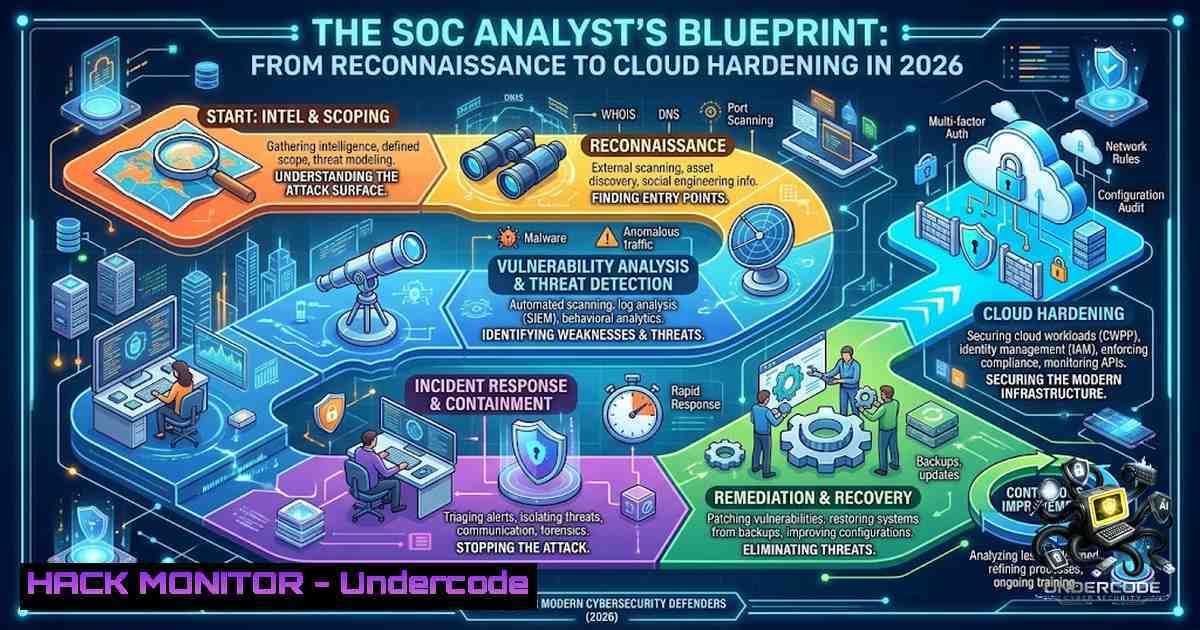
Introduction:
As the digital perimeter dissolves into a mosaic of cloud instances, IoT devices, and remote access points, the role of the Security Operations Center (SOC) Analyst has evolved far beyond simple log monitoring. It now demands a hybrid skillset that marries the attacker’s creativity with the defender’s discipline, encompassing everything from packet-level analysis to blockchain forensics. The modern cybersecurity professional must navigate a labyrinth of evolving threats where understanding the kill chain—from reconnaissance to data exfiltration—is just the baseline for building resilient enterprise defenses.
Learning Objectives & Secrets:
- Objective 1: Master the Active Reconnaissance Lifecycle – Move beyond passive OSINT to execute controlled scanning and enumeration using Nmap and Masscan, while learning to correlate discovered services with potential Common Vulnerabilities and Exposures (CVEs).
- Objective 2: Weaponize Built-in Tools for Post-Exploitation – Leverage PowerShell for Windows persistence and Python for Linux automation, utilizing living-off-the-land binaries to evade detection in simulated breach scenarios.
- Objective 3: Implement Cloud-1ative Defense Mechanisms – Configure Web Application Firewalls (WAF) and Identity and Access Management (IAM) policies to mitigate SQL Injection and XSS, while securing containerized environments against misconfiguration attacks.
You Should Know:
- Reconnaissance and Scanning: The Art of Digital Cartography
Active reconnaissance is the cornerstone of both penetration testing and defensive hardening. While the post highlights “Reconnaissance, Scanning & Enumeration,” the secret lies in understanding how to map a network without triggering intrusion detection systems. For Linux environments, a command like `nmap -sS -sV -p- –min-rate 1000 192.168.1.0/24` performs a stealthy SYN scan to identify open ports and service versions. For Windows, using `Test-1etConnection -Port 80 192.168.1.1` within PowerShell offers a quick connectivity check.
Step‑by‑step guide:
- Establish Scope: Define the target IP range and obtain proper authorization to avoid legal ramifications under cyber laws.
- Perform Initial Ping Sweep: Use `fping -a -g 192.168.1.0/24 2>/dev/null` on Linux to discover live hosts.
- Conduct Service Enumeration: Run `nmap -sC -sV -O -oA targeted_scan 192.168.1.100` to enable default scripts, version detection, and OS fingerprinting.
- Extract Vulnerable Services: Pipe results into a search for outdated SSL/TLS versions or SMBv1 using
nmap --script smb-security-mode -p445 192.168.1.100. - Document Findings: Save the output to a structured format (e.g., XML) for import into vulnerability assessment tools like OpenVAS.
2. Vulnerability Assessment and System Hacking
Understanding the flaw is the first step to patching it. The curriculum mentions “Vulnerability Assessment” and “System Hacking,” which often involves leveraging Metasploit for exploitation. However, a professional should focus on the mitigation side. For instance, if scanning reveals a vulnerable Apache Struts instance, the immediate action is to deploy a WAF rule before patching. Use `searchsploit struts` on Kali Linux to find public exploits, but then immediately pivot to identifying the patch version.
Step‑by‑step guide:
- Identify CVEs: Use `nmap –script vuln 192.168.1.100` to run a vulnerability scan.
- Verify Exploitability: In a lab, use Metasploit: `use exploit/multi/http/struts2_content_type_ognl` and set RHOSTS to the target.
- Simulate Response: After exploitation, examine the logs in the SIEM to understand the indicators of compromise (IoCs).
- Patch Management: On Linux, run `sudo apt update && sudo apt upgrade` to patch known vulnerabilities; on Windows, use `wuauclt /detectnow /reportnow` to force update detection.
- Re-scan: Verify the remediation by running the initial Nmap scan again to ensure the vulnerability is closed.
-
Web Application Security: SQL Injection and XSS Mitigation
The post highlights “SQL Injection” and “XSS” as critical areas. The common misconception is that these are only code issues; they are actually architecture failures. To test for SQLi manually, a simple payload like `’ OR ‘1’=’1` can be used in input fields. For XSS, `` is the classic test. However, the professional response involves configuring Web Application Firewalls (WAF) like ModSecurity. On a Linux server running Nginx, you can enable ModSecurity by compiling it with the `–add-module` flag and configuring rules to block suspicious characters.
Step‑by‑step guide:
- Install ModSecurity: `sudo apt install libapache2-mod-security2` for Apache, or compile for Nginx.
- Enable Core Rule Set (CRS): Download the OWASP CRS and configure `Include /etc/modsecurity/crs-setup.conf` in your configuration file.
- Configure Paranoia Level: Set `SecAction “id:900000, phase:1, nolog, pass, t:none, setvar:tx.paranoia_level=2″` to block generic attacks.
- Test the WAF: Send a request with a SQLi payload: `curl -X GET “http://target.com/page?id=1′ OR ‘1’=’1″` and check if the request is blocked.
- Analyze Logs: Check the `/var/log/modsec_audit.log` to understand what was blocked and tune false positives.
4. Cryptography and Session Hacking Defense
The article touches on “Cryptography” and “Session Hacking.” The real secret is moving beyond hashing to implement perfect forward secrecy and secure cookie attributes. On the server side, ensure that TLS 1.3 is enforced. For Linux, use `openssl s_client -connect target.com:443 -tls1_3` to check if the server supports the latest protocol. For session security, ensure HTTPOnly and Secure flags are set on cookies. In a Node.js application, you would set res.cookie('session', token, { httpOnly: true, secure: true, sameSite: 'Strict' });.
Step‑by‑step guide:
- Assess SSL/TLS Configuration: Use `sslscan target.com` to list supported ciphers and protocols.
- Harden Server Config: For Nginx, add `ssl_protocols TLSv1.3;` and `ssl_ciphers HIGH:!aNULL:!MD5;` to the configuration.
- Inspect Session Tokens: Use Burp Suite to intercept a request and check if the session cookie contains the `Secure` flag.
- Mitigate Session Hijacking: Implement a short session timeout and regenerate the session ID upon login using `session_regenerate_id(true);` in PHP or equivalent in other languages.
- Monitor for Replay Attacks: Enable logging for anomaly detection, such as multiple session attempts from different IPs.
5. Firewalls, Cloud Computing, and IoT Security
The modern perimeter is the identity. The “Firewalls & Cloud Computing” and “IoT Security” segments require a shift to micro-segmentation. In cloud environments like AWS, security groups act as virtual firewalls. To harden an EC2 instance, restrict inbound traffic to only necessary ports (e.g., 22 for SSH from a specific IP) using the AWS CLI: aws ec2 authorize-security-group-ingress --group-id sg-12345 --protocol tcp --port 22 --cidr 203.0.113.0/24. For IoT, disabling unnecessary UPnP services and changing default credentials is critical.
Step‑by‑step guide:
- Review Security Group Rules: Use `aws ec2 describe-security-groups –group-ids sg-12345` to list open ports.
- Implement Least Privilege: Revoke overly permissive rules using
aws ec2 revoke-security-group-ingress. - Configure Network ACLs: As a stateless firewall layer, add rules to block known malicious IP ranges.
- Secure IoT Gateways: For a Raspberry Pi acting as an IoT hub, run `sudo ufw allow from 192.168.1.0/24 to any port 22` to restrict SSH to local networks.
- Encrypt Data at Rest: Enable default encryption on cloud storage buckets using
aws s3api put-bucket-encryption.
What Undercode Say:
- Key Takeaway 1: The roadmap provided is a comprehensive “Swiss Army knife” for an SOC Analyst, but without specialization, the breadth of knowledge can become a shallow puddle. Professionals must choose a domain—such as cloud security or malware analysis—to truly excel.
- Key Takeaway 2: The inclusion of “Blockchain, Deep Web & IoT Security” indicates a forward-looking mindset, anticipating that the next wave of attacks will target decentralized finance and edge devices, requiring analysts to understand data flows beyond traditional TCP/IP stacks.
The listed technologies—from PowerShell to Burp Suite—are not just tools but languages that tell the story of the attack. The analysis of CTF challenges, in particular, is a secret weapon for honing lateral thinking. One cannot simply “learn” SQL injection; one must think like a database engine to query unintended data, which requires deep understanding of query syntax and backend logic. The “ethical responsibility” aspect is often overlooked; a professional’s true value lies not in their ability to exploit but in their ability to contain and eradicate threats without causing collateral damage to production data. The mention of “Cyber Laws” underscores that every action must be legally defensible, meaning all testing must adhere to strict rules of engagement.
Prediction:
- +1 The increasing focus on “Cloud Computing” and “Virtualization” will drive demand for DevSecOps roles, blending coding with security, leading to higher salaries and job security for those who master Infrastructure as Code (IaC) security scanning tools like Terrascan and Checkov.
- -1 The “Deep Web & IoT Security” segment poses a significant negative risk; as IoT devices proliferate without built-in security, we will see a rise in massive botnet-driven DDoS attacks that overwhelm even cloud-based defenses.
- +1 The emphasis on “CTF Challenges” suggests a gamification trend in hiring, where practical skills will increasingly override formal certifications, allowing talented self-taught individuals to break into the industry faster.
- -1 The sheer volume of technologies listed may create a “jack of all trades, master of none” problem, leading to skill gaps in specialized areas like malware reverse engineering, potentially leaving networks vulnerable to sophisticated zero-day exploits.
- +1 The shift toward “Blockchain” security will create a niche market for auditors specializing in smart contract vulnerabilities, with bug bounty programs offering six-figure payouts for critical flaws.
- +1 Integrating “AI” and machine learning into SIEM solutions will soon automate 70% of tier-1 analysis tasks, pushing analysts to become threat hunters who interpret AI alerts rather than just monitor them.
- -1 As we adopt more cloud-1ative architectures, the risk of misconfiguration (e.g., open S3 buckets) will remain the number one attack vector, requiring constant vigilance and automated remediation pipelines.
- +1 The focus on “Sniffing & Spoofing” in a post-IPv6 world will force network engineers to adopt Secure Neighbor Discovery (SEND) protocols, reducing local network attacks significantly.
- -1 “Quantum Computing” advancements are currently missing from this roadmap, which is a negative blind spot; within five years, current RSA encryption standards will be obsolete, demanding a rapid transition to post-quantum cryptographic algorithms.
- +1 The continuous learning mindset mentioned is the ultimate positive prediction; those who adapt and treat cybersecurity as a dynamic field will find themselves indispensable guardians of the digital realm, with endless opportunities for growth and influence.
▶️ Related Video (86% Match):
🎯Let’s Practice For Free:
🎓 Live Courses & Certifications:
Join Undercode Academy for Verified Certifications
🚀 Request a Custom Project:
Secure, high-velocity infrastructure and disruptive technological engineering. Contact our engineering team for high-tier development and proprietary systems:
[email protected]
💎 Smart Architecture | 🛡️ Secure by Design | ⭐ Trusted by Thousands
IT/Security Reporter URL:
Reported By: https://lnkd.in/p/eryY4aAp – Hackers Feeds
Extra Hub: Undercode MoN
Basic Verification: Pass ✅


